Nash Equilibrium: What It Is, How It Works, and Why It Matters
By upGrad
Updated on Jun 11, 2026 | 7 min read | 2.29K+ views
Share:

All courses
Certifications
More
By upGrad
Updated on Jun 11, 2026 | 7 min read | 2.29K+ views
Share:
Table of Contents
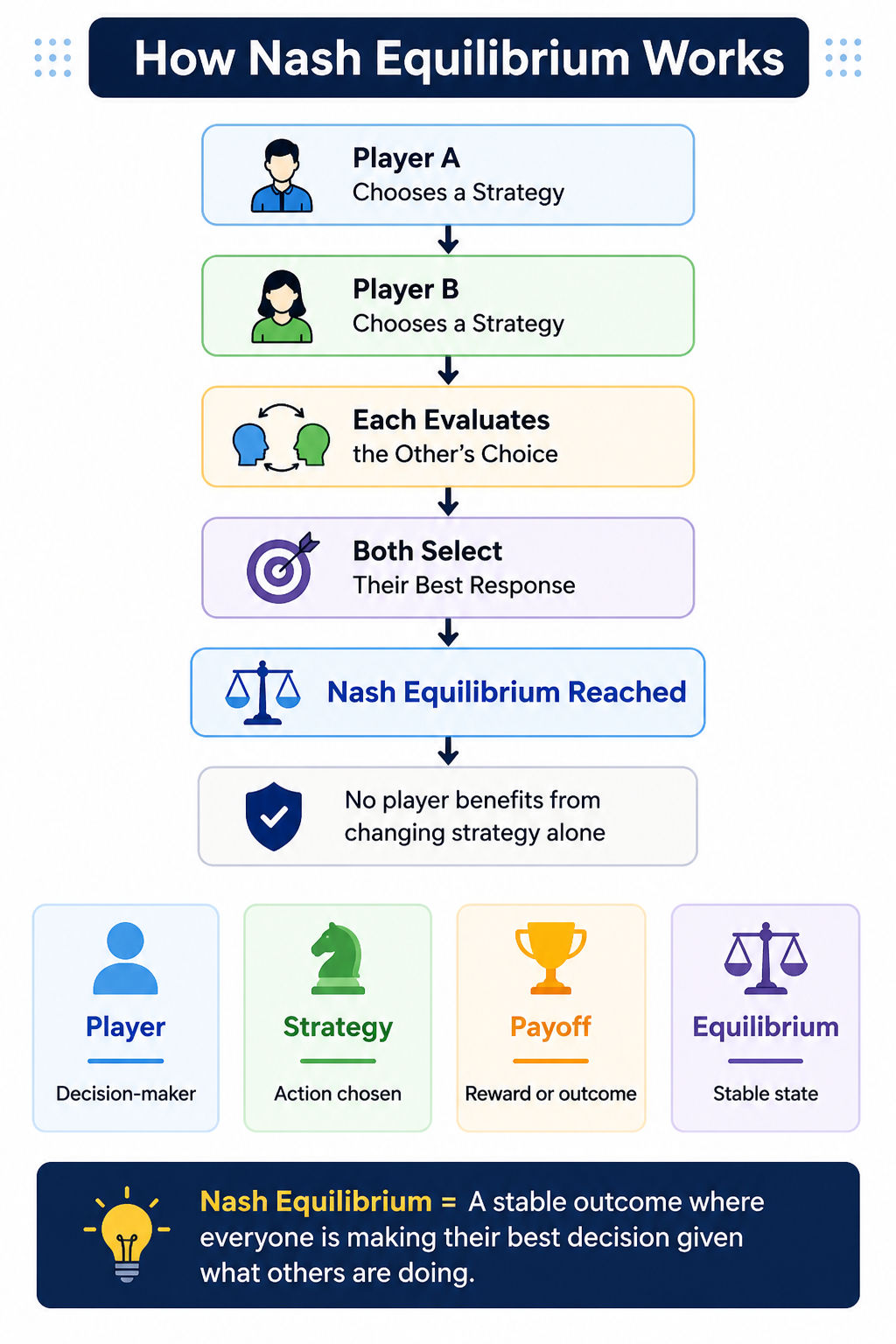
The nash equilibrium is a situation in which every participant in a game chooses the best possible strategy based on the strategies selected by others. At this point, no player can improve their outcome by changing their decision alone.
Named after mathematician John Nash, it describes a stable state in a strategic interaction. Every player has chosen a strategy. And once they're in that state, no one has a reason to move away from it unilaterally.
This blog breaks down the Nash Equilibrium definition, explains how it works in game theory, walks through clear examples, and covers where it applies in the real world. By the end, you'll have a solid understanding of what it is and why it's still relevant decades after it was first introduced.
Explore upGrad's Management and MBA programs to develop expertise in strategic decision-making, game theory concepts, business strategy, competitive analysis, and data-driven problem-solving for real-world business challenges.
Popular Management Programs
Nash Equilibrium is a concept from game theory where no player can improve their outcome by changing only their own strategy, given what the other players are doing. The Nash Equilibrium is about strategic stability, not about fairness or optimality. That distinction matters a lot, especially in real-world applications.
Think of it this way. You're in a situation with another person. You've both made your choices. If neither of you would change your decision knowing what the other has done, you've reached a Nash Equilibrium.
It doesn't mean everyone's happy with the outcome. It just means no one can do better by acting alone.
Key points to understand:
Free Courses
You've probably heard of the Prisoner's Dilemma. It's the most widely used example to explain Nash Equilibrium. It's simple, relatable, and shows why rational decisions can lead to outcomes nobody actually wants.
Here's the setup. Two people are arrested. They're held in separate rooms. Each is given a choice: stay silent or betray the other.
What happens? Both betray each other. That's the Nash Equilibrium here.
Why? Because from each person's perspective, betraying is the better choice regardless of what the other does. If the other person stays silent, betraying means you go free. If the other person betrays, betraying reduces your own sentence. So both players end up confessing, even though staying silent together would've been better for both.
Neither player can improve their outcome by changing their strategy alone.
This is also why the Prisoner's Dilemma is used to model things like corporate price wars, arms races, and environmental negotiations. Everyone ends up in a worse place because the rational individual move doesn't lead to a collectively good outcome.
Do read: What Is the Algorithmic Game Theory? Explained With Examples
Management Courses to upskill
Explore Management Courses for Career Progression
IIIT-B & IIM, Udaipur
Chief Technology Officer & AI Leadership ProgrammeIIM Kozhikode
PCP in AI for Business ProfessionalsGame theory isn't just theoretical. Nash Equilibrium has direct applications in how companies set prices, how markets behave, and how negotiations play out.
Two airlines are competing on the same route. If both keep prices high, both profit. But if one drops prices, it captures more passengers. So both end up lowering prices until neither can profitably go lower. That's a Nash Equilibrium, and it's not great for either airline.
Governments and platforms use Nash Equilibrium logic to design auctions where bidders reveal their true valuations. If everyone's bidding strategy is a best response to what others are doing, the auction reaches equilibrium.
Also read: What are Critical Thinking Skills? Why are they Important?
In labour markets, employers and employees both have strategies. A Nash Equilibrium in this context is a wage level where neither side benefits from unilaterally changing their offer or demand.
Why businesses care about this:
Understanding Nash Equilibrium game theory isn't just for economists. Managers, product teams, and strategists all use this thinking.
Do read: What is Decision-making in Management: Explore Types, Tools, & Techniques
Not every Nash Equilibrium looks the same. There are a few distinctions worth knowing.
A pure strategy is when a player always makes the same definite choice. If both players have a best response that doesn't involve randomness, the equilibrium is pure. The Prisoner's Dilemma example above is a pure strategy Nash Equilibrium.
Do read: Top 10 Risk Management Strategies You Need to Follow for Success!
Sometimes there's no stable pure strategy. In those cases, players randomise over their options. A mixed strategy Nash Equilibrium is where each player is indifferent between their options given the mix the other player is using.
Penalty kicks in football are a real example. The kicker can go left or right. The goalkeeper can dive left or right. If the kicker always went left, the goalkeeper would always dive left. So both players randomise, and the equilibrium is a probability distribution, not a fixed choice.
A game can have more than one Nash Equilibrium. That creates a coordination problem. Which one do players end up at? This is where concepts like focal points and communication come in.
Type |
What it means |
| Pure Strategy | Fixed, definite choices |
| Mixed Strategy | Randomised probabilities |
| Multiple Equilibria | More than one stable state |
Must read: Negotiation Skills: Definition, Process, Various Stages, Benefits [With Examples]
It's a powerful concept, but it isn't perfect. There are real situations where Nash Equilibrium doesn't predict what actually happens.
Limitation of Nash Equilibrium |
Explanation |
| Assumes Perfect Rationality | The model assumes all players make completely rational decisions aimed at maximizing their payoff. In reality, emotions, habits, intuition, and cognitive biases often influence choices, leading to outcomes that differ from theoretical predictions. |
| Multiple Equilibria Problem | Some games have more than one Nash equilibrium. When this happens, the model identifies several stable outcomes but doesn't indicate which one players are most likely to choose in practice. |
| Assumes Complete Information | Nash Equilibrium typically assumes players understand the available strategies and payoffs of all participants. In real-world situations, decision-makers often operate with incomplete or imperfect information. |
| Ignores Dynamic Interactions | The traditional model analyzes a single round of decision-making. It doesn't fully account for factors such as reputation, trust, learning, adaptation, or repeated interactions that shape behavior over time. |
| Limited Real-World Predictability | Because of information gaps, human behavior, and changing environments, real-world outcomes don't always align with the equilibrium predicted by the model. |
Must read: What is Logical Thinking & How to Improve Logical Thinking Skills? [2026]
You don't need to be an economist to encounter Nash Equilibrium. It shows up in surprisingly ordinary situations.
These examples show that define Nash Equilibrium broadly enough and it becomes a lens for understanding cooperative and competitive behaviour across daily decisions.
Nash Equilibrium tells us that in strategic situations, people settle into patterns where no one has reason to break away on their own. It doesn't promise the best outcome for everyone. It just predicts where things stabilise when rational players act in their own interest.
That's what makes it genuinely useful and genuinely sobering. Understanding it helps you anticipate how others will behave, why conflicts persist even when cooperation would help everyone, and where the real points of leverage in a negotiation or market actually sit.
Ready to start your journey? Book a free consultation with upGrad today to find the best path for your career.
John Nash wanted to solve a problem that earlier game theory models struggled with. Most models focused on cooperation, but many real-world situations involve independent decision-makers. His framework showed how stable outcomes can emerge even when people act solely in their own interest.
No. That's one of the most misunderstood aspects of the concept. A Nash Equilibrium can be stable while still producing lower rewards for all players. The Prisoner's Dilemma is a classic example where cooperation would benefit everyone more, but individual incentives prevent it.
A Nash Equilibrium focuses on stability, while Pareto Optimality focuses on efficiency. An outcome is Pareto optimal when no one can be made better off without making someone else worse off. A Nash Equilibrium may be efficient, but it doesn't have to be.
Yes. In fact, the concept doesn't require communication at all. Players only need to consider how others are likely to act. Many market decisions, pricing strategies, and competitive interactions reach equilibrium without direct discussion between participants.
Businesses rarely make decisions in isolation. Pricing, advertising, product launches, and expansion plans often depend on competitors' actions. Nash Equilibrium helps firms anticipate responses and identify situations where changing strategy alone won't create a better outcome.
Not always in pure strategies. However, according to Nash's theorem, every finite game has at least one equilibrium when mixed strategies are allowed. This means players may need to randomize their decisions rather than consistently choosing a single action.
Technology companies use game theory in areas such as online advertising auctions, recommendation systems, network design, and artificial intelligence. Many digital platforms rely on strategic models to predict how users, advertisers, or algorithms will respond to changing conditions.
A mixed strategy equilibrium occurs when players intentionally randomize their choices according to specific probabilities. This prevents opponents from predicting behavior. Sports, military planning, cybersecurity, and competitive gaming frequently involve mixed strategy decision-making.
Economists study situations where individuals, firms, or governments interact strategically. The Nash equilibrium definition provides a practical framework for predicting outcomes in markets, auctions, negotiations, and public policy decisions where every participant influences the final result.
Behavioral economists argue that people don't always act rationally. Emotions, social preferences, overconfidence, and cognitive biases frequently influence decisions. Because of this, actual human behavior sometimes differs from what traditional Nash Equilibrium models predict.
The easiest way is through everyday examples. Think about choosing a traffic route, setting prices against competitors, or deciding which side of the road to drive on. The nash equilibrium meaning becomes clearer when viewed as a stable situation where nobody gains by changing alone.
1283 articles published
We are an online education platform providing industry-relevant programs for professionals, designed and delivered in collaboration with world-class faculty and businesses. Merging the latest technolo...
Get Free Consultation
By submitting, I accept the T&C and
Privacy Policy
Top Resources
Certification
3 Months
Certification
6 Months
O.P. Jindal Global University
Masters in International Accounting and Finance (Accredited by ACCA, UK)Master's Degree
12 Months