PESTLE Analysis: What It Is, How It Works, and Why It Matters
By upGrad
Updated on Aug 11, 2026 | 7 min read | 1.84K+ views
Share:

All courses
Certifications
More
By upGrad
Updated on Aug 11, 2026 | 7 min read | 1.84K+ views
Share:
PESTLE analysis is a strategic framework used to evaluate external factors that affect an organization, industry, or market. It helps businesses identify opportunities, anticipate risks, and make better decisions before entering new markets, launching products, or planning long-term growth.
Every business operates inside a world it didn't build. Markets shift. Governments change rules. New technology disrupts entire industries overnight. A PESTLE analysis gives you a structured way to examine those external forces before they catch you off guard.
This blog covers what PESTLE analysis means, breaks down each of its six factors with real examples, shows you how to actually run one, and explains where it fits inside broader business strategy.
Explore upGrad's Management and MBA programs to build expertise in talent acquisition, employee engagement, performance management, workforce planning, leadership development, HR analytics, and strategic people management.
Popular upGrad Programs
PESTLE analysis is a strategic tool used to scan the external environment of a business. The name is an acronym. Each letter stands for a category of external factors that can affect how an organisation operates and performs.
Here's what the letters stand for:
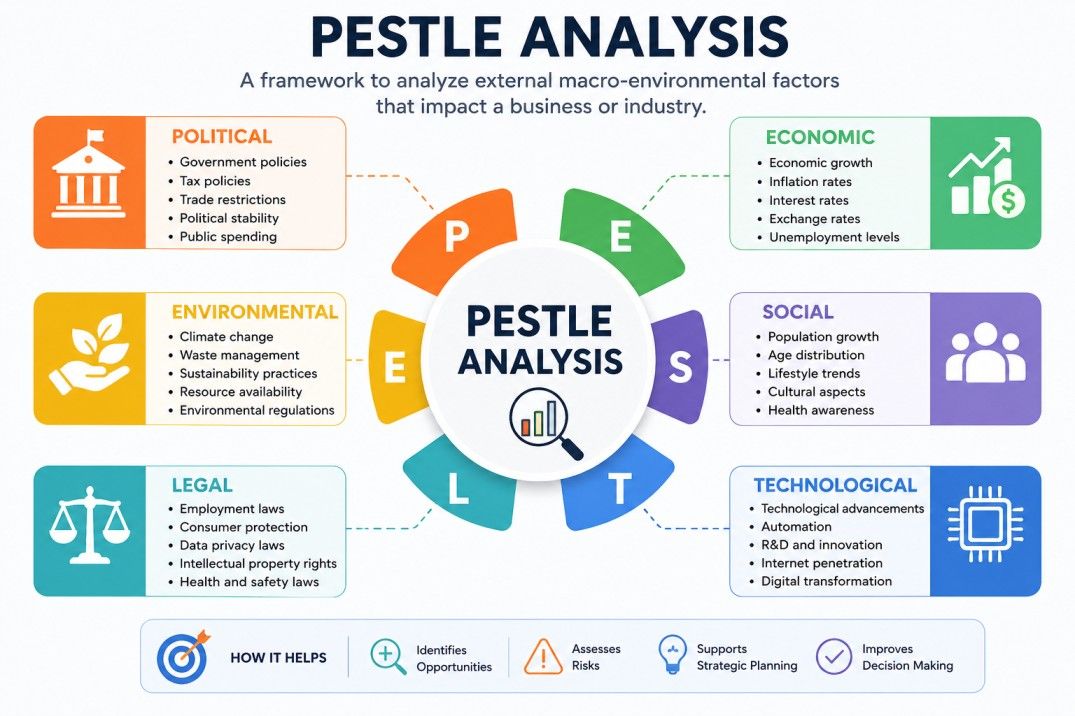
The point isn't to predict the future. It's to build awareness. When you know what external forces exist, you can plan for them instead of reacting to them.
PESTLE doesn't look inside your company. It looks outside. That's what makes it different from frameworks like SWOT, which mixes internal and external factors together.
Free Courses
Political factors refer to how government decisions shape the business environment. Think tax policy, import/export rules, subsidies, political stability, and trade agreements.
A company planning to expand into a new country needs to understand the political climate first. Is the government stable? Are there restrictions on foreign investment? What's the stance on the industry you're entering?
For example, an edtech company launching in India has to consider how government policies on digital education, internet access, and skill development programmes affect its market. That's a political consideration.
Economic factors cover the broader financial environment. Inflation rates, unemployment, consumer spending, currency exchange rates, and economic growth all belong here.
If disposable incomes are falling, demand for premium products drops. If interest rates are rising, businesses borrow less and spend cautiously. These aren't abstract statistics. They directly affect revenue.
A practical question to ask here: who's your customer, and how is their financial situation changing? The answer shapes your pricing, positioning, and launch timing.
Social factors look at people. Their age, lifestyle, values, education levels, and buying habits. Consumer preferences don't stay fixed. A generation that grew up online expects digital-first experiences. Younger audiences care about brand ethics and environmental responsibility in ways older demographics didn't prioritise as loudly.
A fashion brand entering a new market needs to understand local culture, dress preferences, and attitudes toward international brands. Getting this wrong isn't just a missed opportunity. It can damage your reputation.
Technology changes how businesses operate and how customers behave. Automation, artificial intelligence, e-commerce infrastructure, mobile penetration, and cybersecurity all fall under this factor.
Is your industry being disrupted by a new technology? Are your competitors using tools you haven't adopted yet? These questions matter more than ever.
Consider how quickly UPI transformed payments in India. Businesses that didn't adapt lost customers to those that did.
Legal factors cover the regulatory environment. Labour laws, data privacy regulations, consumer protection rules, health and safety standards, and industry-specific compliance requirements all go here.
This isn't just about avoiding fines. Legal compliance shapes product design, hiring practices, marketing claims, and how you store customer data. Ignoring it creates risk.
GDPR in Europe changed how thousands of global companies handled user data. Any business operating there had to rethink entire systems.
Environmental factors have grown significantly in importance. Climate change, sustainability expectations, carbon regulations, waste management, and resource scarcity all affect business decisions.
Consumers and regulators are both pushing companies toward greener practices. For industries like manufacturing, logistics, and agriculture, environmental factors aren't optional considerations. They're operational realities.
A company sourcing raw materials needs to think about supply chain sustainability, not just cost.
Must read: SWOT Analysis in Strategic Management: A Complete Guide
Recommended Courses to upskill
Explore Our Popular Courses for Career Progression
IIIT Bangalore
Executive Diploma in Machine Learning and AI360° Career Support
O.P.Jindal Global University
MBA from O.P.Jindal Global UniversityLive Case Studies and Projects
Let's make this concrete. Here's a simplified PESTLE analysis for an online learning platform entering the Indian market.
Factor |
Key Observations |
| Political | Government push for digital education, NEP 2020, increasing internet infrastructure investment |
| Economic | Rising middle class, growing disposable income in Tier 2 and Tier 3 cities, competitive pricing pressure |
| Social | Young population, high demand for upskilling, English proficiency gap in certain segments |
| Technological | High mobile penetration, growth in regional language content, reliable video streaming needed |
| Legal | Data localisation rules, DPDP Act compliance, course certification regulations |
| Environmental | Push for paperless learning, remote-first model reduces carbon footprint |
This kind of analysis helps a business see where it has an advantage, where the risks sit, and what it needs to prepare for before entering a market or launching a product.
Also read: Disruptive Innovation Examples That Changed Industries
There's no single rigid process, but here's a clear approach that works.
Are you analysing an entire business, a product launch, a market entry, or a strategic decision? Be specific. A vague scope leads to vague insights.
Pull data from government reports, industry publications, news sources, and market research. Don't guess.
Not every factor carries equal weight for every business. A software startup cares more about technological and legal factors than environmental ones. Pick what actually matters for your context.
For each factor you've identified, ask two questions. How likely is this to affect the business? How significant would that impact be?
This is the step most people skip. A PESTLE analysis that sits in a document and doesn't influence decisions is useless. Use your findings to inform product roadmaps, pricing, market entry timelines, and risk planning.
External environments change. A PESTLE analysis done once and never updated becomes outdated fast.
Also read : Essential Functions of Financial Management for Effective Business Strategy
People often confuse these two. They're related but they're not the same.
Aspect |
PESTLE |
SWOT |
| Focus | External macro environment | Internal and external factors |
| Factors | 6 specific external categories | Strengths, Weaknesses, Opportunities, Threats |
| Use case | Market and environment scanning | Strategic planning and decision-making |
| Best used for | Entry strategy, risk assessment | Broad business health check |
You can actually use both together. Run a PESTLE analysis first to understand the external landscape. Then feed those insights into the Opportunities and Threats sections of a SWOT. They work better in combination than in isolation.
Also read : Financial Management Course: Learn Finance, Risk & Strategy in 2025
PESTLE helps businesses understand what's happening in the external environment. However, it works best when combined with tools like SWOT analysis, market research, and strategic decision-making frameworks.
Benefits of PESTLE Analysis |
Limitations of PESTLE Analysis |
| Easy to understand and use | Depends on data quality |
| Supports strategic planning | Doesn't suggest actions or solutions |
| Identifies external risks early | Can become too broad |
| Highlights market opportunities | Requires regular updates |
| Encourages long-term thinking | External factors change quickly |
| Applicable across industries | Doesn't assess internal strengths or weaknesses |
| Provides a structured market view | Future outcomes remain uncertain |
PESTLE analysis helps businesses understand the external forces that shape markets, industries, and customer behavior. By examining political, economic, social, technological, legal, and environmental factors, organizations can identify opportunities, anticipate risks, and make smarter strategic decisions.
The business environment rarely stays predictable for long. Companies that regularly conduct PESTLE analysis gain a clearer view of emerging trends and potential disruptions before they become major challenges. That visibility often makes the difference between reacting to change and preparing for it.
Ready to start your journey? Book a free consultation with upGrad today to find the best path for your career.
A PESTLE analysis helps businesses understand external conditions before investing resources in a new market. It reveals factors such as regulations, economic conditions, consumer behavior, and technology adoption. This allows companies to identify potential barriers early and reduce costly strategic mistakes during expansion.
Yes, PESTLE analysis isn't limited to large corporations. Small businesses can use it to understand local market conditions, customer trends, and regulatory changes. Even a simple analysis can uncover opportunities or risks that might otherwise go unnoticed when planning growth or launching new offerings.
One of the biggest strengths of PESTLE analysis is its ability to identify external risks before they become business problems. By monitoring political, economic, legal, and environmental developments, organizations can prepare contingency plans and make decisions based on potential future scenarios rather than assumptions.
Industries that experience rapid regulatory, technological, or consumer changes often benefit the most. Examples include healthcare, education, financial services, technology, renewable energy, and retail. However, almost any sector can use PESTLE analysis to better understand external influences affecting business performance.
While both frameworks examine external factors, STEEPLE analysis adds an Ethical component to the traditional PESTLE framework. Organizations that operate in highly regulated or socially sensitive industries often use STEEPLE to evaluate ethical considerations alongside political, economic, social, technological, legal, and environmental factors.
There's no fixed rule, but many organizations review their PESTLE analysis every six to twelve months. Industries affected by frequent regulatory changes, economic volatility, or technological disruption may need quarterly reviews to keep strategic decisions aligned with current market conditions.
Not directly. PESTLE analysis doesn't forecast the future with certainty. Instead, it helps businesses recognize emerging patterns and external developments that could shape future outcomes. The framework improves preparedness by highlighting signals that leaders might otherwise overlook during strategic planning.
Reliable sources include government reports, industry publications, market research studies, economic forecasts, regulatory announcements, and consumer surveys. The quality of a PESTLE analysis depends heavily on the accuracy and relevance of the information used during the assessment process.
Artificial intelligence has become an important technological factor within PESTLE analysis. Businesses increasingly assess how AI affects automation, workforce requirements, customer experiences, competition, and regulatory compliance. AI-driven changes can create both opportunities and challenges depending on the industry and market.
A common mistake is collecting too much information without prioritizing its business impact. Teams often create long lists of factors but fail to identify which issues matter most. Effective PESTLE analysis focuses on factors that can significantly influence strategic decisions and outcomes.
Absolutely. Startups often operate with limited resources, making strategic decisions even more critical. A PESTLE analysis helps entrepreneurs understand market conditions, regulatory requirements, customer expectations, and emerging trends before launching products, entering new markets, or seeking investment opportunities.
972 articles published
We are an online education platform providing industry-relevant programs for professionals, designed and delivered in collaboration with world-class faculty and businesses. Merging the latest technolo...
Get Free Consultation
By submitting, I accept the T&C and
Privacy Policy
Top Resources
Certification
3 Months
Certification
6 Months
O.P. Jindal Global University
Masters in International Accounting and Finance (Accredited by ACCA, UK)Master's Degree
12 Months