Disruptive Innovation Examples That Rewrote the Rules of Business
By upGrad
Updated on Jun 18, 2026 | 7 min read | 1.75K+ views
Share:

All courses
Certifications
More
By upGrad
Updated on Jun 18, 2026 | 7 min read | 1.75K+ views
Share:
Table of Contents
Disruptive innovation examples show how simple ideas can reshape entire industries. Many of the world's biggest companies started by serving overlooked customers, offering lower-cost alternatives, or creating entirely new ways for people to access products and services.
Most industries don't change gradually. They get blindsided. A disruptive innovation example isn't just a company doing something new. It's a company doing something cheaper, simpler, or more accessible that makes existing players scramble to catch up or quietly disappear.
This blog breaks down the most powerful disruptive innovation examples from India and around the world.
Explore upGrad's Management and MBA programs to build expertise in talent acquisition, employee engagement, performance management, workforce planning, leadership development, HR analytics, and strategic people management.
Popular upGrad Programs
Disruptive innovation occurs when a smaller company or new offering enters the market by serving overlooked segments and gradually moves upmarket, challenging and eventually overtaking established competitors. The concept was introduced by Harvard professor Clayton Christensen in his 1997 book The Innovator's Dilemma.
A new entrant offers something that's "good enough" for underserved customers. Existing companies ignore it because the margins are low or the customer base seems small. But the disruptor keeps improving, moving upmarket, and eventually eating the lunch of the very companies that dismissed them.
Now let's look at where it actually happened.
Do read: What Is a Business Administration Course and Why Everyone’s Taking It
Free Courses
Blockbuster had 9,000 stores. Netflix started by mailing DVDs. It wasn't trying to beat Blockbuster at its own game. It targeted people who didn't want late fees or weekend trips to a video store. Blockbuster laughed it off.
By 2010, Blockbuster filed for bankruptcy. Netflix had already moved to streaming. The disruption wasn't the technology alone. It was the business model shift combined with changing customer behavior.
Airbnb didn't build a single hotel. It created a platform that turned spare rooms into inventory. Hotels serve business travelers who need consistency. Airbnb initially targeted budget travelers and tourists who couldn't afford standard hotel pricing.
Over time, Airbnb improved quality, added verified reviews, and began pulling customers from mid-range hotel segments too. Hotel chains didn't see it coming because the early Airbnb customer wasn't theirs to begin with.
Amazon started with books. Physical bookstores weren't alarmed. Books seemed like a category where selection and discoverability could be digitized, but actual shopping experiences seemed safe. They weren't.
Amazon used books to build logistics infrastructure, customer trust, and a recommendation engine. It then expanded into electronics, apparel, groceries, and cloud computing. The disruption was cumulative. Each category seemed manageable until the whole ecosystem had shifted.
Netflix, Amazon, and Airbnb share one thing. They all started where incumbents weren't paying attention.
Do read: Top 10 Project Management Companies in India in 2026
Recommended Courses to upskill
Explore Our Popular Courses for Career Progression
IIIT Bangalore
Executive Diploma in Machine Learning and AI360° Career Support
O.P.Jindal Global University
MBA from O.P.Jindal Global UniversityLive Case Studies and Projects
India has produced some of the most compelling disruptive innovation company examples globally. The scale, diversity, and infrastructure gaps here created conditions where disruption could happen fast.
Before Jio launched in September 2016, mobile data in India was expensive and patchy. Jio offered free voice calls and extremely cheap data. The existing players, Airtel, Vodafone, Idea, assumed it was temporary pricing strategy.
It wasn't. Jio compressed a decade of telecom evolution into two years. Data prices collapsed. Two major carriers merged out of necessity. Others exited the market entirely. This is one of the most studied disruptive innovation examples in India, and for good reason.
Traditional broking firms charged a percentage of every trade. Zerodha introduced flat-fee pricing at Rs. 20 per order regardless of trade size. That model broke the profitability logic of incumbent firms.
Zerodha also invested heavily in education through Varsity, pulling in first-time investors who felt too intimidated to approach traditional brokers. Don't underestimate how much an information gap can act as a market barrier. Zerodha removed it.
Physical cash and branch banking dominated Indian financial transactions until UPI arrived. PhonePe, built on UPI infrastructure, made peer-to-peer payments instant and free. This reached customers banks hadn't reached because it didn't require a branch visit or complex documentation.
Small merchants in tier-2 and tier-3 cities adopted it faster than analysts expected. The disruption here wasn't a product. It was access.
OYO aggregated low-cost hotels, applied standardization across amenities, and gave budget travelers predictability they'd never had before. Before OYO, booking a room under Rs. 1,500 in an unfamiliar city was a gamble.
OYO didn't create hotels. It applied brand consistency and booking infrastructure to an existing but fragmented supply. That's a textbook disruptive move.
Must read: Laissez Faire Leadership: What It Is, When It Works, and When It Doesn't
Here's the uncomfortable part. Incumbents often see the disruptor early. They just don't act.
There are a few reasons this keeps happening.
The new entrant's margins are too low to be worth chasing. The customer segment seems too small or too price-sensitive. Internal teams are structured to serve existing customers, not new ones. Success metrics reward protecting current revenue, not experimenting with uncertain models.
Kodak invented the digital camera. They buried it because it would cannibalize film sales. Nokia had smartphone prototypes. Leadership decided touchscreens weren't ready. These aren't stories of companies that were blind. They're stories of companies that chose the wrong time horizon.
Disruption is a market positioning problem as much as a technology problem. Companies that survive disruption usually do so by creating a separate unit, acquiring the disruptor early, or moving into the new segment before the incumbent logic sets in.
Do read: Top 12 Highest-Paying Freelance Jobs in India in 2026
Across all the disruptive innovation examples covered here, a few patterns repeat.
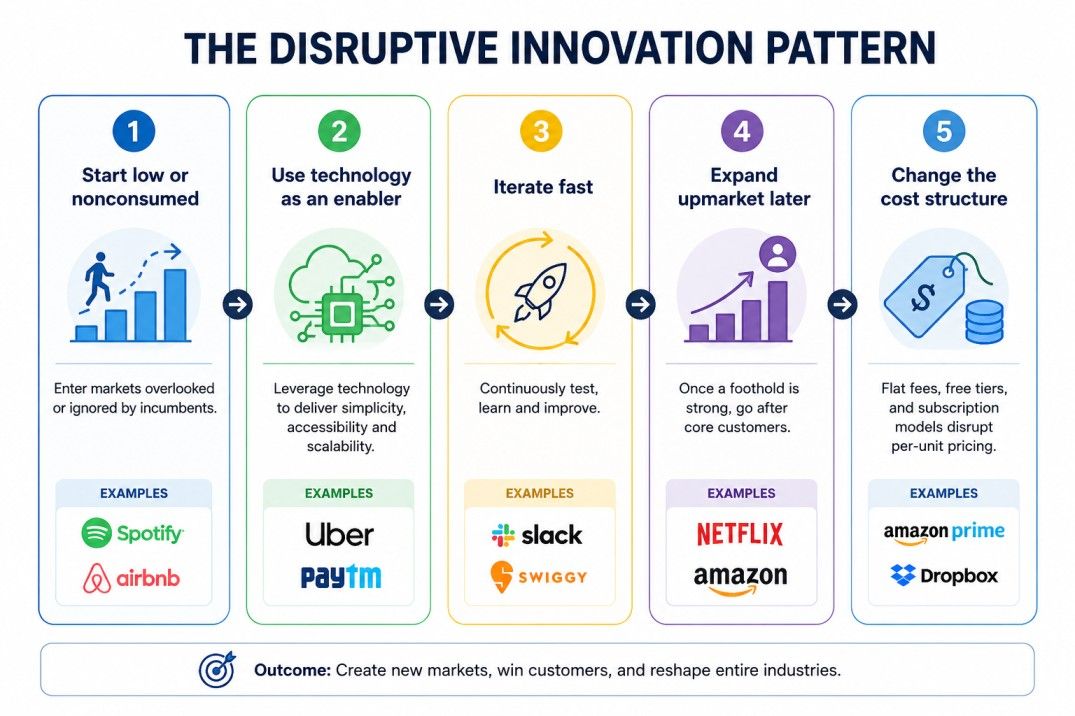
The disruptors that lasted didn't just build a better version of what existed. They changed the rules of the game entirely.
The most powerful disruptive innovation examples rarely look revolutionary at the beginning. They start by solving overlooked problems, serving ignored customers, or removing barriers that limit access.
From Netflix and Uber to Jio and Paytm, these companies reshaped industries by changing how people consume products and services. Understanding these patterns helps businesses recognize future opportunities while helping consumers understand how markets evolve through disruption.
Ready to start your journey? Book a free consultation with upGrad today to find the best path for your career.
Some of the most recognized disruptive innovation examples in business include Netflix, Amazon, Airbnb, Uber, and Spotify. These companies didn't simply improve existing products. They changed how customers accessed services, created new buying habits, and forced established competitors to rethink their strategies.
Disruptive innovation describes a process where a product, service, or business model starts by serving overlooked customers and gradually moves into mainstream markets. Over time, it challenges established companies by offering greater accessibility, convenience, affordability, or a completely different customer experience.
Jio, Zerodha, PhonePe, OYO, and Flipkart are widely regarded as successful disruptive innovation examples in India. Each addressed gaps in affordability, accessibility, or customer experience. Their growth demonstrates how disruption often begins by solving problems that larger players fail to prioritize.
Disruptive innovation theory, introduced by Clayton Christensen, explains why established companies sometimes lose market leadership despite having strong resources. The theory suggests that smaller entrants often succeed by targeting underserved customers and improving their offerings faster than incumbents expect.
Healthcare disruption can be seen through telemedicine platforms, remote patient monitoring, AI-assisted diagnostics, online pharmacies, and wearable health technology. These solutions make healthcare services easier to access while helping reduce costs, waiting times, and geographical barriers for patients.
New market disruption occurs when businesses attract people who previously couldn't access a product or service. Examples include Canva simplifying design for non-designers, Coursera expanding access to education, and mobile payment platforms helping first-time digital users participate in the economy.
Business leaders frequently study Netflix, Amazon, Airbnb, Tesla, Jio, and Uber because they reveal how disruption unfolds in real markets. These companies show how customer-focused business models, rather than technology alone, can reshape industries and create long-term competitive advantages.
A simple answer is Netflix replacing video rental stores. Instead of improving the traditional rental experience, Netflix changed how people accessed entertainment altogether. That's what makes it a disruptive innovation example. It shifted customer behavior rather than competing on the same terms.
Sustaining innovation improves existing products for current customers. Disruptive innovation begins with different customers or new markets. While sustaining innovation strengthens market leaders, disruption often comes from smaller players that eventually challenge those leaders directly.
The biggest lesson is to focus on unmet needs rather than direct competition. Successful disruptors often enter markets that appear too small or unprofitable. They improve gradually, learn from customers, and expand only after establishing a strong foothold.
Artificial intelligence lowers costs, automates tasks, and improves decision-making at scale. Many emerging disruptive innovation examples use AI to deliver services faster and more affordably. However, the winning companies still focus on solving customer problems rather than promoting technology alone.
972 articles published
We are an online education platform providing industry-relevant programs for professionals, designed and delivered in collaboration with world-class faculty and businesses. Merging the latest technolo...
Get Free Consultation
By submitting, I accept the T&C and
Privacy Policy
Top Resources
Certification
3 Months
Certification
6 Months
O.P. Jindal Global University
Masters in International Accounting and Finance (Accredited by ACCA, UK)Master's Degree
12 Months