Laissez Faire Leadership: What It Is, When It Works, and When It Doesn't
By upGrad
Updated on Jun 18, 2026 | 6 min read | 1.67K+ views
Share:

All courses
Certifications
More
By upGrad
Updated on Jun 18, 2026 | 6 min read | 1.67K+ views
Share:
Table of Contents
Laissez faire leadership is a hands-off style where leaders step back and let their team members make decisions on their own. There's no micromanaging, no constant check-ins, and no approval required for every small move. The leader trusts the team to figure things out.
If you've ever worked in a team where your manager gave you room to experiment, make decisions, and learn from outcomes, you've likely experienced this leadership style. Instead of controlling every task, leaders provide direction when needed and trust team members to take ownership of their responsibilities.
This blog covers everything you need to know about the laissez faire leadership style: what defines it, how it looks in real workplaces, where it succeeds, where it fails, and how to decide if it's the right approach for your team.
Explore upGrad's Management and MBA programs to develop practical skills in leadership styles, decision-making, organizational behavior, people management, team development, and strategic leadership for modern workplaces.
Popular upGrad Programs
The phrase "laissez faire" comes from French and roughly translates to "let them do." In leadership, it means giving people the freedom to work without direct supervision or heavy guidance.
Laissez-faire leadership is a type of leadership where leaders give employees significant freedom to make decisions, solve problems, and manage their work with minimal supervision. Instead of controlling every task, leaders provide direction when needed and trust team members to take ownership of their responsibilities.
A laissez-faire leader doesn't disappear entirely. They're available when needed, but they don't push instructions or hover over the team's process. The team owns the work, the decisions, and the outcomes.
This style sits at the opposite end of the spectrum from authoritarian leadership. Think of it as the difference between a manager who approves every email and one who says, "You've got the brief. Go build it."
It's not about being lazy or absent. Done right, it's a deliberate choice to trust your people. The laissez faire leadership style is defined by several distinct traits.
Characteristic |
Description |
| Employee Autonomy | Team members make decisions independently |
| Minimal Supervision | Leaders avoid micromanagement |
| Trust-Based Management | Employees are trusted to manage responsibilities |
| Flexible Work Processes | Teams choose how to complete tasks |
| Decentralized Decision-Making | Authority is distributed across the team |
| Creative Freedom | Individuals can explore new ideas and solutions |
Psychologist Kurt Lewin identified laissez faire leadership in a 1939 study on leadership styles. His research compared authoritarian, democratic, and laissez faire approaches and found that each had different effects on group performance and morale. The laissez faire group in his study had lower productivity but higher creativity in some contexts. That tension has defined discussions about this style ever since.
Also read: Top Leadership Theories Every Manager Should Know
Free Courses
Theory makes more sense when you see it in action. Here are a few contexts where this style actually plays out.
A senior scientist leads a team of researchers. She doesn't tell them how to run experiments or which hypothesis to pursue. She funds the work, connects them to resources, and reviews findings when they're ready. The researchers control the process entirely.
This works because the team members are highly trained experts. They don't need direction. They need freedom.
A tech startup brings in two co-founders who've both built products before. The CEO doesn't set daily schedules or review every design decision. The founders own their domains. Meetings happen when there's a real decision to make, not as routine check-ins.
A creative director assigns a campaign to a team. She shares the client brief, the budget, and the deadline. She doesn't dictate the concept or the execution. The team comes back with ideas. She reviews, gives input, and signs off.
Recommended Courses to upskill
Explore Our Popular Courses for Career Progression
IIIT Bangalore
Executive Diploma in Machine Learning and AI360° Career Support
O.P.Jindal Global University
MBA from O.P.Jindal Global UniversityLive Case Studies and Projects
There are real reasons why experienced leaders choose this approach. It's not for everyone, but when the conditions are right, it works well.
Advantages |
Disadvantages |
| Builds employee ownership and accountability | Can reduce accountability if roles are unclear |
| Encourages creativity and innovation | May create confusion due to lack of direction |
| Speeds up decision-making | Doesn't work well for inexperienced employees |
| Increases job satisfaction by reducing micromanagement | Can lead to inconsistent performance across teams |
| Helps employees develop decision-making skills | Communication gaps may occur |
| Attracts and retains skilled professionals | Leaders may be perceived as disengaged if too hands-off |
The laissez faire leadership style isn't a default you choose when you don't want to manage. It's a deliberate choice that demands careful judgment about whether your team is ready for it.
Must read: Key Qualities of Effective Managers and Leaders
Not every team, not every project. The context matters more than the style.
Use Laissez-Faire Leadership When... |
Avoid Laissez-Faire Leadership When... |
| Team members are highly skilled and experienced. | New employees are being onboarded and need guidance. |
| The work involves creativity, research, or innovation. | A crisis requires quick and clear decision-making. |
| Projects are long-term and require experimentation. | Projects have strict compliance or regulatory requirements. |
| The team has a proven track record of reliability. | Teams frequently miss deadlines or struggle with communication. |
| Employees can work independently with minimal supervision. | Team members need regular direction and support. |
The best leaders don't stick to one style. They read the situation. Laissez faire leadership works as one mode among several, not as a permanent setting.
Do read: What is Decision-making in Management: Explore Types, Tools, & Techniques
It helps to see how this style stacks up against others you'll encounter.
Leadership Style |
Decision-Making |
Team Autonomy |
Best Fit |
| Laissez Faire | Delegated fully | Very high | Expert, self-directed teams |
| Democratic | Shared | High | Collaborative environments |
| Transformational | Leader-driven | Moderate | Teams needing inspiration |
| Autocratic | Leader-only | Very low | Crisis or high-risk settings |
| Transactional | Rule-based | Low | Routine, process-heavy roles |
Laissez faire leadership stands out for the level of trust it places in the team. That's its greatest strength and its greatest vulnerability.
Must read: 4 Key Differences Between Leadership and Management
Choosing this style means making a few clear commitments.
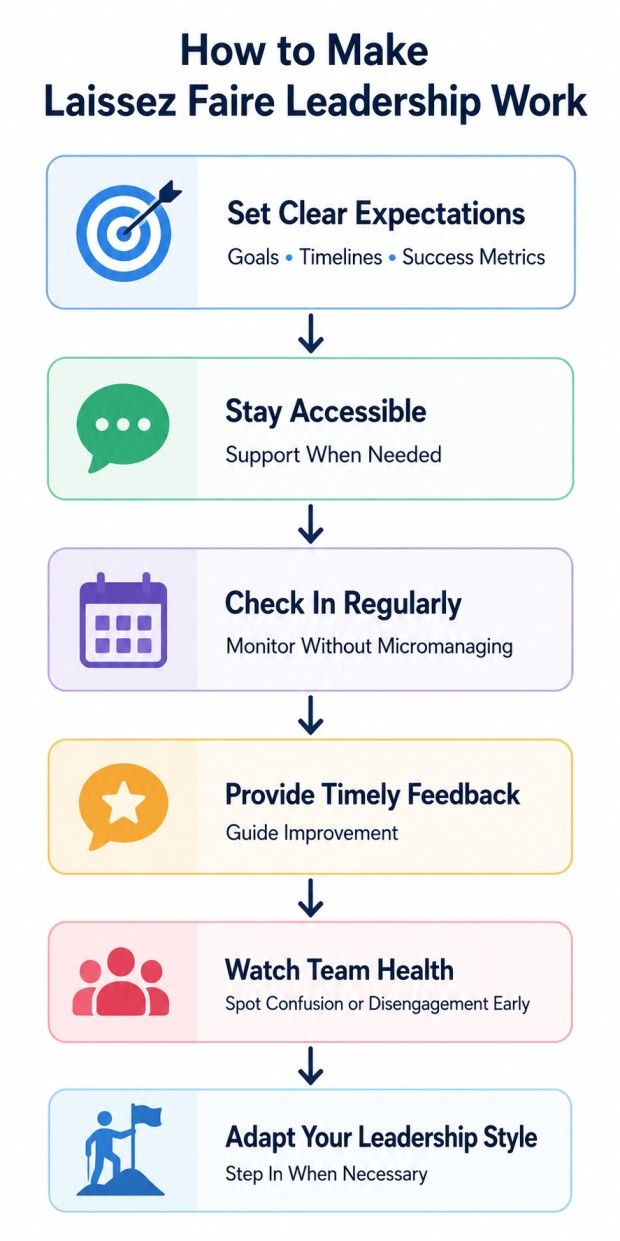
This style demands active awareness, even when you're not actively directing.
Laissez-faire leadership isn't about doing less. It's about trusting more. When it fits the team and the situation, it produces focused, motivated professionals who take ownership of their work. When it doesn't fit, it creates confusion and accountability gaps that quietly damage team performance.
If you're building leadership skills or preparing for a management role, understanding when to step back is just as important as knowing when to lead from the front. upGrad offers courses in management, organizational behavior, and leadership development that can help you build both. Explore programs designed for working professionals who want to lead more effectively.
Ready to start your journey? Book a free consultation with upGrad today to find the best path for your career.
Laissez faire leadership often gets criticism because people confuse it with a lack of leadership. When leaders provide too little direction, teams can become disconnected, priorities may drift, and accountability can weaken. The style works best when employees are capable of managing their responsibilities without constant oversight.
Yes, it can improve retention among experienced professionals who value independence and trust. Many skilled employees prefer workplaces where they can make decisions without seeking approval at every step. Greater autonomy often leads to higher job satisfaction and stronger long-term commitment.
Successful leaders using this approach typically trust others, communicate clearly, and resist the urge to micromanage. They are comfortable delegating authority while remaining available for support. Strong emotional intelligence is also important because they must recognize when intervention becomes necessary.
Remote teams often benefit from the laissez faire leadership style because employees already work with a high degree of independence. When expectations, communication channels, and performance metrics are clear, team members can manage their work efficiently without frequent supervision.
Industries that rely on expertise, creativity, and innovation often see the strongest results. Technology companies, research organizations, universities, design firms, and consulting businesses frequently adopt aspects of this approach because employees are trusted specialists in their fields.
A workplace led through trust and autonomy often develops a culture of ownership and initiative. Employees feel empowered to contribute ideas and solve problems independently. However, if communication is weak, the same culture can become fragmented and difficult to manage.
Business leaders such as Warren Buffett are often cited in discussions about laissez faire leadership examples. Buffett is known for giving managers of acquired companies significant freedom to run operations while focusing on broader strategic direction rather than day-to-day control.
Small businesses can use this leadership approach when team members have strong expertise and understand company goals. In early-stage startups, founders often grant autonomy to specialists because speed and innovation matter. The challenge is maintaining alignment as the business grows.
Success is typically measured through outcomes rather than activity. Leaders focus on project completion, quality standards, business performance, and employee engagement instead of tracking every task. Clear goals and performance indicators are essential for evaluating results effectively.
The most common mistake is stepping back without creating structure. Some leaders assume autonomy means complete independence, but teams still need goals, accountability, and communication. Without those foundations, the approach can quickly turn into confusion rather than empowerment.
Interest in laissez faire leadership has grown as organizations embrace flexible work models and knowledge-based roles. Many companies recognize that highly skilled professionals often perform better when given autonomy. Still, most successful organizations combine this style with other leadership approaches when situations demand it.
973 articles published
We are an online education platform providing industry-relevant programs for professionals, designed and delivered in collaboration with world-class faculty and businesses. Merging the latest technolo...
Get Free Consultation
By submitting, I accept the T&C and
Privacy Policy
Top Resources
Certification
3 Months
Certification
6 Months
O.P. Jindal Global University
Masters in International Accounting and Finance (Accredited by ACCA, UK)Master's Degree
12 Months