Disruptive Innovation: What It Is, How It Works, and Why It Changes Everything
By upGrad
Updated on Jun 18, 2026 | 6 min read | 1.57K+ views
Share:

All courses
Certifications
More
By upGrad
Updated on Jun 18, 2026 | 6 min read | 1.57K+ views
Share:
Table of Contents
Disruptive innovation refers to the process by which emerging companies with limited resources gain a foothold in overlooked or underserved market segments. Through accessible and cost-effective solutions, they progressively expand their capabilities, capture mainstream customers, and ultimately redefine competitive dynamics within the industry.
Disruptive innovation doesn't just improve a product. It replaces the entire way an industry works. A cheaper, simpler alternative enters the market, gets ignored by the big players, and then quietly takes over.
This blog breaks down the meaning of disruptive innovation, the theory behind it, real examples you'll recognise, and how businesses and professionals can actually use this knowledge.
Explore upGrad's Management and MBA programs to build expertise in talent acquisition, employee engagement, performance management, workforce planning, leadership development, HR analytics, and strategic people management.
Popular upGrad Programs
Disruptive innovation is a process where a smaller company or new product enters at the bottom of a market and eventually moves up to displace established players. The term was coined by Harvard professor Clayton Christensen in his 1997 book, "The Innovator's Dilemma."
It's not about being flashy or about the best technology. It's about targeting customers who are either overserved or completely ignored by existing solutions.
Here's the key distinction, not every new technology is disruptive innovation. A faster iPhone isn't disruptive. A phone that made the internet accessible to people who'd never owned a computer? That's closer to disruptive innovation.
Not every new product or technology qualifies as disruptive innovation. Many businesses introduce better features, improved designs, or higher performance, but these changes often strengthen existing markets rather than reshape them.
Disruptive innovations follow a different path. They usually begin by addressing the needs of customers who are overlooked, underserved, or unable to access existing solutions because of cost, complexity, or availability.
Some common characteristics include:
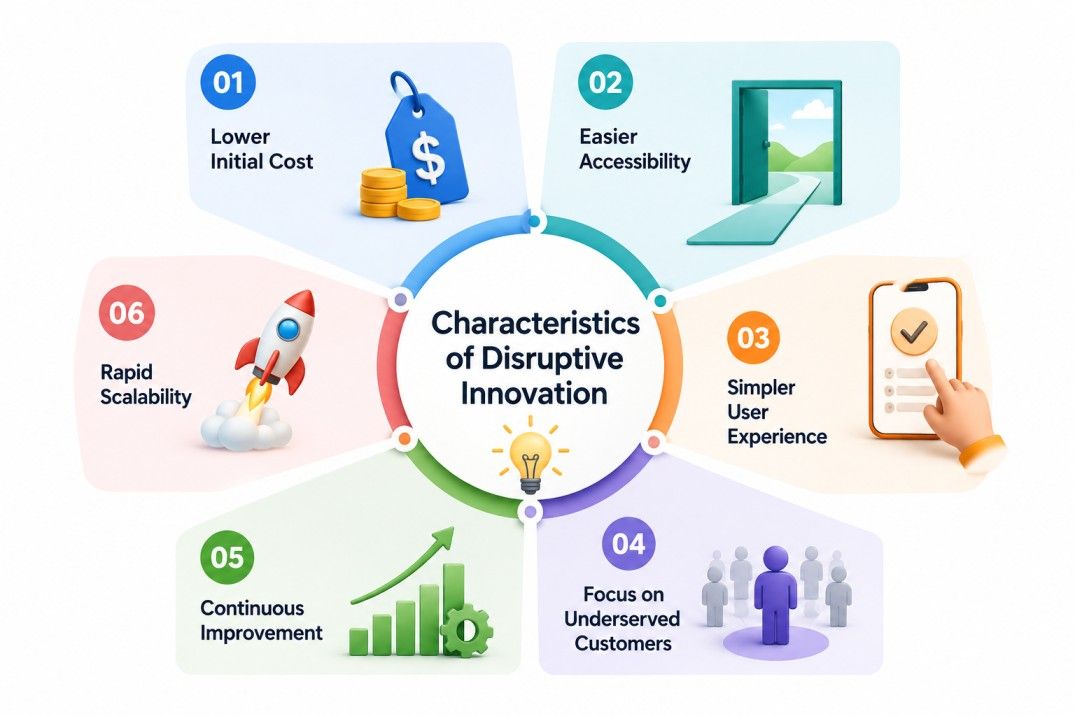
A key point to remember is that disruption rarely happens overnight. The first version of a disruptive product may appear less capable than existing alternatives. However, by solving a customer problem in a simpler or more affordable way, it creates a foundation for long-term growth.
That's why companies often underestimate disruptive competitors. By the time the new solution reaches mainstream adoption, customer expectations may have already shifted, making it difficult for established businesses to catch up.
Do read: Brand Positioning – A Focal Point of All Marketing Efforts
Disruptive innovation typically enters a market through one of two paths:
Both paths look harmless at first. And established companies don't feel threatened until it's too late. Big companies focus on their best customers. Those customers pay the most and demand the best features. So when a cheaper, "inferior" product shows up targeting a segment they don't care about, they ignore it or even feel relieved to let it go.
That choice eventually costs them the market.
Also read: What is Entrepreneurship? Definition, Importance, How to Become one?
Free Courses
Clayton Christensen's disruptive innovation theory explains why dominant companies get overtaken despite doing everything right by their current standards.
The core idea is that the companies get better at serving their existing customers while the market below them shifts. Disruptors enter quietly, improve over time, and then move upstream.
Phase |
What Happens |
| Entry | Disruptor targets low-end or non-consumers |
| Improvement | Product quality improves over time |
| Market shift | Disruptor's offering becomes good enough for mainstream customers |
| Displacement | Incumbent loses market share, often rapidly |
One thing Christensen was clear about was that sustaining innovation and disruptive innovation aren't the same thing. Sustaining innovation makes good products better. Disruptive innovation changes who the product is for.
It's worth knowing that Christensen's framework has faced pushbacks. Some researchers argue that the definition has been stretched too loosely. Uber, often called a classic disruptor, didn't start by targeting non-consumers or the low end. It targeted existing taxi users with a better experience.
That doesn't make Uber unimportant. It just means not every industry shift qualifies as textbook disruptive innovation. The theory is useful, but it's not a universal formula.
Do read: Importance of Business Environment: Definition, Elements and Types
Recommended Courses to upskill
Explore Our Popular Courses for Career Progression
IIIT Bangalore
Executive Diploma in Machine Learning and AI360° Career Support
O.P.Jindal Global University
MBA from O.P.Jindal Global UniversityLive Case Studies and Projects
If you work in any business role, understanding disruptive innovation theory isn't just academic. It changes how you assess risk, spot opportunity, and make decisions.
For professionals, the question to ask is simple: what parts of my industry are currently being underserved or overpriced? That's where disruption enters.
Ignoring disruption doesn't make it go away. Here's what organisations actually do when they take it seriously:
Most organisations only respond to disruption after they've already lost ground. The ones that survive either anticipate it or build their own disruptive arm before a competitor forces their hand.
Must read: What is Business Process Reengineering? Key Steps Explained
Disruptive innovation creates value for consumers through affordability and accessibility, but it also forces businesses to adapt, evolve, and compete in new ways.
Benefits |
Challenges |
| Lower costs for customers | Revenue loss for existing businesses |
| Easier access to products and services | Declining market share |
| Faster technology adoption | Customer migration to new alternatives |
| Better customer experience | Need for operational changes |
| Creation of new markets | Workforce adjustments |
| More competition and innovation | Increased competitive pressure |
| Greater consumer choice | Uncertain business outcomes |
| Business growth opportunities | Balancing current profits with future innovation |
New waves of disruption are already reshaping industries. Artificial intelligence, automation, cloud computing, digital healthcare, and online education continue to create opportunities for new entrants. Many of today's market leaders began as small challengers serving customers that larger organizations overlooked.
The lesson remains relevant. Disruptive innovation isn't simply about technology. It's about identifying unmet needs and delivering value in a way existing solutions don't. Companies that stay close to customer problems and remain open to change are better positioned to thrive when disruption arrives.
Ready to start your journey? Book a free consultation with upGrad today to find the best path for your career.
Disruptive innovation and breakthrough innovation are often confused, but they are not the same. Breakthrough innovations introduce significant technological advances, while disruptive innovation changes market dynamics by making products more accessible or affordable. A breakthrough technology can exist without disrupting an industry, whereas disruptive innovation reshapes how customers access and use products or services.
Yes, strong technology alone does not guarantee successful disruption. Many innovations fail because they do not address an underserved market, solve a real customer problem, or create a sustainable business model. Disruptive innovation succeeds when it combines accessibility, affordability, and continuous improvement with genuine market demand.
Established businesses typically focus on their most profitable customers and highest-margin products. As a result, they may overlook simpler or lower-cost alternatives that initially appear unattractive. According to disruptive innovation theory, this focus on existing customers can create blind spots that allow new competitors to gain market share over time.
No, digital transformation and disruptive innovation are not automatically the same. Many organisations adopt digital tools to improve existing processes without fundamentally changing the market. A transformation becomes disruptive when it creates new customer segments, changes industry economics, or makes products and services accessible to people who previously lacked access.
Industries with high costs, complex customer experiences, or underserved user groups are often more vulnerable to disruption. Financial services, healthcare, education, transportation, and retail continue to experience new forms of disruptive innovation as technology lowers barriers and enables more convenient alternatives for consumers.
Startups should focus on customer groups that are ignored, underserved, or priced out of existing solutions. Instead of competing directly with market leaders, they can identify pain points that established companies overlook. Many successful disruptive innovation examples began by solving simple problems for users who had limited options.
Customer behaviour is often the driving force behind disruption. People generally choose solutions that are more convenient, affordable, and easier to use. As customer expectations evolve, disruptive products gain traction because they align better with changing preferences, even if they initially offer fewer features than traditional alternatives.
Artificial intelligence can be disruptive, but not every AI application qualifies as disruptive innovation. AI becomes disruptive when it expands access, reduces costs, or creates entirely new markets. For example, AI-powered tools that allow small businesses to perform tasks once reserved for large enterprises have strong disruptive potential.
Disruption rarely happens overnight. In many cases, it takes years or even decades for a disruptive product to move from niche adoption to mainstream acceptance. The timeline depends on factors such as customer adoption, technological maturity, regulatory conditions, and the ability of incumbent companies to respond.
Disruptive innovation examples can be found across many sectors. Telemedicine platforms, online learning providers, subscription-based services, fintech solutions, and direct-to-consumer brands have all challenged traditional business models. Their success often comes from simplifying access and serving customer needs more effectively than established competitors.
Understanding disruptive innovation theory helps professionals identify emerging trends before they become mainstream. It encourages strategic thinking about changing customer needs, evolving business models, and market gaps. Whether working in management, marketing, product development, or entrepreneurship, this framework supports better decision-making in rapidly changing industries.
975 articles published
We are an online education platform providing industry-relevant programs for professionals, designed and delivered in collaboration with world-class faculty and businesses. Merging the latest technolo...
Get Free Consultation
By submitting, I accept the T&C and
Privacy Policy
Top Resources
Certification
3 Months
Certification
6 Months
O.P. Jindal Global University
Masters in International Accounting and Finance (Accredited by ACCA, UK)Master's Degree
12 Months