Symbolic AI: How It Works, Applications, and Why It Still Matters
By Sriram
Updated on Jun 10, 2026 | 11 min read | 7.43K+ views
Share:

All courses
Certifications
More
By Sriram
Updated on Jun 10, 2026 | 11 min read | 7.43K+ views
Share:
Table of Contents
Symbolic AI, also called Good Old-Fashioned AI, or GOFAI, is a way of artificial intelligence that uses symbols, rules and logical relationships to represent knowledge. Rather than being trained on large datasets, it’s fed explicitly defined information and reasoning processes to solve problems and make decisions.
This method uses structured, step by step logic to reach conclusions. Symbolic AI is often used for applications where decisions need to be explainable, such as expert systems, legal technology, healthcare support, and business rule management, because the decisions are transparent and traceable.
This Blog covers about symbolic AI, how it works, where it is used today, its strengths and limitations, and why many experts believe symbolic methods will continue to be an important part of the future of of AI. You'll also understand the connection between symbolic reasoning and modern machine learning systems.
Get hands-on experience in AI and machine learning with upGrad’s Artificial Intelligence courses. Explore generative AI and future-ready technologies through practical applications.
Popular AI Programs
At its heart, symbolic AI is an approach to artificial intelligence that represents knowledge through symbols, rules, and logical relationships.
Symbolic systems are based on explicitly defined knowledge and reasoning processes, rather than learning patterns from massive datasets. Facts, relationships, and decision rules are programmed into the system by the developers. The AI then uses logic to make conclusions.
For example, take a simple rule:
Using symbolic reasoning, the system can conclude:
Humans perform this type of reasoning naturally. Symbolic AI attempts to replicate it through formal logic and knowledge representation.
An AI symbol represents a concept, object, action, or relationship within a knowledge system.
Examples include:
These symbols become building blocks for reasoning.
Instead of analyzing raw data directly, symbolic systems manipulate symbols according to predefined rules.
The early AI researchers wanted machines that could reason like people.
They thought intelligence meant:
This led to the development of expert systems, theorem provers, planning systems, and knowledge-based applications.
For decades, symbolic AI dominated artificial intelligence research.
Do read : AI Transportation: How Artificial Intelligence Is Transforming Modern Mobility
Free Courses
The diagram below illustrates the step-by-step process through which symbolic AI transforms knowledge into logical conclusions. Instead of learning patterns from large datasets, symbolic systems rely on predefined facts, rules, and reasoning mechanisms to solve problems.
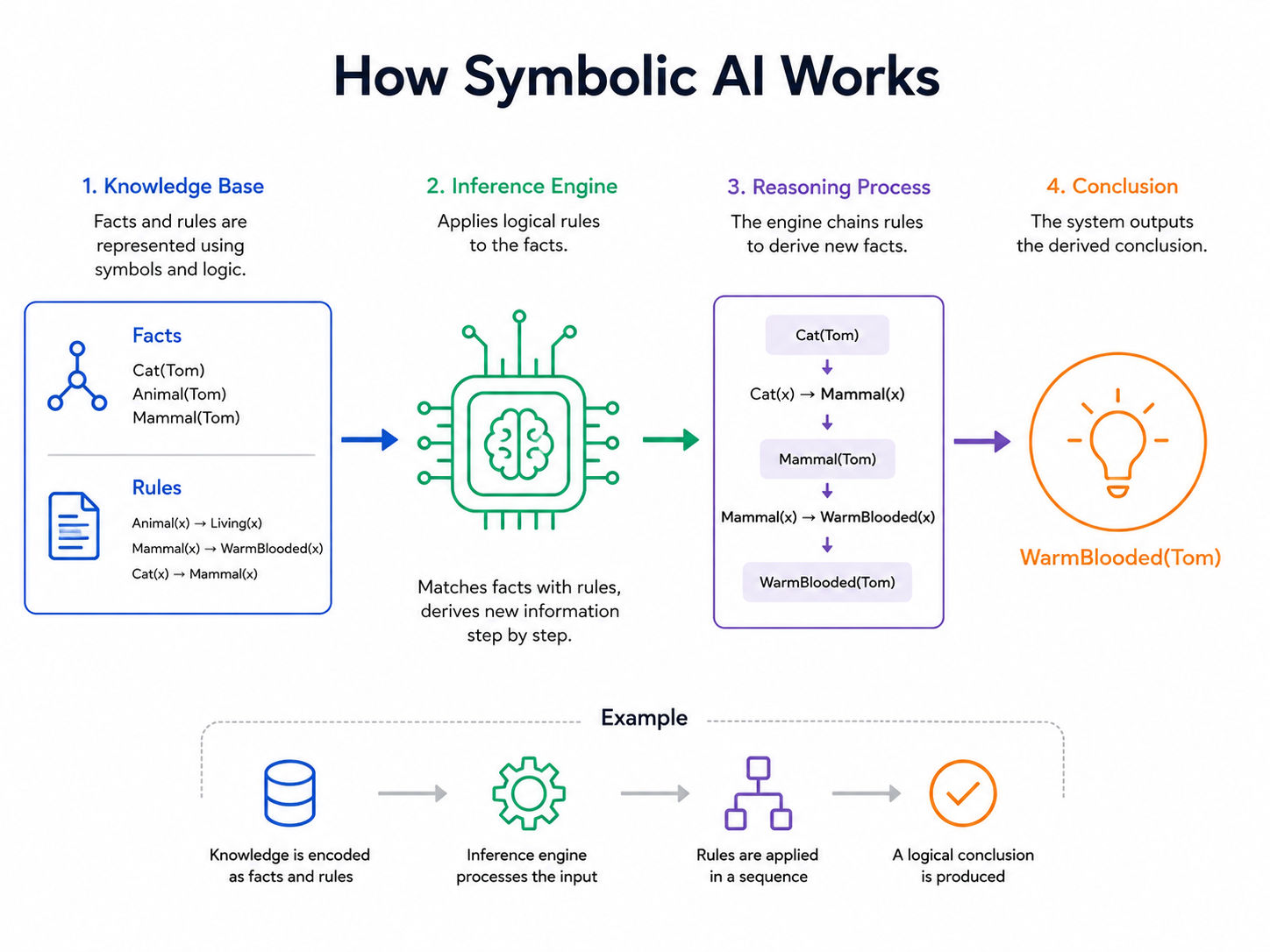
At a high level, symbolic AI stores knowledge in a structured form, applies logical rules to that knowledge, and uses reasoning techniques to derive new information. This process makes every decision transparent and easy to trace.
Most symbolic systems have three key elements:
These components together enable machine reasoning.
Knowledge representation defines how information is stored.
Rather than storing data as numerical weights, symbolic systems organize knowledge into structured forms.
Common methods include:
Consider a healthcare example.
The system might store facts such as:
These facts become part of a knowledge base.
Rules tell the system how to reason.
A rule often follows an IF-THEN structure.
Examples:
These rules allow the system to make decisions using logical reasoning.
Unlike machine learning models, symbolic AI does not discover these rules automatically. Experts typically create and maintain them.
These rules allow the system to make decisions using logical reasoning.
Unlike machine learning models, symbolic AI does not discover these rules automatically. Experts typically create and maintain them.
The inference engine acts as the reasoning component.
It evaluates facts and rules to generate conclusions.
For example:
Known facts:
Rule:
Inference:
This process enables symbolic systems to explain how they reached conclusions.
That transparency remains one of their strongest advantages.
Also read : Best AI Chatbot: A Guide to Choosing the Right AI Assistant in 2026
AI Courses to upskill
Explore Artificial Intelligence Courses for Career Progression
Several traits distinguish symbolic AI from modern data-driven approaches.
Every decision follows a traceable chain of logic.
If a system recommends a diagnosis or action, developers can review the exact rules involved.
This level of transparency is valuable in regulated industries.
Symbolic systems depend heavily on human expertise.
Domain experts contribute knowledge directly through rules and relationships.
This reduces dependence on massive datasets.
Given the same inputs, symbolic systems usually produce the same outputs.
This consistency can improve reliability in certain applications.
Symbolic AI excels when problems involve:
These environments benefit from predictable reasoning paths.
Organizations can inspect the logic behind every decision.
This is especially useful in:
When accountability matters, symbolic approaches often provide advantages over black-box models.
To Know : Understanding the Key Elements of AI
Symbolic AI and machine learning are often juxtaposed, but they are designed to solve different types of problems. Symbolic AI is based on rules, logic and explicit knowledge. Machine learning learns from large datasets and makes predictions or decisions based on patterns it finds.
Whether one is better than the other depends on the problem being solved. Symbolic AI is good where transparency and logical reasoning are important. Machine learning is more effective for complex data, pattern recognition and tasks where it’s difficult to create predefined rules.
Symbolic AI vs Machine Learning :
| Aspect | symbolic AI | Machine Learning |
| Approach | Uses rules and logical reasoning | Learns patterns from data |
| Knowledge Source | Human-defined expertise | Training datasets |
| Explainability | High and transparent | Often difficult to interpret |
| Learning Ability | Limited | Continuously improves with data |
| Data Requirements | Low | High |
| Best For | Reasoning and decision rules | Prediction and pattern recognition |
Must Read : Explore Top Free AI Courses with Certificate in 2026
While much of the current discourse in AI is around deep learning and generative AI, symbolic AI still drives many real-world systems where reasoning, transparency, and rule enforcement are important.
In fact, some industries still rely heavily on symbolic approaches because they need decisions that humans can understand and check.
Expert systems were among the earliest successful symbolic AI applications.
These systems replicate the decision-making process of human specialists using large rule sets.
Examples include:
Suppose a technician enters symptoms of a machine failure. The expert system evaluates predefined rules and suggests likely causes along with recommended actions.
Healthcare often requires explainable recommendations.
Doctors need to understand why a system suggests a diagnosis or treatment.
Symbolic AI can:
Unlike many black-box models, symbolic systems can clearly show the reasoning behind recommendations.
Legal environments depend heavily on rules.
Symbolic AI helps organizations:
Since laws often follow structured logic, symbolic reasoning fits naturally into these workflows.
Many modern search engines and enterprise knowledge systems use symbolic concepts.
Knowledge graphs represent relationships between entities such as:
This structured representation helps systems answer complex questions and connect related information.
Robots often need reasoning capabilities in addition to perception.
A warehouse robot may know:
Using symbolic reasoning, the robot can generate an alternative plan without requiring new training data.
Do read : Top 15 Agentic AI Books for Beginners to Advanced Learners
Subscribe to upGrad's Newsletter
Join thousands of learners who receive useful tips
Like every AI approach, symbolic AI offers unique strengths and notable challenges.
Understanding both helps determine when it is the right solution.
Symbolic AI offers several advantages, especially in environments where transparency, logical reasoning, and decision traceability are important. Unlike many data-driven models, symbolic systems can explain how they arrive at conclusions, making them useful for industries that require accuracy, accountability, and clear decision-making processes.
Every conclusion follows a logical path.
This makes auditing and debugging significantly easier.
Symbolic systems rely on expert knowledge rather than massive datasets.
This is useful in domains where data is limited or expensive to collect.
These systems excel at:
The same inputs generally produce the same outputs.
This consistency is important in highly regulated environments.
Knowledge Engineering Bottleneck.Someone must create and maintain the rules.
As systems grow, this process becomes time-consuming and expensive.
Traditional symbolic systems do not learn automatically from new experiences.
Updating knowledge often requires human intervention.
Difficulty Handling Uncertainty
Pure symbolic systems often struggle with ambiguity.
Managing thousands or millions of rules becomes increasingly complex.
Large rule sets can create maintenance issues and conflicting logic.
Imagine building a medical diagnosis system.
A symbolic approach can provide clear explanations and follow established medical guidelines.
However, if new diseases emerge or patient behaviors change, updating the system may require extensive manual work.
A machine learning model can adapt more easily but may not explain its conclusions as clearly.
This illustrates why many organizations now combine multiple AI techniques.
Must read : Latest AI News and Updates - Stay Ahead in the AI Revolution
While deep learning drives many modern AI applications, symbolic AI continues to play an important role in areas that require reasoning, transparency, and explainable decision-making. Its strengths make it valuable for future hybrid AI systems.
Several factors continue to drive interest in symbolic approaches.
Governments and industries increasingly demand transparency.
Organizations need systems that explain decisions affecting:
Symbolic reasoning supports these requirements.
Future AI systems will likely combine:
Rather than replacing symbolic AI, modern approaches often build on its strengths.
Companies produce lots of structured knowledge.
This information can be organized, managed, and reasoned with the help of symbolic representations.
Symbolic methods will continue to be useful as knowledge-driven applications proliferate.
People are more likely to trust a system if they can understand its reasoning process.
The symbolic AI support for collaboration makes it easier to interpret and validate decision-making. This is increasingly relevant as AI is deployed in high-stakes settings.
Symbolic AI is still one of the cornerstones of AI. It enables to represent knowledge by symbols, rules and logical relationships and reason in a transparent and explainable way.
Knowing what symbolic AI is helps us understand an important part of the history of AI and its continued relevance today. While machine learning dominates many modern applications, symbolic systems still have advantages in reasoning, compliance, planning and decision making.
The future of AI will probably not be either for symbolic methods or neural networks alone. Instead, hybrid approaches such as neuro-symbolic AI are merging the best of both worlds. As organizations look for AI systems that are both intelligent and explainable, symbolic AI will continue to play an important role in the evolution of AI
Want personalized guidance on AI and upskilling? Speak with an expert for a free 1:1 counselling session today.
Yes. Many organizations continue using symbolic AI for compliance, business rules, expert systems, and knowledge management. These applications require explainable decisions and structured reasoning. While deep learning handles pattern recognition well, symbolic methods remain valuable when transparency and logical consistency are priorities.
Traditional symbolic AI does not learn automatically in the same way machine learning models do. Developers usually define rules and knowledge structures manually. However, modern hybrid systems combine symbolic reasoning with machine learning to enable both learning and logical decision-making.
Symbolic AI follows predefined logical rules that humans can inspect and understand. Every decision can be traced back to specific facts and reasoning steps. Neural networks often process information through millions of parameters, making it harder to identify exactly how a particular conclusion was reached.
Industries with strict regulations and decision accountability often benefit the most. These include healthcare, banking, insurance, legal services, manufacturing, and government sectors. Symbolic AI helps organizations justify decisions and ensure compliance with established rules and policies.
Symbolic AI represents knowledge using symbols, facts, relationships, rules, and logical statements. These structures create a knowledge base that enables reasoning. Examples include ontologies, semantic networks, expert systems, and knowledge graphs that organize information in a structured manner.
Neither approach is universally better. Symbolic AI excels at reasoning and explainability, while machine learning excels at pattern recognition and adaptability. The best choice depends on the problem being solved. Many modern applications combine both approaches to leverage their respective strengths.
An AI symbol acts as a representation of an object, concept, action, or relationship. The system manipulates these symbols according to logical rules to reach conclusions. Symbols serve as the foundation of knowledge representation and reasoning in symbolic AI systems.
Yes. Researchers increasingly combine symbolic reasoning with large language models to improve factual accuracy, reasoning capabilities, and explainability. This integration helps address some limitations of purely neural approaches and supports more reliable AI decision-making.
The largest challenge is knowledge engineering. Experts must create, update, and maintain rules manually. As systems grow more complex, managing thousands of interconnected rules becomes difficult, especially in dynamic environments where information changes frequently.
Knowledge graphs organize entities and relationships using symbolic representations. This structure allows systems to answer complex questions, connect related concepts, and support intelligent search experiences. Many enterprise search and recommendation systems use symbolic principles within knowledge graphs.
Many researchers believe it will. As organizations seek trustworthy and explainable AI, symbolic reasoning provides capabilities that purely data-driven models often lack. The future is likely to involve hybrid systems that combine machine learning, symbolic AI, and knowledge-based reasoning techniques.
698 articles published
Sriram K is a Senior SEO Executive with a B.Tech in Information Technology from Dr. M.G.R. Educational and Research Institute, Chennai. With over a decade of experience in digital marketing, he specia...
Speak with AI & ML expert
By submitting, I accept the T&C and
Privacy Policy
Top Resources
Master's Degree
18 Months
Executive Diploma
12 Months
IIIT Bangalore
Executive Programme in Generative AI & Agentic AI for LeadersIndia’s #1 Tech University
Dual Certification
5 Months