Understanding the Key Elements of AI
By upGrad
Updated on Jun 04, 2026 | 8 min read | 2.65K+ views
Share:

All courses
Certifications
More
By upGrad
Updated on Jun 04, 2026 | 8 min read | 2.65K+ views
Share:
Table of Contents
Artificial Intelligence works through a combination of Data, Algorithms, and Computational Power. These core elements help AI systems process information, learn patterns, and make intelligent decisions across different industries.
This blog explains the major elements of AI, including Machine Learning, Deep Learning, Generative AI, NLP, and Computer Vision. You will also learn how these technologies power modern AI applications and real-world systems.
Explore Artificial Intelligence Courses on upGrad to gain a comprehensive understanding of the core elements of Artificial Intelligence.
Popular AI Programs
The main elements of AI are the building blocks that allow machines to mimic human intelligence. These components help AI systems learn patterns, make decisions, understand language, and improve over time.
Without these elements, AI cannot function properly. Every modern AI application depends on a combination of technologies working together.
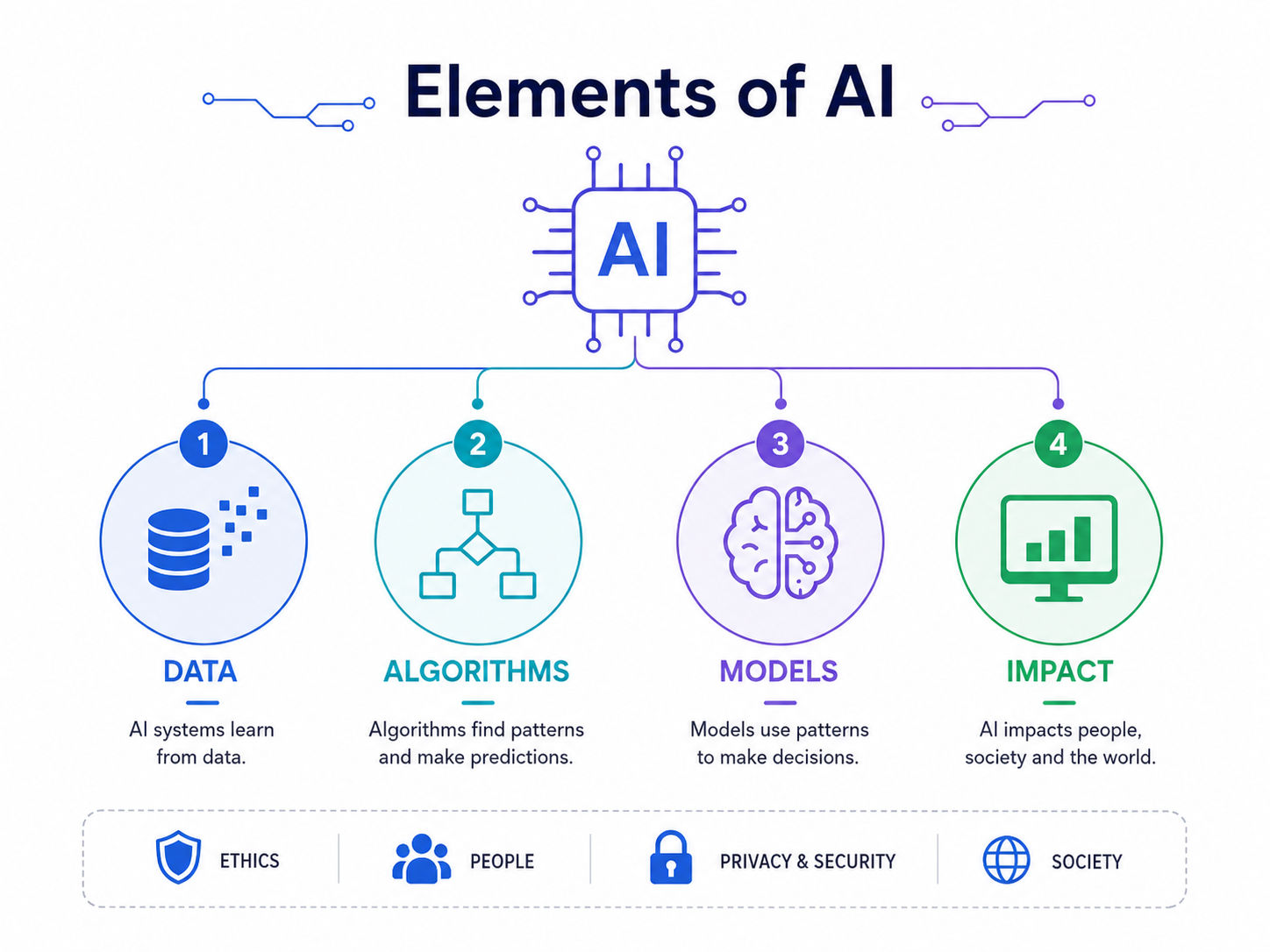
Element |
What It Does |
Why It Matters |
Data |
Provides the information AI learns from. | Higher-quality data leads to more accurate AI outcomes. |
Algorithms |
Process data to identify patterns and relationships. | Enable AI systems to analyze, predict, and automate tasks. |
Models |
Apply learned patterns to make predictions or decisions. | Turn data and algorithms into practical AI applications. |
Impact |
Represents AI's influence on people, businesses, and society. | Determines the real-world value and consequences of AI. |
AI systems are only as strong as the quality of their components. Good Data improves accuracy. Strong Algorithms increase efficiency. Better Compute Power allows faster training and predictions.
These elements work together in almost every AI product, including:
An AI system follows a structured process:
Also Read: AI Tutorial Made Simple: Learn Artificial Intelligence from Scratch
Data-Driven Learning: AI systems learn from examples instead of manual programming. This is why Data is considered the foundation of AI.
Adaptive Intelligence: Machine Learning allows systems to improve over time without constant human intervention.
Decision-Making Ability: AI Problem Solving helps machines analyze situations and produce outcomes based on logic and patterns.
The combination of AI technologies makes Real-World AI practical and scalable across industries.
Industry |
AI Application |
| Healthcare | Disease detection |
| Finance | Fraud detection |
| Education | Personalized learning |
| Retail | Product recommendations |
| Transportation | Autonomous vehicles |
Free Courses
Data and Algorithms are two of the most important elements of AI. They act as the fuel and engine of intelligent systems. Without them, Machine Learning models cannot learn or function correctly.
Data refers to information collected from different sources. AI systems use this information to identify patterns and generate predictions.
Examples include:
High-quality Data improves AI performance. Poor-quality information can lead to incorrect results and biased decisions.
Data Type |
Example |
| Structured Data | Spreadsheets and databases |
| Unstructured Data | Images, videos, audio |
| Semi-Structured Data | Emails and JSON files |
Algorithms are step-by-step instructions that tell AI systems how to process information and make decisions.
Different Algorithms solve different tasks such as:
Algorithm Type |
Use Case |
| Decision Trees | Classification tasks |
| Linear Regression | Prediction analysis |
| K-Means Clustering | Grouping data |
| Random Forest | Improved prediction accuracy |
Algorithms depend on Data to learn patterns. The better the training Data, the more accurate the AI system becomes.
For example:
AI Courses to upskill
Explore Artificial Intelligence Courses for Career Progression
AI systems face several challenges when handling Data and Algorithms.
Common Issues
AI Problem Solving becomes more effective when systems use strong Algorithms and clean Data. These components help AI make logical decisions faster than traditional systems.
Modern companies rely heavily on Data and Algorithms.
Examples include:
This shows how Real-World AI depends on accurate Data processing and smart Algorithms.
Machine Learning and Neural Networks are among the most advanced elements of AI. They allow systems to learn from experience and improve performance automatically.
Machine Learning is a branch of AI that enables systems to learn from Data without explicit programming.
Instead of following fixed instructions, Machine Learning models identify patterns and make predictions based on previous examples.
Type |
Purpose |
| Supervised Learning | Learns using labeled data |
| Unsupervised Learning | Finds hidden patterns |
| Reinforcement Learning | Learns through rewards and penalties |
The process usually includes:
Machine Learning powers many Real-World AI applications today.
Examples of Machine Learning
Neural Networks are AI models inspired by the human brain. They contain connected layers of nodes that process information.
These networks are especially useful for:
Layer |
Function |
| Input Layer | Receives information |
| Hidden Layers | Process data patterns |
| Output Layer | Produces results |
Neural Networks can process large and complex datasets more effectively than traditional systems.
They improve AI Problem Solving by identifying patterns humans may miss.
Subscribe to upGrad's Newsletter
Join thousands of learners who receive useful tips
Deep Learning is an advanced form of Machine Learning that uses multiple Neural Networks layers.
It is widely used in:
Courses from upGrad you can explore: Deep Learning Courses Online
Despite their advantages, these systems also face limitations.
Common Challenges
Also Read: Build Smarter Neural Networks with Keras in Deep Learning
Machine Learning and Neural Networks are transforming industries.
Industry |
AI Use Case |
| Healthcare | Medical diagnosis |
| Banking | Risk analysis |
| Retail | Customer targeting |
| Manufacturing | Predictive maintenance |
These technologies continue to improve Real-World AI systems worldwide.
Modern AI systems require significant Compute Power to process Data, train models, and deliver accurate results. Alongside processing capabilities, AI Problem Solving helps machines make intelligent decisions.
Compute Power refers to the hardware and processing resources needed to run AI systems efficiently.
AI workloads involve:
Component |
Role |
| CPU | General processing |
| GPU | Parallel AI computations |
| TPU | Specialized AI acceleration |
| Cloud Infrastructure | Scalable AI processing |
Advanced Machine Learning models require enormous processing capacity. Without enough Compute Power, AI systems become slow and inefficient.
This is especially important in:
AI Problem Solving is the process of analyzing situations and generating solutions using logical reasoning, pattern recognition, and learning techniques.
AI systems solve problems through:
Method |
Purpose |
| Rule-Based Systems | Follow predefined logic |
| Heuristic Search | Find efficient solutions |
| Predictive Analysis | Forecast outcomes |
| Knowledge Representation | Store and retrieve information |
Real-World AI applications rely heavily on problem-solving capabilities.
Examples include:
As AI systems become more advanced, Compute Power requirements increase. Deep Neural Networks and Machine Learning models need faster processors and scalable infrastructure.
Despite rapid progress, challenges still exist.
Major Concerns
Still, improved Compute Power continues to push the boundaries of Real-World AI innovation.
The elements of AI are evolving rapidly. New technologies are making AI systems faster, smarter, and more accessible across industries.
Future Machine Learning systems will require less training Data while delivering higher accuracy.
Researchers are focusing on:
Neural Networks are becoming more advanced through Deep Learning innovations.
Future improvements may include:
AI processing is moving closer to devices instead of relying only on cloud systems.
Benefits include:
As Real-World AI expands, ethical AI development is becoming more important.
Key focus areas include:
Industry |
Future AI Trend |
| Healthcare | Predictive diagnostics |
| Education | AI tutors |
| Finance | Automated investment analysis |
| Manufacturing | Intelligent automation |
AI is expected to support human decision-making rather than replace people entirely. The future of AI depends on stronger Data systems, efficient Algorithms, advanced Neural Networks, and scalable Compute Power.
This will improve:
Understanding the elements of AI is essential for anyone interested in modern technology. AI systems rely on several key components including Data, Algorithms, Machine Learning, Neural Networks, Compute Power, and AI Problem Solving techniques.
These elements work together to power Real-World AI applications across healthcare, finance, education, retail, and transportation. As technology continues to evolve, AI will become even more integrated into daily life and business operations.
By learning the fundamentals today, beginners can build a strong foundation for future AI skills and opportunities.
Some related articles from upGrad:
Deep Learning Algorithm [Comprehensive Guide With Examples]
Unlocking AI: A Complete Guide To Basic To Advanced Concepts
Data Structures and Algorithms (DSA)
Beginner Guide to the Top 15 Types of AI Algorithms and Their Applications
AI Techniques Explained: Boost Your Knowledge and Skills
How to Learn Artificial Intelligence: A Step-by-Step Roadmap
The main elements of AI include Data, Algorithms, Machine Learning, Neural Networks, Compute Power, and AI Problem Solving methods. These components work together to help machines learn patterns and make decisions. Each element plays a different role in Real-World AI applications. Without these foundational technologies, AI systems cannot function effectively or improve over time.
Data is important because AI systems learn from examples and patterns found in information. High-quality Data improves the accuracy and reliability of Machine Learning models. Poor or biased Data can produce incorrect predictions and unfair outcomes. This is why data collection and cleaning are critical parts of AI development.
Algorithms provide instructions that guide AI systems in processing Data and making decisions. Different Algorithms are designed for prediction, classification, clustering, and optimization tasks. They form the core logic behind AI Problem Solving and allow systems to generate useful outputs based on patterns and rules.
Machine Learning allows AI systems to improve automatically through experience. Instead of being manually programmed for every task, models learn from Data and adapt over time. This technology powers many Real-World AI applications such as recommendation engines, voice assistants, and fraud detection systems.
Neural Networks are inspired by the human brain and process information through connected layers of nodes. They can recognize patterns more effectively than many traditional systems. These models are especially useful for image recognition, speech processing, and natural language understanding in modern AI applications.
AI models process massive amounts of Data and perform complex calculations. Advanced Machine Learning and Neural Networks require powerful hardware for faster training and accurate predictions. Compute Power helps AI systems operate efficiently in real-time applications such as autonomous driving and language translation.
Real-World AI includes applications used in healthcare, banking, education, retail, and transportation. Examples include medical diagnosis tools, fraud detection systems, and recommendation engines. These systems rely on Machine Learning, Data analysis, and AI Problem Solving techniques to deliver accurate results.
Yes, beginners can learn the elements of AI by starting with foundational concepts like Data, Algorithms, and Machine Learning. Many online courses and tutorials simplify these topics for new learners. Understanding the basics first makes advanced concepts like Neural Networks and Deep Learning easier to grasp later.
AI systems face challenges related to biased Data, privacy concerns, energy consumption, and lack of transparency. High Compute Power requirements also increase infrastructure costs. Developers are working to build ethical and responsible AI systems that improve fairness, security, and trustworthiness.
AI Problem Solving uses logic, search techniques, and predictive models to analyze situations and generate solutions. AI systems evaluate multiple possibilities before selecting the best outcome. This capability is widely used in navigation apps, business forecasting, robotics, and customer service automation.
The future of AI includes smarter Machine Learning models, more efficient Neural Networks, and improved Compute Power. AI systems are expected to become faster, more accurate, and easier to use. Future Real-World AI applications will likely transform industries such as healthcare, education, finance, and manufacturing even further.
1277 articles published
We are an online education platform providing industry-relevant programs for professionals, designed and delivered in collaboration with world-class faculty and businesses. Merging the latest technolo...
Speak with AI & ML expert
By submitting, I accept the T&C and
Privacy Policy
Top Resources
Master's Degree
18 Months
Executive Diploma
12 Months
IIIT Bangalore
Executive Programme in Generative AI & Agentic AI for LeadersIndia’s #1 Tech University
Dual Certification
5 Months