AI Transportation: How Artificial Intelligence Is Transforming Modern Mobility
By Sriram
Updated on Jun 03, 2026 | 7 min read | 6.26K+ views
Share:

All courses
Certifications
More
By Sriram
Updated on Jun 03, 2026 | 7 min read | 6.26K+ views
Share:
Table of Contents
Artificial intelligence (AI) is revolutionizing the transportation industry, making it more intelligent, faster and efficient. AI uses technologies including machine learning, computer vision, and predictive analytics to analyze vast amounts of data to support improved decision making across transportation networks.
AI enhances overall mobility by optimizing supply chain logistics and delivery routes, and reducing traffic congestion with smart traffic management systems.
It also plays a key role in development of autonomous vehicles, helping them navigate roads safely while enhancing transportation safety, efficiency and sustainability.
In this guide, you will find out about how AI transportation works, the most important AI applications in transportation, real-world use cases, benefits, limitations, and what the future may look like for intelligent mobility systems.
Build hands-on AI & ML skills with upGrad’s Artificial Intelligence courses. Learn machine learning, generative AI, and emerging technologies through real-world projects.
Popular AI Programs
AI transportation is the application of artificial intelligence technologies to improve the movement of people, goods and vehicles across transportation networks.
These technologies process large volumes of data, identify patterns, predict outcomes and automate decisions that otherwise would require human intervention.
Unlike conventional transport systems that operate on set rules, AI-powered transport systems are constantly learning from new information. This enables them to adapt to changing road conditions, traffic patterns, weather events and user behavior.
Some common AI technologies used in transportation include:
AI Technology |
Transportation Use |
| Machine Learning | Traffic prediction and route optimization |
| Computer Vision | Vehicle detection and autonomous driving |
| Natural Language Processing | Voice assistants in vehicles |
| Deep Learning | Object recognition and navigation |
| Predictive Analytics | Maintenance forecasting |
| Reinforcement Learning | Traffic signal optimization |
The goal is simple: improve efficiency while reducing costs, delays, accidents, and environmental impact.
Must read : AI in Automotive Industry: Innovation, Impact, and Future
Free Courses
AI in transportation is just one example of the growing use of AI across industries. It is no longer limited to experimental use cases, but actively powers real-world systems. AI is transforming transportation networks from logistics and public transit to autonomous vehicles, changing how they work and scale.
1. Self-Driving Cars
Self-driving cars are probably the most visible example of AI in transport.
These vehicles use a combination of:
The AI system continuously observes the environment, identifies objects, recognizes pedestrians, interprets road signs, and makes instantaneous driving decisions.
For example, an autonomous vehicle approaching a busy intersection has to process thousands of data points every second to decide whether to stop, speed up or change direction.
2. Smart Traffic Management
Every year, traffic congestion costs cities billions of dollars in lost productivity and fuel consumption.
AI-powered traffic systems help reduce congestion by:
Instead of relying on fixed traffic signal schedules, AI systems adapt dynamically based on actual road conditions.
3.Public Transportation Optimization
Public transit agencies use AI to improve service reliability and passenger experience.
AI helps operators:
For instance, transit systems can increase vehicle frequency during expected rush-hour spikes rather than relying solely on historical schedules.
4. Logistics and Freight Management
The logistics sector generates massive amounts of operational data.
AI analyzes this information to:
A delivery company operating thousands of vehicles can save significant costs by using AI-driven route planning that avoids congestion and minimizes travel distance.
5.Ride-Sharing Platforms
Ride-hailing companies rely heavily on AI.
AI models determine:
Without AI, managing millions of daily ride requests would be nearly impossible.
Also read : Use of Big Data in Autonomous Vehicles and Transportation Systems
AI Courses to upskill
Explore Artificial Intelligence Courses for Career Progression
Many people interact with AI transportation systems every day without realising how much processing occurs in the background.
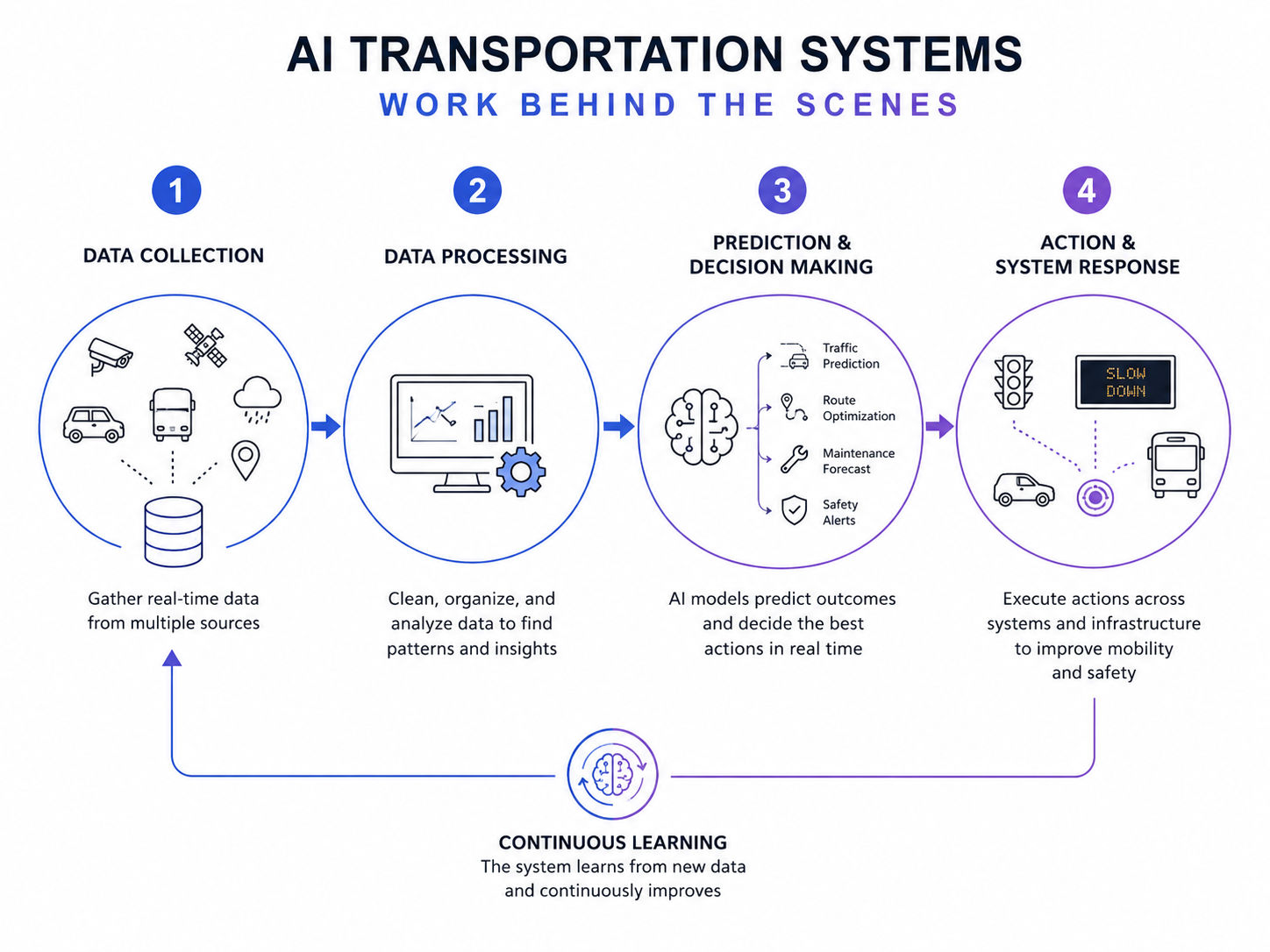
Most intelligent transportation systems follow a similar workflow.
Step 1: Data Collection
Transportation systems collect data from multiple sources:
A modern connected vehicle can generate gigabytes of data during a single day of operation.
Step 2: Data Processing
Raw data alone has little value.
AI systems clean, organize, and analyze incoming information to identify meaningful patterns.
For example:
Step 3: Prediction and Decision-Making
Machine learning models generate predictions based on historical and real-time data.
These predictions may include:
The system then selects the most appropriate action.
Step 4: Continuous Learning
One of the biggest advantages of AI is its ability to improve over time.
As more data becomes available, machine learning models refine their predictions and decision-making processes.
This continuous improvement makes transportation systems increasingly accurate and efficient.
Real-World Example
Consider a logistics company managing 5,000 delivery trucks.
An AI platform might:
The result is lower operational costs and faster deliveries.
Do read :
The adoption of AI transportation creates wide-ranging benefits that go beyond individual organizations. It enhances the performance of whole transportation ecosystems, from logistics chains to public mobility systems. These improvements, over time, create safer roads, lower costs and more efficient movement of people and goods.
Enhanced Safety
Human error is a contributing factor in many road accidents across the globe.
AI systems are able to:
AI-assisted safety features already help reduce accident risks, while autonomous driving technology is still evolving.
Greater Efficiency
Transportation networks often suffer from inefficiencies caused by manual planning and limited visibility.
AI improves efficiency through:
Even small efficiency improvements can generate substantial savings when applied across large fleets.
Reduced Operating Costs
Organizations use AI to lower costs by:
Predictive maintenance alone can prevent expensive equipment failures and unexpected service disruptions.
Better Environmental Outcomes
Transportation contributes significantly to greenhouse gas emissions.
AI can support sustainability initiatives by:
Less wasted fuel translates directly into lower emissions.
Enhanced Customer Experience
Consumers increasingly expect reliable transportation services.
AI helps deliver:
These improvements create smoother experiences for passengers and customers alike.
Also read : Machine Learning Free Online Course with Certificate
But even as AI transportation shows promise, there are real-world challenges that slow down large-scale adoption. Its development is still subject to data reliability issues, safety concerns and regulatory gaps. At the same time, continued innovation is driving the industry towards more advanced and connected mobility systems.
Data Quality Problems
“AI systems are very reliant on accurate data.
Inaccurate or incomplete information can lead to poor predictions and operational errors.
Organizations often spend significant effort improving data quality before deploying AI solutions.
Safety and reliability issues
Autonomous systems need to operate safely in unpredictable environments.
AI models can still struggle with weather, unusual road situations and unexpected human behavior.
Cybersecurity Threats
Connected transportation systems produce and transmit large amounts of sensitive data.
Protecting vehicles and infrastructure from cyber threats remains a critical priority.
Regulation Complexity
Regulations around autonomous vehicles, data privacy, and AI accountability continue to be developed by governments.
Innovation often outpaces regulations.
The Future Outlook for AI Transportation
The future of AI transportation will likely involve deeper integration between vehicles, infrastructure, and digital platforms.
Several developments are expected to accelerate:
Rather than replacing humans entirely, many future transportation systems will combine human expertise with AI-driven decision support.
The most successful implementations will focus on collaboration between people and intelligent technologies.
AI is changing how people and goods are moved across cities, countries and global supply chains. It helps transportation systems to run with higher efficiency and intelligence, from autonomous vehicles and smart traffic systems to predictive maintenance and logistics optimization. The growing application of AI in transportation shows that AI is not an experimental technology anymore, but a solution to real mobility problems.
Its long term impact is strong despite safety, regulation and data quality concerns. As networks become increasingly connected, AI will continue to boost mobility, enhance the user experience and enable more sustainable transportation systems.
Want personalized guidance on AI and upskilling? Speak with an expert for a free 1:1 counselling session today.
AI is already used in live systems like navigation apps, traffic signal control, and fleet management tools. Companies use it to predict congestion, suggest faster routes, and reduce delays. You see it in ride-hailing apps that match drivers efficiently and in logistics platforms that adjust delivery plans based on live traffic conditions.
You need a mix of data science, machine learning, and domain knowledge in transportation systems. Skills in Python, data analysis, and model deployment are important. If you want to work on real systems, understanding geospatial data, optimization techniques, and cloud platforms will help you handle large-scale mobility problems.
AI studies traffic patterns, delivery history, and demand spikes to optimize routes. It reduces idle time, avoids congested roads, and predicts delays before they happen. Logistics teams use it to plan smarter schedules and reduce fuel use. This helps you deliver faster while keeping operational costs under control.
AI can reduce congestion but cannot fully eliminate it. It improves signal timing, suggests alternate routes, and helps planners design better road systems. However, factors like population growth, road capacity, and driver behavior still limit outcomes. You get better flow, but not a complete solution to congestion.
AI relies on data from GPS devices, traffic cameras, vehicle sensors, weather updates, and mobile apps. This data helps the system understand movement patterns and road conditions. When combined, it allows real-time predictions about traffic flow, delays, and safety risks across different parts of a city.
AI helps manage charging schedules, predict battery usage, and optimize charging station placement. It also analyzes driving behavior to extend battery life. For fleet operators, AI ensures vehicles charge at the right time to reduce downtime. This makes electric vehicle operations more practical and cost efficient at scale.
AI depends heavily on data quality and infrastructure. Poor or incomplete data can reduce accuracy. It also struggles with unpredictable real-world conditions like accidents or sudden weather changes. In some cases, integration with old transport systems creates delays in adoption. You still need human oversight for critical decisions.
AI reduces fuel use by optimizing routes, minimizing idle time, and improving driving patterns. It avoids traffic-heavy roads and suggests efficient speed ranges for vehicles. In logistics fleets, even small improvements in routing can reduce fuel consumption significantly over time, especially when scaled across hundreds of vehicles.
AI transportation systems improve safety through driver assistance, collision detection, and real-time monitoring. However, safety depends on system design, testing, and regulatory control. You still need human supervision in many cases. Fully autonomous systems are advancing, but they operate within controlled environments rather than everywhere.
AI improves public transport by predicting passenger demand, adjusting bus and train frequency, and reducing waiting times. It also helps operators manage routes based on real-time conditions. This leads to better service reliability. You experience fewer delays and more accurate scheduling compared to traditional fixed-route systems.
AI will continue to integrate with smart city systems, connected vehicles, and real-time infrastructure. Future systems will focus on automation, predictive mobility, and energy-efficient transport networks. You will see more coordination between vehicles and city infrastructure, which will make transportation more adaptive and responsive to daily demand.
724 articles published
Sriram K is a Senior SEO Executive with a B.Tech in Information Technology from Dr. M.G.R. Educational and Research Institute, Chennai. With over a decade of experience in digital marketing, he specia...
Speak with AI & ML expert
By submitting, I accept the T&C and
Privacy Policy
Top Resources
Master's Degree
18 Months
Executive Diploma
12 Months
IIIT Bangalore
Executive Programme in Generative AI & Agentic AI for LeadersIndia’s #1 Tech University
Dual Certification
5 Months
Artificial Intelligence Animation: How AI Is Transforming Animation Process
20 Aug 2026 | 8 min read