AI Telecom: How Artificial Intelligence is Transforming the Telecom Industry
By Sriram
Updated on Jun 11, 2026 | 6 min read | 4.54K+ views
Share:

All courses
Certifications
More
By Sriram
Updated on Jun 11, 2026 | 6 min read | 4.54K+ views
Share:
Table of Contents
AI telecom combines machine learning, generative AI, and agentic AI to make telecom networks smarter and more efficient. These technologies help service providers automate network management, improve customer support, predict issues before they occur, and create new revenue opportunities through intelligent, data-driven services and personalized customer experiences.
This blog covers how AI applications in the telecom industry work, where telecom companies are using AI today, the benefits and challenges of implementation, and what the future of AI in telecom may look like as 5G, edge computing, and intelligent automation continue to evolve.
Discover upGrad's Artificial Intelligence and Machine Learning programs and learn how to build, deploy, and optimize intelligent systems using technologies that are driving innovation across telecom, healthcare, finance, and other sectors.
Popular AI Programs
AI telecom uses technologies such as machine learning, deep learning, natural language processing, and predictive analytics to improve telecom networks and services. It enables telecom providers to analyze data in real time, automate operations, predict network issues, optimize performance, and enhance overall operational efficiency.
The following table highlights how traditional telecom operations compare with AI-driven
| Traditional Telecom | AI-Powered Telecom |
| Reactive issue resolution | Predictive issue detection |
| Manual network monitoring | Automated network optimization |
| Rule-based operations | Data-driven decision making |
| Static customer support | Intelligent virtual assistants |
| Limited forecasting accuracy | Advanced predictive analytics |
This shift matters because telecom operators face increasing pressure to support:
Without AI, managing these challenges at scale becomes increasingly difficult.
Also read: Applications of Artificial Intelligence and Its Impact
Free Courses
AI applications have now permeated almost every aspect of telecom operations. AI is not a silver bullet but rather a collection of technologies addressing a number of business and technical problems.
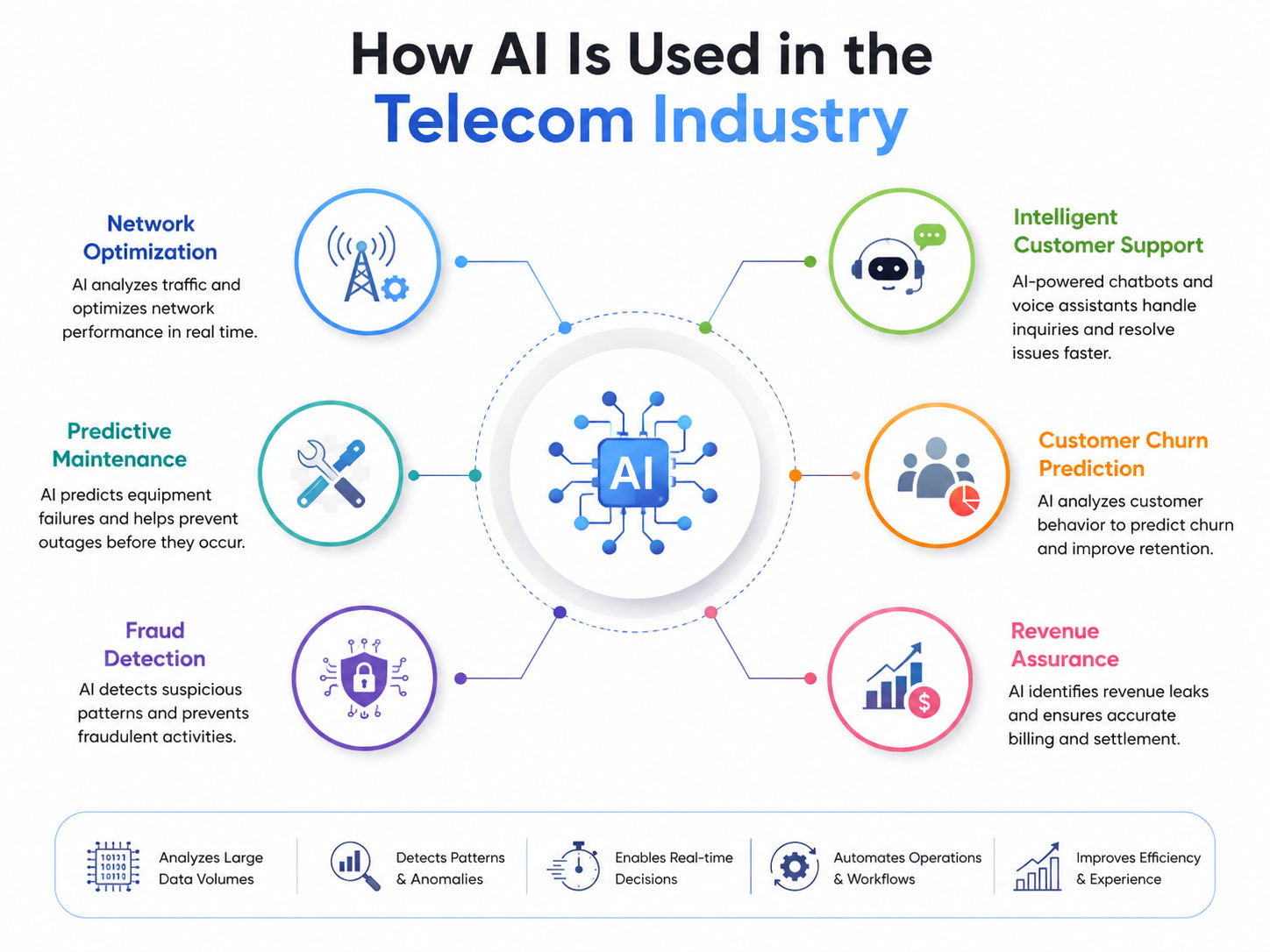
Here are some of the most important use cases.
The demand for traffic in telecom networks is always changing.
AI systems process network performance data and dynamically tweak configurations for improved efficiency. For example, the AI can detect traffic spikes during a major sporting event or festival, and adjust network resources accordingly.
This helps to reduce congestion and maintain the quality of service.
Network outages are expensive and disruptive.
Rather than waiting for equipment to break down, AI models use historical performance data, sensor data, and maintenance records to detect early warning signs before failures happen.
For example, a cellular tower exhibiting abnormal temperature patterns may prompt a maintenance alert prior to service interruption.
Many telecom companies now use AI-powered virtual assistants and chatbots to handle routine customer inquiries.
These systems can:
This reduces support costs while improving response times.
Telecom fraud remains a significant challenge.
AI systems can identify unusual patterns that may indicate:
Because AI continuously learns from new data, it can often detect fraudulent activity faster than traditional rule-based systems.
Customer retention is often more cost-effective than customer acquisition.
AI models analyze customer behavior, service usage, complaint history, and billing patterns to identify users who may be considering switching providers.
Telecom operators can then take proactive measures to improve customer satisfaction and retention.
Must read: What is Generative AI? Understanding Key Applications and Its Role in the Future of Work
AI Courses to upskill
Explore Artificial Intelligence Courses for Career Progression
The adoption of AI in telecom industry operations creates benefits that extend beyond simple automation. It fundamentally changes how telecom providers manage infrastructure and serve customers.
The following advantages explain why AI investment continues to increase across the sector.
AI continuously monitors network conditions and identifies opportunities for optimization.
This allows operators to improve:
Human teams often struggle to process millions of data points in real time.
AI systems can analyze complex datasets almost instantly and recommend actions based on current network conditions.
Customers expect immediate support and consistent service quality.
AI helps telecom companies deliver:
Automation reduces the need for repetitive manual processes.
Areas where AI commonly lowers costs include:
Telecom infrastructure faces constant cybersecurity threats.
AI strengthens security by detecting anomalies and responding to suspicious activity more quickly than traditional monitoring systems.
Must read: 5 Significant Benefits of Artificial Intelligence [Deep Analysis]
Several AI technologies work together to support telecom applications. Understanding these technologies helps explain how modern intelligent telecom systems operate.
The table below outlines the primary technologies and their roles.
| AI Technology | Telecom Application |
| Machine Learning | Traffic forecasting and predictive maintenance |
| Deep Learning | Complex pattern recognition |
| Natural Language Processing | Chatbots and virtual assistants |
| Computer Vision | Infrastructure monitoring |
| Reinforcement Learning | Dynamic network optimization |
| Predictive Analytics | Customer churn prediction |
Machine learning models learn from patterns in the historical data and predict future events.
Telecom companies widely use machine learning techniques for network anomaly detection and demand forecasting.
NLP enables systems to understand and respond to human language.
This technology is used to drive customer service chatbots and voice assistants that manage millions of customer support interactions annually.
Predictive analytics combines statistical techniques and AI algorithms to forecast future results.
Examples include predicting equipment failures and identifying customers who are likely to leave the company.
Reinforcement learning enables systems to improve decision-making through trial and feedback.
Researchers are increasingly exploring its use for autonomous network management in next-generation telecom infrastructure.
Although AI offers significant advantages, implementation is rarely straightforward.
Telecom providers often encounter several practical challenges when deploying AI solutions at scale.
AI systems are heavily dependent on accurate and consistent data.
Incomplete, outdated or poorly structured datasets can compromise model effectiveness and lead to unreliable predictions.
Many telecom operators are still using legacy systems that weren't built for AI integration.
Integrating modern AI platforms with legacy infrastructure usually demands considerable technical effort.
Telecom companies hold vast amounts of sensitive customer data.
AI deployments should adhere to privacy regulations and strong security controls to
safeguard user data.
Building AI-powered systems involves investments in:
Organizations must carefully evaluate expected returns before launching large-scale projects.
Some advanced AI models function as complex black boxes.
Understanding why a model made a specific recommendation can sometimes be difficult, particularly in highly regulated environments.
Also read: Job Opportunities in AI: Salaries, Skills & Careers in 2026
The future of AI telecom will be driven by the increasing convergence of artificial intelligence, 5G, edge computing, cloud infrastructure and the Internet of Things.
Telecom networks are becoming more dynamic, more decentralized, more data intensive. With the rise in complexity, AI will play an increasingly important role in autonomously managing operations.
Several trends are emerging that are likely to drive future innovation:
A particularly interesting development is the idea of autonomous networks. Over time these systems can track performance, identify problems, optimize resources and solve many problems without human intervention.
Complete independence in telecom operations is a long-term objective, but the industry is taking incremental steps in that direction.
Also read: Applications of Artificial Intelligence and Its Impact
AI telecom solutions are changing how communication networks operate, scale, and deliver services. Predictive maintenance, fraud detection, customer support automation and network optimization -artificial intelligence is becoming core to modern telecom infrastructure.
As telecom networks grow and become more complex, the role of AI will only increase. Organizations that successfully combine strong data foundations, advanced analytics and responsible AI practices will be better positioned to improve efficiency, improve customer experiences and enable the next generation of digital connectivity.
Take the next step toward an AI-driven career. Book a free consultation with upGrad and find a program that helps you to find the best path for your career.
AI helps telecom providers deliver faster and more personalized customer support. It can analyze customer behavior, recommend relevant plans, resolve common issues through virtual assistants, and predict service problems before they affect users. This creates smoother interactions and reduces the need for repeated support requests.
Yes. Smaller telecom operators can use cloud-based AI solutions without investing heavily in infrastructure. They often start with customer support automation, churn prediction, or network monitoring. These use cases can improve efficiency and customer satisfaction while keeping implementation costs manageable.
5G networks generate massive amounts of operational data and require continuous optimization. AI helps analyze network conditions in real time, allocate resources efficiently, detect performance issues, and manage traffic demands. This allows telecom providers to maintain service quality across increasingly complex network environments.
Generative AI supports telecom teams by creating knowledge-base content, summarizing customer interactions, generating service reports, and assisting support agents with responses. It can also help employees access technical information faster, reducing the time needed to resolve customer and operational issues.
AI can lower costs by automating repetitive tasks, improving maintenance planning, and reducing network downtime. Instead of relying entirely on manual processes, telecom providers can use intelligent systems to streamline operations and allocate resources more effectively across different business functions.
Professionals working in AI telecom projects often need a mix of technical and domain knowledge. Useful skills include machine learning, data analytics, Python programming, cloud computing, network fundamentals, and data engineering. Understanding telecom operations can also help bridge the gap between AI models and business needs.
AI strengthens cybersecurity by monitoring network activity and identifying unusual behavior that may indicate potential threats. It can detect suspicious login attempts, abnormal traffic patterns, and emerging attack methods faster than traditional monitoring systems, helping security teams respond more quickly.
AI can help optimize network coverage and resource allocation in regions where infrastructure investments need careful planning. By analyzing usage patterns and network performance data, telecom providers can identify areas that require improvements and make more informed deployment decisions.
Scaling AI across large telecom networks often involves integrating data from multiple systems, maintaining data quality, managing infrastructure costs, and ensuring regulatory compliance. Organizations also need skilled professionals who can build, monitor, and continuously improve AI models in production environments.
Agentic AI could enable telecom systems to perform complex tasks with minimal human intervention. Future applications may include autonomous network optimization, automated incident management, and intelligent service orchestration. These capabilities could improve efficiency while reducing response times across telecom operations.
AI telecom offers opportunities for professionals interested in artificial intelligence, data science, network engineering, and cloud technologies. As telecom companies continue adopting intelligent systems, demand is expected to grow for individuals who can combine AI expertise with knowledge of communication networks and digital infrastructure.
698 articles published
Sriram K is a Senior SEO Executive with a B.Tech in Information Technology from Dr. M.G.R. Educational and Research Institute, Chennai. With over a decade of experience in digital marketing, he specia...
Speak with AI & ML expert
By submitting, I accept the T&C and
Privacy Policy
Top Resources
Master's Degree
18 Months
Executive Diploma
12 Months
IIIT Bangalore
Executive Programme in Generative AI & Agentic AI for LeadersIndia’s #1 Tech University
Dual Certification
5 Months
Artificial Intelligence Animation: How AI Is Transforming Animation Process
20 Aug 2026 | 8 min read