AI Hospitality: How Artificial Intelligence is Reshaping the Hospitality Industry
By Sriram
Updated on Jun 04, 2026 | 7 min read | 1.88K+ views
Share:

All courses
Certifications
More
By Sriram
Updated on Jun 04, 2026 | 7 min read | 1.88K+ views
Share:
Table of Contents
AI hospitality refers to the use of artificial intelligence technologies to improve operations, customer service, revenue management, and guest experiences within hotels, restaurants, resorts, travel companies, and other hospitality businesses.
In this guide, you'll learn how AI is being used across the hospitality sector, the benefits it brings, the challenges businesses face during adoption, and what the future looks like for AI-powered guest experiences.
Explore upGrad's AI and Machine Learning programs to develop practical skills in NLP, predictive modeling, and data-driven decision-making.
Popular AI Programs
The hospitality business is about one thing: making guests happy. A check-in, fast service, tailored suggestions, and quick problem-solving can turn a new visitor into a loyal customer. Delivering that experience all the time is tough when hotels, resorts, restaurants, and travel companies deal with thousands of interactions daily.
That's where AI in hospitality comes in. Artificial intelligence applications in the hospitality sector help hotels and restaurants automate routine tasks, understand what guests like, forecast demand, provide customer service, and help staff make quicker decisions.
When a hotel chatbot replies to a guest's question at midnight, AI is working. When room prices change based on how many rooms are likely to be booked, AI is involved. When a restaurant predicts inventory requirements for the weekend rush, artificial intelligence helps drive the decision.
The use of AI in hospitality industry operations focuses on three primary goals:
Must read: Types of AI: From Narrow to Super Intelligence with Examples
Free Courses
This isn't about robots replacing staff. The use of AI in hospitality is mostly invisible. It runs quietly in the background, handling tasks that used to eat up hours of human time.
Here's what that looks like in practice:
Hotels collect enormous amounts of data. Room preferences, check-in times, dining choices, past complaints. AI systems use this data to personalize every guest interaction without a staff member needing to remember it manually.
A returning guest who always books a high-floor room and orders room service after 10 PM? The system flags it. The hotel acts on it before the guest asks.
Revenue management used to mean spreadsheets and gut feeling. Now AI tools analyze competitor rates, local events, seasonal demand, and booking patterns in real time. Prices shift automatically to maximize occupancy and revenue.
Marriott and Hilton both use AI-driven pricing engines. Smaller hotels are catching up through third-party tools.
Most hotel websites now have a chat function. A growing number of those are AI-powered. They answer booking questions, handle cancellations, suggest restaurants, and escalate to human staff when needed.
AI scheduling tools help housekeeping managers assign rooms based on check-out times, staff availability, and cleaning priority. It sounds minor. In a 300-room hotel running at 90% occupancy, it makes a real operational difference.
Do read: 10 Best Artificial Intelligence Examples You See Every Day
AI Courses to upskill
Explore Artificial Intelligence Courses for Career Progression
Not all AI in hospitality looks the same. Some tools are built specifically for hotels. Others are general AI platforms adapted for the industry.
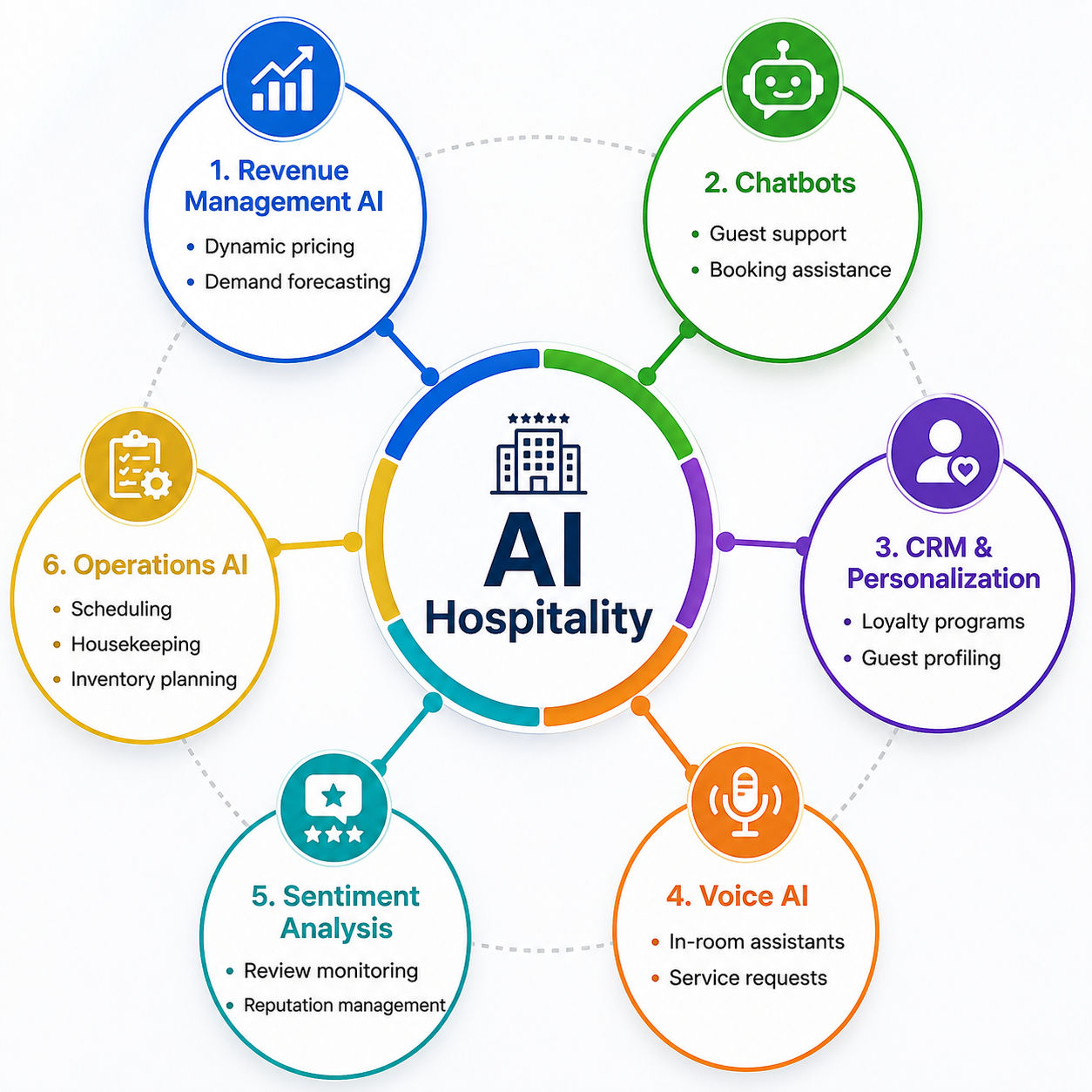
Must read: Comprehensive Guide to IoT Architecture and Layers: Components, Applications and More
Businesses adopt AI because it solves real operational problems, and the benefits of AI extend beyond automation. But adopting AI comes with its own set of practical challenges.
Many hospitality businesses discover it later that implementation requires more planning than expected.
Area |
Benefits of AI Hospitality |
Where AI Hospitality Falls Short |
| Guest Service | Provides instant responses through chatbots and virtual assistants, reducing wait times and improving convenience. | Struggles with emotional situations where guests need empathy, reassurance, or personalized problem-solving from human staff. |
| Personalization | Analyzes guest preferences to recommend rooms, dining options, offers, and services tailored to individual needs. | Some guests feel uncomfortable with extensive data collection and may view hyper-personalization as intrusive. |
| Operational Efficiency | Automates repetitive tasks such as reservation management, housekeeping scheduling, and inventory tracking. | Automation requires accurate workflows and high-quality data. Poor processes can limit effectiveness. |
| Decision-Making | Processes large volumes of operational and customer data quickly, helping managers make informed decisions. | AI recommendations are only as reliable as the data available. Incomplete or inaccurate data can produce poor outcomes. |
| Revenue Management | Supports dynamic pricing, demand forecasting, upselling, and customer retention strategies to increase revenue. | Revenue models may overlook local factors or unique guest behaviors that experienced managers can identify. |
| Availability | Operates 24/7, allowing guests to receive support at any time without waiting for staff assistance. | Guests facing complex issues often prefer speaking directly with a human rather than an automated system. |
| System Scalability | Can handle thousands of customer interactions simultaneously without increasing staffing levels. | Scaling AI often requires investment in software integration, infrastructure upgrades, and ongoing maintenance. |
| Data Utilization | Helps businesses uncover trends, occupancy patterns, and customer preferences that would be difficult to identify manually. | Many hotels have fragmented or outdated systems, making data collection and analysis challenging. |
| Cost Efficiency | Reduces administrative workload and helps staff focus on high-value guest interactions. | Initial implementation, customization, and employee training can be expensive, especially for smaller properties. |
| Long-Term Growth | Creates opportunities for smarter operations, better forecasting, and improved guest experiences. | Success depends on balancing technology with human hospitality. AI alone cannot create memorable guest experiences. |
Human hospitality still makes the most impression on a guest. Guests often remember personal interactions more than automated ones. The strongest businesses combine technology with genuine human service rather than replacing people entirely.
Must read: How to create Chatbot in Python: A Detailed Guide
The future looks increasingly intelligent. Several developments are expected to expand the role of AI hospitality over the next few years.
Guests will interact more frequently with voice assistants for room controls, service requests, and information access.
AI systems will create increasingly individualized guest experiences based on real-time behavioral data, preferences, and contextual signals.
Hotels will anticipate guests' needs before requests are made.
For example, AI could automatically suggest airport transportation, dining reservations, or room upgrades based on travel patterns and previous stays.
Energy efficiency is becoming a major priority. AI can optimize heating, cooling, lighting, and resource usage while helping businesses reduce operating costs and environmental impact.
The hospitality businesses that succeed won't necessarily be the ones with the most technology. They'll be the ones who use technology thoughtfully while preserving the human connection guests value most.
Also read: Automation vs AI in 2025: Key Differences and How They're Shaping the Future
AI hospitality is no longer an emerging concept. It's becoming a core part of how hospitality businesses operate, compete, and serve guests.
From personalized recommendations and intelligent pricing to automated support and predictive maintenance, artificial intelligence is helping organizations improve efficiency while delivering better customer experiences.
The use of AI in hospitality industry operations will continue to expand as technology becomes more accessible and guest expectations evolve. Businesses that combine AI-driven insights with strong human service will be best positioned to create experiences that guests remember and return for.
Ready to start your journey? Book a free consultation with upGrad today to find the best path for your career.
Hotels use Artificial Intelligence to make stays special for each person, make check-ins faster, answer guest questions through chatbots, and suggest things they might like based on what they did. Of treating everyone the same, Artificial Intelligence helps hotels give each person what they want, making the service feel more helpful and efficient.
No, that is not what most hotels want. Artificial Intelligence does tasks that are the same every time, like answering common questions, scheduling when rooms are cleaned, or guessing how many people will come. Hotel staff still do the work of helping with problems, being friendly, and making guests feel welcome.
The tools that are used the most include Artificial Intelligence chatbots, systems that help with money, systems that help with customer relationships, voice assistants, software that checks reviews, and tools that guess how many people will come. These tools help hotels work better and make guests happier.
Not anymore. Many Artificial Intelligence systems now charge a fee, so small hotels and hotels that are not part of a big chain can use them. Smaller hotels often use Artificial Intelligence to help with customer questions, booking rooms, checking reviews, and changing prices without spending a lot of money upfront.
Artificial Intelligence looks at things like how many rooms are booked, what other hotels charge, what is happening in the area, how many rooms are available, what time of year it is, and how the hotel did in the past. Based on this information, the system can change the room prices automatically, helping hotels make money and be competitive.
Artificial Intelligence systems check what guests say about the hotel on the internet. Find any common problems or good things that people say. This helps hotel managers respond quickly to fix problems and make things better before they affect how happy guests are.
Yes. Artificial Intelligence can do tasks that take a lot of time, like scheduling staff using energy planning, what to buy, and making housekeeping more efficient. This helps hotels save money and lets staff focus on helping guests, which is what they are good at.
The main concerns are keeping guest information, protecting against hackers giving bad suggestions because the information is not good, and relying too much on machines. Hotels need to be careful when using Artificial Intelligence and make sure that people are still in charge of decisions.
Artificial Intelligence helps hotels use energy, water, and other resources. Hotels can use Artificial Intelligence to control things like lights, heating, cooling, and waste, which saves money and helps the environment.
Hotel staff do not need to be experts in Artificial Intelligence. It is helpful if they understand how to use data, digital tools, and Artificial Intelligence to make decisions and help guests. Staff who can work with Artificial Intelligence will be better at their jobs. Might even become leaders one day.
In the coming years, Artificial Intelligence, in hotels, will get even better at guessing what guests want and will be able to do things before guests even ask. Hotels will give guests suggestions that are just for them, make things work better in real time, and use voice, data, and customer information to make the guest experience even better.
724 articles published
Sriram K is a Senior SEO Executive with a B.Tech in Information Technology from Dr. M.G.R. Educational and Research Institute, Chennai. With over a decade of experience in digital marketing, he specia...
Speak with AI & ML expert
By submitting, I accept the T&C and
Privacy Policy
Top Resources
Master's Degree
18 Months
Executive Diploma
12 Months
IIIT Bangalore
Executive Programme in Generative AI & Agentic AI for LeadersIndia’s #1 Tech University
Dual Certification
5 Months