AI Mining: How Artificial Intelligence Is Changing Data Discovery
By Sriram
Updated on Jun 03, 2026 | 9 min read | 7.28K+ views
Share:

All courses
Certifications
More
By Sriram
Updated on Jun 03, 2026 | 9 min read | 7.28K+ views
Share:
Table of Contents
Artificial Intelligence (AI) is transforming the mining industry by helping companies make faster and more accurate decisions. Using technologies such as machine learning, computer vision, and advanced analytics, AI can process large amounts of geological and operational data to identify mineral deposits, improve exploration accuracy, and reduce costs.
AI also plays a key role in improving mining operations and safety. It helps predict equipment failures before they occur, supports automated machinery, and monitors hazardous conditions in real time. As a result, mining companies can increase productivity, minimize downtime, and create safer working environments for employees.
This blog explores AI mining, its applications, benefits, challenges, and future trends, showing how artificial intelligence improves exploration, safety, efficiency, and decision-making.
Build job-ready AI skills with upGrad’s Artificial Intelligence Courses and gain hands-on experience in machine learning, generative AI, and real-world projects.
Popular AI Programs
AI mining is the use of artificial intelligence technologies to extract valuable insights from large volumes of structured and unstructured data. It is a traditional data mining approach, extended with machine learning, deep learning, natural language processing and advanced pattern recognition techniques.
Traditional data mining is based on pre-defined rules and statistical models. AI mining extends this by enabling systems to learn from data, adapt to changing conditions, and find relationships that humans may not predict.
At its core, AI mining aims to answer questions such as:
For example, an e-commerce firm may analyze millions of customer interactions. Traditional analysis might show the best selling products. AI mining can discover hidden purchasing behaviors, predict future buying trends, and recommend products to individual customers.
AI Mining vs Traditional Data Mining:
| Aspect | Traditional Data Mining | AI Mining |
| Analysis Approach | Rule-based | Learning-based |
| Adaptability | Limited | High |
| Pattern Discovery | Mostly predefined | Dynamic and automated |
| Prediction Accuracy | Moderate | Often higher |
| Unstructured Data Support | Limited | Strong |
| Scalability | Moderate | Excellent |
This shift from rule-driven analysis to intelligent learning makes AI mining significantly more powerful for modern data environments.
Must read : What is Data Mining? Techniques, Examples, and Future Trends in 2025
Free Courses
Understanding AI mining becomes easier when viewed as a step-by-step process. Although implementations vary across industries, most AI mining systems follow a similar workflow.
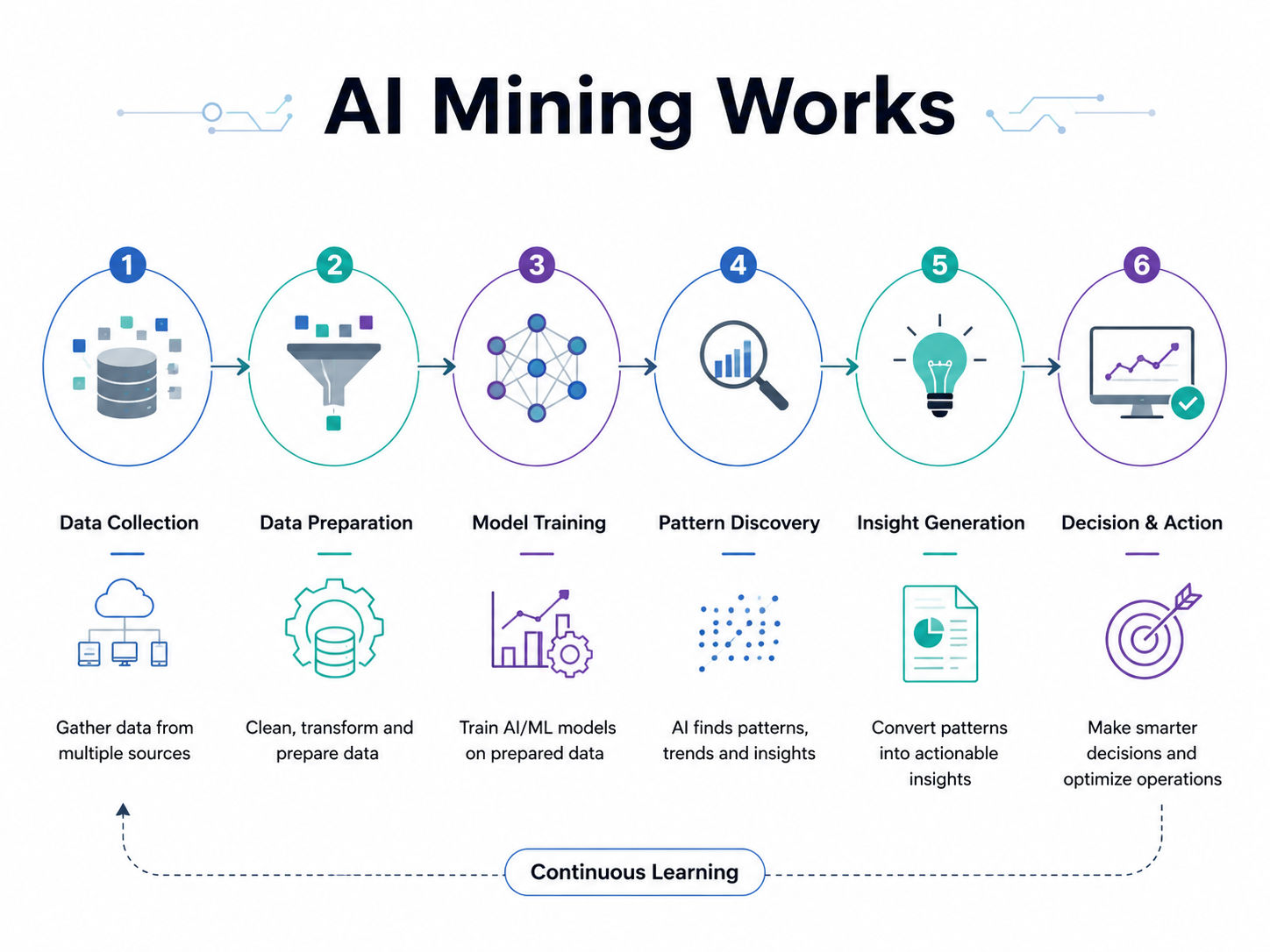
1. Data gathering
The process begins with the collection of information from a number of sources including:
Database systems :
At this point, organizations often collect both structured and unstructured data.
2 Preparing Data .
Raw data seldom shows up in a usable form. It often has errors, duplicates, inconsistencies, and missing values.
Typically, data preparation consists of:
According to many experts, data preparation consumes a large chunk of the analytics project timeline.
3. Feature Extraction
Features are important characteristics within the data that AI models can analyze.
For example:
| Dataset | Example Features |
| Customer Data | Age, location, purchase history |
| Manufacturing Data | Temperature, vibration, output rate |
| Healthcare Data | Symptoms, medical history, test results |
The quality of extracted features often influences the effectiveness of AI mining outcomes.
4. Model Training
Machine learning algorithms learn patterns from historical data.
Common algorithms include:
The system identifies relationships and creates mathematical models that represent those patterns.
5. Pattern Discovery and Prediction
Once trained, models begin identifying:
This stage transforms raw information into actionable insights.
6. Continuous Learning
One advantage of AI mining is its ability to improve over time.
As new information becomes available, models can retrain and adapt to changing environments. This allows organizations to maintain accuracy even when customer behavior, market conditions, or operational processes evolve.
Also read : Artificial Neural Networks for Data Mining: Applications, Benefits & Challenges
AI Courses to upskill
Explore Artificial Intelligence Courses for Career Progression
A lot of people use the terms interchangeably, but AI and data mining are not the same thing. Data mining is about finding patterns , and extracting useful information from data sets . Artificial intelligence is the study of how to make systems that can learn, think and act.
Together they form a powerful framework for intelligent analytics.
How AI Augments Data Mining
Analysts often need to define rules and assumptions before traditional mining techniques can be used.
AI provides capabilities like:
Imagine a financial institution watching transactions.
A traditional system might flag transactions above a certain threshold. An AI-powered system can learn normal customer behavior and detect suspicious activity even when there is no predefined rule.
Key Technologies Used in AI Mining
ML (machine learning)
Machine learning enables systems to learn from historical data and improve predictions over time.
Examples would be:
Deep Learning .
Deep learning is using multi-layered neural networks to analyze complex information.
Applications are:
Natural Language Processing (NLP)
NLP enables systems to understand and analyze human language.
Typical use cases are:
Reinforcement Learning
Reinforcement learning allows systems to improve by trial and error.
It is increasingly used in optimization and decision making environments.
Together, these technologies have extended the power of AI and data mining well beyond the limits of traditional analytical techniques.
Also read : Explore Top Free AI Courses with Certificate in 2026
The AI mining has become a practical tool and has exited a test phase in a number of industries. Organizations use it to analyze large data sets, automate processes, and make better decisions. AI mining helps unlock insights, reduce costs and improve operational performance in everything from health and finance, to manufacturing and mining.
1.Healthcare
Healthcare providers generate massive amounts of clinical and operational data.
AI mining supports:
Hospitals can identify patients at higher risk of readmission and intervene before complications arise.
2. Financial Services
Banks and other financial institutions use AI mining to:
Fraud detection is still one of the most successful applications as AI systems can detect unusual behavior patterns in real time
3.Retail and E-Commerce
Retailers use AI mining to gain insights into customer behavior.
Typical applications include:
Online marketplaces, for example, constantly analyze user activity to enhance shopping experiences.
4. Manufacturing
Machines, sensors and production systems in modern factories generate data.
AI mining assists organizations:
Manufacturers can realize significant operational savings through predictive maintenance alone.
5. Cybersecurity
Cybersecurity teams face a growing volume of threats every day.
AI mining supports:
Rather than relying solely on predefined attack signatures, AI systems can identify suspicious patterns that indicate previously unknown threats.
Benefits and Challenges of AI Mining
AI mining provides multiple advantages such as increased exploration precision, operational efficiency, and workplace safety. It allows mining companies to make quicker data-driven decisions and optimize resource usage. However, challenges like high implementation costs, data quality issues, and system complexity can impact both adoption and performance.
Key Benefits
| Benefit | Impact |
| Faster Analysis | Processes large datasets quickly |
| Improved Accuracy | Identifies complex patterns |
| Predictive Insights | Anticipates future outcomes |
| Scalability | Handles growing data volumes |
| Automation | Reduces manual effort |
Organizations often use AI mining to move from reactive decision-making to proactive planning.
Instead of simply reporting what happened, businesses can predict what may happen next.
Common Problems :
Data quality problems
Quality data is the foundation of AI systems.
Misleading outcomes can result from inaccurate, partial or biased data sets.
Explainability Problems
More sophisticated models can sometimes act as ‘black boxes’.
Decision makers may find it difficult to understand how certain conclusions were reached.
Threats to privacy and security
Sensitive information must be handled responsibly by organizations.
Rules and regulations change constantly across industries and areas.
High infrastructure needs
Large-scale AI mining projects usually involve a lot of computing power, specialized knowledge and continuous maintenance.
Bias in the Models
If training data contains biases, AI systems can unwittingly reinforce them.
Organizations need strong governance practices to follow model behaviour and fairness.
These challenges notwithstanding, developments in explainable AI, model governance and data management are enhancing the reliability of AI mining systems.
AI mining is far more than analytics in the future. Organizations want systems that understand context, generate insights automatically and that can help them make decisions in real-time.
A few trends are shaping the next wave of AI mining:
Large language models are also starting to change the way users interact with data. No more complex queries, analysts can ask questions in natural language and get detailed answers on the fly.
Organizations are collecting more and more diverse data sets, and AI mining will continue to evolve from a specialized analytics capability into a core business function.
AI mining is transforming the mining industry and improving exploration accuracy, operational efficiency, equipment maintenance and worker safety. By combining artificial intelligence with data-driven decision-making, mining companies can discover valuable resources more quickly, which can reduce costs and risks.
Despite some challenges, such as data quality and implementation costs, ongoing technology advances continue to expand the possible uses of AI. In the evolving industry, AI mining will be increasingly important in creating safer, smarter and more productive mining operations.
Want personalized guidance on AI and upskilling? Speak with an expert for a free 1:1 counselling session today.
Yes. Many mining companies use historical drilling records, geological surveys, and production reports to train AI models. Even older datasets can reveal patterns that were previously overlooked. The key requirement is data quality. Clean and organized records help AI generate more accurate predictions about mineral deposits and operational performance.
AI mining analyzes large geological datasets to identify areas with higher resource potential before expensive fieldwork begins. This allows companies to focus exploration efforts on promising locations. As a result, they can reduce unnecessary drilling, save time, and allocate resources more efficiently.
Yes. AI tools are becoming more accessible through cloud platforms and specialized software solutions. Smaller mining companies can use AI for exploration analysis, equipment monitoring, and operational planning without building large in-house AI teams. The scale of implementation can match the company's budget and needs.
No. AI supports experts rather than replacing them. Geologists and engineers still make critical decisions based on their experience and field knowledge. AI helps by processing large amounts of data quickly and highlighting patterns that professionals can investigate further.
Successful AI mining projects often combine multiple data sources, including geological surveys, drilling records, satellite imagery, sensor readings, equipment data, and production reports. The more relevant and accurate the data, the better the AI system can identify trends and generate useful insights.
Accuracy depends on factors such as data quality, model selection, and geological complexity. AI can improve exploration success rates by identifying hidden patterns across datasets. However, predictions are not guarantees and still require field validation, sampling, and expert assessment before major investment decisions.
Yes. AI mining can help optimize resource extraction, reduce waste, and improve energy efficiency. It can also monitor environmental conditions in real time and identify potential risks earlier. These capabilities help mining companies balance productivity with environmental responsibilities.
Computer vision allows AI systems to analyze images and video data from drones, cameras, and mining equipment. Companies use it to inspect infrastructure, monitor site conditions, detect safety hazards, and analyze rock formations. This reduces manual inspection efforts and improves operational visibility.
Common challenges include limited data quality, high initial investment, integration with legacy systems, and a shortage of skilled professionals. Many organizations also face difficulties in managing large datasets. A clear implementation strategy often helps overcome these barriers more effectively.
AI continuously monitors equipment performance using sensor data. It detects unusual patterns that may indicate wear, overheating, or potential failure. Maintenance teams can then address issues before breakdowns occur. This reduces downtime, lowers repair costs, and extends equipment lifespan.
Several emerging technologies are expected to enhance AI mining, including digital twins, autonomous mining vehicles, advanced robotics, edge computing, and generative AI. These innovations can improve real-time decision-making, automate repetitive tasks, and provide deeper operational insights across mining environments.
724 articles published
Sriram K is a Senior SEO Executive with a B.Tech in Information Technology from Dr. M.G.R. Educational and Research Institute, Chennai. With over a decade of experience in digital marketing, he specia...
Speak with AI & ML expert
By submitting, I accept the T&C and
Privacy Policy
Top Resources
Master's Degree
18 Months
Executive Diploma
12 Months
IIIT Bangalore
Executive Programme in Generative AI & Agentic AI for LeadersIndia’s #1 Tech University
Dual Certification
5 Months
Artificial Intelligence Animation: How AI Is Transforming Animation Process
20 Aug 2026 | 8 min read