Generalization in Machine Learning: Why It Matters and How It Works
By Sriram
Updated on Jun 23, 2026 | 7 min read | 2.38K+ views
Share:

All courses
Certifications
More
By Sriram
Updated on Jun 23, 2026 | 7 min read | 2.38K+ views
Share:
Table of Contents
Generalization in machine learning is important for successful AI systems. A machine learning model is not good just because it works well with the data it was trained on, what really matters is how well it can make predictions with data that it has never seen before. This is what we call generalization in machine learning.
In this blog, you’ll learn what generalization in machine learning means and why generalization in machine learning is important. You will also learn what things affect generalization in machine learning and some common problems like overfitting and underfitting in machine learning. How generalization in machine learning can be improved, how generalized linear models are used in machine learning.
Explore Machine Learning Courses Online & Artificial Intelligence Courses from upGrad to unlock the power of generalization in ML and be industry ready.
Popular AI Programs
If you want to know what generalization is in machine learning it is really simple. Generalization is when a machine learning model can use what it learned from the data it was trained on to figure out data it has not seen before.
Example: Think about a student who is getting ready for a test. If the student just remembers the answers without getting what the concepts are they will do okay on the practice questions, but they will have a hard time with new questions they have not seen. A machine learning model is like that.
A machine learning model that is good at generalization can find patterns in the data that're not just in the training data but also in the machine learning model itself and that is what generalization in machine learning is all about it is, about the machine learning model generalizing what it learned.
Also Read: 12 Issues in Machine Learning: Key Problems in Training, Testing, and Deployment
Machine learning systems are unreliable if they do not know how to generalize.
Good generalization helps models:
The aim of each machine learning project is not just to get accuracy, with training data. The main goal is to perform new unseen data.
Consider an email spam detection model.
Scenario |
Result |
| Trained on historical spam emails | Learns patterns |
| Receives new emails | Applies learned patterns |
| Correctly identifies spam | Good generalization |
| Misclassifies new emails frequently | Poor generalization |
Data scientists look at the training accuracy and the testing accuracy of machine learning when discussed generalization in machine learning.
Aspect |
Training Performance |
Generalization Performance |
| Data Used | Training Data | New unseen data |
| Objective | Learn patterns | Apply patterns |
| Accuracy | Usually higher | More realistic |
| Importance | Initial learning | Real-world success |
The difference between training performance and testing performance is called the generalization gap.
A small gap indicates:
A large gap usually signals overfitting, which we'll discuss later.
Understanding “what is generalization in machine learning,” helps beginners realize that machine learning is not about memorization. It is about learning meaningful relationships that remain useful when new information arrives.
Also Read: Top 5 Machine Learning Models Explained For Beginners
Free Courses
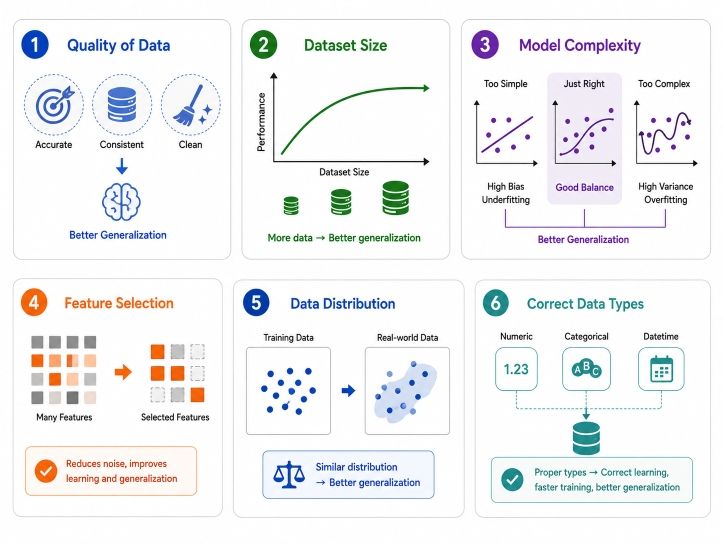
Several factors determine whether a model can generalize effectively. Even powerful algorithms can struggle if these factors are ignored.
Data quality is often more important than model complexity.
Poor-quality data can contain:
High-quality datasets help models learn genuine patterns rather than misleading information.
Larger datasets generally improve learning. However, a big size does not always mean performance. The quality and how relevant it is are also very important. These things are just as important as size.
Benefits include:
Models that are really complicated can see how things are connected in a way.
However, when a model is too complicated it can just remember the examples it was trained on of figuring out the basic rules that apply to the model.
Complexity Level |
Outcome |
| Too simple | Underfitting |
| Balanced | Good generalization |
| Too complex | Overfitting |
Features represent the input variables used by a model.
Effective feature selection:
Selecting meaningful features often improves generalization in machine learning more than changing algorithms.
Models perform best when the training data and future data come from similar distributions.
Problems arise when:
This phenomenon is often called data drifts.
AI Courses to upskill
Explore Artificial Intelligence Courses for Career Progression
Many beginners encounter the term generalized linear models in machine learning.
Generalized linear models (GLMs) extend traditional linear regression by allowing different probability distributions and link functions.
Examples include:
These models are widely used because they balance simplicity and interpretability.
Also Read: Types of Regression in Machine Learning You Should Know
Generalized linear models or GLMs are an extension of linear regression. They allow for probability distributions and link functions. GLMs are used a lot because they are simple and easy to understand.
They give a balance between being straightforward and being able to interpret the results; they are also helpful in data analysis.
Advantages include:
So generalized linear models usually work well. They can make predictions, especially when the datasets are not huge. Generalized linear models are useful in these situations because they can handle the data well.
Also Read: A Detailed Guide to Feature Selection in Machine Learning
The biggest challenge in machine learning generalization is finding the balance between learning and memorization. When this balance is not right, two common problems happen.
One problem is that the model learns a lot and does not generalize well. The other problem is that the model does not learn enough and makes many mistakes.
Overfitting happens when a model gets too good at learning the training data.
It does not really find the patterns that we want it to. Instead, the model memorizes the specific examples from the training data.
Characteristics include:
Imagine you have a computer program that can recognize faces. This program was only taught to recognize a few people. It was always the same lighting when it learned.
The program is really good at recognizing these people when it is trained. If the lighting is different, the program does not work very well. Facial recognition is what this program does. It has trouble with facial recognition when things are not exactly the same, as when it is learned.
When a model does not learn the important relationships from data that is called underfitting.
Characteristics include:
Factor |
Overfitting |
Underfitting |
| Training Accuracy | High | Low |
| Testing Accuracy | Low | Low |
| Model Complexity | High | Low |
| Generalization | Poor | Poor |
The best models sit between these extremes.
A balanced model:
This balance is the foundation of successful generalization in machine learning.
Also Read: What is Overfitting and Underfitting in Machine Learning?
A common search query is in general linear machine learning models are associated with relationships between input variables and outputs through weighted combinations of features.
These models are often valued because they are:
This explains why linear approaches are still important even though deep learning is popular.
Subscribe to upGrad's Newsletter
Join thousands of learners who receive useful tips
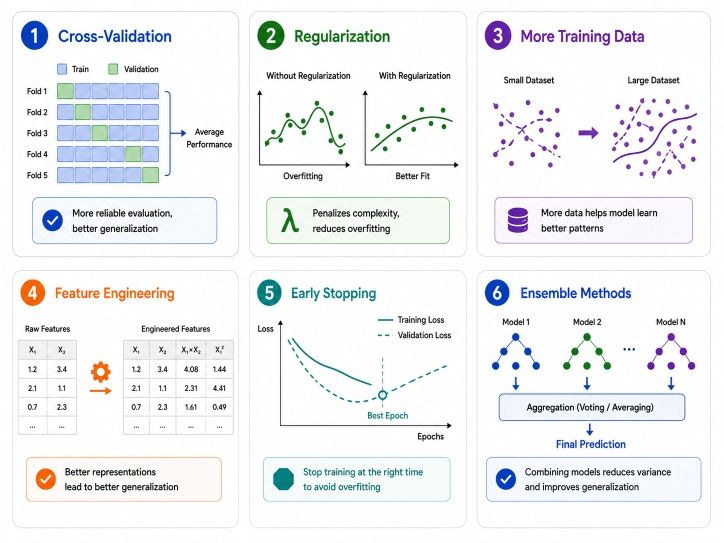
Improving generalization is a primary goal for machine learning practitioners. Several proven techniques help achieve this objective. Improving generalization is the primary goal for people who work with machine learning.
Here are some techniques that help; these methods are proven to work:
Cross-validation analyzes model performance across multiple subsets of data.
Benefits include:
Regularization adds penalties to model complexity.
Common methods include:
Technique |
Purpose |
| L1 Regularization | Feature selection |
| L2 Regularization | Weight reduction |
| Elastic Net | Combines L1 and L2 |
Regularization helps models avoid memorization.
Also Read: Regularization in Machine Learning: How to Avoid Overfitting?
Additional data often improves learning.
Benefits include:
Many organizations prioritize data collection before experimenting with more complex algorithms.
Feature engineering involves creating better input variables.
Examples:
Thoughtful feature engineering often delivers significant improvements in generalization in machine learning.
Many deep learning models train through multiple iterations.
Early stopping:
Ensemble techniques combine multiple models.
Popular approaches include:
These methods often generalize better because they reduce dependence on a single model.
Generalization in machine learning determines whether a model succeeds in the real world. A model that performs well only on training data offers little practical value. The true objective is to learn patterns that remain useful when new data arrives.
Whether working with advanced neural networks or generalized linear models in machine learning, the ultimate goal remains the same: create models that perform consistently beyond the data they were trained on.
Want to explore more about Generalization in machine learning? Book your free 1:1 personal consultation with our expert today.
Training accuracy only measures performance on known data. Real-world applications involve unseen data. A model with strong generalization can maintain reliable predictions after deployment, making it significantly more valuable than a model that only performs well during training.
Prediction refers to producing an output for a given input. Generalization refers to the model's ability to make accurate predictions on completely new data. Strong generalization ensures predictions remain reliable across different situations.
Perfect generalization is extremely rare because future data can vary in unexpected ways. The goal is not perfection but minimizing errors while maintaining stable performance across different datasets and environments.
Poor-quality data introduces noise and misleading patterns. Models trained on inaccurate or biased data often learn incorrect relationships. High-quality datasets improve learning and help models generalize more effectively.
Larger datasets often help, but quality matters just as much as quantity. A smaller, clean, representative dataset can sometimes outperform a larger dataset containing noise, duplicates, or irrelevant information.
Cross-validation evaluates models using multiple data splits. This process provides a more realistic estimate of performance and reduces the likelihood of selecting a model that only performs well on one specific dataset.
Yes. Generalized linear models in machine learning remain widely used because they are interpretable, computationally efficient, and often provide strong baseline performance for many business and analytical applications.
Industries such as healthcare, finance, retail, cybersecurity, and manufacturing rely on strong generalization. Models in these sectors must perform accurately on constantly changing real-world data.
Deep learning models contain many parameters and can learn highly detailed patterns. Without proper controls such as regularization, early stopping, or sufficient data, they may memorize training examples rather than learn general principles.
In general, linear machine learning models are associated with interpretability, faster training times, lower computational requirements, and easier debugging. These characteristics make them useful for both research and production environments.
Beginners can compare training and testing performance. A small difference between these metrics usually indicates better generalization. Cross-validation and independent test datasets also provide useful evaluation methods.
730 articles published
Sriram K is a Senior SEO Executive with a B.Tech in Information Technology from Dr. M.G.R. Educational and Research Institute, Chennai. With over a decade of experience in digital marketing, he specia...
Speak with AI & ML expert
By submitting, I accept the T&C and
Privacy Policy
Top Resources
Master's Degree
18 Months
Executive Diploma
12 Months
IIIT Bangalore
Executive Programme in Generative AI & Agentic AI for LeadersIndia’s #1 Tech University
Dual Certification
5 Months