XGBoost Machine Learning: How It Works, Why It Wins, and How to Use It
By Rahul Singh
Updated on Jun 26, 2026 | 11 min read | 4.71K+ views
Share:

All courses
Certifications
More
By Rahul Singh
Updated on Jun 26, 2026 | 11 min read | 4.71K+ views
Share:
Table of Contents
XGBoost stands for Extreme Gradient Boosting, an open-source machine learning library developed by Tianqi Chen in 2014. Built on the gradient boosting framework, it is designed to deliver fast, accurate, and scalable models for classification and regression tasks. Its ability to handle structured data efficiently has made it one of the most widely used machine learning algorithms in both industry and research.
This blog covers everything you need to know about XGBoost Machine Learning. You will learn how it works under the hood, what makes it different from other algorithms, how to implement it in Python, and when you should or should not use it.
Popular AI Programs
At its core, the XGBoost machine learning algorithm builds an ensemble of decision trees. Each new tree corrects the mistakes made by the previous ones. The final prediction is the combined output of all those trees.
Boosting is a technique where weak learners (simple models that are only slightly better than random guessing) are combined to create a strong learner.
Think of it this way. You have a team of five analysts. Each one is decent but not perfect. If you combine their insights, weighting the smarter ones more, your final answer is much better than any single analyst could produce. That is boosting.
XGBoost does this with decision trees. Each tree is a weak learner, but together they form a powerful model.
Feature |
Standard Gradient Boosting |
XGBoost |
| Speed | Slower | Much faster (parallel processing) |
| Regularization | None built-in | L1 and L2 built-in |
| Missing value handling | Manual preprocessing needed | Handles natively |
| Pruning | Post-pruning | Max depth pruning |
| Memory efficiency | Lower | Higher (cache-aware) |
XGBoost adds regularization to the gradient boosting framework, which reduces overfitting. It also uses a more efficient tree-building algorithm that takes advantage of hardware (CPU caching, parallel threads), making it significantly faster on large datasets.
Also Read: Understanding Gradient Boosting in Machine Learning: Techniques, Applications, and Optimization
Free Courses
Understanding the math behind XGBoost machine learning does not require a PhD. Here is a step-by-step breakdown that connects the theory to practice.
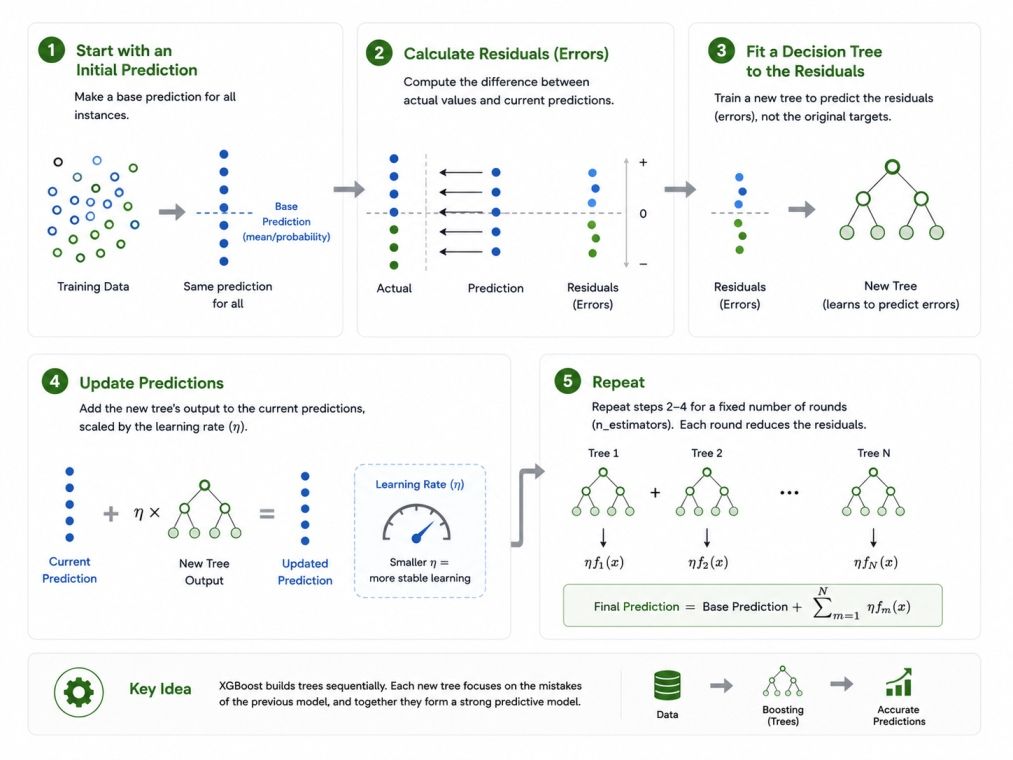
Step 1: Start with an Initial Prediction
XGBoost begins with a base prediction for all data points. For regression, this is often the mean of the target variable. For classification, it is a probability.
Step 2: Calculate Residuals (Errors)
The algorithm calculates how far off the predictions are from the actual values. These errors are called residuals or pseudo-residuals.
Step 3: Fit a Decision Tree to the Residuals
Instead of fitting the next tree to the original labels, XGBoost fits it to the residuals. The tree learns to predict the errors, not the target directly.
Step 4: Update Predictions
The new tree's output is added to the existing predictions, but scaled down by a learning rate (also called shrinkage). A smaller learning rate means slower but more stable learning.
Step 5: Repeat
Steps 2 through 4 repeat for a set number of rounds (controlled by n_estimators). Each round reduces the residuals a bit more.
Also Read: Classification Model Using Artificial Neural Networks (ANN) with Keras
What separates XGBoost in machine learning from other boosting methods is its objective function. It combines two parts:
This balance prevents overfitting, which is a common failure point in other boosting implementations.
When building each tree, XGBoost uses a gain score to decide where to split. It evaluates every possible split point and picks the one that reduces the loss the most. Splits that do not improve the model are pruned using the gamma parameter.
Also Read: What is Overfitting and Underfitting in Machine Learning?
AI Courses to upskill
Explore Artificial Intelligence Courses for Career Progression
Tuning XGBoost well is as important as using it in the first place. Here are the parameters you need to know.
Parameter |
What It Controls |
Default |
| n_estimators | Number of trees | 100 |
| learning_rate (eta) | Step size for each tree | 0.3 |
| max_depth | Maximum depth of each tree | 6 |
| subsample | Fraction of training data per tree | 1.0 |
| colsample_bytree | Fraction of features per tree | 1.0 |
| gamma | Minimum gain to allow a split | 0 |
| reg_alpha | L1 regularization | 0 |
| reg_lambda | L2 regularization | 1 |
Also Read: Bagging vs Boosting in Machine Learning: Difference Between Bagging and Boosting
Here is how to use the XGBoost machine learning algorithm in Python from start to finish.
pip install xgboost scikit-learnimport xgboost as xgb
from sklearn.datasets import load_breast_cancer
from sklearn.model_selection import train_test_split
from sklearn.metrics import accuracy_score
# Load data
data = load_breast_cancer()
X, y = data.data, data.target
# Train-test split
X_train, X_test, y_train, y_test = train_test_split(
X, y, test_size=0.2, random_state=42
)
# Initialize model
model = xgb.XGBClassifier(
n_estimators=200,
learning_rate=0.1,
max_depth=4,
subsample=0.8,
colsample_bytree=0.8,
use_label_encoder=False,
eval_metric='logloss'
)
# Train
model.fit(
X_train, y_train,
eval_set=[(X_test, y_test)],
early_stopping_rounds=20,
verbose=False
)
# Evaluate
predictions = model.predict(X_test)
print(f"Accuracy: {accuracy_score(y_test, predictions):.4f}")Want to build advanced machine learning models with algorithms like XGBoost? Explore these upGrad programs:
import xgboost as xgb
from sklearn.datasets import fetch_california_housing
from sklearn.model_selection import train_test_split
from sklearn.metrics import mean_squared_error
import numpy as np

# Load data
housing = fetch_california_housing()
X, y = housing.data, housing.target

# Train-test split
X_train, X_test, y_train, y_test = train_test_split(
   X, y, test_size=0.2, random_state=42
)

# Initialize model
model = xgb.XGBRegressor(
   n_estimators=500,
   learning_rate=0.05,
   max_depth=5,
   subsample=0.75,
   colsample_bytree=0.75,
   reg_lambda=1.5
)

# Train with early stopping
model.fit(
   X_train, y_train,
   eval_set=[(X_test, y_test)],
   early_stopping_rounds=30,
   verbose=False
)

# Evaluate
predictions = model.predict(X_test)
rmse = np.sqrt(mean_squared_error(y_test, predictions))
print(f"RMSE: {rmse:.4f}")One of the most useful things about XGBoost is that you can see which features matter most.
import matplotlib.pyplot as plt

xgb.plot_importance(model, max_num_features=10)
plt.tight_layout()
plt.show()
This gives you a bar chart of the top 10 most influential features, ranked by how often they appear in splits across all trees.
The XGBoost machine learning algorithm is powerful, but it is not the right tool for every job. Here is a clear breakdown.
Algorithm |
Best For |
Limitation vs. XGBoost |
| Random Forest | Baseline ensemble | Slower, less accurate on average |
| LightGBM | Very large datasets | XGBoost often more stable for small/medium data |
| CatBoost | Categorical features | XGBoost more widely supported |
| Neural Networks | Images, text, sequences | Much more data and compute required |
| Logistic Regression | Linear problems | Cannot capture complex non-linear patterns |
Subscribe to upGrad's Newsletter
Join thousands of learners who receive useful tips
The xgboost machine learning algorithm is not just popular in competitions. It is deployed across industries for real business problems.
In most of these use cases, XGBoost is chosen because it handles messy real-world data well, trains quickly, and produces accurate results without extensive preprocessing.
XGBoost machine learning is a staple of modern data science for good reason. It is fast, flexible, accurate, and handles real-world data challenges that other algorithms stumble on. Once you understand how gradient boosting works and how XGBoost builds on it, you have one of the strongest tools in your machine learning toolkit.
Start with the Python examples in this guide, experiment with the hyperparameters, and see how XGBoost performs on your own datasets. With practice, tuning it becomes second nature.
If you want to go deeper into machine learning algorithms, model evaluation, and building production-ready models, upGrad's programs in data science and AI offer structured learning paths designed to take you from fundamentals to job-ready in months.
Want to build expertise in machine learning and AI? Speak with an upGrad expert in a free 1:1 counselling session to find the right program for your career goals.
XGBoost (Extreme Gradient Boosting) is an open-source machine learning library that implements the gradient boosting algorithm. It builds an ensemble of decision trees sequentially, where each tree corrects the errors of the previous one, producing highly accurate predictions on structured data.
XGBoost improves on traditional gradient boosting by adding built-in regularization (L1 and L2), parallel tree construction, native missing value handling, and cache-aware computation. These changes make it significantly faster and less prone to overfitting compared to the standard gradient boosting implementation.
XGBoost is a supervised learning algorithm. It requires labeled training data, meaning each input row must have a known output value. It supports both regression (predicting numbers) and classification (predicting categories) tasks.
XGBoost works best with structured or tabular data, the kind you would find in spreadsheets or relational databases. It is not well suited for unstructured data like raw images, audio files, or natural language text.
The XGBoost machine learning algorithm has a built-in sparsity-aware split finding mechanism. During training, it learns the best direction (left or right branch) to send missing values based on what reduces the loss the most. You do not need to impute missing values before using it.
The learning rate (also called eta) controls how much each new tree contributes to the final prediction. A lower learning rate means the model learns more slowly but tends to generalize better. A higher learning rate speeds up training but risks overfitting. Values between 0.01 and 0.3 are most common.
Early stopping tells XGBoost to stop adding new trees when the model's performance on a validation set stops improving. This prevents overfitting and saves computation time. You set it using the early_stopping_rounds parameter, which stops training if no improvement is seen after that many consecutive rounds.
Yes. The XGBoost machine learning algorithm supports multiclass classification using the multi:softmax or multi:softprob objective. You set num_class to the number of target classes, and the model returns either the predicted class label or class probabilities for each sample.
Several strategies help prevent overfitting in the xgboost machine learning algorithm: reduce max_depth, increase reg_alpha or reg_lambda, lower subsample and colsample_bytree, reduce the learning_rate while increasing n_estimators with early stopping, and increase gamma to require a higher gain before allowing splits.
Both are strong ensemble methods, but XGBoost generally achieves higher accuracy on benchmark datasets because it learns from errors sequentially rather than independently. Random Forest is simpler to tune and less prone to overfitting with default settings, making it a good baseline. For most competitive tasks, XGBoost in machine learning tends to outperform Random Forest with proper tuning.
XGBoost provides three measures of feature importance: weight (how many times a feature is used in a split), gain (the average improvement in loss from splits using that feature), and cover (the average number of samples affected by splits on that feature). The gain metric is generally the most meaningful for understanding which features actually drive predictions.
98 articles published
Rahul Singh is an Associate Content Writer at upGrad, with a strong interest in Data Science, Machine Learning, and Artificial Intelligence. He combines technical development skills with data-driven s...
Speak with AI & ML expert
By submitting, I accept the T&C and
Privacy Policy
Top Resources
Master's Degree
18 Months
Executive Diploma
12 Months
IIIT Bangalore
Executive Programme in Generative AI & Agentic AI for LeadersIndia’s #1 Tech University
Dual Certification
5 Months