SVD in Machine Learning: How It Works and Why It Matters
By Rahul Singh
Updated on Jun 26, 2026 | 10 min read | 5.65K+ views
Share:

All courses
Certifications
More
By Rahul Singh
Updated on Jun 26, 2026 | 10 min read | 5.65K+ views
Share:
Table of Contents
Singular Value Decomposition, or SVD, sounds intimidating at first. But once you see what it actually does, it becomes one of the most satisfying tools in machine learning. At its core, SVD in machine learning is a way to break down a complex matrix into simpler parts, without losing the important information inside it. Think of it like compressing a heavy image file into a smaller one that still looks almost identical.
This blog covers everything you need to know about SVD in machine learning, from the basic math to real-world applications. Whether you are just starting out or looking to sharpen your understanding, you will walk away knowing what SVD is, how it works step by step, where it gets used, and how to implement it in Python.
Popular AI Programs
SVD stands for Singular Value Decomposition. It is a matrix factorization technique that decomposes any matrix into three separate matrices. Understanding what is SVD in machine learning starts with understanding matrices, which are just grids of numbers used to represent data.
Given a matrix A, SVD breaks it down like this:
A = U x S x V^T
Each of these three components plays a distinct role:
Component |
Shape |
What It Represents |
| U | m x m | Left singular vectors (patterns in rows) |
| S | m x n | Diagonal matrix of singular values |
| V^T | n x n | Right singular vectors (patterns in columns) |
U (Left Singular Vectors)
U is an orthogonal matrix. Its columns represent the directions of maximum variance in the row space of the original matrix. In practical terms, if your matrix contains user-movie ratings, U captures patterns about users.
S (Singular Values)
S is a diagonal matrix. The values along its diagonal are called singular values, and they are always non-negative, arranged from largest to smallest. These values tell you how much information each component holds. Larger singular values = more important patterns.
V^T (Right Singular Vectors)
V^T is also orthogonal. Its rows represent patterns in the column space of A. In the user-movie example, V^T would capture patterns about movies.
Also Read: Identity Matrix in Linear Algebra: Definition, Properties, and Examples
Imagine you have a spreadsheet with thousands of rows and columns representing customer purchase data. Most of that data has hidden patterns, maybe customers who buy running shoes also tend to buy protein bars. SVD finds those hidden patterns and ranks them by importance. You can then keep only the top patterns and discard the rest. That is the core idea.
In practice, you rarely use all components. Instead, you use Truncated SVD, where you keep only the top k singular values and their corresponding vectors.
Type |
Keeps |
Use Case |
| Full SVD | All components | Exact reconstruction |
| Truncated SVD | Top k components | Dimensionality reduction, efficiency |
Truncated SVD is what most machine learning applications actually use because it is faster and still preserves the most meaningful structure in the data.
Free Courses
Knowing the formula is one thing. Seeing how it plays out step by step is much more useful.
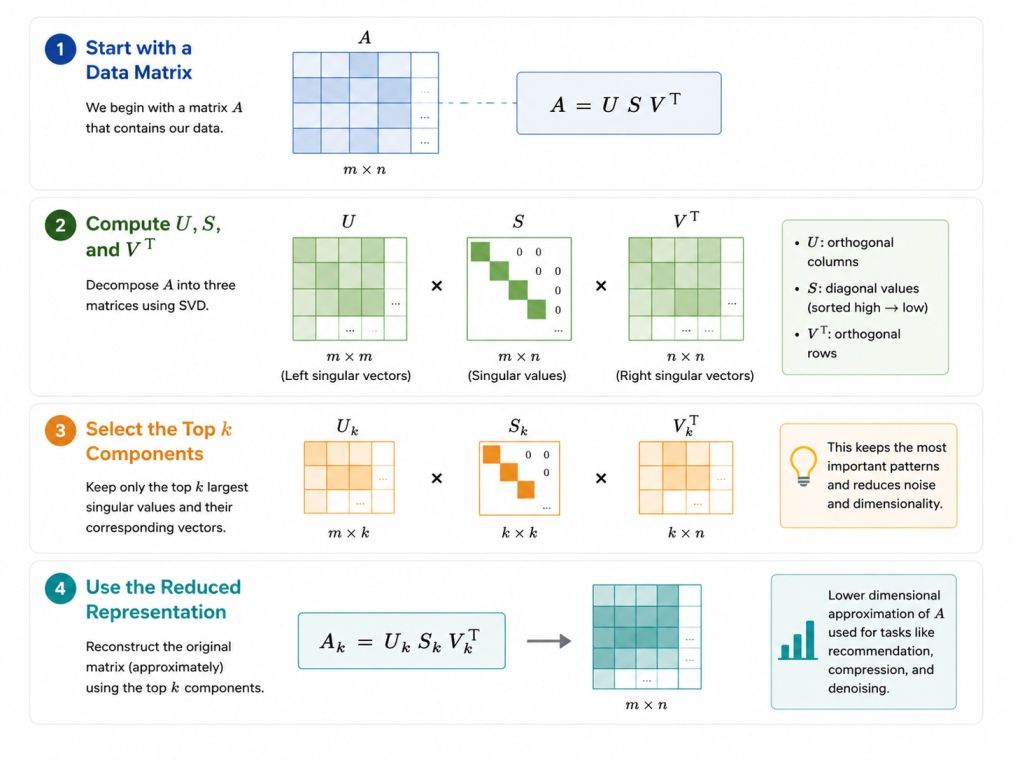
Suppose you have a matrix A where rows represent documents and columns represent words. Each cell contains how often a word appears in a document. This is a classic setup in natural language processing.
You feed matrix A into an SVD algorithm. The algorithm returns three matrices: U, S, and V^T. Most programming libraries handle the heavy computation for you.
Look at the singular values in S. They drop off quickly. The first few values capture most of the meaningful structure. You pick a value of k, say 50 or 100, and keep only the top k columns of U, top k values of S, and top k rows of V^T.
Your data is now compressed. Each document can now be represented as a point in k-dimensional space instead of thousands of dimensions. This smaller representation is faster to work with and often leads to better model performance because it removes noise.
Here is a basic implementation using NumPy and scikit-learn:
import numpy as np
from sklearn.decomposition import TruncatedSVD

# Sample data matrix (e.g., document-term matrix)
A = np.array([
   [1, 0, 0, 1, 0],
   [0, 1, 1, 0, 1],
   [1, 0, 1, 1, 0],
   [0, 1, 0, 0, 1]
])

# Apply Truncated SVD with k=2 components
svd = TruncatedSVD(n_components=2)
A_reduced = svd.fit_transform(A)

print("Original shape:", A.shape)
print("Reduced shape:", A_reduced.shape)
print("Explained variance ratio:", svd.explained_variance_ratio_)
Output:
Original shape: (4, 5)
Reduced shape: (4, 2)
Explained variance ratio: [0.58 0.27]
The two components explain roughly 85% of the variance in the original data. You went from 5 features to just 2 while keeping most of the information.
Want to learn techniques like SVD and build real-world machine learning solutions? Explore these upGrad programs:
You can calculate this using the explained variance ratio:
k Components |
Variance Retained |
| 1 | ~58% |
| 2 | ~85% |
| 3 | ~95% |
| All | 100% |
Choosing k depends on your task. For recommendation systems, k between 20 and 200 is common. For visualization, k = 2 or 3 is ideal.
Also Read: A Guide to Linear Regression Using Scikit [With Examples]
AI Courses to upskill
Explore Artificial Intelligence Courses for Career Progression
The applications of SVD in machine learning span nearly every major domain. This is not a niche tool. It is foundational.
High-dimensional data is slow and noisy. SVD in machine learning reduces the number of features while preserving the most important structure. This is often the first step before training any model.
Latent Semantic Analysis (LSA) in NLP uses SVD to reduce a document-term matrix. Instead of working with 50,000 word features, you compress to 200 latent topics that capture meaning better than raw word counts.
Task |
Without SVD |
With SVD |
| Text classification | 50,000 word features | 200 latent topics |
| Image recognition | 1,000 pixel features | 50 components |
| User behavior data | 10,000 columns | 100 components |
One of the most well-known applications of SVD in machine learning is collaborative filtering for recommendations. Netflix, Spotify, and Amazon all use matrix factorization approaches rooted in SVD.
Here the user-item interaction matrix (users as rows, items as columns) is decomposed. The latent factors capture hidden preferences. If user A and user B have similar U vectors, they have similar tastes. Items with similar V^T rows are similar in nature.
This approach powered the winning solution in the Netflix Prize competition in 2009.
Also Read: What Are the Three Types of Semantic Analysis?
An image is just a matrix of pixel values. SVD can compress that matrix by keeping only the top k singular values. The reconstructed image looks almost identical to the original but requires far less storage.
from PIL import Image
import numpy as np

# Load grayscale image
img = np.array(Image.open("photo.jpg").convert("L"), dtype=float)

# Perform SVD
U, S, Vt = np.linalg.svd(img, full_matrices=False)

# Reconstruct with top 50 singular values
k = 50
img_compressed = U[:, :k] @ np.diag(S[:k]) @ Vt[:k, :]

print(f"Original pixels: {img.size}")
print(f"Compressed storage: {U[:,:k].size + k + Vt[:k,:].size}")
At k = 50, most images look nearly identical to the original while using significantly less data.
Real-world data is messy. Sensor readings, financial data, and medical scans all contain noise alongside signal. SVD separates the signal (captured in the top singular values) from the noise (captured in the small singular values). Dropping the small ones gives you a cleaner version of your data.
PCA is one of the most commonly used dimensionality reduction techniques. Under the hood, PCA is essentially SVD applied to a centered data matrix. When you call sklearn.decomposition.PCA, it is running SVD internally.
Technique |
SVD Relationship |
| PCA | SVD on mean-centered data |
| LSA | SVD on TF-IDF matrix |
| Collaborative Filtering | SVD on user-item matrix |
It helps to know how SVD compares to alternatives so you can pick the right tool.
Method |
Best For |
Key Difference |
| SVD | General decomposition, NLP, images | Works on any matrix |
| PCA | Variance-based reduction | Requires centered data |
| NMF | Parts-based representation | Non-negative values only |
| LDA | Topic modeling | Probabilistic, text-focused |
| QR Decomposition | Numerical stability | Not used for compression |
SVD is the most general and widely applicable. NMF is better when you need interpretable parts (like topics where words must have positive contributions). LDA is better for probabilistic topic modeling.
Also Read: Bias Variance Tradeoff in Machine Learning
Choose SVD when:
Avoid SVD when your matrix is extremely sparse and very large. In those cases, alternatives like Alternating Least Squares (ALS) or stochastic gradient descent on matrix factors are more computationally efficient.
Also Read: ANOVA (Analysis Of Variance)
One underrated benefit of SVD is interpretability. You can inspect U and V^T to understand what each component captures. In an NLP pipeline using LSA, the first few right singular vectors often correspond to major topics in your corpus.
Subscribe to upGrad's Newsletter
Join thousands of learners who receive useful tips
SVD in machine learning is not just a mathematical curiosity. It is a working tool that sits at the heart of recommendation systems, text processing, image compression, noise reduction, and dimensionality reduction. What makes it powerful is its generality. It works on any matrix, makes no assumptions about your data distribution, and is mathematically exact.
upGrad offers structured programs in machine learning and data science that cover topics like SVD in depth, with hands-on projects and mentorship. If you want to go from understanding the concepts to applying them in real jobs, explore the programs designed for working professionals and fresh graduates alike.
Want to build expertise in machine learning and AI? Speak with an upGrad expert in a free 1:1 counselling session to find the right program for your career goals.
SVD in machine learning is a technique that breaks a matrix into three smaller matrices. These three matrices together capture the most important patterns in your data. It is widely used for compression, noise reduction, and building recommendation systems.
SVD stands for Singular Value Decomposition. It refers to the mathematical process of decomposing a matrix A into three components: U, S, and V-transpose, where S contains the singular values ranked by importance.
PCA and SVD are closely related. PCA is essentially SVD applied to a mean-centered data matrix. In fact, most PCA implementations use SVD under the hood. SVD is more general and can be applied to any matrix, while PCA is focused specifically on finding directions of maximum variance.
The main applications of SVD in machine learning include dimensionality reduction, collaborative filtering for recommendation systems, image compression, noise reduction, Latent Semantic Analysis in NLP, and computing the pseudo-inverse of a matrix for solving linear systems.
Truncated SVD keeps only the top k singular values and their corresponding vectors instead of computing the full decomposition. You should use it whenever you want to reduce dimensionality efficiently, especially on large datasets where full SVD would be too slow or memory-intensive.
Plot the singular values in order and look for an elbow where the values drop sharply. You can also use the explained variance ratio from scikit-learn. A common rule of thumb is to retain enough components to explain 90 to 95 percent of the total variance, but the right choice depends on your downstream task.
Yes. For large sparse matrices, use scipy.sparse.linalg.svds or sklearn.decomposition.TruncatedSVD. These implementations are specifically designed to handle sparse data efficiently without converting it to dense format first, which saves memory and computation time.
Singular values in SVD represent the importance of each component. Larger singular values correspond to components that capture more variance or information in the data. By keeping only the largest singular values and discarding the smaller ones, you retain the most meaningful structure while removing noise.
In recommendation systems, SVD decomposes a user-item rating matrix into latent factors. The U matrix captures user preferences and the V-transpose matrix captures item characteristics. Multiplying these reconstructed factors gives predicted ratings for user-item pairs that were not originally observed.
Full SVD on a large dense matrix can be expensive. However, Truncated SVD is much more practical. For very large sparse matrices, randomized SVD algorithms (used in scikit-learn's TruncatedSVD) scale well and run efficiently even on matrices with millions of rows or columns.
Latent Semantic Analysis, or LSA, is a technique in NLP that uses SVD to find hidden relationships between words and documents. You build a term-document matrix, apply SVD, and keep the top k components. The result maps words and documents into a shared semantic space where similar meanings are close together, even if they use different words.
98 articles published
Rahul Singh is an Associate Content Writer at upGrad, with a strong interest in Data Science, Machine Learning, and Artificial Intelligence. He combines technical development skills with data-driven s...
Speak with AI & ML expert
By submitting, I accept the T&C and
Privacy Policy
Top Resources
Master's Degree
18 Months
Executive Diploma
12 Months
IIIT Bangalore
Executive Programme in Generative AI & Agentic AI for LeadersIndia’s #1 Tech University
Dual Certification
5 Months