Labeled Data in Machine Learning: What It Is and Why It Matters
By Rahul Singh
Updated on Jun 26, 2026 | 11 min read | 4.71K+ views
Share:

All courses
Certifications
More
By Rahul Singh
Updated on Jun 26, 2026 | 11 min read | 4.71K+ views
Share:
Table of Contents
Labeled data in machine learning is data that has been tagged with the correct output or category, giving each data point a known meaning. These labels act as the ground truth, helping machine learning models learn patterns, classify new data, and make accurate predictions based on previously labeled examples.
It is the foundation of supervised learning and is widely used in applications such as image recognition, spam detection, fraud detection, sentiment analysis, and medical diagnosis.
In this blog, you will learn what labeled data in machine learning actually means, how it differs from unlabeled data, how the labeling process works, and which types of ML tasks depend on it.
Popular AI Programs
Think of it this way. You show a child 100 photos and tell them which ones have cats and which ones do not. Over time, the child learns to spot a cat on their own. Machine learning works the same way. You feed a model thousands of labeled examples, and it learns the pattern.
Say you are building a spam filter. You collect 10,000 emails and manually mark each one as "spam" or "not spam." Those marks are the labels. The ML model trains on this labeled dataset and learns what makes an email spam.
Data Point |
Label |
| "You won a prize! Click here now." | Spam |
| "Your meeting is at 3 PM tomorrow." | Not Spam |
| "Earn $5,000 a week from home!" | Spam |
| "Please review the attached report." | Not Spam |
Without labels, a model has no reference point. It cannot learn what is right or wrong. Labeled data provides that ground truth. It tells the algorithm: this input maps to this output.
This is what makes labeled data in machine learning the foundation of supervised learning, the most common and widely used form of machine learning today.
Key things labeled data includes:
Also Read: 6 Types of Supervised Learning You Must Know About in 2026
Free Courses
Both types of data play a role in ML, but they serve different purposes. Understanding labeled and unlabeled data in machine learning helps you choose the right approach for your use case.
Unlabeled data is raw data with no tags or annotations. It has no associated output values. Examples include:
Unlabeled data is easy to collect and exists in massive quantities. The challenge is that it cannot directly train a supervised model.
Also Read: Machine Learning Methods: A Complete Beginner's Guide
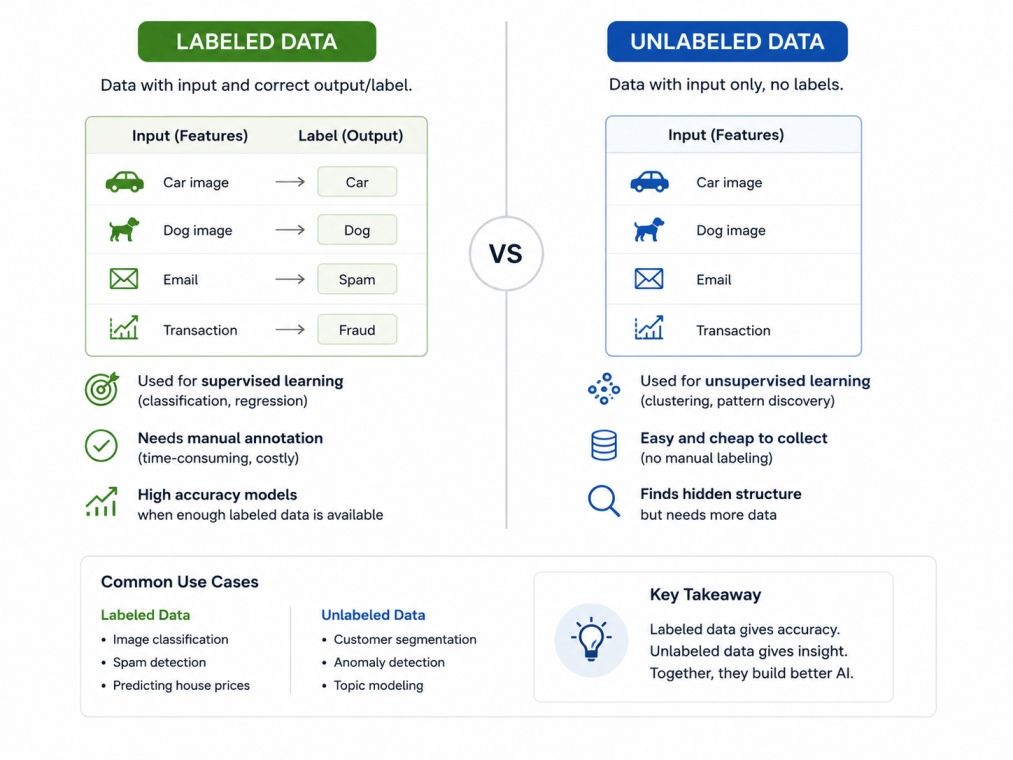
There is also a middle ground called semi-supervised learning, where you combine a small amount of labeled data with a large pool of unlabeled data. This approach cuts annotation costs while still producing strong results.
AI Courses to upskill
Explore Artificial Intelligence Courses for Career Progression
Data labelling in machine learning is the process of manually or automatically adding tags to raw data. It is one of the most time-consuming and critical steps in building any supervised ML model.
1. Define the labeling schema Before anyone annotates a single data point, the team defines what the labels mean. For example, if you are building a sentiment classifier, you might decide on three labels: Positive, Negative, and Neutral.
2. Choose the annotation method You can label data through:
Also Read: Exploring the 6 Different Types of Sentiment Analysis and Their Applications
3. Annotate the data Human annotators go through each data point and assign the correct label. This step requires clear guidelines to keep labels consistent.
4. Review and validate A quality control step checks for errors, inconsistencies, and conflicting labels. This is where inter-annotator agreement scores come in handy.
5. Store and version the dataset Once labeled, the dataset is stored with version control so that teams can track changes and reproduce experiments.
Task Type |
Example |
| Image classification | Tag each image as cat, dog, or bird |
| Object detection | Draw bounding boxes around faces in a photo |
| Text classification | Label each sentence as positive, negative, or neutral |
| Named entity recognition | Tag names, places, and dates in text |
| Audio labeling | Mark start and end times of speech segments |
Want to build AI models with real-world datasets and master concepts like supervised learning and data labeling? Explore these upGrad programs:
Labeled data in machine learning is not just for one type of algorithm. It powers several distinct learning paradigms.
This is the most direct use case. The model trains on labeled examples and learns to map inputs to outputs.
Common algorithms:
Real-world applications:
Here, a model pre-trained on a large labeled dataset is fine-tuned on a smaller labeled dataset for a specific task. This dramatically reduces the amount of labeled data you need.
For example, a language model trained on billions of text examples can be fine-tuned with just a few thousand labeled customer support tickets.
Modern large language models like ChatGPT use human feedback as a form of labeled data. Human raters compare model outputs and label which response is better. This feedback trains a reward model that guides the main model's behavior.
Learning Type |
Labeled Data Needed |
Unlabeled Data Used |
| Supervised learning | High volume | No |
| Semi-supervised learning | Low volume | Yes |
| Unsupervised learning | None | Yes |
| Transfer learning | Small amount | No (uses pre-trained model) |
| Reinforcement learning | Depends on task | Depends |
Even a perfect model cannot perform well on noisy or inconsistent labeled data. The quality of your labels directly determines the quality of your model.
All annotators must follow the same guidelines. If three people label the same image differently, the model receives conflicting signals and learns the wrong pattern.
Run calibration sessions before annotation starts. Show annotators example edge cases and discuss how to handle them.
Active learning is a technique where the model itself identifies which data points it is most uncertain about and sends only those for human labeling. This means you label fewer examples but get more value from each one.
How it works:
Also Read: Reinforcement Learning vs Supervised Learning
Use inter-annotator agreement (IAA) scores to measure how consistently different annotators label the same data. High disagreement signals that the labeling guidelines need clarification.
Common IAA metrics include:
If all your labeled examples come from one demographic or source, your model will inherit those biases. Make sure your labeled dataset reflects the diversity of the real-world data your model will encounter.
Subscribe to upGrad's Newsletter
Join thousands of learners who receive useful tips
You have seen what labeled data in machine learning means, how it differs from unlabeled data, what the data labelling process looks like end to end, and which types of ML rely on it. The takeaway is clear: invest in your labeled data, and your models will reflect that investment.
If you want to go deeper into machine learning concepts and build real-world skills, explore upGrad's programs in data science and AI. These programs take you from core concepts like labeled and unlabeled data in machine learning all the way to deploying production-grade models.
Planning to build a career in machine learning or AI? Connect with an upGrad expert for a free 1:1 counselling session and explore the best learning path for you.
Labeled data in machine learning is a collection of examples where each piece of data has been tagged with a correct answer or category. For instance, an image of a cat tagged as "cat" is labeled data. The model learns from these tags to make predictions on new, unseen data.
Labeled data includes both input features and output tags, making it suitable for supervised learning. Unlabeled data has no tags and is used in unsupervised or semi-supervised learning. Labeled data requires human effort to create, while unlabeled data is easier to collect in large quantities.
Data labelling gives a model its training signal. Without labels, the model has no ground truth to learn from. The quality and consistency of labels directly impact how well a model performs on real-world tasks like image classification or text analysis.
Examples include emails tagged as spam or not spam, medical images annotated with a diagnosis, audio files with transcribed text, photos with bounding boxes around detected objects, and customer reviews marked as positive, negative, or neutral.
Labeled data in machine learning is created through manual annotation by human experts, crowdsourcing platforms, or automated labeling tools. The process involves defining a labeling schema, annotating data, reviewing for quality, and storing the final dataset with proper version control.
Poor-quality labels lead to noisy training data, which causes the model to learn wrong patterns. This results in lower accuracy and unpredictable behavior in production. Regular quality checks and inter-annotator agreement scoring help catch and fix label errors early.
Yes, but with different techniques. Unsupervised learning algorithms like clustering and dimensionality reduction work entirely on unlabeled data. Semi-supervised learning uses a mix of both. However, for tasks that require specific predictions, labeled data remains essential.
Active learning is a technique that reduces the labeling cost by letting the model identify which unlabeled examples would be most useful to label. Instead of labeling everything, human annotators focus on the data points that are most informative, making the labeling process more efficient.
There is no fixed number. It depends on the complexity of the task, the algorithm used, and the quality of the labels. Simple classifiers may need a few thousand examples, while deep learning models for computer vision or NLP can require millions of labeled data points.
Popular data labeling tools include Label Studio, Scale AI, Labelbox, Amazon SageMaker Ground Truth, and Snorkel. These platforms support different annotation types including image bounding boxes, text classification, audio segmentation, and more.
Semi-supervised learning trains a model using a small labeled dataset alongside a much larger unlabeled dataset. The model uses the labeled examples to learn initial patterns, then uses those patterns to make sense of the unlabeled data. This approach significantly reduces labeling costs while still achieving strong model performance.
98 articles published
Rahul Singh is an Associate Content Writer at upGrad, with a strong interest in Data Science, Machine Learning, and Artificial Intelligence. He combines technical development skills with data-driven s...
Speak with AI & ML expert
By submitting, I accept the T&C and
Privacy Policy
Top Resources
Master's Degree
18 Months
Executive Diploma
12 Months
IIIT Bangalore
Executive Programme in Generative AI & Agentic AI for LeadersIndia’s #1 Tech University
Dual Certification
5 Months