Feature Scaling in Machine Learning: What It Is and Why It Actually Matters
By upGrad
Updated on Oct 23, 2026 | 6 min read | 1.66K+ views
Share:

All courses
Certifications
More
By upGrad
Updated on Oct 23, 2026 | 6 min read | 1.66K+ views
Share:
Table of Contents
Feature scaling in machine learning is the process of transforming numerical features so they share a similar range or distribution. It doesn't change the relationship between data points. Instead, it changes how values are represented, making learning more balanced for many algorithms.
Most machine learning models don't care about your data's meaning. They care about numbers. And when those numbers live on wildly different scales, like age in single digits and salary in lakhs, your model can quietly break without you realizing it. That's where feature scaling in machine learning comes in.
This blog covers what feature scaling is, the techniques you'll use most often, when to apply each one, and the mistakes that trip up beginners.
Want to master concepts like feature scaling and model optimization? Enrol in our online machine learning courses to build practical skills, understand key algorithms, and advance your career in AI.
Popular AI Programs
Feature scaling is the process of bringing all numerical features in your dataset to a comparable range or distribution. It doesn't change what the data means. It changes how the numbers are sized relative to each other.
Here's the core problem. Say you're training a model to predict house prices. One feature is the number of bedrooms (values like 2, 3, 4). Another is the property area in square feet (values like 800, 2500, 5000). The model's math doesn't know that one unit of "area" isn't the same as one unit of "bedrooms." It just sees larger numbers and assigns them more weight.
Feature scaling in machine learning is especially critical for:
Tree-based models like Decision Trees and Random Forests don't need scaling. They split on thresholds, not distances. But for most other algorithms, skipping this step leads to slower training, poor convergence, or skewed predictions.
Learn to apply machine learning concepts like feature scaling and model optimization with the Master of Science in Machine Learning & AI from LJMU. Build advanced AI skills and prepare for emerging career opportunities. Enrol today!
Free Courses
There's no single right method. The technique you pick depends on your data's distribution and the algorithm you're using.
This rescales values to a fixed range, usually 0 to 1. The formula is straightforward:
X_scaled = (X - X_min) / (X_max - X_min)
Every value gets squeezed between 0 and 1. It's fast, simple, and works well when you know the data won't have extreme outliers.
The problem? One outlier can distort the entire scale. If your dataset has a salary value of Rs 1 crore among otherwise Rs 5-15 lakh values, that outlier becomes 1.0 and everything else gets compressed near zero.
Use min-max normalization when:
This technique transforms data to have a mean of 0 and a standard deviation of 1.
X_scaled = (X - mean) / standard deviation
It doesn't bound the output to a specific range. Values can go negative. They can exceed 1. That's fine. What matters is that the distribution is centered and scaled consistently.
Standardization handles outliers better than min-max normalization. It doesn't eliminate them, but it doesn't let them hijack the scale either.
Technique |
Output Range |
Handles Outliers |
Best For |
| Min-Max Normalization | 0 to 1 | No | Neural networks, image data |
| Standardization (Z-Score) | No fixed range | Better | Most ML algorithms |
| Robust Scaling | No fixed range | Yes | Data with heavy outliers |
| MaxAbs Scaling | -1 to 1 | No | Sparse data |
If your dataset has significant outliers you can't remove, robust scaling is the practical choice. It uses the median and the interquartile range (IQR) instead of mean and standard deviation.
X_scaled = (X - median) / IQR
The median and IQR aren't affected much by extreme values. So the scale doesn't warp around a few bad data points.
Also read: Feature Engineering for Machine Learning: Methods & Techniques
AI Courses to upskill
Explore Artificial Intelligence Courses for Career Progression
Say you're building a model to predict customer churn. Your dataset has three features:
Without scaling, a model using gradient descent would update the weight for "monthly spend" far more aggressively than for "tickets," just because the numbers are bigger. The gradient for spend will be steeper, and your model won't converge cleanly.
After applying standardization:
Feature |
Original Range |
After Standardization |
| Age | 22-65 | Approx. -2 to +2 |
| Monthly spend | 500-80,000 | Approx. -1.5 to +2.5 |
| Support tickets | 0-12 | Approx. -1.2 to +2.2 |
Now the model treats all three features on equal footing. Training becomes faster. The weights update in proportion to actual signal, not arbitrary number size.
This is the most direct answer to how to do feature scaling in machine learning: identify your features, choose a method suited to your data and algorithm, apply it before training, and fit the scaler only on training data (never on test data).
Advance your career with upGrad's Executive Diploma in Data Science & AI from IIIT Bangalore. Build expertise in Python, SQL, machine learning, data visualization, and AI through hands-on projects and real-world case studies.
Feature scaling improves many machine learning models, but it isn't something you should apply by default. In some cases, it adds extra data preprocessing without improving performance. In others, applying it incorrectly can lead to misleading evaluation results.
The key is understanding when feature scaling helps and when it doesn't.
When Should You Skip Feature Scaling?
Scenario |
Should You Apply Feature Scaling? |
Why? |
| K-Nearest Neighbors (KNN) | Yes | KNN calculates distances between data points. Scaling prevents features with larger values from dominating the distance calculation. |
| Support Vector Machine (SVM) | Yes | SVM relies on feature distances. Scaling helps the model converge faster and improves performance. |
| Logistic Regression | Yes | Since it uses gradient-based optimization, similar feature scales lead to faster and more stable training. |
| Neural Networks | Yes | Scaling stabilizes gradient updates and speeds up model training. |
| Decision Tree | No | Decision Trees split data using feature thresholds, not distances. Scaling doesn't affect how the tree creates splits. |
| Random Forest | No | As an ensemble of Decision Trees, Random Forest doesn't benefit from feature scaling. |
| XGBoost | No | XGBoost also builds decision trees, so scaling only adds unnecessary preprocessing. |
| Features where the original scale has business value | Usually No | Sometimes the magnitude itself carries useful information. Scaling may reduce that context, so evaluate the data before applying it. |
If you scale the entire dataset before splitting it into training and test sets, the scaler learns information from the test data. Although the model never directly trains on those records, it has already "seen" their statistical distribution.
That creates data leakage. The result is overly optimistic evaluation metrics that don't reflect how the model will perform on new, unseen data.
The correct workflow is simple.
from sklearn.preprocessing import StandardScaler

scaler = StandardScaler()

# Learn scaling parameters from training data
X_train_scaled = scaler.fit_transform(X_train)

# Apply the same transformation to test data
X_test_scaled = scaler.transform(X_test)
You don't call fit_transform() on the test data. Doing so creates a different scaling rule for the test set and introduces data leakage. Always reuse the scaler fitted on the training data to keep model evaluation fair and reliable.
Do read: A Detailed Guide to Feature Selection in Machine Learning
Even experienced practitioners get these wrong. Here are the ones that matter most.
Mistake |
Why It Matters |
Best Practice |
| Scaling before train-test split | Causes data leakage and inflated model performance. | Split first, then fit the scaler on the training data only. |
| Using the wrong scaling method | Can slow training or reduce model accuracy. | Choose the method based on the algorithm and data distribution. |
| Not scaling new data | Predictions become inconsistent with training data. | Apply the same fitted scaler to all new inputs. |
| Scaling categorical features | Creates meaningless numerical relationships. | Scale only continuous numerical features. |
| Using one method for every feature | Different features may need different preprocessing. | Check feature distributions before selecting a scaling technique. |
A quick look at the feature distribution can help you choose the right scaling method.
import matplotlib.pyplot as plt

df["monthly_spend"].hist()
plt.show()
It takes less than a minute to plot a histogram, but that simple step can help you decide whether Standardization, Min-Max Scaling, or Robust Scaling is the better choice for your data.
Must read: How to Implement Machine Learning Steps: A Complete Guide
Not sure which technique fits your situation? Use this.
Situation |
Recommended Method |
| Clean data, no major outliers | Min-Max Normalization |
| General-purpose ML (most cases) | Standardization (Z-Score) |
| Data with outliers you can't remove | Robust Scaling |
| Sparse data or NLP features | MaxAbs Scaling |
| Tree-based models (RF, XGBoost) | No scaling needed |
| Neural networks with sigmoid/tanh | Min-Max Normalization |
| SVM or KNN | Standardization |
When you're unsure, standardization is the safe default. It works for most algorithms, handles moderate outliers reasonably well, and doesn't make assumptions about a bounded output range.
Here's the step-by-step process that actually holds up in production.
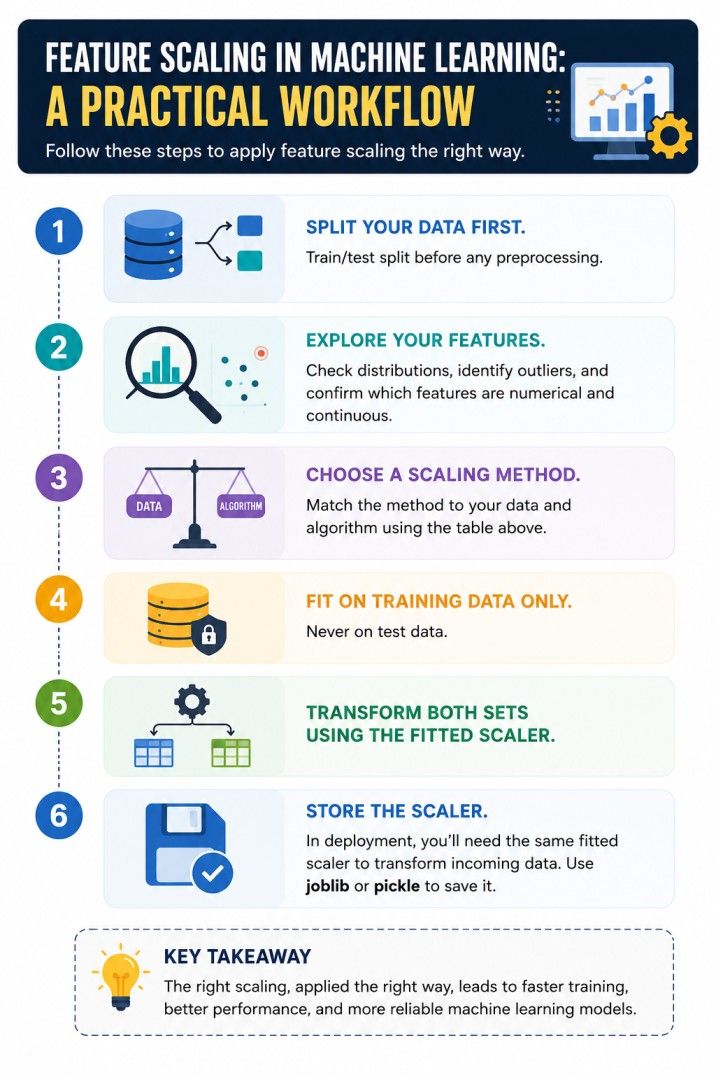
Feature scaling in machine learning helps algorithms learn from data more effectively by bringing numerical features onto a comparable scale. It improves training efficiency, reduces bias toward larger values, and often increases model accuracy for distance-based and gradient-based algorithms.
The right scaling technique depends on your dataset and the model you're building. Understanding when to use Min-Max Scaling, Standardization, or Robust Scaling allows you to build cleaner machine learning pipelines and avoid common preprocessing mistakes. As you work on larger datasets and advanced AI applications, mastering feature scaling becomes a valuable skill that strengthens every stage of model development.
Ready to start your journey? Book a free consultation with upGrad today to find the best path for your career.
A quick way to check is by comparing the ranges of your numerical features. If one feature varies between 1 and 10 while another ranges from thousands to lakhs, feature scaling in machine learning is usually recommended. Models that rely on distances or gradient optimization typically benefit the most.
Yes. Feature scaling helps many optimization-based algorithms converge faster because all features contribute on a similar scale. Instead of taking large or uneven optimization steps, the model learns more efficiently, which often reduces training time without changing the underlying data.
Feature scaling is a broader preprocessing concept that includes techniques such as normalization, standardization, and robust scaling. Normalization is just one type of feature scaling that rescales values to a fixed range, usually between 0 and 1, making it suitable for specific machine learning algorithms.
It's best to complete feature engineering first. Any newly created numerical features should also be scaled if required. Applying feature scaling after feature engineering keeps all relevant numerical variables on a comparable scale before model training begins.
Feature scaling doesn't change the actual relationship between features and the target variable. However, it can influence how certain algorithms learn feature weights. Tree-based models usually report similar feature importance with or without scaling, while linear models may show different coefficient magnitudes.
Yes. Many unsupervised learning techniques depend on distance calculations. Algorithms like K-Means Clustering, Hierarchical Clustering, and Principal Component Analysis often produce more meaningful groupings and components after feature scaling because no single variable dominates the calculations.
The choice depends on your data. Min-Max Scaling works well for datasets without significant outliers and is commonly used for neural networks. Robust Scaling is a better option when extreme values are present because it uses the median and interquartile range instead of the mean.
Suppose you're predicting customer churn using age, monthly income, and account balance. Income values may be thousands of times larger than age. After scaling these features to a comparable range, the model evaluates each variable more fairly instead of being influenced by the largest numbers.
The same scaler used during training should also be used after deployment. Save the fitted scaler along with your trained model and apply it to every new data point before making predictions. This keeps the model's input consistent throughout its lifecycle.
Yes. Extremely large or very small feature values can create unstable calculations during optimization. Feature scaling reduces this issue by keeping numerical values within a manageable range, leading to smoother training and more reliable model convergence, especially for deep learning models.
Most AutoML platforms automatically include preprocessing steps, but understanding feature scaling remains valuable. Knowing when and why scaling is applied helps you troubleshoot models, improve performance, and build reliable machine learning pipelines instead of relying entirely on automated workflows.
1277 articles published
We are an online education platform providing industry-relevant programs for professionals, designed and delivered in collaboration with world-class faculty and businesses. Merging the latest technolo...
Speak with AI & ML expert
By submitting, I accept the T&C and
Privacy Policy
Top Resources
Master's Degree
18 Months
Executive Diploma
12 Months
IIIT Bangalore
Executive Programme in Generative AI & Agentic AI for LeadersIndia’s #1 Tech University
Dual Certification
5 Months