Standardization in Machine Learning: Complete Guide
By Sriram
Updated on Jun 24, 2026 | 7 min read | 2.27K+ views
Share:

All courses
Certifications
More
By Sriram
Updated on Jun 24, 2026 | 7 min read | 2.27K+ views
Share:
Table of Contents
Standardization in machine learning comes in and helps when not all the information in a dataset is measured in the same way during the pattern learning process from data by machine learning models. For example, one thing that we are trying to measure might be between 1 to 100 and another thing might be between 10,000 to 1,000,000. This difference can be a problem when we are training our machine learning models. Thus, standardization is needed.
In this blog, you’ll learn what standardization is, why it matters, how it works, when to use, and how it differs from normalization. You will also explore the role of the standard scaler in machine learning, practical examples, advantages, and limitations. By the end, you'll have a strong foundation for using feature scaling effectively in machine learning projects.
Enroll Machine Learning Courses Online in upGrad and start learning from industry experts today. Master Standardization in machine learning and every other critical industry-aligned ML courses.
Generative AI Courses to upskill
Explore Generative AI Courses for Career Progression
IIIT Bangalore
Executive Diploma in Machine Learning and AI360° Career Support
Standardization in machine learning is a way to make sure all the numbers are on the level. It takes the data and changes it so that it has an average of 0 and a standard deviation of 1.
The main idea of machine learning standardization is really simple: we want to make sure all the features of machine learning are comparable to each other, without changing what the numbers really mean.
If there is inconsistency in the variables that are fed directly into some machine learning algorithms, the higher or larger value may dominate the learning process. Standardization helps prevent this issue.
Consider the following dataset:
Feature |
Range |
| Age | 18–65 |
| Annual Income | 20,000–2,000,000 |
| Years of Experience | 0–40 |
The standardized value is calculated using:
z = (x - μ) / σ
Where:
After transformation:
Example
Suppose a feature contains:
Original Values
|
Standardized Values |
10 |
-1.41 |
20 |
-0.71 |
30 |
0 |
40 |
0.71 |
50 |
1.41 |
The scale changes, but the data pattern remains intact.
Also Read: Normalization vs Standardization in Machine Learning
Tree-based algorithms like Decision Trees and Random Forests are not that bothered by how big or small the features are. They can handle things fine even if the features are all different sizes.
Many algorithms perform better after standardization in machine learning:
The thing that people use the most to make things standard is the scaler in machine learning. In Pythons Scikit-learn library, the Standard Scaler does the job of scaling, for the machine learning models.
Step 1: Calculate Mean
The scaler computes the average value of each feature.
Example:
| Values |
| 5 |
| 10 |
| 15 |
Mean = 10
Step 2: Calculate Standard Deviation
The spread of the feature values is measured.
Step 3: Transform Values
Each value is converted using the z-score formula.
Stage |
Action |
| Training Data | Calculate mean and standard deviation |
| Transformation | Apply scaling |
| Model Training | Use standardized features |
| Testing Data | Apply same scaling parameters |
Also Read: What Is Scaling in Machine Learning? Methods, Benefits, and Use Cases
A common beginner mistake is calculating scaling statistics using the entire dataset.
Correct process:
This prevents data leakage.
The standard scaler in machine learning offers several advantages:
Imagine building a customer churn prediction model.
Features include:
Feature |
Scale |
| Age | 18–80 |
| Monthly Charges | 500–10,000 |
| Tenure | 1–120 |
Without scaling, monthly charges may dominate model learning. After applying the standard scaler in machine learning, all features contribute more fairly to the prediction process.
So, when the numbers are not exactly as we expect using Standard Scaler can still make our model work better. This is because Standard Scaler helps with the model's performance, and that is what Standard Scaler is good for even when things are not perfectly normal, Standard Scaler can make a difference, in our model performance.
It is most effective when:
Many beginners confuse normalization and standardization in machine learning because both are feature scaling techniques. However, they serve different purposes.
Factor |
Standardization |
Normalization |
| Output Range | No fixed range | Usually 0 to 1 |
| Mean | 0 | Not fixed |
| Standard Deviation | 1 | Not fixed |
| Outlier Handling | Better | Sensitive |
| Distribution Shape | Preserved | Altered |
| Common Method | Z-score scaling | Min-Max scaling |
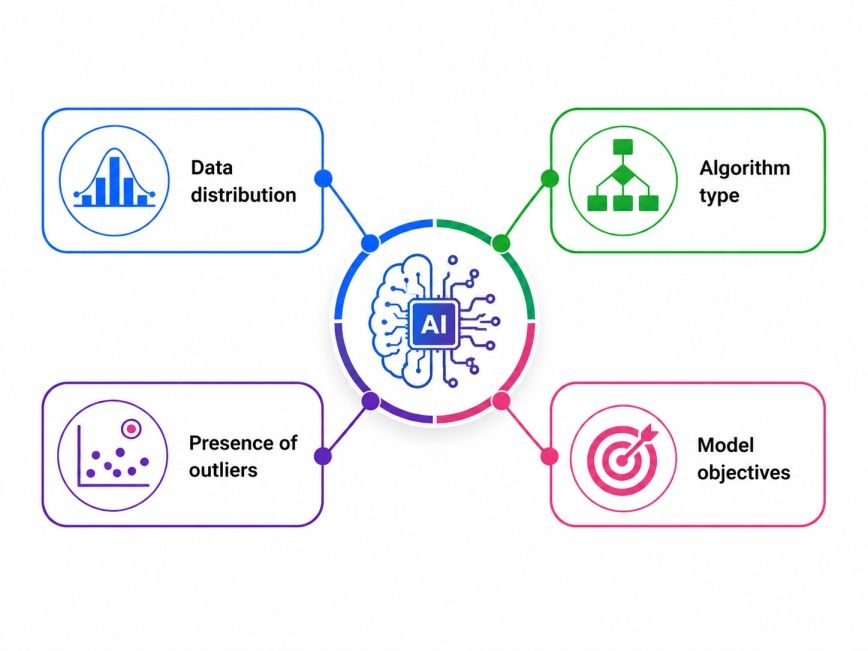
The debate around normalization and standardization in machine learning does not have a universal winner.
The right choice depends on:
A practical approach is to experiment with both methods and compare performance using cross-validation.
Also Read: Foundations of Machine Learning: What You Actually Need to Know
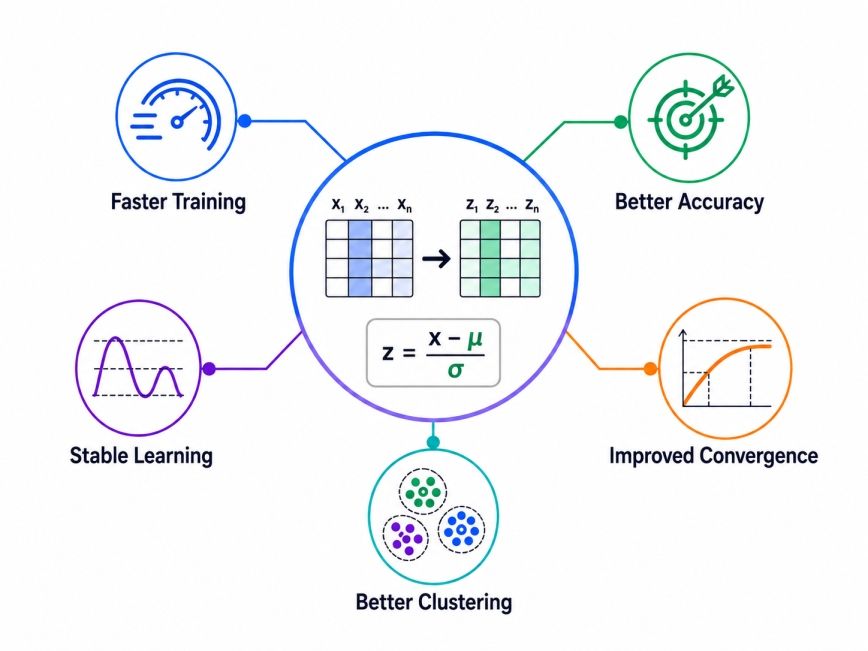
Applying standardization correctly can significantly improve model performance.
Benefit |
Impact |
| Faster Training | Reduces optimization time |
| Better Accuracy | Improves feature balance |
| Stable Learning | Reduces numerical issues |
| Improved Convergence | Helps gradient descent |
| Better Clustering | Improves distance calculations |
1.Standardize After Splitting Data
Always split data before scaling.
Correct sequence:
2. Store Scaling Parameters
Production systems must use the same scaling parameters used during training.
3. Understand Algorithm Requirements
Not every model requires scaling.
Usually recommended:
Usually optional:
Before applying standardization in machine learning, ask:
If the answer to most questions is yes, standardization is likely beneficial.
In real-world machine learning pipelines, feature scaling is often treated as a standard preprocessing step. Teams building recommendation systems, fraud detection models, customer analytics platforms, and predictive maintenance solutions frequently use the standard scaler in machine learning to ensure stable and reliable model performance.
Ignoring preprocessing may not always break a model, but it can limit its accuracy and efficiency. That is why understanding normalization and standardization in machine learning remains a core skill for aspiring data scientists and machine learning engineers.
Standardization in machine learning is one of the most important preprocessing techniques for building effective models. By transforming features to have a mean of zero and a standard deviation of one, it prevents large-scale variables from dominating the learning process.
The standard scaler in machine learning provides a simple and reliable way to implement this transformation. For beginners, understanding when and how to standardize data can significantly improve model performance and help build more robust machine learning systems.
Want to explore more about standardization in machine learning? Book your free 1:1 personal consultation with our expert today.
Standardization is the process of transforming data into a common scale so that features can be compared fairly. In machine learning, it typically involves adjusting values to have a mean of zero and a standard deviation of one. Common types include z-score standardization, robust standardization, decimal scaling, and unit vector scaling. Each method serves different preprocessing needs depending on data characteristics.
Standardization refers to converting numerical features into a standardized format where they share similar statistical properties. This reduces the influence of different measurement scales. In machine learning, standardization helps algorithms learn patterns more effectively by ensuring that no single feature dominates due to larger numerical values.
Standardization improves model training by making features comparable. Many algorithms rely on distances or optimization methods that can be heavily affected by feature scales. Without proper scaling, larger features may disproportionately influence model predictions and reduce overall performance.
Neither technique is universally better. The choice depends on the data and algorithm being used. For many regression, classification, and clustering algorithms, standardization often performs well. Normalization may be more suitable when values need to remain within a fixed range.
A standard scaler in machine learning is a preprocessing tool that automatically standardizes numerical features using z-score scaling. It calculates the mean and standard deviation from training data and applies those statistics to transform both training and testing datasets consistently.
In many cases, yes. Algorithms such as SVM, KNN, logistic regression, and neural networks often benefit from standardized features. However, improvements depend on the dataset and algorithm. Some models, especially tree-based methods, may see little change.
Standardization should always be performed after splitting the dataset. The scaler must be fitted only on training data. The same parameters are then used to transform testing data. This prevents data leakage and ensures reliable evaluation results.
Standardization can reduce scale differences, but it does not remove outliers. Because it relies on mean and standard deviation, extreme values can still influence the transformation. Robust scaling techniques are often preferred when datasets contain significant outliers.
Algorithms that use distance measurements or gradient-based optimization generally benefit the most from standardization. Examples include KNN, K-Means, PCA, logistic regression, support vector machines, and many neural network architectures.
In practice, there is no major difference. Standard scaling is simply the implementation of z-score standardization. Both methods use the same formula to transform features so that they have a mean of zero and a standard deviation of one.
Yes, in certain advanced workflows, both techniques may be used sequentially. For example, data might first be standardized to handle scale differences and later normalized to meet specific algorithm requirements. The approach depends on the use case and model architecture.
730 articles published
Sriram K is a Senior SEO Executive with a B.Tech in Information Technology from Dr. M.G.R. Educational and Research Institute, Chennai. With over a decade of experience in digital marketing, he specia...
Speak with AI & ML expert
By submitting, I accept the T&C and
Privacy Policy