Foundations of Machine Learning: What You Actually Need to Know
By Sriram
Updated on Sep 17, 2026 | 7 min read | 1.46K+ views
Share:

All courses
Certifications
More
By Sriram
Updated on Sep 17, 2026 | 7 min read | 1.46K+ views
Share:
Table of Contents
The foundations of machine learning combine mathematical concepts, structured data preparation workflows, and various learning paradigms, empowering computers to derive insights and recognize patterns from data independently of explicit programming instructions.
The foundations of machine learning form the building blocks of modern artificial intelligence systems. Whether you're using a recommendation engine, a chatbot, or a fraud detection system, machine learning sits behind many of these technologies. Understanding its core principles helps you move beyond using AI tools and start understanding how they work.
This blog breaks down the core concepts you need before anything else, including how machines learn, what types of learning exist, which algorithms matter most, and where things can go wrong.
Explore upGrad's Data Science, AI, and Machine Learning programs to build a strong foundation in machine learning, data analysis, model development, supervised and unsupervised learning, and real-world AI applications. Gain hands-on experience with industry tools and learn how to turn data into actionable insights.
Popular AI Programs
Machine learning is a branch of artificial intelligence where systems learn from data to improve their performance over time. But here's what that actually means in practice, you feed a system examples, and it figures out the rules on its own.
Classic programming works differently. A developer writes explicit instructions. If X, do Y. Machine learning flips that. You show the system thousands of X-Y pairs, and it builds its own logic to handle new inputs it hasn't seen before.
Why do the foundations matter so much? Because if you don't understand what's happening underneath, you'll build models that work on training data and fail in the real world. That gap between theory and practice is exactly where most beginners get stuck.
The foundations of machine learning include:
Getting these right helps you build things that actually work.
The foundations of machine learning rely on three essential components.
Component |
Purpose |
| Data | Provides examples for learning |
| Algorithm | Identifies patterns in data |
| Model | Uses learned patterns to make predictions |
Do read: How to Implement Machine Learning Steps: A Complete Guide
Free Courses
Not all machine learning works the same way. There are three main types of ML, and each solves a different kind of problem.
Supervised Learning is the most common type. You give the model labelled data, meaning each input has a known output. The model learns the relationship and uses it to predict outputs for new inputs.
Spam detection is a simple example. You train a model on thousands of emails, each labeled "spam" or "not spam." It learns what patterns signal spam and applies that logic to new emails.
Feature |
Supervised Learning |
| Data type | Labeled |
| Goal | Predict an output |
| Common use | Classification, regression |
| Example | Loan approval, image recognition |
Here, in Unsupervised Machine Learning, the data isn't labeled. The model has to find structure on its own. It's used for clustering similar items, detecting anomalies, or reducing the complexity of large datasets.
Customer segmentation is a classic case. You don't tell the model how many groups to find. It discovers them based on purchasing patterns, browsing behavior, or demographics.
Reinforcement Learning is different from both. An agent learns by interacting with an environment, taking actions, and receiving rewards or penalties. Over time, it figures out which actions lead to the best outcomes.
It's what powers game-playing AI and, increasingly, robotic systems. But it's also the hardest to implement well, because designing the reward function correctly takes real care.
Must read: 9 Important Machine Learning Benefits You Should Know
AI Courses to upskill
Explore Artificial Intelligence Courses for Career Progression
Before touching any algorithm or tool, you need to understand the ideas that sit behind all of machine learning.
Concept |
What It Means |
Example |
| Features | Input variables used by the model | House size, bedrooms, location |
| Label | The value the model predicts | House price |
| Training Data | Data used to teach the model | 80% of housing dataset |
| Testing Data | Data used to evaluate performance | Remaining 20% of dataset |
| Overfitting | Model memorizes data instead of learning patterns | High training accuracy, low test accuracy |
| Loss Function | Measures prediction error | Mean Squared Error (MSE) |
| Gradient Descent | Method used to reduce prediction errors | Updates model parameters step by step |
| Goal of Training | Improve prediction accuracy | Minimize loss and improve generalization |
These concepts are behind almost every modern ML algorithm, including deep neural networks.
Also read: What is the Ideal Sequence of Topics for Learning Machine Learning? A Complete Roadmap (2026)
Algorithms are the methods models use to learn. You don't need to memorize every one, but you should understand what each type is suited for.
Algorithm |
Type |
Best For |
| Linear Regression | Supervised | Predicting continuous values |
| Logistic Regression | Supervised | Binary classification |
| Decision Trees | Supervised | Interpretable classification |
| K-Means | Unsupervised | Grouping similar data |
| Random Forest | Supervised | High-accuracy classification |
| Neural Networks | Supervised/Unsupervised | Complex pattern recognition |
Linear regression is the starting point for most people. It draws a line through your data and uses that line to make predictions. Straightforward, interpretable, and still widely used.
Decision trees are easy to visualize. The model asks a series of yes/no questions to arrive at an answer. They're not always the most accurate, but they're much easier to explain to a non-technical stakeholder.
Random forests take that further. They build many decision trees and combine their outputs, which significantly reduces the chance of overfitting.
Neural networks are where things get complex. They're loosely inspired by how neurons in the brain connect, and they're what powers most deep learning applications. But they're also resource-heavy and harder to interpret.
Don't fall into the trap of thinking more complex always means better. A logistic regression model trained on clean data will outperform a neural network trained on messy, insufficient data every time.
Do read: Exploring the Scope of Machine Learning: Trends, Applications, and Future Opportunities
Building a model is one thing. Building a model that works reliably is another.
Every model faces a tension between two types of error. Bias is when your model is too simple and misses important patterns. Variance is when your model is too complex and captures noise instead of the signal.
High bias leads to underfitting. High variance leads to overfitting. The goal is to find the balance between both, and that is the Bias-Variance Tradeoff.
Here's something most courses underemphasize: the data matters more than the algorithm. A messy dataset with missing values, inconsistent formatting, and mislabeled examples will produce a bad model, regardless of which algorithm you use.
Data preprocessing, cleaning, and feature engineering often take up 70-80% of an ML project's time. That's not a bug in the process. It's the reality of working with real-world data.
Accuracy alone doesn't tell the full story. If 95% of your dataset belongs to one class, a model that always predicts that class will hit 95% accuracy without learning anything useful.
Evaluation Metrics like precision, recall, F1 score, and AUC-ROC give a more honest picture of what a model is actually doing.
Also read: How to Learn Machine Learning – Step by Step
Evaluating performance is equally important because predictions influence real business decisions, customer experiences, and operational processes.
Different problems require different metrics.
Metric |
What It Measures |
Best Used When |
| Accuracy | Percentage of correct predictions out of all predictions | Classes are balanced, and overall correctness matters |
| Precision | Percentage of predicted positives that are actually positive | False positives are costly, such as spam detection |
| Recall | Percentage of actual positives correctly identified | Missing positive cases is risky, such as disease screening |
| F1 Score | Balance between precision and recall | Both false positives and false negatives are important |
Do read: Precision, Recall, and F1 Score Explained: From Basics to Advanced
Metric |
What It Measures |
Best Used When |
| Mean Absolute Error (MAE) | Average absolute difference between predicted and actual values | You want an easy-to-understand measure of prediction error |
| Mean Squared Error (MSE) | Average squared difference between predicted and actual values | Larger errors should receive greater penalties |
| Root Mean Squared Error (RMSE) | Square root of MSE expressed in the original unit of measurement | You need an interpretable measure that highlights larger prediction errors |
Choosing the wrong metric can create misleading conclusions, especially in situations where class distributions are highly uneven.
Machine learning isn't perfect.
Challenge |
Description |
Result |
| Poor Data Quality | Incomplete or incorrect data | Poor predictions |
| Overfitting | Learns data too closely | Fails on new data |
| Underfitting | Misses important patterns | Low accuracy |
| Dataset Bias | Unrepresentative data | Unfair outcomes |
| Limited Data | Too few examples | Weak learning |
| Feature Issues | Wrong or missing inputs | Reduced performance |
For example, a hiring model trained on biased historical data could learn undesirable patterns and produce unfair outcomes.
That's why responsible model development matters.
The foundations of machine learning support countless modern systems.
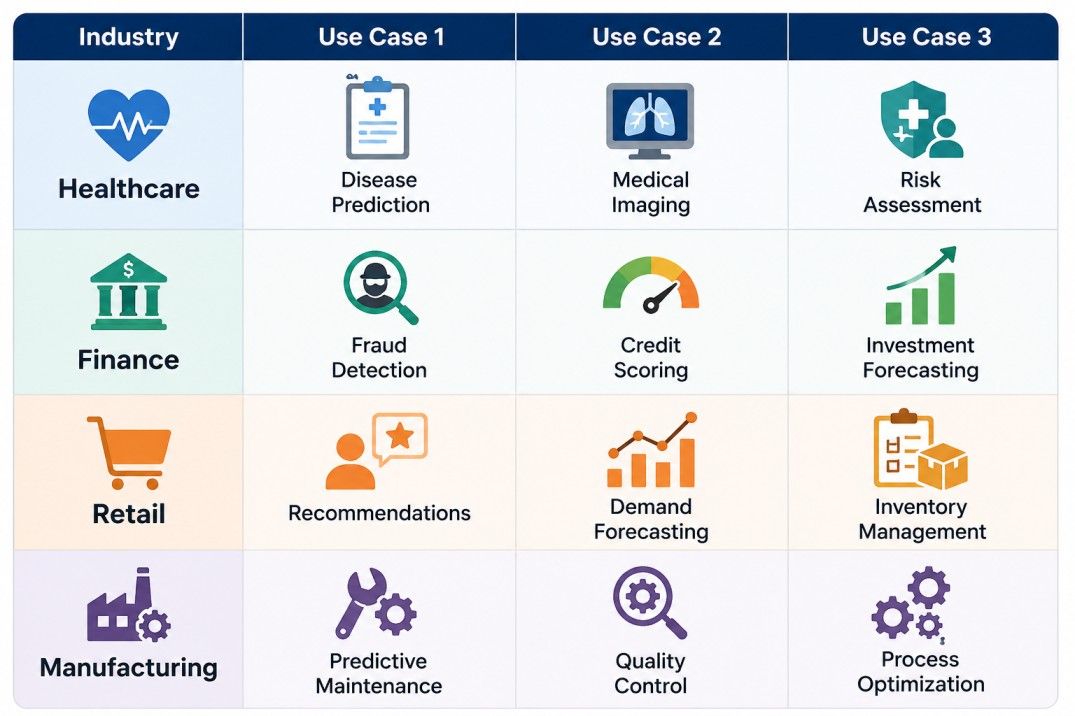
The range of applications keeps expanding as organizations collect more data and computing resources become increasingly accessible.
Do read: GRU Vs LSTM in Machine Learning: Full Comparison Guide
The foundations of machine learning revolve around data, algorithms, model training, evaluation, and continuous improvement. Understanding supervised learning, unsupervised learning, reinforcement learning, feature engineering, and performance metrics gives you the knowledge needed to explore advanced AI topics with confidence.
Machine learning isn't just about algorithms. It's about teaching systems to learn from data, make informed predictions, and improve through experience. Once these fundamentals become clear, more advanced concepts such as deep learning, neural networks, and generative AI become much easier to understand.
Ready to start your journey? Book a free consultation with upGrad today to find the best path for your career.
Before learning machine learning, focus on basic mathematics, statistics, and programming fundamentals. Python is the most popular starting language because of its simple syntax and extensive machine learning libraries. Understanding data structures, functions, and basic probability will make learning machine learning much easier and less overwhelming.
The foundations of machine learning provide the theoretical base employers expect, but they're usually not enough on their own. Most entry-level roles also require practical projects, data analysis skills, Python proficiency, and experience using machine learning frameworks such as Scikit-learn, TensorFlow, or PyTorch.
Machine learning is a broad field that includes many algorithms designed to learn from data. Deep learning is a subset of machine learning that uses multi-layer neural networks. While traditional machine learning often requires manual feature engineering, deep learning can learn features directly from raw data.
You don't need advanced mathematics to begin learning machine learning. A working understanding of algebra, probability, statistics, and basic linear algebra is enough for most beginner concepts. As you move into neural networks, optimization, and research-focused topics, deeper mathematical knowledge becomes increasingly valuable.
Many models perform well during development but struggle after deployment because real-world data changes over time. Data drift, incomplete records, changing customer behavior, and unexpected scenarios can reduce accuracy. Continuous monitoring and retraining are necessary to maintain reliable machine learning performance.
Feature engineering involves creating or transforming input variables to help models learn more effectively. Well-designed features often improve accuracy more than switching algorithms. For example, calculating customer purchase frequency may reveal stronger patterns than using raw transaction records alone.
For most beginners, developing solid machine learning fundamentals takes three to six months of consistent study and practice. The timeline depends on your technical background and learning pace. Building projects alongside theory usually speeds up understanding and helps concepts stick longer.
Many beginners focus heavily on algorithms while ignoring data quality, feature selection, and evaluation methods. Others jump directly into deep learning without understanding basic concepts first. These shortcuts often create confusion and make it harder to troubleshoot model performance problems later.
Yes, machine learning can work with smaller datasets, depending on the problem and algorithm. Simpler models such as linear regression or decision trees often perform well with limited data. However, complex models like deep neural networks usually require significantly larger datasets to achieve reliable results.
Machine learning models improve through retraining, better feature engineering, additional data collection, and parameter optimization. As more relevant data becomes available, models can learn new patterns and adapt to changing conditions. Continuous improvement is a key part of successful machine learning systems.
Once you've mastered the foundations of machine learning, consider exploring deep learning, natural language processing, computer vision, reinforcement learning, and MLOps. These specialized areas build on core concepts and open pathways into advanced AI development, research, and industry-focused applications.
730 articles published
Sriram K is a Senior SEO Executive with a B.Tech in Information Technology from Dr. M.G.R. Educational and Research Institute, Chennai. With over a decade of experience in digital marketing, he specia...
Speak with AI & ML expert
By submitting, I accept the T&C and
Privacy Policy
Top Resources
Master's Degree
18 Months
Executive Diploma
12 Months
IIIT Bangalore
Executive Programme in Generative AI & Agentic AI for LeadersIndia’s #1 Tech University
Dual Certification
5 Months