Bias Variance Tradeoff in Machine Learning
By Rahul Singh
Updated on May 05, 2026 | 13 min read | 2.8K+ views
Share:

All courses
Certifications
More
By Rahul Singh
Updated on May 05, 2026 | 13 min read | 2.8K+ views
Share:
Table of Contents
The bias–variance tradeoff is a key concept in machine learning that helps you balance model complexity to reduce prediction errors. Errors come from bias, which happens when a model is too simple, and variance, which occurs when it is too sensitive to training data.
As you reduce bias, variance often increases, and vice versa. If a model is too simple, it misses patterns and performs poorly. If it is too complex, it overfits the data and fails on new inputs. The goal is to balance both so your model generalizes well on unseen data.
In this blog, you will learn what the bias variance tradeoff in machine learning is, how it works in real-world machine learning scenarios, and how to manage it effectively.
Popular AI Programs
The bias variance tradeoff describes the balance between two types of errors in a machine learning model: bias and variance. These errors impact how well your model performs on new, unseen data.
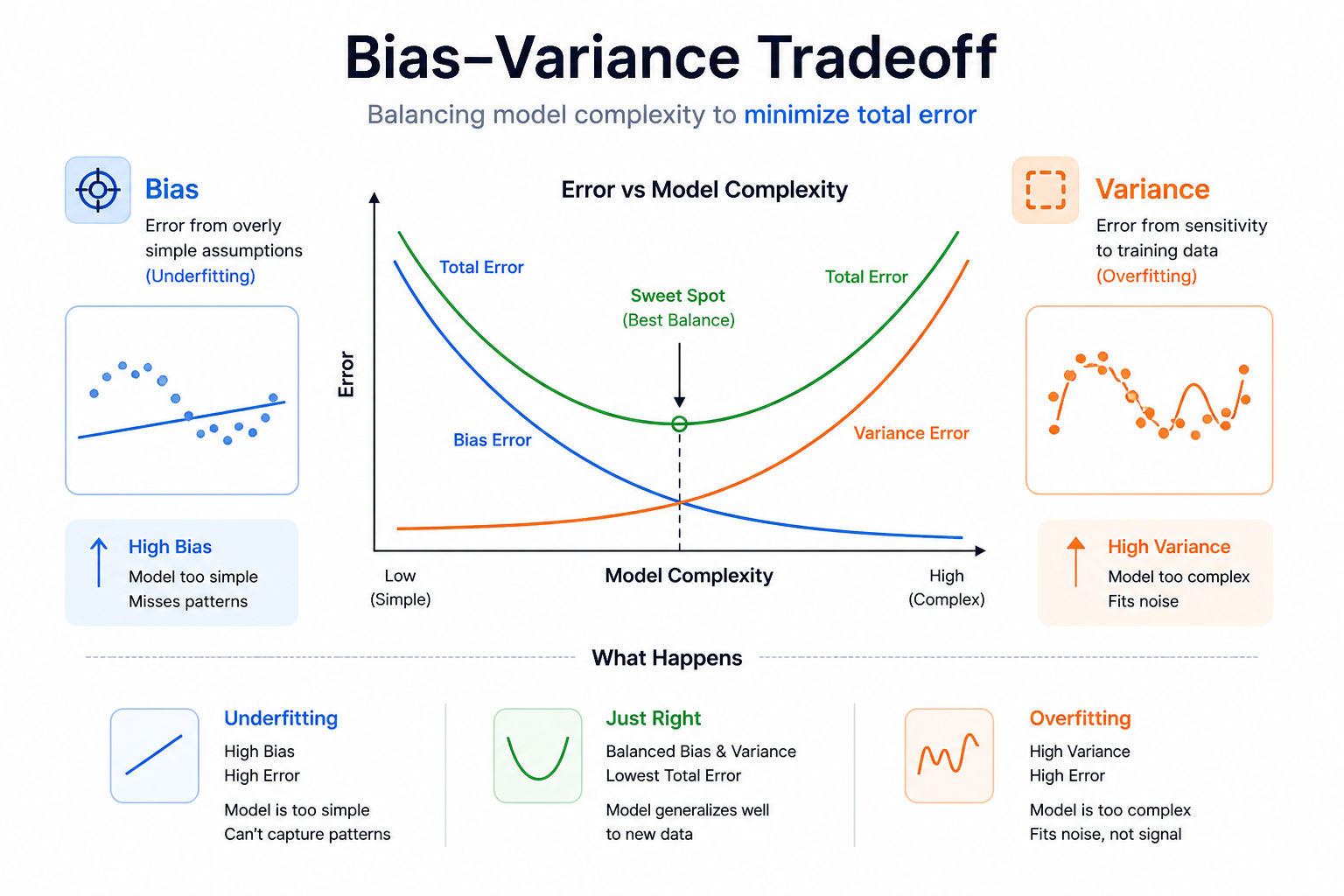
Bias comes from overly simple assumptions in the model. It limits the model’s ability to learn from data.
A high-bias model makes strong assumptions and ignores important relationships. This leads to underfitting, where the model performs poorly on both training and test data.
Example: A linear model trying to fit a curved dataset cannot capture the actual pattern
To reduce bias, you can:
Also Read: Learning Models in Machine Learning: 16 Key Types and How They Are Used
Variance measures how much the model changes when the training data changes. It shows how sensitive the model is to small variations.
A high-variance model learns noise instead of real patterns. It performs well on training data but fails on new data, which leads to overfitting.
Example:
To reduce variance, you can:
The bias and variance tradeoff happens because you cannot easily reduce both errors at the same time. If you make your model more complex, you lower the bias. However, adding that complexity automatically increases the variance. If you make your model simpler, you lower the variance. But simplifying it automatically increases the bias.
Here is a simple breakdown of the relationship:
| Model Complexity | Bias Level | Variance Level | Common Result |
| Very Simple | High | Low | Underfitting |
| Perfectly Balanced | Low | Low | Accurate Predictions |
| Very Complex | Low | High | Overfitting |
Mastering the bias variance tradeoff in machine learning means finding the perfect middle ground. You want a model complex enough to capture the true pattern. At the same time, you want it simple enough to ignore random noise.
Also Read: What is Overfitting and Underfitting in Machine Learning?
You can represent the bias variance tradeoff using a simple equation:
Total Error = Bias² + Variance + Irreducible Error
This formula explains why reducing one type of error often increases the other. The goal in the bias variance tradeoff in machine learning is to minimize the total error, not just one component.
Think of learning like studying for an exam:
That balance is the bias variance tradeoff in machine learning.
Also Read: Feature Engineering for Machine Learning: Methods & Techniques
Free Courses
To truly grasp this concept, you need to see it visually. The bias variance tradeoff graph is the most famous visualization in data science. It plots your model errors against the complexity of your algorithm. Understanding this visual tool helps you diagnose problems immediately.
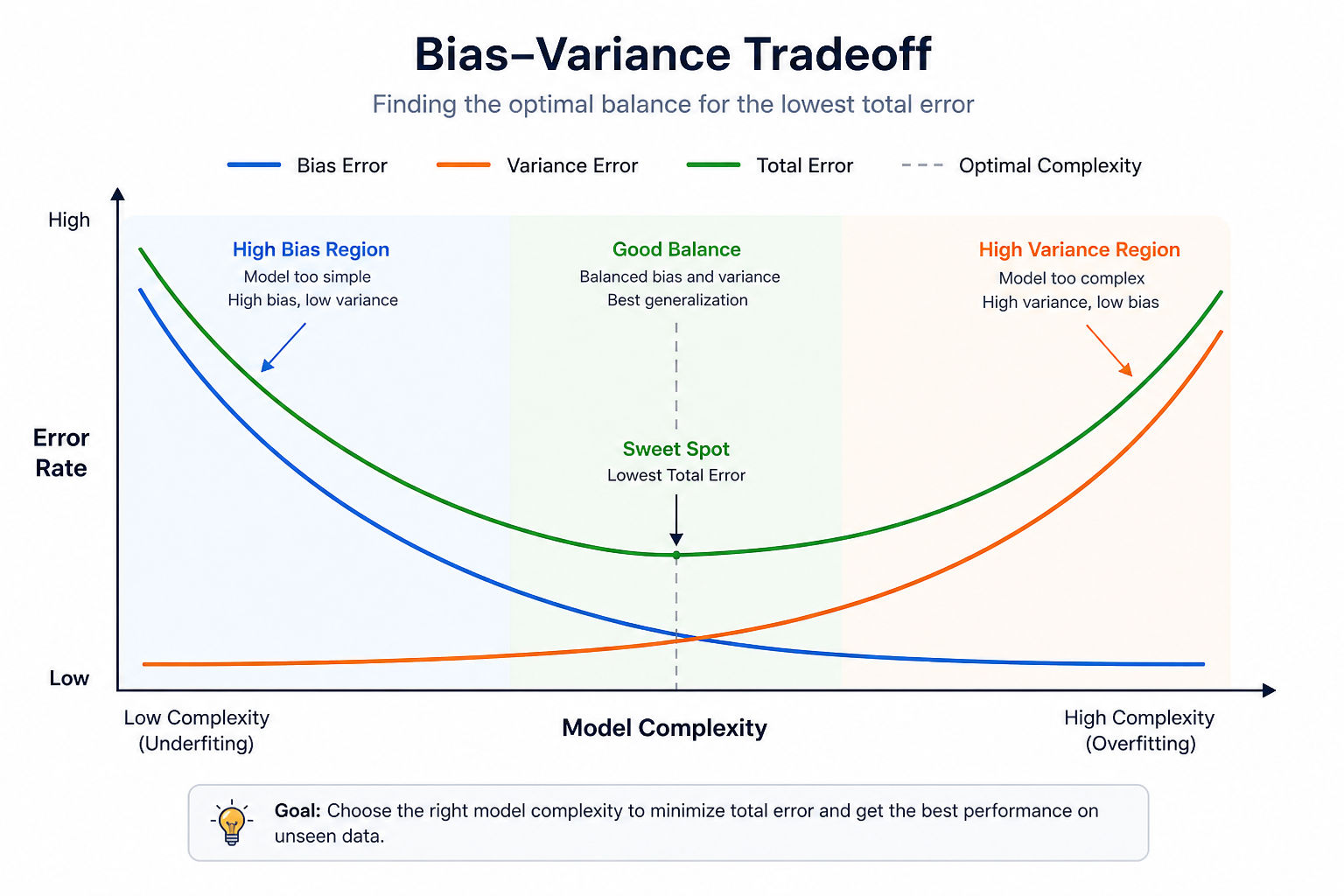
The horizontal axis of the bias variance tradeoff graph represents model complexity. The far-left side shows highly simple models, like linear regression. The far-right side shows highly complex models, like deep neural networks. The vertical axis represents the error rate. Lower is always better.
You will typically see three distinct curves on this graph.
When you study the bias variance tradeoff graph, your eyes should go straight to the total error curve. Because it forms a U-shape, it naturally has a bottom point. This lowest point on the U-shape is your target.
Finding this spot is rarely done on the first try. Data scientists spend most of their time tweaking algorithms to push the total error down into that valley. They monitor how the model performs on new, unseen data to figure out where they currently sit on the graph. If the error starts climbing again, they know they have pushed too far to the right.
Also Read: Multiple Linear Regression in Machine Learning: Concepts and Implementation
AI Courses to upskill
Explore Artificial Intelligence Courses for Career Progression
Now that you can diagnose the problem, you need the tools to fix it. Managing the bias variance tradeoff in machine learning requires practical engineering skills. You cannot magically change the underlying math, but you can alter your approach to the data.
When your model is underfitting, you are sitting on the left side of the bias variance tradeoff graph. Your primary goal is to push the algorithm to the right by making it smarter and more capable.
Also Read: Regularization in Deep Learning: Techniques to Prevent Overfitting
When your model is overfitting, you are sitting on the far right of the bias variance tradeoff graph. You need to pull the complexity back. You must force the algorithm to forget the random noise.
Navigating the bias variance tradeoff in machine learning is an ongoing cycle. You train a model, diagnose its position on the curve, and apply a fix. You repeat this process until the testing error hits its lowest possible point. Mastering this loop is what separates beginners from senior engineers.
Understanding the theory is helpful, but you must see how it breaks real projects. The bias and variance tradeoff destroys actual business value when ignored. Let us look at how these errors manifest in everyday prediction tasks.
Underfitting occurs when your model is too simple to capture real patterns in the data. It fails to learn even from the training data, which leads to poor performance everywhere.
Imagine you are building a house price prediction model. You decide to use only one feature: square footage. You ignore important factors like location, number of bedrooms, and property condition. Your model assumes pricing is straightforward.
Also Read: Top 48 Machine Learning Projects [2026 Edition] with Source Code
Overfitting is the sneaky enemy of data scientists. It happens when your model learns the training data perfectly but fails on new data.
This is high variance. The model is too sensitive to training data and cannot generalize. To fix this, you need to reduce complexity, remove irrelevant features, and focus on patterns that matter.
Also Read: 25 Must-Try Machine Learning Projects in Python for Beginners and Experts in 2026
You can easily diagnose these issues by comparing your training error against your testing error.
| Scenario | Training Error | Testing Error | Diagnosis |
| Scenario A | Very High | Very High | Underfitting (High Bias) |
| Scenario B | Very Low | Very High | Overfitting (High Variance) |
| Scenario C | Low | Low | Optimal Balance |
Monitoring these metrics is your primary defense. If your training score looks perfect, you should immediately suspect high variance. Perfect scores rarely exist in the real world.
The bias variance tradeoff defines how well your model performs in real situations. If your model is too simple, it misses patterns. If it is too complex, it learns noise. Both cases lead to poor results.
You need to find the right balance where the model learns meaningful patterns and performs well on new data. This balance is what separates a working model from a failing one.
Want personalized guidance on Machine Learning and upskilling? Speak with an expert for a free 1:1 counselling session today.
The bias variance tradeoff in machine learning explains how two types of errors affect model performance. Bias comes from overly simple assumptions, while variance comes from sensitivity to training data. You must balance both to reduce total prediction error and improve generalization.
The standard formula expresses total error as the sum of three parts: bias², variance, and irreducible error. This shows how prediction error is split into components you can control and noise you cannot reduce.
The derivation starts from mean squared error and breaks it into bias, variance, and noise terms. It uses expectations and variance properties to separate systematic error and data variability. The result shows how each component contributes to total prediction error.
It helps you choose the right model complexity. A simple model leads to underfitting, while a complex one leads to overfitting. Balancing both ensures better predictions on new data and improves overall model reliability.
The bias variance tradeoff directly impacts how well a model performs on unseen data. High bias causes consistent errors, while high variance leads to unstable predictions. Managing both helps reduce total error and improve accuracy in real-world applications.
A linear model on complex data shows high bias because it cannot capture patterns. A deep decision tree shows high variance because it memorizes noise. The best model lies between these extremes, where it learns patterns without overfitting.
When bias is too high, the model becomes too simple. It misses important relationships in the data and performs poorly on both training and test sets. This condition is known as underfitting and leads to weak predictions.
In deep learning, larger models reduce bias but may increase variance. However, modern neural networks sometimes break the traditional pattern, where both bias and variance can decrease together under certain conditions.
High variance occurs when a model is too complex or trained on limited data. It learns noise instead of real patterns, which causes strong performance on training data but poor results on new inputs.
You can adjust model complexity, add more data, or use techniques like regularization and cross-validation. The goal is to find a balance where both bias and variance are controlled for better generalization.
Irreducible error is the noise in the data that cannot be removed by any model. Even a perfect model cannot eliminate this part of the error, as it comes from randomness or unknown factors in the data.
98 articles published
Rahul Singh is an Associate Content Writer at upGrad, with a strong interest in Data Science, Machine Learning, and Artificial Intelligence. He combines technical development skills with data-driven s...
Speak with AI & ML expert
By submitting, I accept the T&C and
Privacy Policy
Top Resources
Master's Degree
18 Months
Executive Diploma
12 Months
IIIT Bangalore
Executive Programme in Generative AI & Agentic AI for LeadersIndia’s #1 Tech University
Dual Certification
5 Months