Hypothesis Space in Machine Learning: Complete Guide
By Sriram
Updated on Jun 26, 2026 | 8 min read | 2.37K+ views
Share:

All courses
Certifications
More
By Sriram
Updated on Jun 26, 2026 | 8 min read | 2.37K+ views
Share:
Table of Contents
Hypothesis space in machine learning is a collection of possible solutions. Machine learning models do not learn by randomly selecting answers so when a machine learning algorithm is trying to solve a problem, it doesn't just pull an answer out of thin air it searches through a collection of possible solutions until it finds one that fits.
Understanding the hypothesis space in machine learning is essential because it forms the foundation of how algorithms learn patterns, make predictions, and generalize to new data.
In this guide, you'll learn what a hypothesis space is, how it works, why it matters, different types of hypothesis spaces, the relationship between hypothesis space and inductive bias in machine learning.
Explore Machine Learning Courses Online from upGrad and master the foundational machine learning concepts like hypothesis space and build smarter industry-focused AI models.
Popular AI Programs
The hypothesis space in machine learning is all the solutions that a machine learning algorithm can think of when learning from data. A hypothesis is a guess that connects the input into a system and the output.
For example, if you want to guess house prices based on how big the house is, the hypothesis space would include all possible ways to make that guess.
A model may consider:
All these possible solutions together form the hypothesis space.
Also Read: 12 Issues in Machine Learning: Key Problems in Training, Testing, and Deployment
The hypothesis space includes all possible lines. The goal of the learning algorithm is to find a line that explains the training data well.
Imagine you are fitting a line through a dataset. The model can choose from:
Possible Function |
Example |
| Linear | y = 2x + 5 |
| Linear | y = 4x - 3 |
| Linear | y = 1.5x + 8 |
| Linear | y = 7x + 1 |
A hypothesis space typically contains:
Component |
Description |
| Hypotheses | Candidate solutions |
| Search Process | Method used to find the best solution |
| Evaluation Function | Measures performance |
| Learning Algorithm | Selects the final hypothesis |
Every machine learning algorithm defines its own hypothesis space.
Without a hypothesis space:
For instance:
The size and structure of the hypothesis space directly influence model performance.
This is also where hypothesis space search in machine learning becomes important because the algorithm must efficiently explore possible hypotheses to find the best one.
Explore this article: Hypothesis Testing in Statistics: Explained Simply
Free Courses
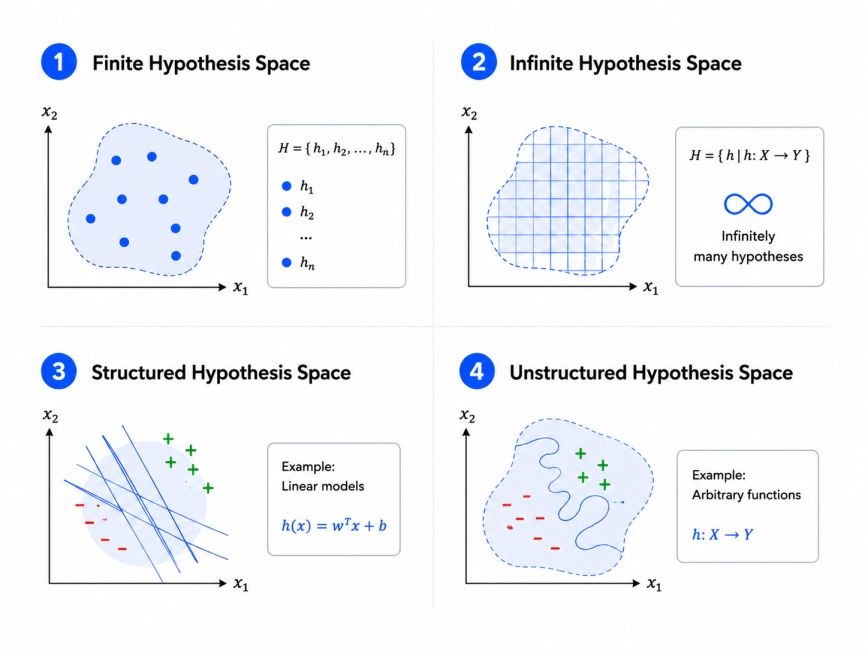
Not all hypothesis spaces are the same. Some are small and simple, while others contain millions or even billions of possible solutions.
Understanding the different types helps explain model behavior and performance.
A finite hypothesis space contains a limited number of hypotheses.
For example:
A decision tree restricted to a fixed depth may only generate a specific number of possible trees.
Advantage |
Limitation |
| Faster learning | Less flexibility |
| Easier interpretation | May underfit |
An infinite hypothesis space contains an unlimited number of possible hypotheses. Linear regression provides a simple example because coefficients can take infinitely many values.
Advantage |
Limitation |
| Better representation ability | Higher computational demands |
| Can model complex patterns | Increased overfitting risk |
Some models organize hypotheses in a structured manner.
Examples include:
The structure helps algorithms perform more efficient searches.
In an unstructured space, hypotheses have no obvious hierarchy. Searching becomes more difficult because relationships between solutions are less clear.
Modern deep learning models operate in enormous hypothesis spaces containing billions of possible parameter combinations.
Algorithm |
Hypothesis Space Type |
| Linear Regression | Infinite |
| Logistic Regression | Infinite |
| Decision Tree | Finite or Infinite |
| Support Vector Machine | Large Structured Space |
| Neural Networks | Extremely Large Space |
Also Read: What are Machine Learning Algorithms?
Once a hypothesis space is defined, the next challenge is finding the best hypothesis. This process is called hypothesis space search in machine learning.
Hypothesis search refers to the process of exploring candidate solutions and selecting the one that best fits the training data.
The search strategy depends on:
This approach doesn't believe in shortcuts; it evaluates every hypothesis. The advantages of this are that it always lands on the guaranteed optimal solution. But it is far too slow and resource-heavy for most real-world problems
Greedy Search makes the best local decision at each step it took; it simply looks at what's available, picks up the best option in front of it, and keeps moving forward without ever second-guessing itself.
Used in:
Gradient-Based Search approach is common in neural networks. Rather than making bold, sweeping changes, gradient-based search is all about patience and precision; the model updates parameters gradually to minimize errors.
Search Method |
Speed |
Accuracy |
| Exhaustive Search | Slow | Very High |
| Greedy Search | Fast | Moderate |
| Gradient Search | Efficient | High |
AI Courses to upskill
Explore Artificial Intelligence Courses for Career Progression
One of the most important concepts connected to hypothesis spaces is inductive bias. The hypothesis space and inductive bias are closely linked in machine learning.
They decide how well a model performs on unseen data. The hypothesis space is the set of all solutions a model can find.
The hypothesis space defines all possible solutions. Inductive bias guides the selection process.
Concept |
Role |
| Hypothesis Space | Defines possible solutions |
| Inductive Bias | Chooses preferred solutions |
Linear regression assumes relationships are approximately linear. This assumption acts as an inductive bias.
As a result:
Decision trees prefer simpler structures. This preference becomes an inductive bias toward shorter trees.
Many beginners focus on how accurate their model is. Understanding inductive bias helps you know why a model works the way it does.
In practice good machine learning systems make sure to balance two things: how complex the model can. How strong the inductive bias is. They get the mix of hypothesis space size and inductive bias strength.
The connection between hypothesis space and inductive bias in machine learning explains:
A common question among beginners is why experts often explain why to restrict hypothesis space in machine learning. At first glance, a larger hypothesis space seems better because it provides more options.
In reality, unrestricted spaces create significant challenges.
When you have a hypothesis space, it is really bad because it makes the risk of overfitting go up.
The model might just remember the training data of actually learning the important patterns in the training data, like the things that the model is supposed to learn from the training data.
For example:
A highly complex neural network may achieve perfect training accuracy but perform poorly on unseen data.
When experts explain why to restrict hypothesis space in machine learning, they usually focus on the following advantages:
Restricted Space |
Unrestricted Space |
| Faster training | Slower training |
| Better generalization | Greater overfitting risk |
| Easier interpretation | Harder interpretation |
| Lower complexity | Higher complexity |
Choosing simpler algorithms naturally restricts the search space.
Examples:
Regularization penalizes excessive complexity.
Popular methods include:
Decision trees often use maximum depth limits. This reduces the number of possible hypotheses.
When we are talking about business, the model that works the best is not always the one that's really complicated. Sometimes a model that is a little less accurate but works well in situations is actually the one that does a better job, over time because the business model is what we are trying to make work well in the long run and that is what matters for the business model.
This practical reality helps explain why to restrict hypothesis space in machine learning despite having access to powerful computing resources. The goal is not to explore every possible hypothesis. The goal is to find the most useful hypothesis that performs well on new data.
The hypothesis space in machine learning is the collection of all possible solutions a learning algorithm can consider during training. It forms the foundation of how models learn patterns, make predictions, and generalize to unseen data.
Understanding different hypothesis space types, the connection between hypothesis space and inductive bias in machine learning, and the reasons experts explain why to restrict hypothesis space in machine learning can help you build more effective models. Equally important is understanding hypothesis space search in machine learning, since the ability to find the right hypothesis often determines a model's success.
Want to explore more about hypothesis space in machine learning? Book your free 1:1 personal consultation with our expert today.
A hypothesis space in machine learning is the complete set of candidate functions or solutions that a learning algorithm can choose from while training. The algorithm searches within this space to identify the hypothesis that best matches the available data and generalizes well to unseen examples.
The space of hypotheses refers to all possible rules, functions, or models that can explain a dataset. Different machine learning algorithms define different hypothesis spaces depending on their structure, assumptions, and learning mechanisms.
A finite hypothesis space contains a limited number of candidate hypotheses, while an infinite hypothesis space contains unlimited possibilities. Decision trees with fixed depth often create finite spaces, whereas linear regression usually operates within an infinite hypothesis space.
Hypothesis space defines all possible solutions available to a learning algorithm, while inductive bias represents the assumptions used to select among those solutions. Together, they influence how a model learns from data and generalizes to future observations.
In machine learning discussions, hypotheses are commonly categorized into simple, complex, finite-space, and infinite-space hypotheses. Depending on the context, researchers may also classify them according to structure, representation, or learning constraints.
The size and structure of the hypothesis space influence a model's ability to capture patterns. A space that is too small may underfit the data, while a space that is too large may lead to overfitting and poor generalization.
Hypothesis space is important because it determines the range of solutions a model can explore. It directly affects learning efficiency, prediction quality, computational complexity, and the model's ability to perform well on unseen data.
Hypothesis space search in machine learning is the process of exploring candidate hypotheses and selecting the best-performing one. Different algorithms use methods such as exhaustive search, greedy search, or gradient-based optimization to perform this task.
Experts often explain why to restrict hypothesis space in machine learning because smaller spaces reduce overfitting, improve learning efficiency, and make models easier to interpret. Restriction techniques help models focus on meaningful patterns rather than noise.
Neural networks operate in extremely large hypothesis spaces containing millions or billions of parameter combinations. Optimization algorithms such as gradient descent help navigate these spaces efficiently and identify useful solutions.
Yes. Different algorithms define different hypothesis spaces even when trained on the same dataset. For example, a linear regression model searches among linear functions, while a decision tree searches among tree-based structures.
730 articles published
Sriram K is a Senior SEO Executive with a B.Tech in Information Technology from Dr. M.G.R. Educational and Research Institute, Chennai. With over a decade of experience in digital marketing, he specia...
Speak with AI & ML expert
By submitting, I accept the T&C and
Privacy Policy
Top Resources
Master's Degree
18 Months
Executive Diploma
12 Months
IIIT Bangalore
Executive Programme in Generative AI & Agentic AI for LeadersIndia’s #1 Tech University
Dual Certification
5 Months