Version Space in Machine Learning
By Rahul Singh
Updated on Jun 22, 2026 | 10 min read | 4.78K+ views
Share:

All courses
Certifications
More
By Rahul Singh
Updated on Jun 22, 2026 | 10 min read | 4.78K+ views
Share:
Table of Contents
In machine learning, a Version Space is the subset of all possible hypotheses that remain fully consistent with the training data. Introduced by Tom Mitchell in 1977, it provides a systematic framework for concept learning, particularly in binary classification tasks. Rather than selecting a single hypothesis too early, the version space maintains all hypotheses that correctly classify the positive and negative training examples seen so far.
This blog covers everything you need to know, from what version space in machine learning is and why it matters, to how it is searched, what can go wrong, and how it connects to real-world algorithms.
Popular AI Programs
Version space in machine learning refers to the set of all hypotheses that are consistent with the training data. A hypothesis is simply a rule or model that tries to explain what the correct output should be for a given input.
When a learning algorithm sees examples, it tries to figure out which rules fit all the examples correctly. The version space holds every hypothesis that passes that test. It is not just one answer. It is the entire collection of valid answers at any given point during learning.
Imagine you are teaching a model to identify ripe mangoes. Your training data contains examples like:
Colour |
Texture |
Size |
Ripe? |
| Yellow | Smooth | Large | Yes |
| Green | Rough | Small | No |
| Yellow | Rough | Large | Yes |
| Green | Smooth | Large | No |
A hypothesis could be: "If colour is yellow, the mango is ripe." Another could be: "If colour is yellow AND size is large, the mango is ripe." Both fit the data above.
Version space contains all such valid hypotheses. As you add more training examples, some hypotheses get ruled out and version space shrinks. Ideally, at the end of training, only one hypothesis remains.
Also Read: Types of Algorithms in Machine Learning: Uses and Examples
In formal terms, version space is defined relative to:
Version space VS(H, D) is the subset of H where every hypothesis correctly classifies every example in D.
This definition comes from Tom Mitchell's work on machine learning, particularly through the Candidate Elimination Algorithm, which directly operates on the version space.
Free Courses
The Candidate Elimination Algorithm is the most well-known method for searching through version space. It was introduced by Tom Mitchell in 1982 and forms the theoretical backbone of many supervised learning ideas.
The algorithm maintains two boundaries:
Every hypothesis in the version space lies between these two boundaries. As new training examples arrive, S and G are updated.
When a positive example arrives:
When a negative example arrives:
This continues until either:
Also Read: Supervised vs Unsupervised Learning: Key Differences
Suppose you are learning a concept with features [Colour, Size] and the target is whether something is a fruit.
Starting state:
After seeing (Yellow, Large) = Fruit:
After seeing (Green, Small) = Not Fruit:
As more examples come in, the space tightens. The version space is always what lies between the current S and G.
AI Courses to upskill
Explore Artificial Intelligence Courses for Career Progression
Understanding what is version space in machine learning is not just academic. It has direct relevance to how learning algorithms behave, especially in concept learning.
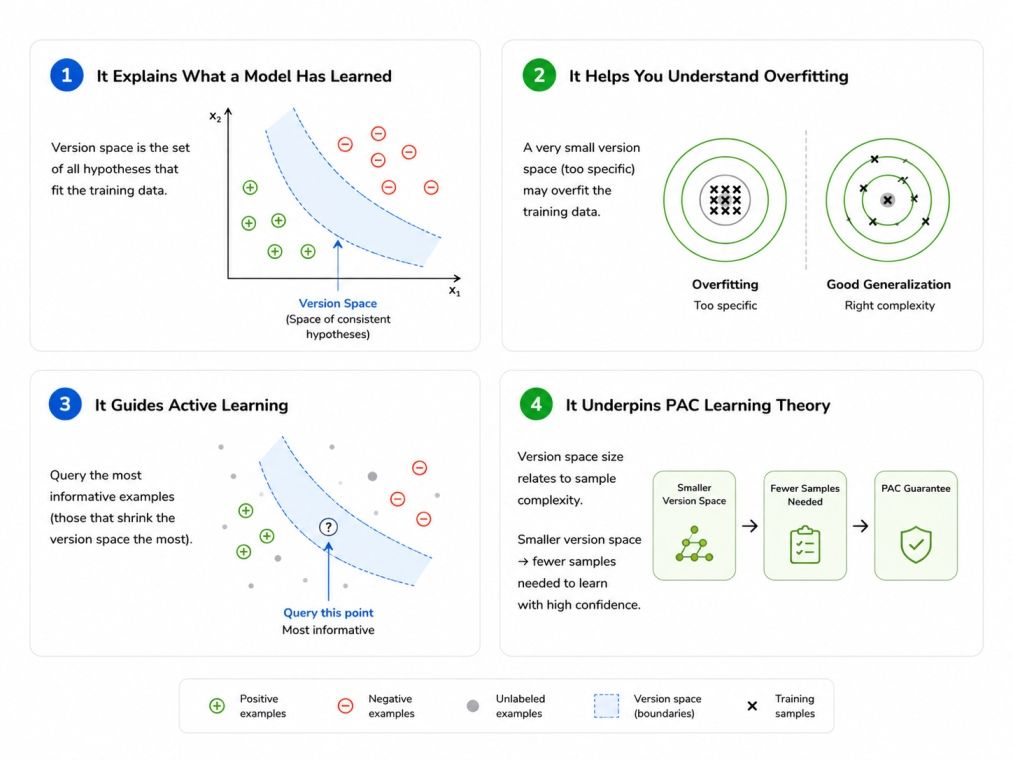
Also Read: What is Overfitting and Underfitting in Machine Learning?
While version space is a powerful concept, it has real-world limitations you should know about.
1. The Hypothesis Space Must Be Defined in Advance
The Candidate Elimination Algorithm only works within a predefined hypothesis space. If the true concept cannot be expressed within that space, the algorithm will fail.
2. It Does Not Handle Noisy Data Well
Real datasets almost always contain errors or noise. Even a single mislabelled example can cause version space to collapse to empty, making the algorithm useless. Modern machine learning methods like decision trees and neural networks are far more robust to this.
3. It Scales Poorly
As the number of features grows, the hypothesis space can become astronomically large. Searching through all of it is computationally infeasible. This is known as the hypothesis space explosion problem.
4. It Assumes Independent Features
The version space approach typically assumes features influence the output independently or in simple combinations. Real-world data often involves complex, non-linear interactions that this framework struggles to capture.
You might wonder: if version space has all these limitations, why study it?
The answer is that it is a foundational concept. Understanding version space helps you grasp how learning actually works at its core.
Here is how it connects to the broader picture:
Concept |
Version Space View |
Modern ML Equivalent |
| Learning | Eliminating bad hypotheses | Gradient descent updating weights |
| Training data | Constraints on version space | Loss function minimisation |
| Generalisation | Choosing from version space | Regularisation, dropout |
| Overfitting | Hypothesis space too specific | Model memorising training data |
| Underfitting | Version space too large | Model too simple for the data |
Modern algorithms like SVMs, decision trees, and neural networks do not explicitly maintain a version space. But conceptually, they are all doing something similar: narrowing down from a space of possible models to one that fits the data well.
Before finishing, here is a quick reference for the most important terms connected to version space in machine learning:
Version space in machine learning is one of those concepts that makes everything else click. It gives you a clear mental model of what learning actually means: you start with a large space of possible rules, and your data gradually eliminates the ones that do not fit.
The Candidate Elimination Algorithm, the S and G boundaries, and the idea of consistency are all pieces of this framework. Together, they explain why more data leads to better models, why noisy data causes problems, and how generalisation works at a fundamental level.
If you are studying machine learning seriously, whether for a degree, a certification, or a career, understanding what is version space in machine learning will give you a strong theoretical grounding that most practitioners lack.
Want personalized guidance on AI and upskilling? Speak with an expert for a free 1:1 counselling session today.
Version space is the set of all hypotheses that correctly explain your training data. As you add more examples, hypotheses that do not fit are eliminated and the version space shrinks. It represents what the learning algorithm still considers possible.
Hypothesis space is the full set of all possible rules or models the algorithm can consider. Version space is a subset of that. It contains only the hypotheses that are consistent with the actual training examples seen so far.
An empty version space means no hypothesis in the predefined space can correctly explain all the training examples. This usually happens when the training data is noisy, mislabelled, or when the hypothesis space is too limited to capture the true pattern.
Yes, and it usually does, especially early in training. Multiple hypotheses can all fit the current training data. As more examples are added, hypotheses that contradict new examples are removed and the version space narrows.
The algorithm maintains two boundaries within the version space: S (most specific) and G (most general). As new training examples arrive, it updates both boundaries to keep only hypotheses that remain consistent. Learning is complete when S and G converge.
In active learning, the model picks which examples to ask about. The best strategy is to pick examples that split the version space in half. This eliminates the most hypotheses per query and helps the model learn faster with fewer labelled examples.
Neural networks do not explicitly maintain a version space, but the concept still applies indirectly. Training a neural network is essentially the process of searching through a very large hypothesis space and finding weights that fit the training data, which is version space thinking in a continuous form.
The main limitations are poor handling of noisy data, difficulty scaling to large feature spaces, and the requirement to define the hypothesis space in advance. Because of these constraints, version space methods are rarely used directly in production machine learning systems today.
Positive examples cause the specific boundary S to generalise so that all positive cases are covered. Negative examples cause the general boundary G to specialise so that incorrect cases are excluded. Both types of examples are needed to fully constrain the version space.
PAC (Probably Approximately Correct) learning builds on version space ideas by asking how many training examples are needed to reduce the version space to a set of hypotheses that will generalise well. It provides mathematical guarantees on learning performance.
Yes. Version space and the Candidate Elimination Algorithm are standard topics in foundational ML courses and textbooks, including Tom Mitchell's classic book. They remain important for building intuition about what learning means, even if direct applications are limited in modern deep learning workflows.
98 articles published
Rahul Singh is an Associate Content Writer at upGrad, with a strong interest in Data Science, Machine Learning, and Artificial Intelligence. He combines technical development skills with data-driven s...
Speak with AI & ML expert
By submitting, I accept the T&C and
Privacy Policy
Top Resources
Master's Degree
18 Months
Executive Diploma
12 Months
IIIT Bangalore
Executive Programme in Generative AI & Agentic AI for LeadersIndia’s #1 Tech University
Dual Certification
5 Months