Feature Reduction in Machine Learning
By Rahul Singh
Updated on Jun 16, 2026 | 11 min read | 4.24K+ views
Share:

All courses
Certifications
More
By Rahul Singh
Updated on Jun 16, 2026 | 11 min read | 4.24K+ views
Share:
Table of Contents
Feature reduction in machine learning is the process of reducing the number of input variables used to train a model while retaining the most valuable information from the dataset. Rather than using every available feature, data scientists identify and keep only the variables that contribute meaningfully to predictions, helping create simpler and more efficient models.
As datasets grow larger and more complex, many features can become redundant, irrelevant, or highly correlated. It addresses this challenge by removing unnecessary variables or transforming them into a smaller set of informative features. This can improve model performance, reduce training time, minimize overfitting, and make results easier to interpret.
In this blog, you will learn exactly what feature reduction means, why it is important, the most effective feature reduction techniques in machine learning, how to choose the right method for your use case, and common mistakes to avoid.
Popular AI Programs
Think of it this way. Imagine you are trying to predict house prices. Your dataset might have 50 columns, from number of bedrooms and square footage to the color of the front door and the name of the previous owner. Not all of these columns help the model predict price. Some are noise. Feature reduction helps you figure out which ones to keep and which ones to drop.
Having too many features is not just inefficient. It actively hurts model performance in several ways.
People often use these two terms interchangeably, but they are not exactly the same.
Aspect |
Feature Selection |
Feature Reduction (Dimensionality Reduction) |
| What it does | Picks existing features | Creates new, combined features |
| Original features kept? | Yes | Not always |
| Interpretability | High | Lower (sometimes) |
| Example method | LASSO, RFE | PCA, Autoencoders |
Feature selection is a subset of the broader idea of feature reduction in machine learning. Both aim for the same goal, fewer and better inputs, but through different paths.
Free Courses
Feature reduction is not just a preprocessing step. It is a core part of building good models. Here is why it deserves serious attention.
Every extra feature adds to your training time. In deep learning, this can mean hours of added compute. Reducing features directly cuts costs, especially when you are training on cloud infrastructure where every GPU minute costs money.
A model trained on 10 highly relevant features will often outperform one trained on 100 mixed features. When you remove irrelevant or redundant features, the model focuses on what actually predicts the target. This leads to better performance on new, unseen data.
Also Read: How to Choose a Feature Selection Method for Machine Learning
Regulatory frameworks like GDPR increasingly require model explainability. A lean feature set makes it far easier to explain why a model made a certain prediction. This matters in healthcare, finance, and legal domains where black-box outputs are not acceptable.
In the real world, datasets are messy. They come with redundant columns, correlated variables, and irrelevant noise. Feature reduction in machine learning gives you a systematic way to clean this up before the model ever sees the data.
Also Read: Linear Regression Model in Machine Learning: Concepts, Types, And Challenges in 2026
AI Courses to upskill
Explore Artificial Intelligence Courses for Career Progression
There is no single best method. The right technique depends on your data type, model, and goals. Here are the most widely used feature reduction techniques in machine learning, explained clearly.
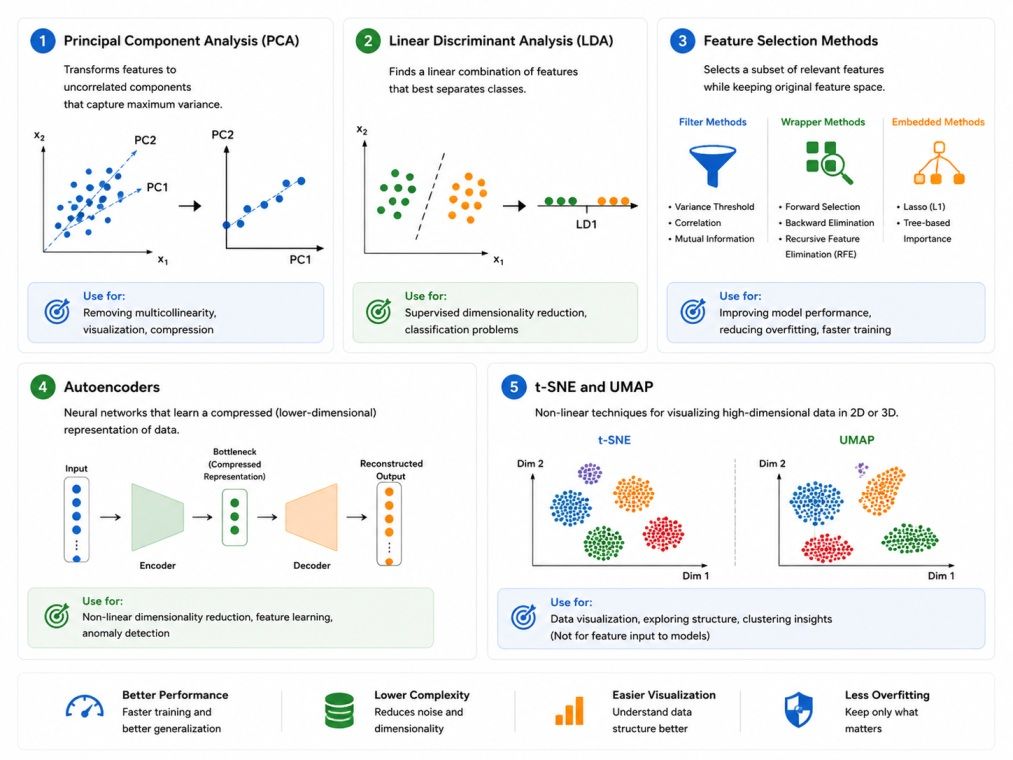
PCA is one of the most popular dimensionality reduction techniques. It transforms your original features into a new set of uncorrelated variables called principal components. These components are ordered by how much variance they explain in the data.
How it works:
Best for: Numerical data, image processing, visualisation.
Limitation: The new components are combinations of original features, so interpretability suffers.
LDA is similar to PCA but uses class labels. Instead of maximising variance, it maximises the separation between classes. This makes it a supervised technique.
Best for: Classification problems where you want to reduce features while preserving class separability.
Unlike PCA and LDA, feature selection keeps the original features intact. There are three main types.
Autoencoders are neural networks trained to compress data into a smaller representation (encoding) and then reconstruct it (decoding). The compressed middle layer captures the most important structure in the data.
Best for: High-dimensional data, image data, unstructured data.
Limitation: Needs more data and compute than traditional methods.
These are mainly used for visualisation. They reduce high-dimensional data to 2D or 3D so you can see clusters and patterns. They are not typically used for feature preparation before model training but are extremely useful during exploratory analysis.
Technique |
Type |
Best For |
Keeps Original Features? |
| PCA | Unsupervised | Numerical, image data | No |
| LDA | Supervised | Classification tasks | No |
| RFE | Supervised (wrapper) | Tabular data | Yes |
| LASSO | Supervised (embedded) | Linear models | Yes |
| Autoencoders | Unsupervised | Complex, high-dim data | No |
| t-SNE / UMAP | Unsupervised | Visualisation | No |
Knowing what is feature reduction in machine learning is one thing. Knowing which technique to use is another. Here is a practical framework to help you decide.
Do not jump to the most complex method right away. Start with a correlation matrix to spot redundant features. Then try PCA or filter selection. See how your model performs. Only move to more complex methods if simpler ones do not work.
Also Read: Explore 8 Must-Know Types of Neural Networks in AI Today!
Even experienced practitioners make these errors. Knowing them upfront saves a lot of debugging time.
Also Read: Decision Tree vs Random Forest: Use Cases & Performance Metrics
Feature reduction in machine learning is not just about making your dataset smaller. It is about making your model smarter. When you remove irrelevant and redundant features, you reduce training time, improve accuracy, and build models that are far easier to explain and maintain.
The best thing you can do is experiment. Apply a technique, measure your model's performance, and iterate. Feature reduction in machine learning is as much an art as it is a science, and the more you practice it, the better your instincts will get.
If you want to master these techniques and apply them to real-world projects, upGrad's machine learning courses cover feature engineering, dimensionality reduction, and model optimisation in depth, with hands-on projects that mirror industry workflows.
Want personalized guidance on AI and upskilling? Speak with an expert for a free 1:1 counselling session today.
Feature reduction in machine learning means reducing the number of input variables used to train a model. It keeps only the most useful features and removes noise, redundancy, and irrelevant information, leading to faster and more accurate models.
Not exactly. Feature selection picks a subset of the original features and keeps them as is. Feature reduction (dimensionality reduction) can also transform features into entirely new ones, like PCA does. Feature selection is one approach within the broader concept of feature reduction.
You should consider feature reduction when your dataset has many features relative to the number of data points, when your model is overfitting, when training is too slow, or when you need the model to be more explainable to stakeholders or regulators.
Not always. In some cases, removing features can hurt performance, especially if the removed features contained signal that the model needed. Always compare model performance before and after reduction using the same evaluation metric.
The most widely used feature reduction techniques in machine learning include PCA (Principal Component Analysis), LDA (Linear Discriminant Analysis), Recursive Feature Elimination (RFE), LASSO regression, and autoencoders. Each works best in different scenarios.
Yes. For text, techniques like TF-IDF combined with truncated SVD (Latent Semantic Analysis) reduce high-dimensional word vectors. For images, PCA and autoencoders are commonly used. Pretrained embeddings from models like BERT or ResNet also serve as a form of feature reduction.
The curse of dimensionality refers to the phenomenon where data becomes increasingly sparse as the number of dimensions grows, making it harder for models to learn meaningful patterns. Feature reduction directly combats this by lowering the number of dimensions, making the data denser and patterns more learnable.
A common approach is to look at the explained variance ratio. Most practitioners aim to retain components that together explain 90-95% of the total variance in the data. A scree plot can visually help you identify the point where adding more components gives diminishing returns.
Yes. LASSO (Least Absolute Shrinkage and Selection Operator) is an embedded feature reduction technique. It adds a penalty to the model that forces coefficients of less important features toward zero, effectively removing them from the model during training.
Absolutely. While deep learning models can learn feature representations internally, pre-applying feature reduction to tabular input data can speed up training and reduce overfitting, especially when training data is limited. Autoencoders are also used as a feature reduction step inside deep learning pipelines.
Python is the go-to language. The scikit-learn library covers PCA, LDA, RFE, and LASSO. TensorFlow and PyTorch are used for autoencoder-based reduction. UMAP-learn covers UMAP, and matplotlib or seaborn help visualise feature importance scores and variance explained plots.
98 articles published
Rahul Singh is an Associate Content Writer at upGrad, with a strong interest in Data Science, Machine Learning, and Artificial Intelligence. He combines technical development skills with data-driven s...
Speak with AI & ML expert
By submitting, I accept the T&C and
Privacy Policy
Top Resources
Master's Degree
18 Months
Executive Diploma
12 Months
IIIT Bangalore
Executive Programme in Generative AI & Agentic AI for LeadersIndia’s #1 Tech University
Dual Certification
5 Months