What is an Autoencoder in Machine Learning?
By Rahul Singh
Updated on May 06, 2026 | 10 min read | 4.83K+ views
Share:

All courses
Certifications
More
By Rahul Singh
Updated on May 06, 2026 | 10 min read | 4.83K+ views
Share:
Table of Contents
An autoencoder is a type of neural network that learns efficient data representations without using labeled data. It compresses input into a smaller form using an encoder and then reconstructs it back using a decoder.
The goal is to minimize reconstruction error so the output matches the input as closely as possible. This makes autoencoders in deep learning useful for tasks like data denoising, dimensionality reduction, and anomaly detection.
In this blog, you will learn what an autoencoder in machine learning is, how it works, its types, real-world applications, and why it matters.
Popular AI Programs
To understand this concept, you must first understand the primary goal of the system. An autoencoder is a specific type of artificial neural network used to learn highly efficient data coding entirely without human supervision.
Its main job is to take an input, actively compress it into a much smaller representation, and then reconstruct the original input as perfectly as possible.
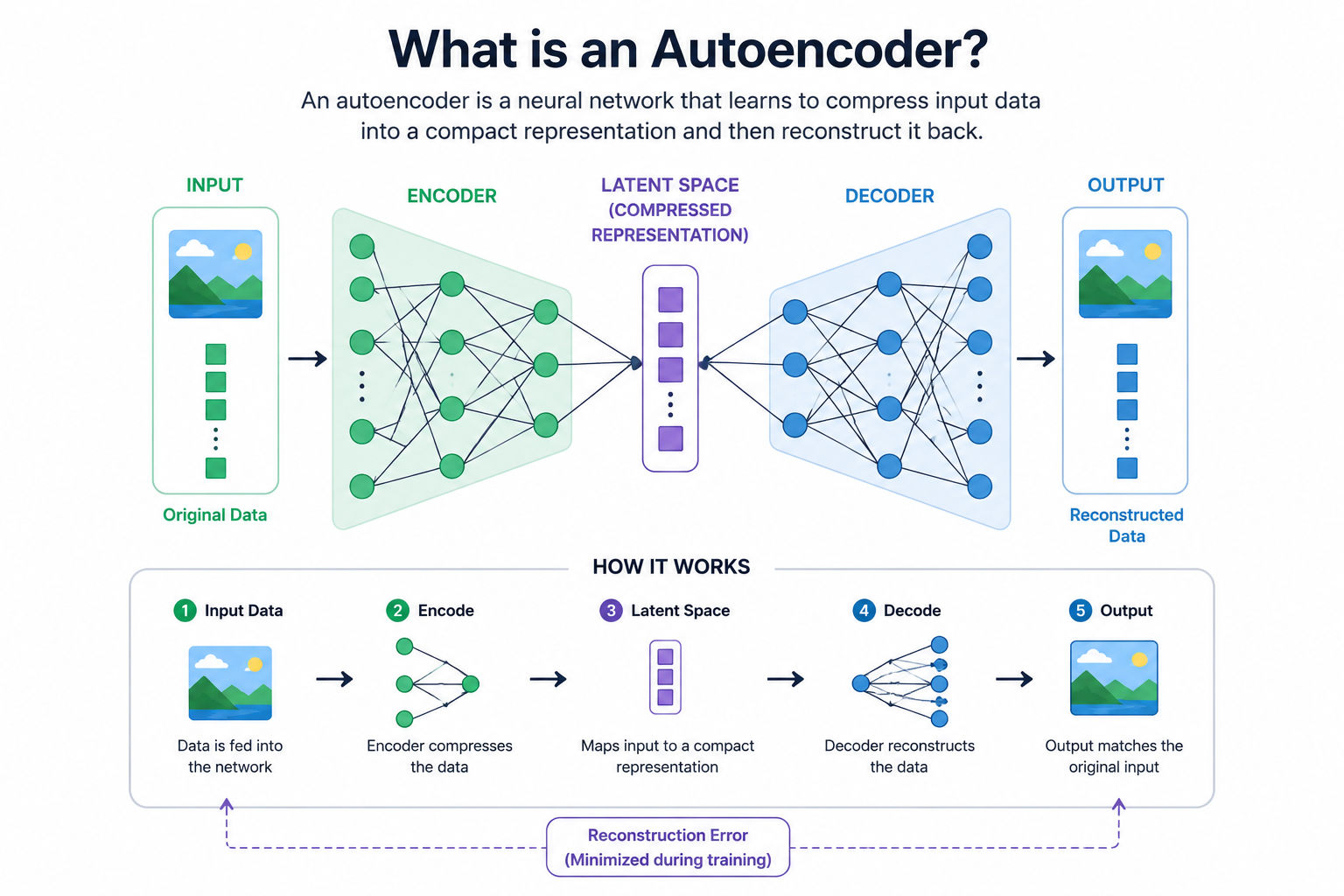
Think of it like a highly skilled sketch artist.
In technical terms, the network learns to ignore irrelevant background noise. It forces itself to discover the absolute core features that define a piece of data.
Also Read: Isolation Forest Algorithm for Anomaly Detection
Autoencoders in deep learning are useful because they:
Unlike traditional compression methods, an autoencoder learns how to compress data based on patterns rather than fixed rules.
Also Read: Types of Algorithms in Machine Learning: Uses and Examples
Free Courses
The physical structure of an autoencoder is surprisingly simple once you break it down into pieces. It always consists of three primary interconnected parts.
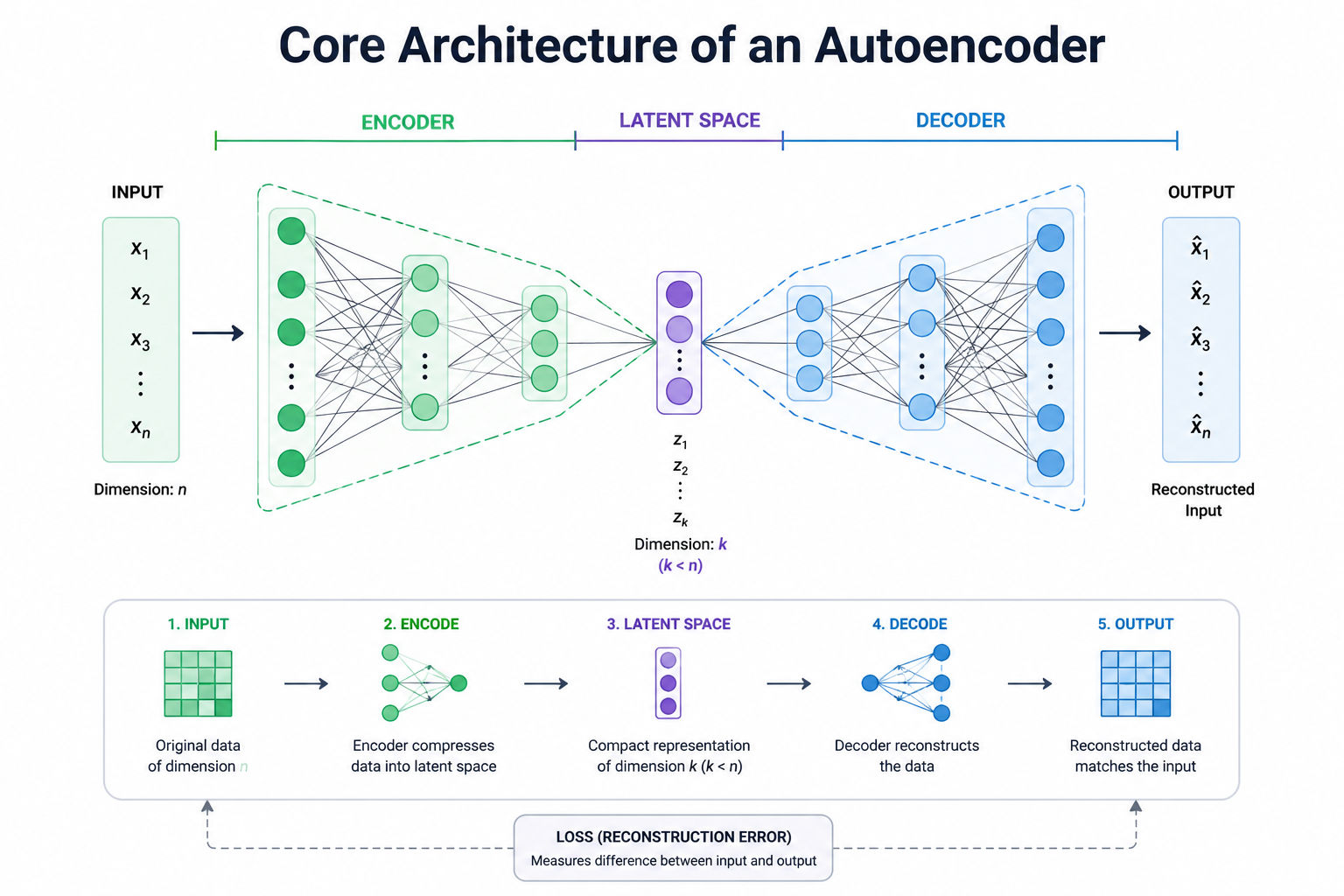
Here is a simple table showing the exact flow of data through the system:
| Stage | Action | Data Size |
| Input Data | Raw information enters the system | Large |
| Encoder | System compresses the data heavily | Shrinking |
| Bottleneck | Core features are fully isolated | Tiny |
| Decoder | System rebuilds the data outward | Expanding |
| Output Data | Final reconstructed information | Large |
If you simply passed data straight through a network without the bottleneck, the system would just copy the data mindlessly. It would learn absolutely nothing. The bottleneck strictly forces the autoencoder to drop useless information and memorize only what truly matters.
Also Read: Learning Models in Machine Learning: 16 Key Types and How They Are Used
AI Courses to upskill
Explore Artificial Intelligence Courses for Career Progression
There are several types of autoencoder models, each built to solve a specific problem. You choose the type based on your data and task. Understanding these helps you apply autoencoders in deep learning more effectively.
This is the simplest type of autoencoder. It focuses on learning how to compress and reconstruct data without adding extra constraints or complexity.
Also Read: Data Preprocessing in Machine Learning: 11 Key Steps You Must Know!
This type adds a constraint so that only a few neurons activate at a time. This forces the model to learn more meaningful and efficient features.
This model is trained to recover clean data from noisy input. It learns to ignore noise and focus on important patterns.
Also Read: 15 Dimensionality Reduction in Machine Learning Techniques
This type is designed for image and visual data. It uses convolutional layers to capture spatial patterns and structure.
This is a more advanced version that learns data distributions instead of just reconstruction. It is widely used in generative tasks.
Type |
Main Use Case |
Complexity |
| Basic Autoencoder | Simple compression | Low |
| Sparse Autoencoder | Feature learning | Medium |
| Denoising Autoencoder | Noise removal | Medium |
| Convolutional Autoencoder | Image processing | High |
| Variational Autoencoder | Data generation | High |
Autoencoders in deep learning are flexible, and each type solves a different problem effectively.
Also Read: Image Classification in CNN: Everything You Need to Know
Autoencoder models are used in many real-world systems where labeled data is limited. They learn patterns directly from data, which makes them useful for compression, detection, and feature learning.
You can apply autoencoders in deep learning across domains like healthcare, finance, and media.
Autoencoders can reduce image size while keeping important details. This helps you store and transmit data more efficiently.
They learn a compact representation of images and reconstruct them with minimal loss.
Example: Compress large image datasets without losing key visual features
Also Read: Feature Engineering for Machine Learning: Methods & Techniques
Denoising autoencoders remove unwanted noise from data. They learn to recover clean signals from corrupted inputs.
This is useful when data quality is poor or affected by external factors.
Example:
Autoencoders detect unusual patterns by measuring reconstruction error. If the model cannot reconstruct data well, it flags it as abnormal.
Example: Detect fraudulent transactions in financial systems
Also Read: Difference Between Anomaly Detection and Outlier Detection
Autoencoders in deep learning are used to extract meaningful features from raw data. They reduce complexity while keeping important information.
This helps improve performance in other models.
Example:
Autoencoders help understand user preferences by learning hidden patterns in user behavior. This improves recommendation accuracy.
They work well when explicit feedback is limited.
Example: Suggest products or content based on user activity
Also Read: Automated Machine Learning Workflow: Best Practices and Optimization Tips
Autoencoder models are useful for learning patterns and compressing data without labels. They work well in many tasks, but they also have limitations you need to consider before using them in real projects.
Aspect |
Advantages |
Limitations |
| Learning type | Works without labeled data | May learn trivial patterns |
| Data handling | Reduces dimensionality | Sensitive to data quality |
| Flexibility | Used in multiple tasks | Needs careful tuning |
| Performance | Captures complex patterns | Can overfit easily |
| Scalability | Handles large datasets | Training can be slow |
| Applications | Works in vision, audio, and text | Not ideal for all supervised tasks |
| Output quality | Good reconstruction ability | Reconstruction may not always be accurate |
This helps you decide when an autoencoder fits your use case and when you should consider other models.
Also Read: Applied Machine Learning: Workflow, Models, and Uses
Subscribe to upGrad's Newsletter
Join thousands of learners who receive useful tips
An autoencoder is a simple yet powerful neural network that learns to compress and reconstruct data. It plays a key role in unsupervised learning and is widely used for tasks like feature extraction, anomaly detection, and noise reduction.
As you explore autoencoders in deep learning, start with basic models and gradually move to advanced ones like variational autoencoders. With practice, you will understand how to apply them effectively in real-world problems.
Want personalized guidance on Machine Learning and upskilling? Speak with an expert for a free 1:1 counselling session today.
An autoencoder is used to learn compressed representations of data and reconstruct it. It is widely applied in tasks like data compression, noise removal, anomaly detection, and feature extraction. These capabilities make it useful in real-world AI systems dealing with large and complex datasets.
A CNN is not an autoencoder by default, but it can be used to build one. Convolutional layers are often used inside autoencoder architectures for image data. This helps capture spatial features and improves performance in visual tasks like image reconstruction.
Yes, an autoencoder is an AI model and a type of neural network. It learns patterns from data without labels by encoding and decoding input. It is commonly used in unsupervised learning tasks within machine learning and deep learning systems.
ChatGPT is based on a decoder architecture. It generates text by predicting the next word in a sequence. Unlike autoencoders, it focuses on generation rather than reconstruction of input data.
Autoencoders in deep learning focus on learning data representations without labels, while traditional models often rely on supervised learning. They are designed to reconstruct input data and extract meaningful features, making them useful for tasks like compression and anomaly detection.
No, large language models are not autoencoders. They are designed for sequence prediction and text generation. While both use neural networks, their goals are different. Autoencoders reconstruct input data, while LLMs generate new content.
LSTM is not an autoencoder by itself. It is a type of recurrent neural network used for sequence data. However, LSTM layers can be used within an autoencoder architecture for tasks like time-series reconstruction.
Autoencoders in deep learning help handle large and complex datasets without requiring labels. They are widely used for feature learning, anomaly detection, and data compression, making them valuable in industries like healthcare, finance, and cybersecurity.
Yes, certain types like variational autoencoders can generate new data. They learn the distribution of input data and create new samples based on it. This makes them useful in generative tasks like image creation.
Autoencoders in deep learning reduce high-dimensional data into a compact latent representation. This helps simplify data while preserving important features, making it easier for other models to process and analyze effectively.
Autoencoders and PCA both reduce data dimensions, but they work differently. PCA is a linear method, while autoencoders can learn non-linear patterns using neural networks. This makes autoencoders more powerful for complex datasets where relationships are not strictly linear.
98 articles published
Rahul Singh is an Associate Content Writer at upGrad, with a strong interest in Data Science, Machine Learning, and Artificial Intelligence. He combines technical development skills with data-driven s...
Speak with AI & ML expert
By submitting, I accept the T&C and
Privacy Policy
Top Resources
Master's Degree
18 Months
Executive Diploma
12 Months
IIIT Bangalore
Executive Programme in Generative AI & Agentic AI for LeadersIndia’s #1 Tech University
Dual Certification
5 Months