SHAP in Machine Learning: A Complete Guide
By Sriram
Updated on Jul 07, 2026 | 5 min read | 7.39K+ views
Share:

All courses
Certifications
More
By Sriram
Updated on Jul 07, 2026 | 5 min read | 7.39K+ views
Share:
SHAP is a game theory-based method for explaining machine learning model predictions. It assigns a contribution score to each feature by measuring how much it influences a specific prediction. This approach fairly distributes credit among all input features, providing clear local explanations while maintaining a strong mathematical foundation. As a result, SHAP helps make complex AI models more transparent, interpretable, and trustworthy.
In this blog, you'll learn what SHAP in machine learning is, how it works, its mathematical foundations, common visualization techniques, practical applications, benefits, challenges, and future relevance in explainable AI.
Ready to understand how AI models make decisions? Join upGrad's Machine Learning to gain practical experience with SHAP, explainable AI, model evaluation, and advanced.
Popular AI Programs
SHAP stands for SHapley Additive exPlanations, a framework used to explain machine learning predictions.
The method assigns an importance value to every feature involved in a prediction. These values indicate how much each feature contributed to pushing the prediction higher or lower compared to a baseline prediction.
Unlike many explainability techniques that provide approximate insights, SHAP is grounded in a strong mathematical framework, making its explanations more consistent and reliable.
As machine learning systems became increasingly complex, organizations needed ways to understand:
SHAP addresses these challenges by offering both local and global model explanations.
Also Read : Markov Random Fields in Machine Learning: A Complete Guide
Free Courses
The origins of SHAP can be traced back to cooperative game theory.
Imagine a team participating in a competition and winning a reward. Determining how much each member contributed to that success can be difficult. Game theory provides a method for calculating a fair contribution score for every participant.
SHAP applies this same concept to machine learning models.
In a machine learning model:
SHAP evaluates how much each feature contributes to the final prediction by examining different combinations of features and measuring their impact on the result.
This approach helps determine the true influence of each variable on model behavior.
Also read: Introduction to Machine Learning for Beginners: What is, History, Function & Classification
SHAP follows key mathematical principles that ensure feature contributions are fair,
consistent, and easy to interpret.
Core Principle |
Description |
| Local Accuracy (Efficiency) | The total SHAP values equal the difference between the prediction and the baseline value. |
| Consistency (Symmetry) | Features with equal influence receive the same SHAP value, and more influential features never receive lower importance. |
| Missingness (Dummy Property) | Features that do not affect the prediction receive a SHAP value of zero. |
| Additivity | SHAP values from multiple models can be combined to explain ensemble model predictions. |
Must read: 9 Important Machine Learning Benefits You Should Know
AI Courses to upskill
Explore Artificial Intelligence Courses for Career Progression
SHAP explains a model's prediction by measuring how each feature contributes to the final outcome. It compares different combinations of features to determine the individual impact of every variable.
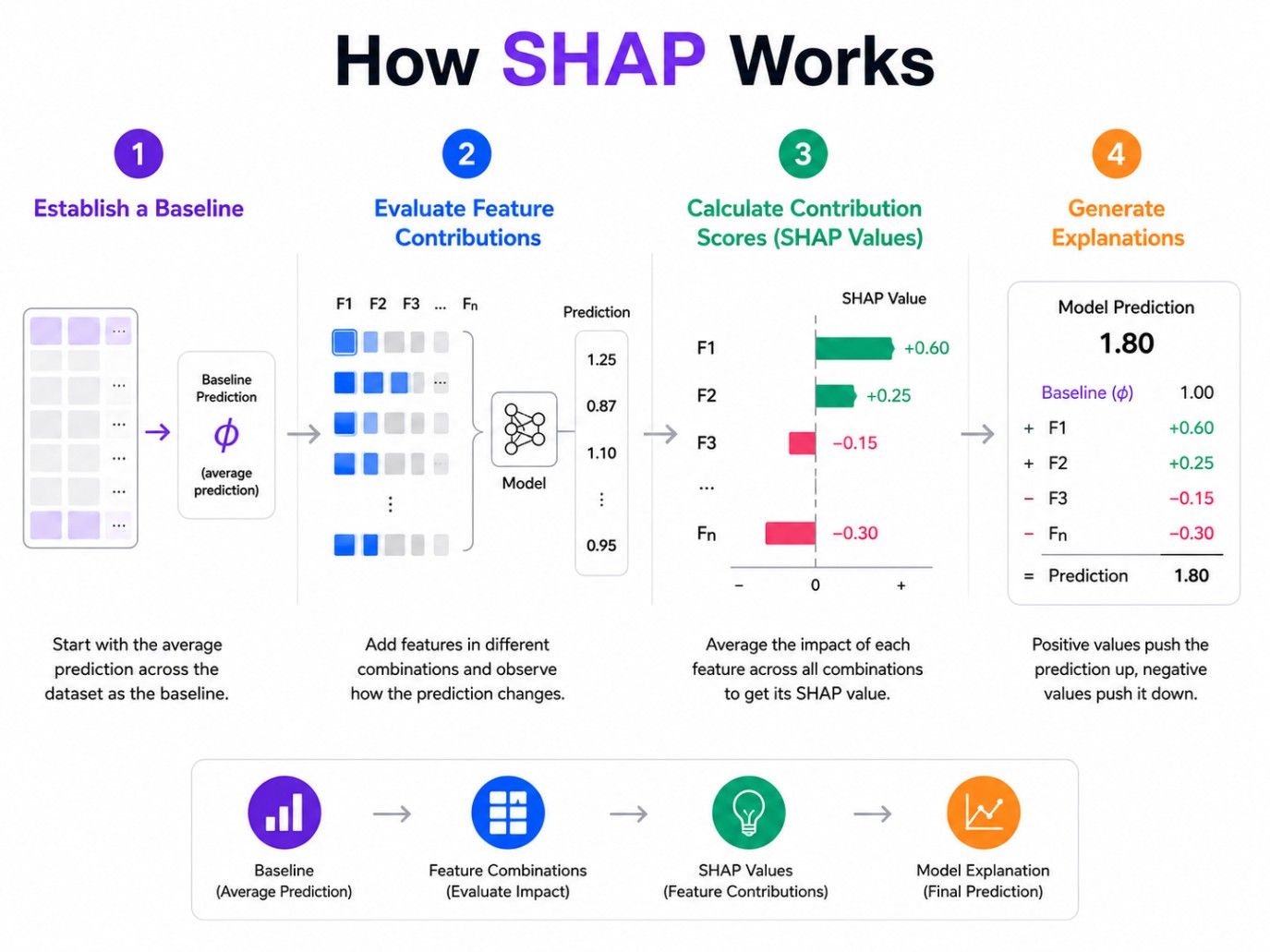
SHAP begins by calculating the model's average prediction across the entire dataset. This baseline acts as the starting point for measuring feature contributions.
Key Outcome: Creates a reference value for all explanations.
The algorithm evaluates how the prediction changes when each feature is added to different feature combinations. This helps determine the influence of every variable.
Key Takeaway: Identifies the individual impact of each feature on the prediction.
SHAP computes the average contribution of each feature across all possible combinations. These contribution scores are known as SHAP values.
Key Outcome: Assigns a fair importance score to every feature.
The individual SHAP values are combined to explain the model's prediction. Positive values increase the prediction, while negative values decrease it.
Key Takeaway : Produces a transparent explanation showing how each feature influenced the final prediction.
Baseline Prediction → Measure Feature Contributions → Calculate SHAP Values → Generate Model Explanation
Take your machine learning skills beyond model building. Enroll in upGrad's AI and Machine Learning programs
Master of Science in Machine Learning & AI from LJMU
Executive Post Graduate Programme in Applied AI and Agentic AI
One of the biggest strengths of SHAP in machine learning is its ability to explain both individual predictions and the overall behavior of a model. Local and global interpretability serve different purposes, helping users understand AI decisions at different levels.
Aspect |
Local Interpretability |
Global Interpretability |
| Purpose | Explains why the model made a specific prediction. | Explains how the model behaves across the entire dataset. |
| Focus | A single data instance or prediction. | Overall model performance and feature importance. |
| Insights | Shows how each feature influenced an individual prediction. | Identifies the most influential features and overall trends. |
| Best Used For | Loan approvals, medical diagnoses, fraud detection, customer-specific predictions. | Feature importance analysis, model validation, bias detection, and business insights. |
| Common SHAP Plots | Waterfall Plot, Force Plot | Summary (Beeswarm) Plot, Dependence Plot |
This format is more concise, visually appealing, and easier for readers to compare than separate text sections.
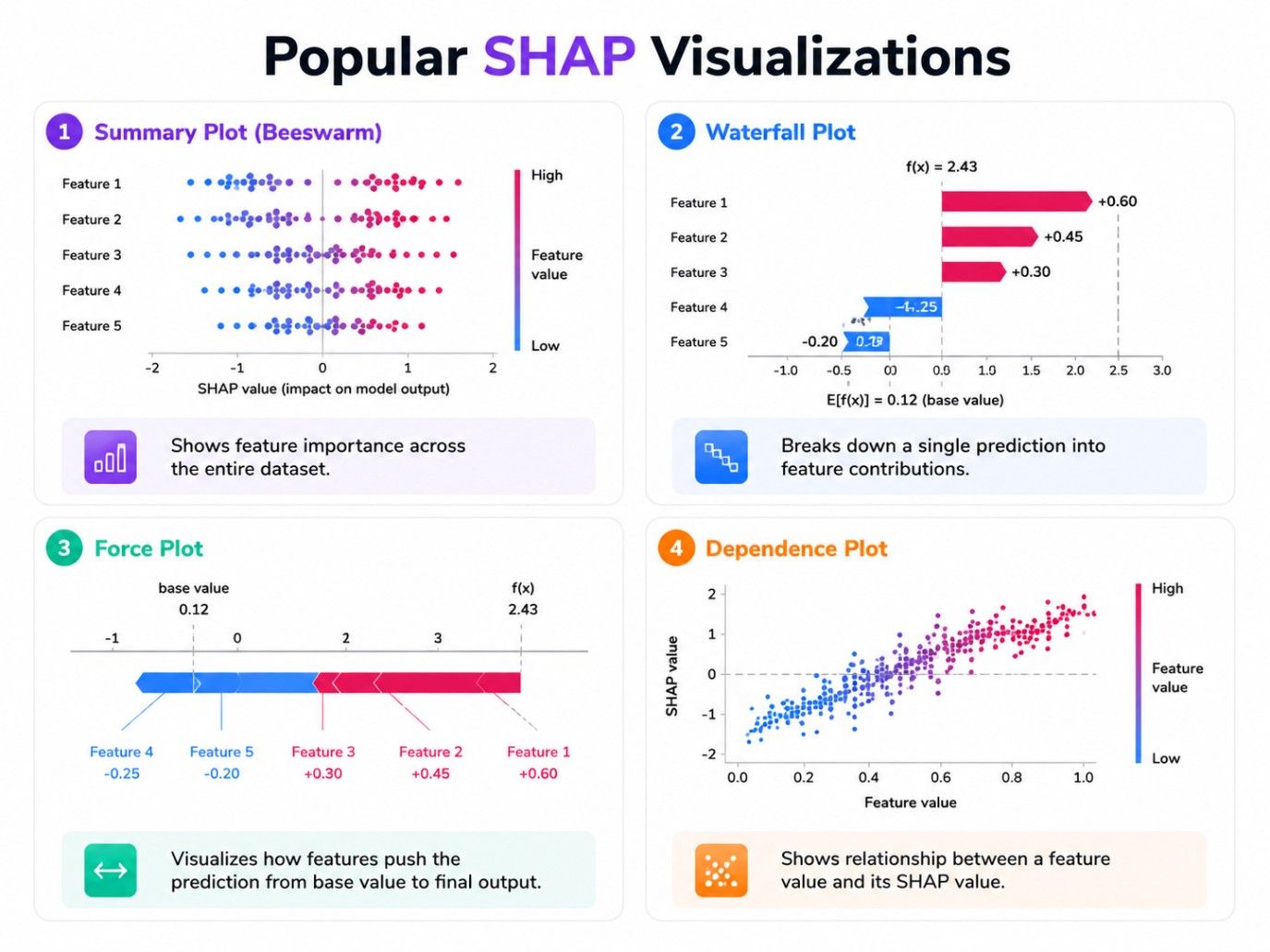
A waterfall plot explains a single prediction step by step.
The chart begins with a baseline prediction and shows how individual features move the prediction higher or lower until the final result is reached.
Best used for:
A force plot visualizes prediction contributions as opposing forces.
Some features push predictions upward, while others pull them downward.
Best for:
Summary plots provide an overview of feature importance across an entire dataset.
They display:
Best used for:
A dependence plot shows the relationship between a feature's value and its SHAP contribution.
These plots help identify:
Best for:
Calculating exact SHAP values can become computationally expensive as the number of features increases. To make explanations more efficient, SHAP provides specialized explainers optimized for different machine learning algorithms.
Explainer |
Best Used For |
Key Advantages |
| Tree Explainer | XGBoost, LightGBM, CatBoost, |
Extremely fast, highly accurate, and provides exact SHAP values for tree-based models |
| Deep Explainer | Neural Networks, TensorFlow Models, PyTorch Models | Optimized for deep learning architectures and faster than generic explainability methods |
| Kernel Explainer | SVMs, KNN Models, Custom Pipelines, Black-Box Models | Flexible, model-agnostic, and compatible with nearly all machine learning models |
Each SHAP explainer is designed for specific model types and use cases. Selecting the appropriate explainer helps improve computational efficiency, generate more accurate explanations, and gain deeper insights into model behavior without sacrificing interpretability.
Read: Image Recognition Machine Learning: Brief Introduction
As machine learning models become more integrated into critical business operations, understanding why a model makes a specific prediction is just as important as the prediction itself. SHAP in machine learning enables organizations to build transparent, trustworthy, and explainable AI systems across various industries.
Financial institutions increasingly rely on artificial intelligence in banking to improve fraud detection, credit scoring, and customer experience. SHAP complements these AI systems by making their predictions transparent and easier to interpret.
SHAP helps banks comply with regulatory requirements while providing clear explanations for automated financial decisions.
Healthcare organizations rely on SHAP to make AI-driven medical predictions more interpretable for doctors and patients.
Medical professionals can better understand AI recommendations, leading to improved patient care and greater trust in predictive healthcare systems.
Online retailers use SHAP to understand customer behavior and optimize business strategies.
SHAP reveals the factors influencing customer decisions, helping businesses deliver more personalized experiences and increase conversions.
Insurance companies use SHAP to make risk assessments and policy decisions more transparent.
Explainable predictions improve customer trust and help insurers justify important business decisions.
Modern cybersecurity systems generate thousands of alerts daily. SHAP helps analysts understand which factors contribute to security threats.
Security teams can quickly identify the root causes of threats and respond more effectively to potential attacks.
Also Read: Machine Learning Tutorial: Basics, Algorithms, and Examples Explained
Organizations increasingly use AI in talent management and workforce planning.
SHAP helps HR teams understand the factors influencing predictions and promotes fair, unbiased hiring and employee management practices.
Manufacturers use SHAP to improve operational efficiency and reduce equipment failures.
By identifying the factors contributing to equipment failures, organizations can reduce downtime and maintenance costs.
Across industries, the primary value of SHAP lies in its ability to transform complex machine learning models into understandable and trustworthy systems. Whether explaining a loan rejection, diagnosing a medical condition, detecting fraud, or predicting equipment failure, SHAP enables organizations to make AI decisions more transparent, accountable, and actionable.
Also Read: Machine Learning Tools: A Guide to Platforms and Applications
SHAP provides several advantages for organizations adopting AI solutions.
Benefit |
Impact |
| Model Transparency | Helps understand prediction logic |
| Regulatory Compliance | Supports explainable decision-making |
| Better Trust | Increases confidence in AI systems |
| Feature Insights | Reveals important variables |
| Bias Detection | Helps identify unfair model behavior |
| Model Debugging | Simplifies error analysis |
These benefits make SHAP one of the most widely adopted explainability frameworks
in modern machine learning.
Read : Weka Machine Learning: A Complete Guide for Beginners
The demand for explainable AI continues to grow across industries.
Future developments are expected to focus on:
As AI adoption expands, SHAP will likely remain a critical component of trustworthy machine learning systems.
SHAP in machine learning is one of the most effective techniques for explaining AI model predictions. It assigns contribution scores to each feature, helping users understand how different inputs influence individual outcomes while making complex models more transparent and easier to interpret.
With its strong mathematical foundation, support for local and global explanations, and compatibility across many machine learning algorithms, SHAP is widely adopted in data science. As explainable AI becomes increasingly important, SHAP will remain a key tool for building fair, reliable, and trustworthy AI systems.
Want to explore SHAP in machine learning? Book your free 1:1 personal consultation with our expert today.
Feature importance tells you which variables matter overall, but it does not explain individual predictions. SHAP is a better choice when you need to understand why a model produced a specific result. It is especially useful in finance, healthcare, and fraud detection, where every prediction must be explained clearly to users, regulators, or business teams.
Yes. SHAP supports deep learning models through methods such as Deep SHAP and Gradient SHAP. These approaches estimate how input features contribute to predictions in neural networks. While they may require more computational resources than tree-based models, they still provide valuable insights into complex AI systems.
Yes, but it depends on your use case. Many organizations use SHAP in machine learning during model validation, monitoring, and debugging rather than generating explanations for every prediction in real time. This approach balances explainability with performance while helping teams detect unexpected model behavior after deployment.
SHAP works by comparing a prediction against a baseline value and calculating how much each feature changes the final outcome. It evaluates different feature combinations using game theory to assign fair contribution scores. The combined SHAP values explain exactly why a prediction increased or decreased compared to the average prediction.
No. SHAP does not change how a model learns or improve prediction accuracy. Instead, it improves your understanding of model behavior. By identifying misleading features, data quality issues, or unexpected patterns, SHAP can help you refine your model and make better decisions during development.
SHAP cannot remove bias directly, but it can reveal whether sensitive features or related variables influence predictions unfairly. By comparing SHAP values across different user groups, you can identify patterns that may require further investigation and improve the fairness of your machine learning workflow.
In large language models, SHAP can estimate how different input tokens or phrases influence a prediction or classification task. While it is less common for generative text outputs, researchers often use SHAP to explain sentiment analysis, text classification, and question-answering models built with transformer architectures.
Although SHAP in machine learning provides detailed explanations, it can become computationally expensive for large datasets or highly complex models. Results may also vary depending on the SHAP method used. Choosing the right explainer and validating explanations with domain knowledge helps ensure meaningful interpretation.
XGBoost is a gradient boosting algorithm known for high performance on structured data. SHAP is commonly paired with XGBoost because Tree SHAP efficiently calculates feature contributions for tree-based models. This combination allows data scientists to understand both overall feature importance and individual prediction explanations with high accuracy.
SHAP is an explainability framework that helps interpret predictions from AI models by assigning each feature a contribution score. It works across many algorithms, including decision trees, ensemble models, and neural networks. This makes it easier to build transparent AI systems and explain model decisions to technical and non-technical stakeholders.
Neither tool is universally better. SHAP provides consistent explanations backed by game theory and supports both local and global interpretation. LIME is often faster for quick local explanations. Your choice depends on whether you need mathematical consistency, scalability, or faster approximations for your machine learning project.
730 articles published
Sriram K is a Senior SEO Executive with a B.Tech in Information Technology from Dr. M.G.R. Educational and Research Institute, Chennai. With over a decade of experience in digital marketing, he specia...
Speak with AI & ML expert
By submitting, I accept the T&C and
Privacy Policy
Top Resources
Master's Degree
18 Months
Executive Diploma
12 Months
IIIT Bangalore
Executive Programme in Generative AI & Agentic AI for LeadersIndia’s #1 Tech University
Dual Certification
5 Months