Data Cleaning in Machine Learning: A Complete Guide
By Sriram
Updated on Oct 21, 2026 | 12 min read | 3.45K+ views
Share:

All courses
Certifications
More
By Sriram
Updated on Oct 21, 2026 | 12 min read | 3.45K+ views
Share:
Table of Contents
Quick Overview
This blog walks you through everything you need to know about data cleaning in machine learning. You will learn what it means, why it matters, the exact steps involved, common techniques, tools, and even a Python walkthrough you can follow along with. By the end, you will have a clear, practical understanding of how to clean data the right way, whether you are a student, an analyst, or someone just starting out in machine learning.
Want to build models that hold up on real-world data, not just in practice notebooks? Take your first step with upGrad’s Machine Learning courses and learn Python, data preparation and model building through practical projects.
Popular AI Programs
So, what is data cleaning in machine learning, exactly? It is the process of detecting and correcting inaccurate, incomplete, or irrelevant parts of a dataset. This includes handling missing values, removing duplicate rows, correcting incorrect labels, and ensuring the data is consistent across the board.
In simple terms, data cleaning in machine learning means preparing your raw data so it becomes usable and trustworthy. Real-world data is unclean and may have errors and irregularities. It comes from different sources, different formats, and often different people entering it manually. That means errors are unavoidable. Data cleaning is the process of catching and fixing errors before they affect your model.
Here is a simple way to think about it. If you were baking a cake, you would not use spoiled eggs or expired flour. Data cleaning works the same way. You are checking your ingredients, in this case, your data, before you use them to build something.
Also Read: Data Cleaning Techniques
People often confuse data cleaning with data preprocessing in machine learning, but they are not quite the same thing. Data cleaning is actually a part of data preprocessing, not the whole thing.
Think of data cleaning as one important stage inside the larger preprocessing pipeline.
Also Read: The Importance of Data Quality in Big Data Analytics
Data wrangling is a wider term that includes cleaning, but also involves reshaping, merging, and transforming data into a format that is ready for analysis.
Data cleaning fixes what is wrong with the data. Data wrangling changes the shape and structure of the data to fit your needs. Cleaning is one part of the wrangling process, not a replacement for it.
Data transformation changes the format or structure of data, such as converting units, changing date formats, or combining columns.
Data cleaning, on the other hand, deals with correcting errors and inconsistencies. You usually clean your data first, then transform it into the shape your model needs.
Feature engineering is about creating new, useful variables from existing data to help a model perform better. Data cleaning happens before this step.
You cannot build strong features on top of messy, incomplete, or incorrect data. Clean data first, then engineer features on top of it.
Data cleaning in data mining follows the same core idea as in machine learning. It means removing noise, fixing missing values, and resolving inconsistencies before patterns are extracted from large datasets. Since data mining also depends heavily on data quality, the cleaning techniques used in both fields overlap significantly.
Free Courses
Before you can fix a dataset, you need to know what you are looking for. Most raw datasets suffer from a similar set of problems. Recognizing these early makes the cleaning process much faster.
Issue |
What It Looks Like |
Why It Matters |
| Missing values | Empty cells or null entries | Can bias results or break model training |
| Duplicate records | Same row appearing more than once | Skews statistics and overweights certain data |
| Outliers | Values far outside the normal range | Can distort averages and model predictions |
| Inconsistent formats | Dates written as DD/MM/YYYY and MM/DD/YYYY in the same column | Causes errors during analysis |
| Structural errors | Typos, inconsistent capitalization, extra spaces | Creates false categories |
| Irrelevant data | Columns or rows that do not relate to the problem | Adds noise and slows down processing |
These issues rarely show up alone. Most real datasets have a mix of several problems at once. That is exactly why a structured data cleaning process matters, which we will cover next.
Knowing how to clean and prepare data is a core skill every machine learning professional needs, but it's just the beginning. Executive Programme in Generative AI for Leaders can help you build on it. The program covers everything from core Python and data handling to building, deploying, and scaling real-world ML and AI systems, including MLOps pipelines, Generative AI, and Agentic AI applications.
AI Courses to upskill
Explore Artificial Intelligence Courses for Career Progression
The importance of data cleaning in machine learning comes down to one simple fact: models learn from data, and bad data teaches bad lessons. If your dataset is full of errors, your model will pick them up and repeat them in its predictions.
Dirty data or unclean data does not just slow things down. It actively hurts model performance in specific ways:
In short, a model trained on dirty data might look fine during testing but fail badly once it meets real-world data. This is one of the most common reasons machine learning projects fail after deployment.
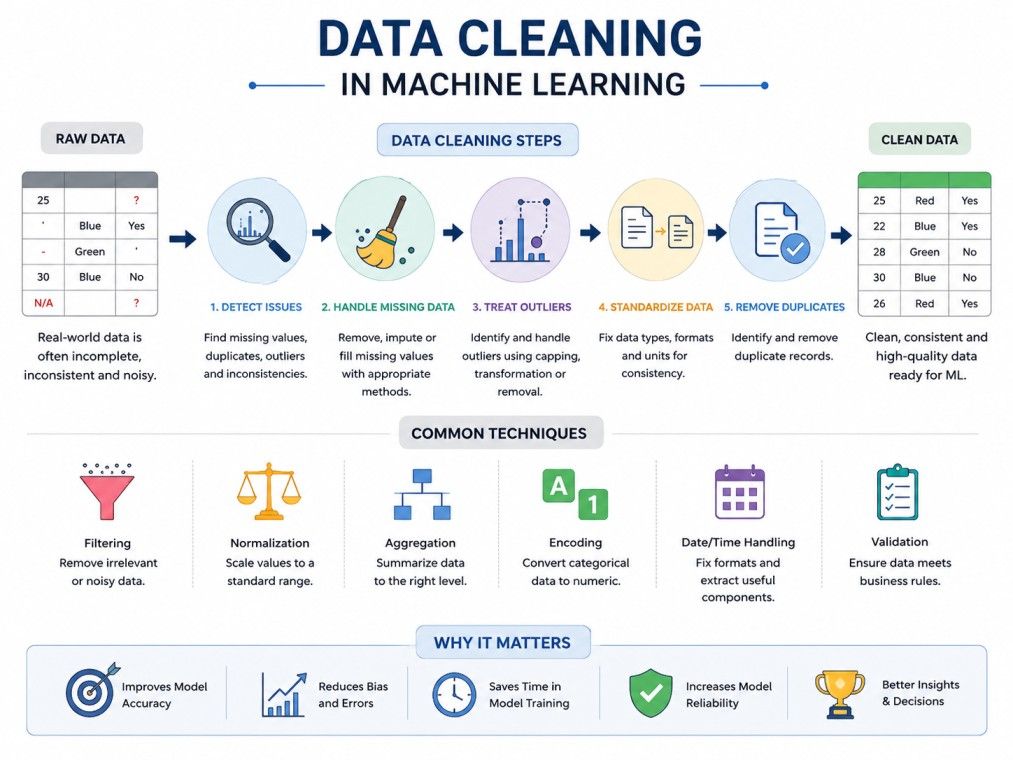
The data cleaning process in machine learning follows a fairly consistent set of steps, regardless of the industry or dataset you are working with. Following the right data cleaning steps in machine learning helps you avoid missing something important.
Before fixing anything, you need to understand your data. This means:
This step gives you a map of what needs to be fixed.
Not every row or column belongs in your dataset. You should remove:
This keeps your dataset focused and easier to work with.
Structural errors are small but common. They include typos, inconsistent capitalization, and extra white spaces. For example, "New York", "new york", and "NewYork" might all refer to the same city but get treated as three different categories if left uncleaned. Standardizing text formatting fixes this.
Missing data is one of the most common problems you will face. There are a few standard ways to deal with it:
Common imputation methods include:
Mean imputation replaces missing values with the column's mean. Median imputation replaces them with the middle value. The median is usually the safer choice when your data has outliers, since extreme values can pull the mean in one direction, while the median stays more stable.
Outliers are values that sit far outside the normal range of your data. You can detect them using:
Once found, you can remove them, cap them at a reasonable limit, or investigate whether they are genuine data points that should stay.
Duplicate rows inflate your dataset and can cause a model to overweight certain patterns. Most tools, including pandas, make it simple to find and drop exact duplicate rows in a few lines of code.
These techniques adjust numeric values so they are on a similar scale. Normalization rescales data to a fixed range, usually 0 to 1. Standardization adjusts data to have a mean of 0 and a standard deviation of 1. Both help models that are sensitive to the scale of input features, such as k-nearest neighbors and gradient-based algorithms.
Feature scaling is closely related to normalization and standardization. It ensures that no single feature dominates a model simply because it has larger numeric values. For example, a column measuring income in thousands should not overpower a column measuring age in years simply because of differences in scale.
In classification problems, one class sometimes appears far more often than another. For example, in fraud detection, genuine transactions vastly outnumber fraudulent ones. This is called class imbalance, and it can cause models to ignore the minority class entirely. Common fixes include:
Once the cleaning is done, you need to double-check your work. This means confirming that:
Also Read: Data Validation in Excel
Use this quick checklist before moving on to model building:
Some cleaning steps, such as fixing typos or removing duplicates, can occur before splitting. But steps involving statistics, such as imputing missing values with the mean, should occur after splitting. This prevents information from leaking from the test set into your training process, which can make your model appear better than it actually is.
There are several data-cleaning techniques in machine learning that go beyond the basic steps outlined above. These data cleaning methods apply to specific types of columns and problems you will run into again and again.
Categorical columns often have inconsistent entries. Common fixes include:
Noisy data refers to random errors or irrelevant variation in your dataset. You can reduce noise by:
Dates, phone numbers, and currency values are common places where formatting breaks down. A date column mixing formats like "01/02/2024" and "2024-02-01" will cause errors during analysis. Standardizing every column to one consistent format solves this before it becomes a bigger problem.
Beyond individual techniques, it helps to think about data cleaning at a strategy level. Different situations call for different approaches:
Most real projects use a mix of all three, depending on the dataset's size and complexity.
Subscribe to upGrad's Newsletter
Join thousands of learners who receive useful tips
Even experienced practitioners make mistakes during cleaning. Watch out for these common errors:
Avoiding these mistakes saves significant time down the line and prevents your model from learning the wrong lessons.
Should you clean data by hand or use automated tools? The answer depends on your dataset size and complexity.
Factor |
Manual Cleaning |
Automated Cleaning |
| Best for | Small, simple datasets | Large or repetitive datasets |
| Speed | Slower | Much faster |
| Control | High, you review every change | Lower, but consistent |
| Risk of human error | Higher | Lower, if rules are set correctly |
| Skill required | Basic spreadsheet or coding knowledge | Familiarity with tools or scripts |
In practice, most professionals use a combination. Automated tools handle the repetitive, large-scale fixes, while manual review catches edge cases the tools might miss.
Python is by far the most popular language for data cleaning in machine learning python workflows, mainly because of libraries like pandas and NumPy. Let us walk through a simple example.
Step-by-Step Python Code Walkthrough
Step 1: Import libraries and load the dataset
import pandas as pd
df = pd.read_csv("data.csv")
print(df.head())
Step 2: Check for duplicate rows
print(df.duplicated().sum())
df = df.drop_duplicates()
Step 3: Check missing values as a percentage
missing_percent = df.isnull().mean() * 100
print(missing_percent)
Step 4: Handle missing data
df['age'] = df['age'].fillna(df['age'].median())
df = df.dropna(subset=['important_column'])
Step 5: Detect outliers using IQR
Q1 = df['income'].quantile(0.25)
Q3 = df['income'].quantile(0.75)
IQR = Q3 - Q1
lower = Q1 - 1.5 * IQR
upper = Q3 + 1.5 * IQR
df = df[(df['income'] >= lower) & (df['income'] <= upper)]
Step 6: Validate the final dataset
print(df.info())
print(df.isnull().sum())
This simple sequence covers most of what you need for a basic cleaning pass. Real projects often add more steps depending on the dataset.
While Python code gives you full control, several dedicated data cleaning tools can speed up the process, especially for non-coders or very large datasets.
Tool |
Best For |
| pandas | Coding-based cleaning in Python, most flexible option |
| OpenRefine | Cleaning messy, inconsistent text data without code |
| Trifacta Wrangler | Visual, drag-and-drop data cleaning for large datasets |
| DataCleaner | Profiling and cleaning enterprise-level data |
If you are looking for the best Python libraries for data cleaning in machine learning, pandas remains the top choice, followed by NumPy for numerical operations and scikit-learn for imputation and preprocessing utilities.
Different types of data need slightly different cleaning approaches.
For natural language processing tasks, cleaning usually includes:
For image data, cleaning focuses on:
Time series data needs its own set of checks:
Let us look at a simple data cleaning example to tie everything together. Imagine a dataset of customer orders with the following issues:
Here is how you would clean it:
This is a small example, but it shows the same logic that applies to much larger, real-world datasets.
Like any process, data cleaning comes with trade-offs worth understanding.
Despite these downsides, the benefits of data cleaning almost always outweigh the costs. Skipping it tends to cause bigger problems later in the project.
Conclusion
Data cleaning in machine learning is one of the most important parts of a project. Every step, from handling missing values to fixing inconsistent formats, directly affects how well your model performs. Skipping this step or rushing through it usually leads to bigger problems later, including biased predictions and unreliable results. With the right techniques, tools like pandas and OpenRefine, and a bit of practice, you can turn messy, unreliable data into something your model can actually learn from.
Want personalized guidance on Data Science and upskilling? Speak with an expert for a free 1:1 counselling session today.
Data cleaning in machine learning is the process of finding and fixing errors, missing values, and inconsistencies in a dataset. It ensures the data used to train a model is accurate and reliable, which directly improves how well the model performs on real-world tasks.
You can find helpful tutorials and reference material on platforms like GeeksforGeeks, official documentation for pandas, and Kaggle notebooks. These sources often include practical examples alongside explanations, which makes them useful for both beginners and experienced practitioners.
While this blog covers the full process in detail, you can save or print this page as a PDF for offline reference. Many educational platforms also offer downloadable guides and cheat sheets that summarize the key steps in a condensed format.
The most common data cleaning techniques include handling missing values, removing duplicates, detecting outliers, standardizing formats, and correcting inconsistent labels. Most datasets require a combination of these techniques rather than just one, depending on the type of errors present.
Yes, but it helps to also complete other preprocessing steps like feature scaling and encoding categorical variables first. Cleaning removes errors, while preprocessing prepares the data structurally, so combining both gives your model the best possible starting point.
Besides Python libraries like pandas, popular tools include OpenRefine for text-heavy data, Trifacta Wrangler for visual cleaning workflows, and Excel for smaller datasets. The right tool depends on dataset size, your coding comfort level, and how repetitive the cleaning tasks are.
Data cleaning often takes up a significant portion of total project time, sometimes more than model building itself. The exact duration depends on dataset size, the number of quality issues present, and whether the process is automated or done manually.
AI tools can suggest cleaning approaches, generate code snippets, and explain errors in a dataset, but they still need human review. They work best as an assistant that speeds up repetitive tasks, not as a replacement for understanding your specific dataset.
Skipping data cleaning usually leads to inaccurate models, biased predictions, and unreliable results. Errors like missing values or duplicates get learned by the model as if they were normal patterns, which causes poor performance once the model is used on new data.
No, structured data like spreadsheets mainly needs fixes for missing values, duplicates, and formatting. Unstructured data, such as text or images, needs additional techniques like removing stop words or checking for corrupted files, since the type of errors is quite different.
Basic skills include familiarity with Python, especially the pandas library, along with a solid understanding of statistics like mean, median, and standard deviation. Beyond tools, developing a habit of carefully inspecting data before and after changes is just as important.
710 articles published
Sriram K is a Senior SEO Executive with a B.Tech in Information Technology from Dr. M.G.R. Educational and Research Institute, Chennai. With over a decade of experience in digital marketing, he specia...
Speak with AI & ML expert
By submitting, I accept the T&C and
Privacy Policy
Top Resources
Master's Degree
18 Months
Executive Diploma
12 Months
IIIT Bangalore
Executive Programme in Generative AI & Agentic AI for LeadersIndia’s #1 Tech University
Dual Certification
5 Months