Convex Optimization in Machine Learning: A Complete Guide
By Rahul Singh
Updated on Jun 10, 2026 | 9 min read | 2.93K+ views
Share:

All courses
Certifications
More
By Rahul Singh
Updated on Jun 10, 2026 | 9 min read | 2.93K+ views
Share:
Table of Contents
Convex optimization is the process of finding the lowest value of a convex function within a set of valid solutions. It is one of the most important mathematical concepts in machine learning because many algorithms learn by minimizing a loss function to improve prediction accuracy.
The key advantage of convex optimization is that a convex function has only one global minimum. This means optimization algorithms can reliably find the best possible solution without getting stuck in suboptimal points. As a result, convex optimization provides stable, efficient, and predictable model training for many machine learning algorithms.
This blog covers everything from the basic idea of what convex optimization in machine learning is, to how it works in real ML algorithms, to the limitations you will hit and what to do about them.
Popular AI Programs
Imagine a bowl. If you drop a marble anywhere inside that bowl, it always rolls to the same lowest point. That lowest point is the global minimum. A convex function behaves exactly like that bowl. No matter where you start, if you keep moving downhill, you will always end up at the best answer.
In machine learning, your "bowl" is the loss function. The marble is your model's parameters. Optimization is the process of rolling that marble to the bottom.
A function f(x) is convex if, for any two points on the curve, the line segment connecting them lies on or above the curve. Mathematically:
f(tx + (1-t)y) ≤ t·f(x) + (1-t)·f(y) for all t in [0, 1]
You do not need to memorize this. What you need to understand is the implication: a convex function has exactly one minimum, and any local minimum is also the global minimum. This is the property that makes convex optimization so powerful in machine learning.
Property |
Convex Function |
Non-Convex Function |
| Shape | Bowl-shaped | Wavy, multiple valleys |
| Local minima | Only one (= global) | Many possible |
| Optimization guarantee | Always finds global min | May get stuck |
| Example in ML | Logistic regression loss | Neural network loss |
| Computation cost | Relatively efficient | Can be very expensive |
Most classical ML algorithms are convex by design. Deep learning, however, is almost always non-convex. This distinction matters a lot when you are choosing algorithms or debugging a model that is not converging.
Also Read: 55+ Logistic Regression Interview Questions and Answers
A set is convex if the straight line between any two points in the set stays entirely within the set. A filled circle is convex. A crescent shape is not. In optimization, constraints on your parameters often define a convex set. When both the function and the constraint set are convex, you get a well-behaved optimization problem with guaranteed solutions.
Free Courses
Understanding the concept is one thing. Knowing the actual tools that apply it is where things get practical.
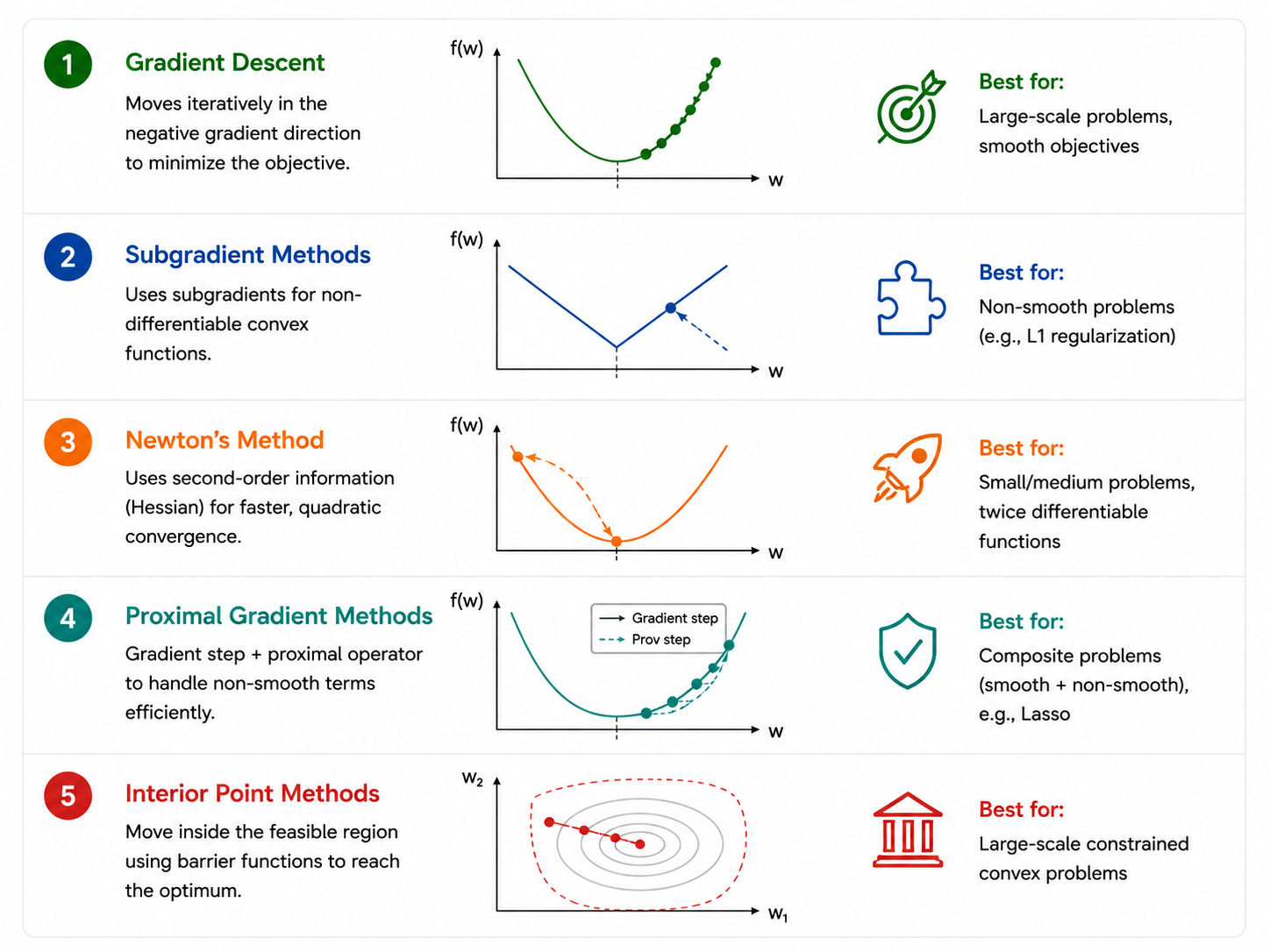
This is the most used optimization algorithm in all of machine learning. The idea is simple: compute the slope of the loss function at your current point, and take a small step in the direction that reduces the loss.
How it works:
For convex functions, gradient descent is guaranteed to reach the global minimum if you set the learning rate correctly.
Variants of gradient descent used in practice:
Some convex functions are not smooth everywhere. The absolute value function, for instance, has a sharp corner at zero. You cannot compute a regular gradient there. Subgradient methods handle this by using a generalized notion of the gradient at these non-smooth points. They are used in algorithms like Lasso regression and SVMs with hinge loss.
Instead of just using the first derivative (gradient), Newton's method also uses the second derivative (curvature). This gives it a much faster convergence rate. The tradeoff is cost: computing second derivatives for large models is expensive. In practice, approximations called Quasi-Newton methods (like L-BFGS) are used when you need faster convergence without the full cost of Newton's method.
Also Read: Different Types of Regression Models You Need to Know
When your loss function has a non-smooth penalty term (like the L1 regularization in Lasso), proximal methods split the problem into a smooth part and a non-smooth part. They handle each separately, making them efficient for sparse optimization problems.
These are used when your optimization problem has strict constraints. Instead of projecting back onto the feasible region after each step, interior point methods stay inside the feasible region throughout. They are the backbone of modern convex solvers like CVXPY.
AI Courses to upskill
Explore Artificial Intelligence Courses for Career Progression
You might not realize how often convex optimization is already at work in the models you use. Here is a quick map.
The ordinary least squares loss function is convex and quadratic. This means you can find the exact optimal weights in one step using the normal equation, or iteratively using gradient descent. Either way, convergence is guaranteed.
The log-loss (cross-entropy loss) used in logistic regression is a convex function of the weights. This is why logistic regression is reliable and easy to optimize. Gradient descent on this loss will always find the true optimal weights given enough iterations.
Also Read: Logistic Regression in R: Equation Derivation [With Example]
SVMs are a classic example of constrained convex optimization. The goal is to find the maximum-margin hyperplane, which is a quadratic programming problem. Because the objective is convex and the constraints define a convex set, SVM training always finds the exact optimal solution.
Both L1 (Lasso) and L2 (Ridge) regularization add convex penalty terms to a convex loss function. The sum of two convex functions is still convex. So regularized linear models remain convex and solvable. Lasso uses L1, which introduces non-smoothness but can be handled with subgradient or proximal methods.
This is the exception. Neural networks use non-convex loss functions because of the multiple layers and non-linear activations. You are not guaranteed to find the global minimum. But in practice, many local minima in neural networks are nearly as good as the global minimum, especially for large networks. Researchers are still actively studying why deep learning works as well as it does despite this.
Also Read: Convolutional Neural Networks: Ultimate Guide for Beginners in 2026
This section is for readers who want to go deeper into the theory. It is used heavily in research and in systems like SVMs.
Every constrained optimization problem (called the primal problem) has a corresponding dual problem. Solving the dual is often easier. For convex problems, the primal and dual solutions are always equal under certain conditions. This property is called strong duality.
KKT stands for Karush-Kuhn-Tucker. These are the conditions a solution must satisfy to be optimal in a constrained convex problem. They generalize the idea that at the minimum of an unconstrained function, the gradient is zero.
The KKT conditions include:
In SVMs, the support vectors are exactly the points where the complementary slackness condition is active. This is where the name "support vector" comes from.
Understanding duality helps you choose better solvers and interpret model outputs. For instance, in SVMs, the dual formulation makes it easy to apply kernel methods, which extend the model to non-linear boundaries while still solving a convex problem.
Also Read: Build Smarter Neural Networks with Keras in Deep Learning
Convex optimization is powerful, but it is not a solution to everything. Knowing where it breaks down is just as important as knowing where it works.
Modern neural networks have non-convex loss surfaces. You cannot guarantee finding the global minimum. In practice, you get stuck in local minima or saddle points. Techniques like momentum, adaptive learning rates (Adam, RMSProp), and careful initialization help navigate non-convex landscapes but do not solve the theoretical problem.
Classical convex solvers work well for small to medium datasets. But interior point methods, for example, scale poorly with the number of variables. For very large datasets, you almost always fall back to stochastic gradient descent variants, which are approximate but fast.
Also Read: Recurrent Neural Networks: Introduction, Problems, LSTMs Explained
Not every ML problem naturally maps to a convex form. Sometimes you need to reformulate the problem, relax constraints, or use convex surrogates for non-convex objectives. This requires mathematical knowledge that goes beyond just using a library.
Real-world implementations use iterative methods that stop before reaching the exact minimum. In most cases, an approximate solution is good enough. But for high-stakes applications, understanding how far you are from the true optimum matters.
Situation |
Convex Optimization Applies? |
Notes |
| Linear/logistic regression | Yes | Guaranteed global min |
| SVM training | Yes | Quadratic programming |
| Neural network training | No | Non-convex, use SGD variants |
| Lasso/Ridge regression | Yes | Smooth or proximal methods |
| Reinforcement learning | Mostly no | Policy optimization is non-convex |
Subscribe to upGrad's Newsletter
Join thousands of learners who receive useful tips
You do not need to implement these algorithms from scratch. Here are the tools practitioners actually use.
Python Libraries:
When to use which:
Convex optimization in machine learning is one of those foundational ideas that quietly powers a large part of what you do. When logistic regression converges reliably, when your SVM finds the perfect margin, when gradient descent actually reaches the minimum, convex optimization is the reason why.
The key takeaway is this: convex problems are solvable with guarantees. Non-convex problems like deep learning are not, but they work well enough in practice because of smart engineering and large-scale computation. Knowing the difference, understanding the tools, and being able to recognize when you are dealing with a convex problem versus a non-convex one will make you a stronger practitioner.
Want personalized guidance on AI and upskilling? Speak with an expert for a free 1:1 counselling session today.
Convex optimization is the process of finding the lowest point of a bowl-shaped function. In machine learning, it means finding the model parameters that minimize the loss function. Because the function is convex, there is only one minimum, and any optimization algorithm will find it.
It gives you guarantees. When your loss function is convex, you know that any optimization algorithm that keeps moving downhill will eventually reach the best possible answer. This reliability is why most classical ML models are designed with convex loss functions.
Gradient descent is a general optimization algorithm that works especially well for convex functions. For a convex loss function with a properly tuned learning rate, gradient descent is guaranteed to converge to the global minimum. For non-convex functions, it may get stuck in local minima.
Convex optimization has one minimum and always finds the best answer. Non-convex optimization has many valleys, and you can get stuck in a suboptimal one. Logistic regression uses convex optimization. Neural networks use non-convex optimization. The practical implication is that classical models are more predictable, while deep learning requires more careful training.
Neural networks are non-convex. The combination of multiple layers and non-linear activation functions creates a complex loss surface with many local minima and saddle points. This is why training deep learning models is less predictable than training logistic regression, even though in practice many local minima produce similarly good models.
Strong duality means the optimal value of the primal problem equals the optimal value of the dual problem. This only holds reliably for convex problems under certain regularity conditions (Slater's condition). Strong duality is what makes solving SVMs through the dual formulation exact and efficient.
KKT (Karush-Kuhn-Tucker) conditions are the necessary and sufficient conditions for a point to be optimal in a constrained convex optimization problem. They are used in SVM training to identify which data points (support vectors) determine the decision boundary, and in any constrained ML problem where you need to verify or characterize the optimal solution.
Lasso regression minimizes a convex loss (mean squared error) plus a convex L1 penalty on the weights. The sum of two convex functions is still convex, so the overall problem is convex. The challenge is that L1 is not smooth at zero, so you need subgradient or proximal gradient methods instead of standard gradient descent.
The most popular options are CVXPY for custom constrained problems, scikit-learn for standard ML models with built-in solvers, and SciPy for general-purpose optimization. For large-scale problems, mini-batch SGD implemented in PyTorch or TensorFlow is the standard approach even though it is an approximation.
Not directly, because deep learning loss functions are non-convex. However, ideas from convex optimization like learning rate selection, momentum, and convergence analysis inform how deep learning optimizers like Adam and RMSProp are designed. Some researchers also use convex relaxations to analyze or approximate deep learning problems theoretically.
A saddle point is a critical point where the gradient is zero but it is neither a minimum nor a maximum. It looks like a minimum from one direction and a maximum from another. In high-dimensional non-convex problems like neural networks, saddle points are more common than local minima and can slow down training. Convex functions do not have saddle points, which is another reason convexity is a desirable property.
98 articles published
Rahul Singh is an Associate Content Writer at upGrad, with a strong interest in Data Science, Machine Learning, and Artificial Intelligence. He combines technical development skills with data-driven s...
Speak with AI & ML expert
By submitting, I accept the T&C and
Privacy Policy
Top Resources
Master's Degree
18 Months
Executive Diploma
12 Months
IIIT Bangalore
Executive Programme in Generative AI & Agentic AI for LeadersIndia’s #1 Tech University
Dual Certification
5 Months