Radial Basis Function in Machine Learning: Examples, Uses, and Benefits
By Sriram
Updated on Jun 29, 2026 | 7 min read | 8.01K+ views
Share:

All courses
Certifications
More
By Sriram
Updated on Jun 29, 2026 | 7 min read | 8.01K+ views
Share:
Table of Contents
The radial basis function in machine learning is useful for solving problems that involve predicting things or putting things into categories. The name radial basis function sounds scary, but the idea behind it is actually pretty easy to understand. A radial basis function or radial basis function is a way to figure out how close one piece of data is to another piece of data. This helps machine learning models find patterns that're hard to see when you are just looking at straight lines.
In this guide, you'll learn about the radial basis function in machine learning, how it works, where it is used, and why it is popular in algorithms such as Support Vector Machines (SVMs) and Radial Basis Function Networks.
Explore the full breakdown in Machine Learning Courses Online from upGrad and accelerate your ML career.
Popular AI Programs
A radial basis function in machine learning is a kind of function that looks at how apart two things are. The radial basis function gives a score when two points are close to each other. When the points are apart, the score from the radial basis function goes down slowly.
Radial basis functions are different from linear models that just draw straight lines to make decisions. The radial basis function allows algorithms to create curved and boundaries that can bend and change. This is useful when we are working with real-world datasets where the relationships between them are usually not straight. The radial basis function is helpful for this kind of work.
Also Read: Introduction to Machine Learning Tutorials
An RBF behaves in a similar way. Every point influences its nearby region more than distant regions.
Imagine placing a small light bulb on every data point.
The most common radial basis function is the Gaussian function:
RBF(x, c) = exp(-γ ||x − c||²)
Where:
Symbol |
Meaning |
| x | Input data point |
| c | Center point |
| γ (gamma) | Controls how quickly similarity decreases |
| exp | Exponential function |
When you have higher gamma value, it makes the regions of influence smaller. On the hand, a lower gamma value makes the regions of influence bigger.
Also Read: Top 5 Machine Learning Models Explained For Beginners
Many machine learning problems involve clusters of similar observations rather than simple linear relationships.
For example:
Problem |
Why RBF Helps |
| Face recognition | Similar faces form clusters |
| Fraud detection | Fraudulent transactions share hidden patterns |
| Medical diagnosis | Patients with similar symptoms often belong to similar categories |
| Image classification | Pixels create non-linear relationships |
Instead of forcing a straight boundary, the radial basis function lets models adapt naturally to these patterns.
Because of these properties, the radial basis function in machine learning has become one of the most important kernel functions used today.
Free Courses
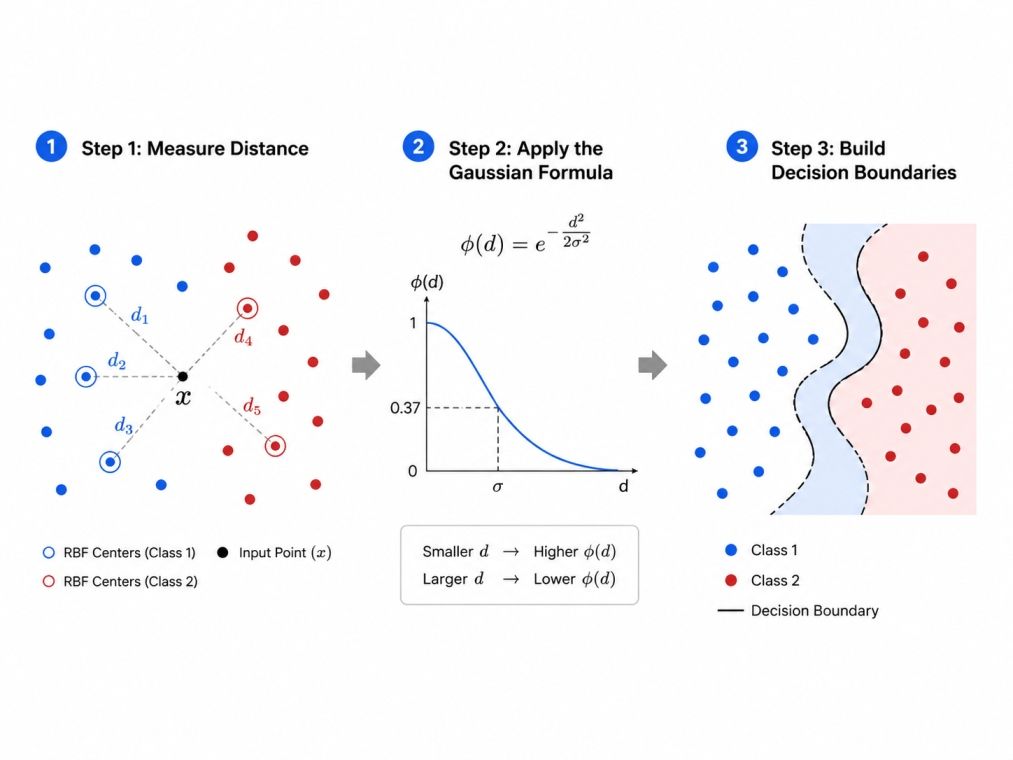
Understanding how the radial basis function works is easy when you break it down step, by step.
The algorithm starts by measuring how far a new piece of data is from the data points it has already learned from. Closer observations receive larger similarity values. Farther observations receive smaller similarity values.
Instead of using raw distance directly, the distance passes through the Gaussian equation. This transformation converts distances into values between 0 and 1.
Examples
Distance |
Similarity |
| Very small | Close to 1 |
| Moderate | Around 0.5 |
| Large | Close to 0 |
The model combines similarities from multiple training points. Instead of drawing one straight line, it creates smooth curved boundaries around clusters. This flexibility allows better predictions on complex datasets.
Gamma is one of the most important parameters. Choosing gamma is a balancing act. A very low gamma may underfit. A very high gamma may overfit by memorizing the training data.
Gamma Value |
Effect |
| Low | Smooth boundary, broader influence |
| High | Complex boundary, narrower influence |
Suppose an email spam classifier is trained using thousands of emails. When new email arrives, instead of checking only one feature, the classifier measures how similar the new email is to known spam and non-spam emails.
Emails that are closer to spam examples receive higher similarity scores. The classifier then predicts whether the email is spam based on these similarities. This simple idea makes the radial basis function in machine learning highly effective for classification tasks.
Also Read: Machine Learning Methods: A Complete Beginner's Guide
AI Courses to upskill
Explore Artificial Intelligence Courses for Career Progression
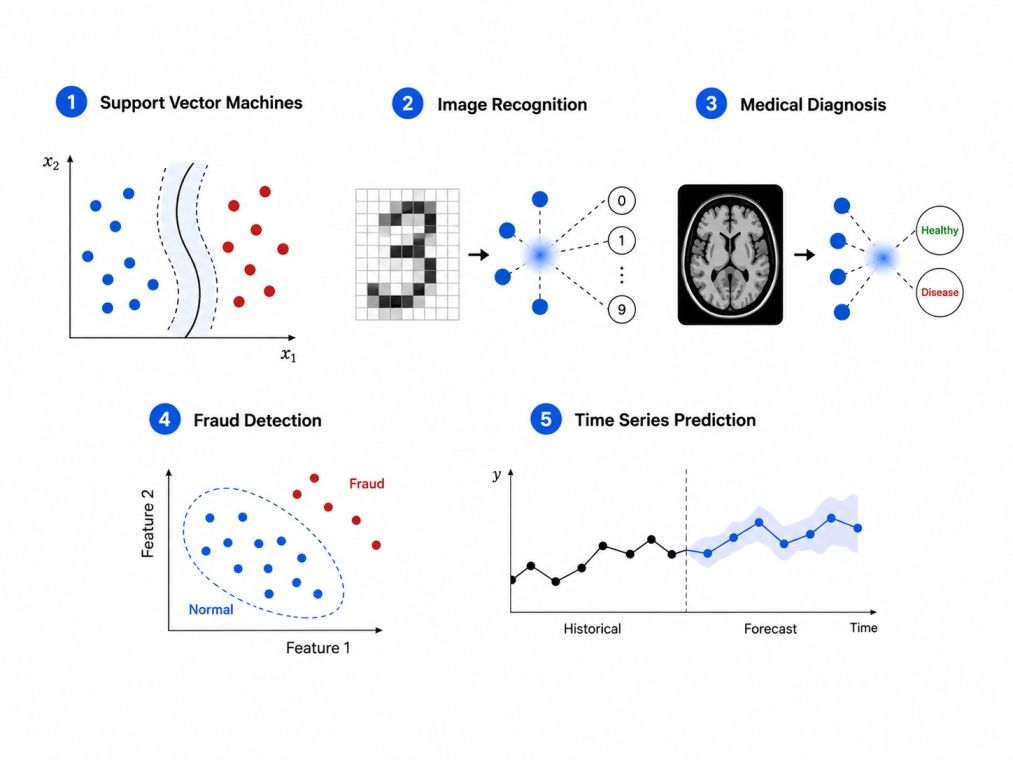
The radial basis function in machine learning appears across many real-world applications.
1. Support Vector Machines:
The RBF kernel enables SVMs to solve non-linear classification problems efficiently.
2. Image Recognition:
Objects rarely follow linear patterns. RBF kernels help classify handwritten digits, faces, and everyday objects.
3. Medical Diagnosis:
Doctors use machine learning models to detect diseases from scans and patient records. RBF kernels improve prediction accuracy for complex medical datasets.
4. Fraud Detection:
Banks analyze transaction behavior using non-linear decision boundaries. The RBF kernel identifies suspicious activity more accurately.
5. Time Series Prediction:
Financial forecasting and weather prediction often benefit from radial basis functions because relationships change over time.
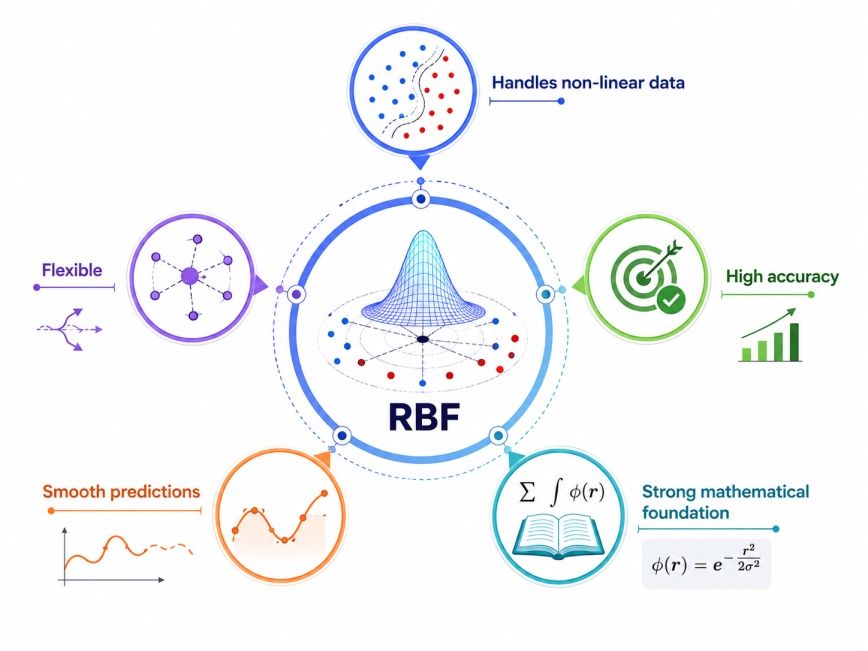
The radial basis function in machine learning remains one of the most practical kernel methods available.
Advantage |
Benefit |
| Handles non-linear data | Captures complex relationships |
| High accuracy | Performs well on many datasets |
| Flexible | Works across industries |
| Smooth predictions | Reduces abrupt classification changes |
| Strong mathematical foundation | Widely researched and reliable |
Limitation |
Explanation |
| Parameter tuning | Gamma and C require careful selection |
| Computational cost | Slower on very large datasets |
| Sensitive to scaling | Features should be normalized |
| Less interpretable | Harder to explain than linear models |
Understanding Radial Basis Functions is just the beginning; the real value comes from applying them to classification, regression, and pattern recognition challenges in the wild. Explore our Machine Learning Courses Online and go hands-on with the models that power modern AI systems.
Choosing the right settings often matters more than choosing the algorithm itself.
The radial basis function in machine learning is more than a math equation. It helps machine learning models understand patterns that traditional linear techniques could not capture.
If you are beginning your machine learning journey, understanding radial basis functions will also make concepts like kernel methods, SVMs, and non-linear classification much easier to grasp. It is one of those foundational topics that continues to appear throughout advanced machine learning and artificial intelligence.
Want to explore more about management accounting? Book your free 1:1 personal consultation with our expert today.
A radial basis function is a mathematical function that measures similarity based on distance between data points. It helps algorithms recognize complex, non-linear relationships and is commonly used in Support Vector Machines and Radial Basis Function Networks.
The RBF kernel is popular because it can solve many non-linear problems without requiring manual feature transformations. It performs well across different datasets and is often the default choice for SVM classification.
Gamma controls how quickly similarity decreases as distance increases. Smaller gamma values create smoother decision boundaries, while larger values create more detailed and complex boundaries that may overfit the data.
Neither is universally better. Linear kernels work well for linearly separable datasets, while RBF kernels are better for complex datasets with curved decision boundaries.
Healthcare, finance, cybersecurity, robotics, manufacturing, speech recognition, image processing, and recommendation systems all use radial basis function techniques for solving prediction and classification problems.
Yes. Feature scaling ensures that distance calculations remain meaningful. Without normalization, features with larger numerical ranges can dominate similarity calculations and reduce model performance.
Yes. Although the mathematics can become advanced, the core idea is simple: nearby points are considered more similar than distant points. Understanding this intuition makes the topic much easier.
An RBF network is a type of neural network that uses radial basis functions as activation functions. An SVM with an RBF kernel uses radial basis functions within the kernel trick to separate non-linear data.
The most common approach is to use cross-validation with grid search or randomized search. This helps identify a gamma value that balances model complexity and generalization.
Yes. Radial basis functions are used in regression models, especially Support Vector Regression (SVR), where they help model complex relationships between input features and continuous target values.
Absolutely. Despite the rise of deep learning, the radial basis function in machine learning remains widely used for medium-sized datasets, scientific computing, anomaly detection, and many classification tasks because of its reliability and strong predictive performance.
730 articles published
Sriram K is a Senior SEO Executive with a B.Tech in Information Technology from Dr. M.G.R. Educational and Research Institute, Chennai. With over a decade of experience in digital marketing, he specia...
Speak with AI & ML expert
By submitting, I accept the T&C and
Privacy Policy
Top Resources
Master's Degree
18 Months
Executive Diploma
12 Months
IIIT Bangalore
Executive Programme in Generative AI & Agentic AI for LeadersIndia’s #1 Tech University
Dual Certification
5 Months