Foundation Models in AI: Types, Examples, Uses and Benefits
By Sriram
Updated on Aug 31, 2026 | 10 min read | 4.26K+ views
Share:

All courses
Certifications
More
By Sriram
Updated on Aug 31, 2026 | 10 min read | 4.26K+ views
Share:
Table of Contents
Key Highlights
Explore generative AI courses in India to learn about generative AI, LLMs, model development, and real-world applications. Build practical skills and stay ready for the evolving AI landscape with upGrad.
Generative AI Courses to upskill
Explore Generative AI Courses for Career Progression
IIIT Bangalore
EPGP in Applied AI and Agentic AIIIIT Bangalore
Executive Diploma in Machine Learning and AI360° Career Support
A foundation model is trained on large datasets to learn general patterns rather than perform one specific task. It can later be adapted for text generation, image analysis, coding, speech, and other applications.
Unlike a traditional machine learning model built for a specific task, a foundation model can support multiple applications through fine-tuning, prompting, or retrieval.
For example, a company could use an existing model to build a customer-support assistant by connecting it to company documents and adjusting its behaviour.
Foundation models can work with:
Their capabilities depend on how they are trained. This is why foundation models include more than chatbots, covering language, vision, and multimodal applications.
The training process is where much of the model's general capability comes from. A foundation model typically starts with large datasets, learns patterns through pre-training, and then adapts to specific applications
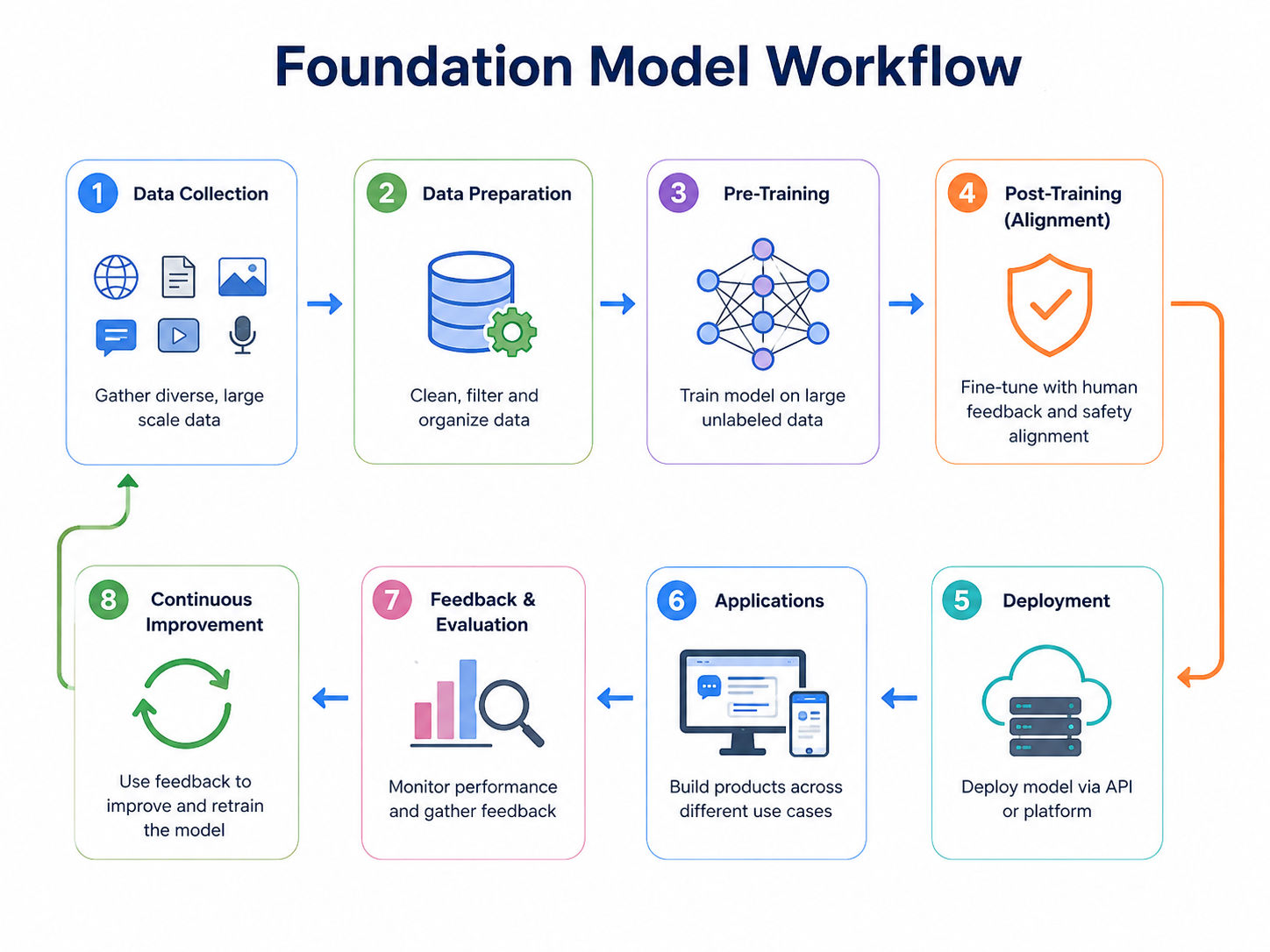
Training data quality matters enormously. Poor data can produce poor results, even when a model has billions of parameters.
Training datasets may contain books, websites, code repositories, images, audio recordings, videos, or other sources. Developers need to process this material before training because raw internet data can contain duplicates, errors, spam, copyrighted material, and harmful content.
Good preparation takes work. It isn't just about collecting more data.
Pre-training teaches the model general patterns within its training data. The exact learning objective depends on the architecture and modality.
For a language model, training might involve predicting the next token. For an image model, the objective could involve learning relationships between visual features or reconstructing missing information.
This stage requires substantial computing resources. Training runs can involve large numbers of specialised processors and take considerable time.
Once pre-training is complete, the foundation model has learned broad representations that developers can use for other tasks.
A general model isn't automatically perfect for every business problem. It usually needs some form of adaptation.
Developers can use techniques such as
Suppose a legal technology company wants an assistant that works with contracts. It could adapt an existing model and connect it to its own approved documents rather than building a new model from zero. That saves considerable development effort, although the resulting system still needs testing.
Also Read: Deep Learning Techniques: Methods, Applications & Examples
After training and adaptation, the model receives an input and generates a prediction or response based on patterns learned during training.
For a text application, the output might be an answer or a summary. A vision system might classify an image. A multimodal system might interpret an image and explain what it contains.
The result isn't guaranteed to be correct.
That distinction matters when Foundation Models are used in sensitive settings. Human review, testing, data controls, and application-level safeguards still have an important role.
Also Read: Top Deep Learning Advantages in AI Applications
Not every Foundation Model works with the same type of data. Some focus on language, while others process images, audio, video, code, or several modalities together.
Language models learn patterns in human language. They can support tasks such as writing, summarisation, translation, question answering, classification, and information extraction.
This is where large language models fit. Large language models are a subset of foundation models because language-focused models represent one part of the wider category.
Vision models work with visual information. They can identify objects, analyse images, segment visual regions, or generate new images depending on their design.
For example, a medical imaging application might use a vision model to help analyse scans before a specialist reviews the results.
Multimodal models work across more than one type of input. A system might accept text and images together or combine text, audio, and video.
This makes multimodal systems useful for applications where information doesn't arrive in one format. A user could upload a chart and ask the model to explain the data in plain language.
Code models are trained to understand programming languages and software-related patterns. They can generate code, explain functions, suggest fixes, and assist with documentation.
Their usefulness depends heavily on the programming language, task, context, and quality of the generated code.
Must read: GeneratiMust-readdmap
Audio models can process speech and other forms of sound. Applications include transcription, translation, voice interfaces, and audio classification.
These systems are particularly useful when spoken information needs to become searchable or machine-readable.
Also Read: Easy Guide to the Generative AI Course Syllabus
Examples help make the category easier to understand. The important point is that these models don't all perform the same job or process the same type of information.
A few well-known examples include:
Model |
Organization |
Main focus |
| GPT | OpenAI | Language and multimodal tasks |
| Gemini | Multimodal tasks | |
| Llama | Meta | Language and AI applications |
| Claude | Anthropic | Language and reasoning tasks |
| CLIP | OpenAI | Image and text understanding |
| DALL-E | OpenAI | Image generation |
| Stable Diffusion | Stability AI and open ecosystem | Image generation |
The list isn’t exhaustive. Foundation models now cover language, vision, audio, video, biology, robotics, and more. Some focus on one area, while others work across multiple types of data.
So, the list depends on the model’s purpose and capabilities.
Do Read : Generative AI Course Eligibility
Foundation Models and LLMs are related but not the same. Large language models are a subset of foundation models, while foundation models can handle text, images, audio, video, or multiple data types.
An LLM mainly focuses on language tasks such as generating, understanding, and summarising text. In contrast, a vision model that analyzes images is a foundation model but isn't an LLM.
Here's a quick comparison.
Feature |
Foundation Models |
LLMs |
| Category | Broad model category | Language-focused category |
| Main data | Text, images, audio, video, code, or combinations | Primarily language data |
| Typical tasks | Generation, classification, recognition, reasoning, analysis | Writing, translation, summarisation, coding, Q&A |
| Modalities | One or multiple | Mainly language, with some newer multimodal systems |
| Scope | Wider | More specific |
Large language models are a subset of foundation models, but not every foundation model is an LLM. This distinction matters because foundation models can work with different types of data, including text, images, audio, and video, depending on how they are designed.
Understand how AI is reshaping businesses and build the skills to lead in this changing landscape with the Master of Business Administration from Paris School of Business with IIM Lucknow Certification.
A base model is a pre-trained model that can be fine-tuned for specific tasks. A foundation model is broader and can support many applications. For example, one general model can be adapted for customer service, document classification, and other use cases.
Feature |
Foundation Model |
Base Model |
| Meaning | Broadly capable pre-trained model | Pre-trained model before further adaptation |
| Purpose | Supports multiple downstream uses | Starting point for additional training |
| Scope | Can include several modalities | Depends on the model |
| Adaptation | Fine-tuning, prompting, or other methods | Usually adapted for a specific purpose |
So, Foundation Models describe a broader concept, while base models often describe a particular stage in a model's development.
Also Read: Getting Started with Data Exploration: A Beginner's Guide
The real value of a Foundation Model appears when developers build applications around it. The model itself is only one part of the final system.
1. Generative AI
Foundation models can create text, images, code, and audio. Marketers can draft content, designers can explore ideas, and developers can generate code. Human review is still important.
2. Customer Service
AI assistants can answer customer questions using approved company information, such as baggage rules, refunds, or booking policies.
3. Software Development
Code models can write functions, explain code, create tests, and spot possible errors. Developers still need to test and review the output.
4. Healthcare and Research
Specialised models can help analyse medical text, research papers, images, and biological data. These uses require careful validation.
5. Education
Foundation models can explain topics, create practice questions, give feedback, and adjust explanations to suit different learning levels.
Also Read: Difference Between RAG and LLM
Foundation Models give teams a ready starting point instead of building every AI system from scratch. This can save time, resources, and development effort.
Faster Application Development
Teams can use a pre-trained model and focus on building the application instead of training a new model from the beginning.
Support for Multiple Tasks
One model can be adapted for tasks such as summarization, classification, question answering, and content generation.
Reuse of Learned Knowledge
Pre-training gives the model a broad base of knowledge that can be useful across different tasks and domains.
Less Task-Specific Training
A shared model can reduce the need to maintain separate models for every task. However, teams still need to consider cost, privacy, licensing, and performance.
Also Read: Getting Started with Data Exploration: A Beginner's Guide
Foundation Models offer broad capabilities, but they also have some practical challenges:
Also Read: Top Agentic AI Tools in 2026 for Automated Workflows
Traditional AI systems are frequently designed around a specific problem. A fraud detection model, for example, might be trained specifically to identify suspicious transactions.
A Foundation Model starts from a broader objective. It learns general patterns that can later support several tasks.
Factor |
Traditional AI Model |
Foundation Model |
| Training goal | Specific task | Broad capabilities |
| Data | Often task-focused | Large and diverse |
| Adaptation | Usually task-specific | Can support many downstream tasks |
| Typical use | One defined problem | Multiple applications |
| Development approach | Build for the task | Start with a pre-trained model |
If a company needs a simple classification model with predictable behaviour, a smaller task-specific system might be cheaper and easier to evaluate.
If it needs several language or multimodal capabilities, starting with a Foundation Model can make more sense. The right choice depends on the problem.
Must Read: Agentic AI vs Generative AI
The future of Foundation Models will focus on making them more useful, efficient, and specialised rather than simply larger.
However, bigger models aren't always better. Data quality, security, evaluation, retrieval, and human oversight will remain important for building reliable AI applications.
Foundation Models provide a flexible starting point for building AI applications across language, vision, audio, code, and other areas. LLMs are one part of this broader category.
However, challenges such as cost, bias, inaccurate outputs, privacy, and evaluation remain. The best model depends on the task, data, budget, performance needs, and risks involved.
Ready to start your journey? Book a free consultation with upGrad today to find the best path for your career
A foundation model is a broad term for a model trained on large-scale data that can support different applications. An LLM is a type of foundation model built mainly for language. So, all LLMs are not necessarily the only kind of foundation model.
LLM foundation models are large, pre-trained models designed to handle a wide range of language tasks. They learn patterns from extensive text and code during training and can later power applications such as chatbots, search tools, coding assistants, and content-generation systems.
LLMs are called foundation models because they can act as a starting point for many different applications. Instead of building a separate language model for every use case, developers can build products and specialised systems on top of an existing broadly trained model.
ChatGPT is an AI application rather than simply the name of a foundation model. It uses OpenAI models underneath and adds a conversational interface and other system features. This distinction matters because a foundation model is the underlying technology, while ChatGPT is the user-facing product.
Making a foundation model involves collecting and preparing large datasets, selecting an architecture, training the model with substantial computing resources, and then testing its capabilities. Developers also need post-training, safety checks, infrastructure, and ongoing improvements before the model is ready for practical use.
A common introductory classification divides AI into reactive machines, limited-memory systems, theory-of-mind AI, and self-aware AI. This is a conceptual framework rather than a strict technical classification. Modern foundation models generally fall under limited-memory AI because they learn from previously collected training data.
Traditional AI models are often built for a narrower task, such as predicting customer churn or detecting fraud. A foundation model is trained more broadly and can support several downstream uses. This difference changes how developers approach model building, adaptation, and application design.
A base model is a model in its relatively general pre-trained form, before additional task-specific adaptation. In practice, the terms base model and foundation model can overlap, although foundation model usually highlights the model’s broad usefulness across multiple downstream applications rather than simply its training stage.
Large-scale training data helps a foundation model learn patterns across language, images, code, or other inputs. More data can improve coverage and generalisation, but quality matters too. Duplicated, inaccurate, biased, or poorly filtered data can affect what the model learns.
When an application sends an input to a foundation model, the model processes that input and produces an output based on patterns learned during training. The application may add prompts, tools, external information, or other instructions to shape how the model responds.
Not exactly. Foundation models are a broader model category, while generative AI refers to systems that create new content such as text, images, audio, or code. Many generative AI tools use foundation models, but foundation models can also support tasks beyond content generation.
724 articles published
Sriram K is a Senior SEO Executive with a B.Tech in Information Technology from Dr. M.G.R. Educational and Research Institute, Chennai. With over a decade of experience in digital marketing, he specia...
Speak with AI & ML expert
By submitting, I accept the T&C and
Privacy Policy