Diffusion Models in Generative AI: Architecture, Examples and Uses
By Sriram
Updated on Aug 30, 2026 | 10 min read | 4.27K+ views
Share:

All courses
Certifications
More
By Sriram
Updated on Aug 30, 2026 | 10 min read | 4.27K+ views
Share:
Table of Contents
Key Highlights
Ready to build practical skills in generative AI? Explore upGrad’s generative AI courses in India to develop hands-on skills in modern AI technologies and prepare for real-world AI applications.
Generative AI Courses to upskill
Explore Generative AI Courses for Career Progression
IIIT Bangalore
EPGP in Applied AI and Agentic AIIIIT Bangalore
Executive Diploma in Machine Learning and AI360° Career Support
Creating an image from random noise may sound odd. Diffusion models make this possible by learning how to remove noise and turn it into useful content.
During training, the model adds noise to clean data in small steps. It then learns how to reverse those steps. Later, it can start with random noise and generate a new image, audio clip, or other content.
Diffusion models work through two basic processes.
The basic flow is: Random noise → Noise prediction → Denoising → Final output
The model doesn't remove everything at once. Each step makes the output clearer.
Noise gives the model a starting point for creating different outputs. Changing the initial noise can produce a different result.
Text prompts can also guide generation. For example, a prompt such as "a red bicycle near a mountain" tells the model what the final image should represent.
The strength of diffusion models comes from their iterative generation process. Rather than attempting to create a complete image immediately, the system gradually improves a noisy representation until it becomes a coherent result.
That's useful when precise visual structure matters. A model can repeatedly adjust shapes, textures, colours, and other details as generation progresses.
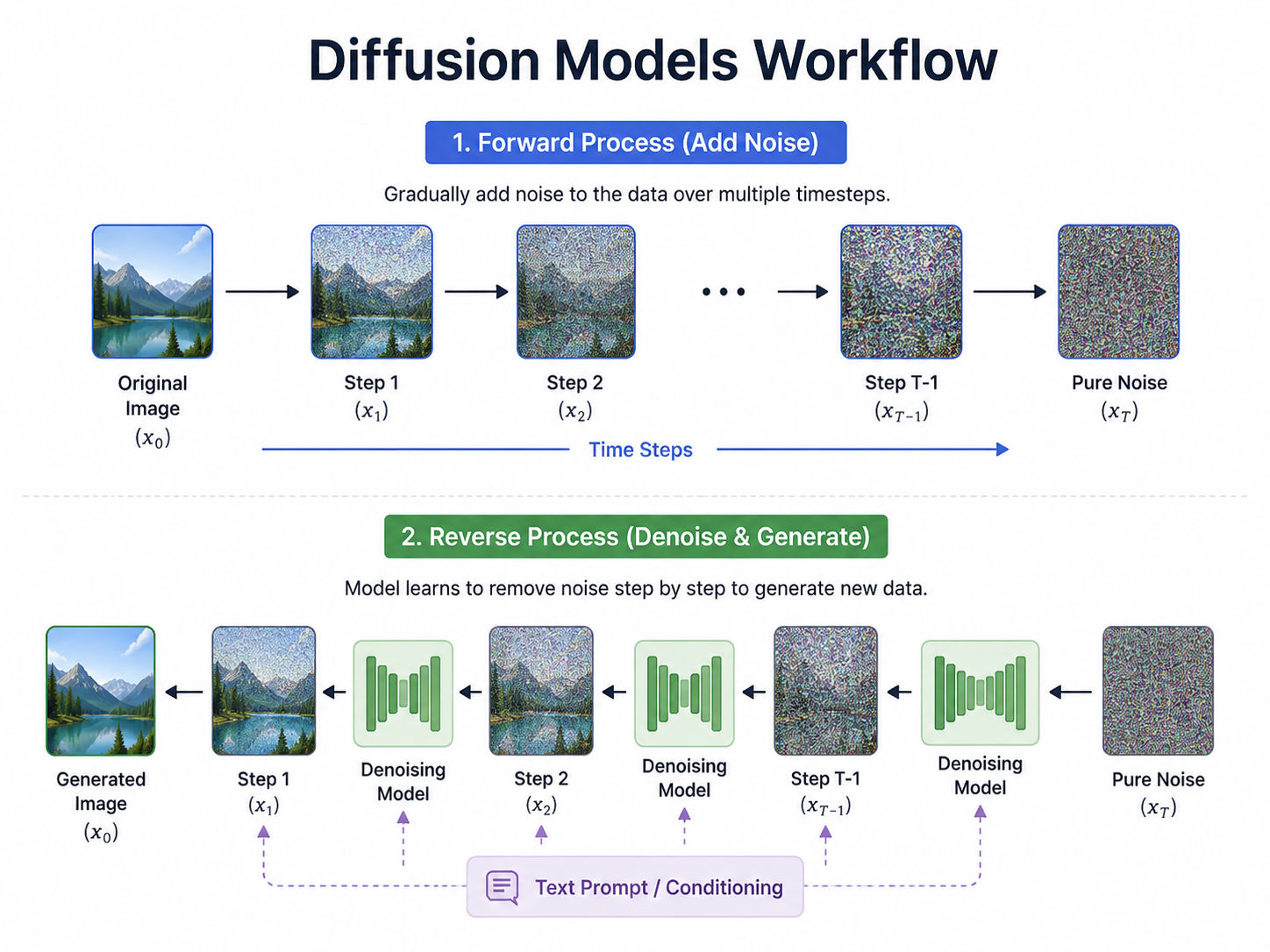
Text conditioning allows users to influence generation without manually controlling every pixel or feature.A text encoder converts the prompt into a representation that the generative system can use. The denoising network then considers that information while producing the output.
For example, a prompt such as "a small robot reading a book in a library" provides several concepts that the system needs to represent together.
The prompt doesn't guarantee a perfect result. Details can still be misplaced, and complex relationships can be difficult to represent accurately.
A diffusion system isn't just one neural network. It usually combines several components that work together during training and generation.
The architecture depends on the type of data and model design. Image systems have different requirements from audio or video systems, although the core denoising idea remains similar.
U-Net has been widely used in image diffusion systems because it can process information at different levels of detail.
It contains down sampling and up sampling paths that help the network understand both broad structure and fine features. Skip connections pass useful information between these stages.
The network receives a noisy representation and predicts information that helps the system remove noise.
That's why the denoising network sits at the centre of many diffusion architectures. Without it, the reverse generation process wouldn't have a learned way to improve the noisy sample.
The amount of noise changes at every stage. The model therefore needs to know which step it's processing.
A time-step embedding provides this information to the neural network. It tells the system whether the current sample is heavily corrupted or already close to the final output.
This small detail matters. A denoising strategy suitable for heavy noise wouldn't necessarily work well when only a little noise remains.
Text-to-image systems need another mechanism. They must connect language with visual generation.
A text encoder converts words into numerical representations. The diffusion network uses those representations as guidance during generation.
The architecture can therefore connect a written description with visual features. That's how a phrase such as "snow-covered cabin beside a lake" can influence the generated image.
Also Read: AI in Automotive Industry: Innovation, Impact, and Future
The noise scheduler controls how noise changes throughout the process. Different schedules can affect generation quality and speed.
A sampler determines how the system moves from one denoising step to another. Some samplers require fewer steps while maintaining useful output quality.
The main architectural components can be viewed like this:
Component |
Main purpose |
| Noise scheduler | Controls noise levels |
| Denoising network | Predicts how to remove noise |
| Time embedding | Identifies the current generation step |
| Text encoder | Represents text prompts |
| Conditioning mechanism | Connects prompts with generation |
| Sampler | Controls the denoising path |
| Decoder | Converts latent information into output |
Also Read: Top 10 Data Modeling Tools You Must Know
The best way to understand diffusion models is to look at what they can actually produce. Their use isn't limited to creating attractive pictures from text prompts.
Different systems can work with images, video, audio, molecules, and other structured data. The underlying process changes based on the type of information being generated.
Text-to-image generation is one of the most visible applications. A user provides a written prompt, and the system generates an image based on the requested concepts. The same approach can support design exploration, concept art, advertising visuals, and creative experiments.
Image editing is another important application. A system can modify selected areas, remove objects, extend an image beyond its original borders, or change visual elements.
Video generation adds another challenge. The system must maintain consistency across multiple frames.
A person's appearance shouldn't change randomly between frames. Objects need to move in ways that make sense, and the scene should remain coherent.
Diffusion-based approaches are being used for text-to-video, image-to-video, and video editing tasks.
The same general concept can be applied to audio. Instead of generating pixels, the model works with representations of sound.
Applications include speech synthesis, music generation, sound effects, and audio restoration.
The technical details differ from image generation, but the central idea of gradually refining a noisy representation remains relevant.
Diffusion models can also work with structured scientific data.
Researchers have explored them for areas such as molecular generation, protein design, medical imaging, and scientific simulation. These applications require more than visually convincing results because the generated structures need to satisfy specific constraints.
Some well-known examples include:
Model or approach |
Main use |
| DDPM | Foundational diffusion approach |
| DDIM | Faster sampling approach |
| Latent Diffusion | Generation in compressed latent space |
| Stable Diffusion | Text-to-image generation |
| Video diffusion systems | Video generation and editing |
These examples show how diffusion models have moved beyond basic image synthesis. Their architecture can be adapted for different generation problems when the data can be represented in a suitable form.
Looking to apply generative AI to real business challenges? Explore upGrad’s IIMK AI for Business Professionals Certificate Program and build practical skills to make smarter, AI-driven business decisions.
Both diffusion models and large language models can generate content, but they don't generate that content in the same way.
LLMs typically work with tokens. Given a sequence of tokens, an LLM predicts what should come next. This process allows it to generate text one token after another.
Diffusion models generally take a different route. They begin with noise and progressively refine it until a useful output appears.
Key Differences
Factor |
Diffusion Models |
LLMs |
| Main strength | Images, video, audio and other data | Text and language |
| Typical generation method | Iterative denoising | Token prediction |
| Starting point | Noise or corrupted representation | Input token sequence |
| Common architecture | U-Net or transformer-based designs | Transformer |
| Generation style | Multiple refinement steps | Sequential token generation |
| Common output | Images, video, audio | Text, code and structured language |
The distinction isn't absolute. Research has explored diffusion approaches for text and transformer-based designs for visual generation, so the boundary between model families isn't fixed. What matters is the generation mechanism and the type of data the model is trained to represent.
Yes. They can form part of the same AI system.
For example, an LLM could interpret a user's detailed request, create a structured prompt, and pass that information to an image generation system.
The language model handles language. The diffusion system handles visual generation.
That combination is useful for applications where users need to communicate through natural language while the system produces visual or multimodal content.
Also Read: Difference Between RAG and LLM
Diffusion models aren't the only generative approach. GANs and VAEs have also played major roles in generative machine learning.
Understanding the differences helps explain why diffusion approaches became so widely studied for content generation.
GANs use two neural networks. A generator creates samples, while a discriminator evaluates whether those samples look real.
Training the two networks against each other can produce high-quality results, but GAN training can be difficult to balance.
Diffusion models don't use the same generator-discriminator setup. They learn a denoising process instead.
VAEs learn a compressed latent representation of data. They encode an input into a latent space and then decode that representation into an output.
They can generate new samples efficiently, but basic VAE outputs may look less detailed than those produced by strong diffusion systems.
The comparison becomes clearer here:
Model |
Core idea |
Common strength |
| GAN | Generator competes with discriminator | Sharp generated samples |
| VAE | Encode and decode through latent space | Compact representations |
| Diffusion model | Learn iterative denoising | High-quality controlled generation |
Each approach has a place. The right choice depends on the generation task, hardware, speed requirements, and quality target.
Also Read: Getting Started with Data Exploration: A Beginner's Guide
The popularity of diffusion models comes from their strong generation quality and flexibility. They can produce detailed outputs and support different forms of conditioning.
Still, generation isn't free. The iterative process can require substantial computation, especially when models generate high-resolution images or long videos.
Key Advantages
The process also gives developers several points where they can adjust sampling, conditioning, and noise schedules.
That's useful when an application needs a balance between output quality and generation speed.
Key Limitations
Speed remains a practical concern. If an application needs thousands of images every minute, an iterative generation process needs careful optimisation.
Quality isn't the only metric either. Developers also need to consider latency, memory usage, infrastructure costs, licensing, and the type of hardware available.
The phrase diffusion can create confusion because it appears in two very different fields. In AI, diffusion models describe a method for generating data. In business and social science, the diffusion of innovation model describes how people adopt new ideas or technologies.
The diffusion of innovation model is associated with Everett Rogers and explains how an innovation spreads through a population over time.
It divides adopters into five groups:
The concept isn't about generating content. It focuses on adoption behaviour.
Also Read: Top Agentic AI Tools in 2026 for Automated Workflows
AI diffusion models learn a process for transforming noisy data into generated content.
The diffusion of innovation model deals with people, organisations, and adoption patterns. It can help explain why some technologies gain acceptance quickly while others take longer.
For example, a new AI writing tool might first attract technology enthusiasts. Early adopters then test it in practical settings. Wider groups may adopt it after they see clear benefits and lower risks.
The two concepts share the word diffusion, but their purposes are completely different.
Aspect |
AI Diffusion Models |
Diffusion of Innovation Model |
| Field | Artificial intelligence | Business and social science |
| Focus | Content generation | Innovation adoption |
| Process | Noise and denoising | Adoption over time |
| Main subject | Data and neural networks | People and organisations |
| Example | Generating an image | Adopting a new AI tool |
Understanding this distinction helps avoid a common search-intent mix-up. Someone looking for an AI generation technique needs a machine learning explanation, while someone researching adoption behaviour needs the diffusion of innovation model.
Also Read: LLM vs Generative AI
Diffusion models are moving toward faster generation, better control, and support for more content types. One key goal is reducing denoising steps. Fewer steps can lower processing time and make these models more practical for real-time applications.
Future systems may also handle text, images, video, and audio together. Better control over objects, poses, layouts, and editing will make generated content more useful.
The challenge is clear. Models need to produce consistent results while following prompts accurately without demanding excessive computing power
Diffusion models are widely used in generative AI to create images, video, audio, and other content by gradually removing noise. Their architecture uses components such as denoising networks, time steps, and sampling methods. Unlike LLMs, which generate text by predicting tokens, diffusion models refine noisy data over several steps.
The diffusion of innovation model is different because it explains how people adopt new ideas. Understanding diffusion models helps beginners explore modern generative AI applications more clearly.
Ready to start your journey? Book a free consultation with upGrad today to find the best path for your career
Diffusion models are generative AI models that learn patterns in data and use them to create new samples. They’re best known for image generation, but the approach also applies to video, audio, scientific data, and other domains.
A diffusion model is a mathematical and machine learning framework for modelling how data can be gradually corrupted with noise and then reconstructed. In generative AI, this idea is reversed so the learned process can produce new samples from noisy inputs.
Five well-known examples include Stable Diffusion, DALL·E 2, Imagen, DDPM, and DDIM. They represent different developments in diffusion-based generation, from foundational research models to systems designed for high-quality image creation and faster sampling.
ChatGPT is a generative AI application that uses language models to generate responses. An LLM is the underlying type of model designed to understand and produce language, while generative AI is the broader category covering systems that create new text, images, audio, or other content.
The answer depends on the DALL·E version. The original DALL·E used an autoregressive Transformer, while DALL·E 2 used diffusion for image generation. DALL·E 3 is also described as a diffusion-based image generation system in industry references.
Yes. Researchers are applying diffusion methods to language generation as well as visual content. Recent work explores diffusion language models that can generate or revise multiple tokens through iterative decoding, offering a different approach from traditional autoregressive language models.
They can produce detailed images while allowing generation to be guided by text, images, or other conditions. Their strong results and flexible control have helped make them a major approach for modern image synthesis, alongside other generative architectures.
A generative model is a broad category of AI systems that create new data. A diffusion model is one type within that category. GANs, VAEs, autoregressive models, and diffusion approaches all generate content but use different learning and generation methods.
Yes. Researchers use diffusion-based methods to generate and explore molecular structures, including possible applications in drug discovery and protein-related research. The goal isn't simply to create realistic-looking molecules but to generate structures that satisfy useful chemical or biological constraints.
The diffusion of innovation model explains how a new idea, product, or technology spreads among people over time. It categorises adopters into groups such as innovators, early adopters, early majority, late majority, and laggards. This concept is separate from AI diffusion models.
Yes. An LLM can interpret a user's language and provide instructions that guide another generative model. This makes it possible to combine language understanding with image, video, or other content generation, creating applications that respond to natural-language requests across multiple formats.
724 articles published
Sriram K is a Senior SEO Executive with a B.Tech in Information Technology from Dr. M.G.R. Educational and Research Institute, Chennai. With over a decade of experience in digital marketing, he specia...
Speak with AI & ML expert
By submitting, I accept the T&C and
Privacy Policy