Learning Agent in AI: Architecture, Types, Examples, and Real-World Applications
By Sriram
Updated on Jun 10, 2026 | 10 min read | 3.86K+ views
Share:

All courses
Certifications
More
By Sriram
Updated on Jun 10, 2026 | 10 min read | 3.86K+ views
Share:
Table of Contents
Artificial Intelligence Learning Agent is an intelligent system that learns from its interaction with its environment and improves its performance. Instead of following hard-coded rules, it observes the results of its actions, gathers feedback and adjusts its behavior to make better choices in the future.
That ability to learn from experience makes learning agents more adaptable than traditional AI. They continuously adapt their behavior based on the outcomes of both successful and unsuccessful actions, allowing them to excel in dynamic and evolving environments like recommendation systems, autonomous vehicles, and intelligent assistants.
This Blog, you’ll learn what is learning agent in AI, how it works, its architecture, different types, practical applications, and why it plays critical role in building adaptive AI systems.
Advance your AI career with upGrad’s Artificial Intelligence courses. Gain practical experience in machine learning, generative AI, and real-world industry applications.
Popular AI Programs
In AI, a learning agent is an intelligent system that can learn from experience and improve its performance over time. A learning agent , unlike simple rule-based systems that always behave the same way , can modify its actions based on feedback from its environment .
The basic idea of a learning agent is simple: learn from the past to do better in the future.
Think of an online streaming platform recommending movies. At first it may know very little about a user. As the user watches content, skips recommendations, rates movies or searches for a particular genre, the system learns user preferences over time and uses this information to improve future recommendations.
This adaptability is what makes learning agents different from traditional AI systems.
Key Characteristics of Learning Agents
A learning agent usually:
These features make learning agents suitable for dynamic environments where conditions are constantly changing.
Must know : Agentic AI Learning Path: A Complete Guide for Developers and AI Professionals
Free Courses
Understanding the architecture helps explain how learning agents continuously improve. Most learning agents consist of four core components working together.
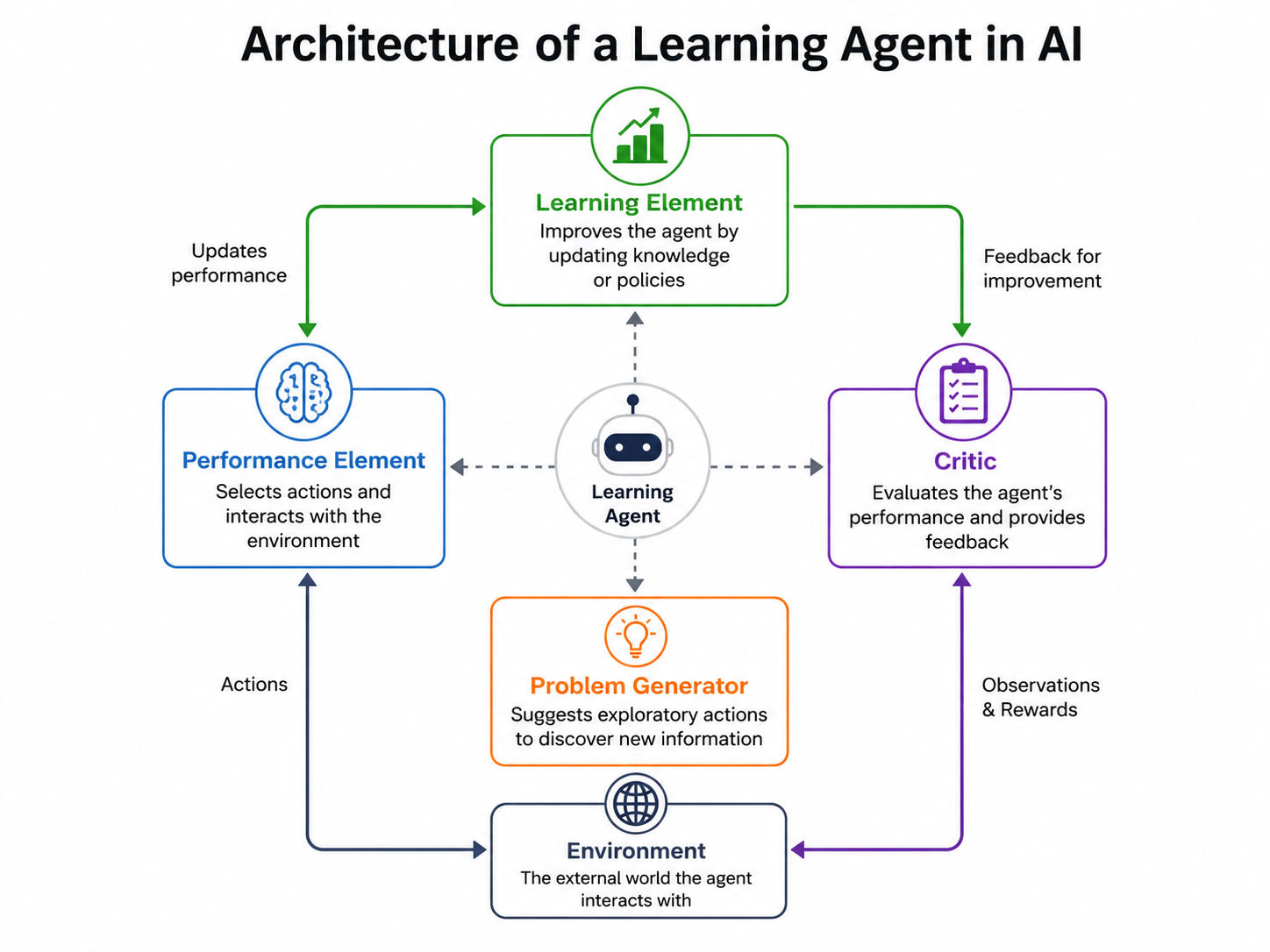
The performance element directly interacts with the environment. It determines which action the agent should take based on current information.
For example in a self-driving car, the performance element decides when to accelerate, brake or turn.
Improvement is the learning element.
It looks at feedback and then changes the way the agent behaves so that it gets better results in the future. This part is effectively the student in the system.
The critic assesses the agent’s performance.
It compares results with objectives And generates feedback. The feedback could be success, failure, or areas for improvement.
For example, a recommendation system might monitor whether users clicked on suggested content.
A common problem in AI is to balance known successful actions with exploration.
The problem generator facilitates experimentation. Otherwise the agent would just keep selecting actions it has seen before and never discover better ones.
Let us take an autonomous warehouse robot:
The robot gets faster and more efficient over time.
Do read : The Complete Guide to Knowledge-Based Agents in AI
AI Courses to upskill
Explore Artificial Intelligence Courses for Career Progression
To understand the practical value of learning agents, it helps to examine the learning cycle.
A learning agent follows a continuous loop:
Observe → Act → Receive Feedback → Learn → Improve
Let's break it down.
The agent collects information through sensors, user interactions, databases, or external systems.
Examples include:
Based on available information, the agent selects an action.
The decision may come from:
The environment responds to the action.
The feedback can be:
For instance, if a chatbot provides a useful answer and users continue the conversation, that outcome serves as positive feedback.
The learning element analyzes the results and updates the agent's knowledge.
This update may involve:
The updated knowledge influences future actions.
As this cycle repeats thousands or millions of times, performance steadily improves.
This continuous adaptation is what makes learning agents so powerful in real-world AI systems.
Also read : Agentic AI Learning Path: A Complete Guide for Developers and AI Professionals
Different environments require different learning approaches. Several types of learning agents exist depending on how they acquire knowledge.
These agents learn from labeled data.
The system receives examples with correct answers and learns patterns from them.
Examples include:
The advantage is high accuracy when quality data is available. The limitation is the need for large labeled datasets.
These agents learn from unlabeled data.
Instead of receiving correct answers, they discover hidden patterns independently.
Common applications include:
These agents excel when labeled data is unavailable.
Reinforcement learning agents learn through rewards and penalties.
The agent experiments with actions and gradually identifies strategies that maximize rewards.
Popular examples include:
This approach closely resembles how humans learn through trial and error.
Deep learning agents use artificial neural networks to process large amounts of complex data.
They are widely used for:
Modern AI assistants and large language models often rely on deep learning techniques combined with learning-agent principles.
Also read : What Is Agentic AI? The Simple Guide to Self-Driving Software
Understanding a learning agent in AI example makes the concept much easier to visualize.
Recommendation Systems
Streaming platforms and online retailers continuously learn from user behavior.
Every click, watch, purchase, or search provides new information that improves future recommendations.
Autonomous vehicles process enormous amounts of sensor data.
Learning agents help these systems:
Financial institutions use learning agents to identify suspicious transactions.
As new fraud patterns emerge, the system adapts and updates its detection models.
Intelligent Chatbots
Modern conversational AI systems improve by analyzing interactions.
They learn:
This allows more natural and relevant communication.
Factories increasingly deploy AI-powered robots.
Learning agents help optimize:
Learning agents offer significant advantages because they can improve their performance through experience. However, like any AI technology, they also come with certain challenges that organizations must consider before deployment.
Learning agents are one of the most powerful types of AI systems because they can improve their performance through experience and feedback. Their ability to adapt and learn over time makes them valuable across a wide range of real-world applications, from recommendation systems to autonomous technologies.
Learning agents can adjust their behavior based on new information and changing conditions. This makes them highly effective in dynamic environments where fixed-rule systems may struggle.
Unlike traditional AI systems that require frequent rule modifications, learning agents continuously improve through experience, reducing the need for constant human intervention.
As learning agents process more data and interactions, they can identify patterns, refine their strategies, and make more accurate decisions over time.
Learning agents can handle large volumes of data, users, and tasks efficiently, making them suitable for enterprise-scale applications across various industries.
While learning agents offer impressive adaptability and continuous improvement, they are not without challenges. Their effectiveness depends on factors such as data quality, computational resources, and the ability to balance learning efficiency with reliable decision-making.
The effectiveness of a learning agent largely depends on the quality of the data it receives. Inaccurate, incomplete, or biased data can lead to poor learning outcomes and unreliable decisions.
Training sophisticated learning models often requires significant computing power, storage capacity, and processing resources, which can increase implementation costs.
During the learning process, agents may experiment with different actions to discover better strategies. This exploration can occasionally result in suboptimal decisions before optimal behavior is learned.
Many advanced learning models operate as complex systems, making it difficult to clearly understand or explain how certain decisions are reached. This can create challenges in regulated industries where transparency is essential.
Organizations can benefit greatly from learning agents, but successful implementation requires balancing their advantages against potential limitations. Factors such as data quality, computational resources, business objectives, and regulatory requirements should be carefully evaluated to maximize the value of AI-driven learning systems.
The future of artificial intelligence depends heavily on systems that can adapt and improve independently.
Static rule-based systems work well in predictable situations. Real-world environments, however, rarely remain predictable for long.
Learning agents allow AI systems to:
From recommendation engines and autonomous vehicles to intelligent assistants and industrial automation, learning agents serve as the foundation for many of today's most advanced AI applications.
As AI adoption continues to expand, understanding learning agents becomes increasingly important for developers, data scientists, students, and technology professionals.
Do read : Top 15 Agentic AI Books for Beginners to Advanced Learners
In AI, a learning agent is an intelligent system that learns from experience and feedback to improve its performance. Learning agents differ from traditional rule-based systems in that they adjust their behavior as time passes, thus making them appropriate for dynamic and complex environments.
To understand what is learning agent in AI we need to explore its architecture, learning process and practical application. The learning element, performance element, critic, and problem generator work together to build systems that learn continuously.
Every learning agent in AI -whether it’s a recommendation engine, a self-driving car, a chatbot, or a fraud detection platform - is a textbook case of the same basic principle: learn from experience and make better decisions going forward. This ability remains one of the reasons modern artificial intelligence is advancing so fast.
Want personalized guidance on AI and upskilling? Speak with an expert for a free 1:1 counselling session today.
A learning agent focuses on improving its decisions through interactions and feedback from its environment. A generative AI model primarily creates content such as text, images, or code. While some generative AI systems can be part of a learning agent framework, their core purpose differs. Learning agents prioritize adaptation and decision-making, whereas generative models focus on content generation.
Yes, but its capabilities will be limited. A learning agent needs some mechanism to improve from experience. Machine learning provides the most common approach, but agents can also use rule adaptation, optimization techniques, or feedback-driven adjustments. Without learning mechanisms, the system behaves more like a traditional rule-based agent.
Learning agents are widely used in industries where conditions change frequently. Common examples include:
Their ability to adapt makes them valuable in environments with large amounts of data and constant change.
Yes. Small businesses often use learning-agent-based tools without realizing it. Customer support chatbots, marketing automation platforms, recommendation engines, and CRM systems increasingly rely on adaptive AI. The key is choosing solutions that align with business goals rather than implementing AI simply because it is available.
Learning agents continuously collect new data and update their decision-making process. If user preferences change over time, the agent can identify new patterns and adjust recommendations or actions accordingly. This makes them particularly useful for applications where customer behavior evolves frequently.
Python remains the most popular choice because of its extensive AI and machine learning ecosystem. Developers also use:
The best language depends on performance requirements and deployment environments.
Several practical challenges can affect performance:
Even well-designed systems may require ongoing monitoring and adjustments to maintain reliable results in production environments.
Yes. Many modern applications require real-time decision-making. Examples include fraud detection systems, stock trading platforms, recommendation engines, and autonomous vehicles. The challenge is ensuring the agent can process information quickly enough while still maintaining accuracy and adapting to new conditions.
Learning agents analyze user interactions and identify patterns that help personalize experiences. They can recommend products, prioritize support requests, tailor content, and predict customer needs. When implemented correctly, they reduce friction and make interactions more relevant without requiring users to repeatedly provide the same information.
If you want to build learning agents, focus on:
Practical project experience often matters as much as theoretical knowledge because real-world systems involve noisy data and unpredictable environments.
Yes. As organizations move toward autonomous and adaptive systems, learning agents will play a larger role. Future AI applications will need to respond to changing conditions, user preferences, and business requirements without constant manual updates. Learning agents provide the foundation for that adaptability, making them a key component of next-generation AI systems.
724 articles published
Sriram K is a Senior SEO Executive with a B.Tech in Information Technology from Dr. M.G.R. Educational and Research Institute, Chennai. With over a decade of experience in digital marketing, he specia...
Speak with AI & ML expert
By submitting, I accept the T&C and
Privacy Policy
Top Resources
Master's Degree
18 Months
Executive Diploma
12 Months
IIIT Bangalore
Executive Programme in Generative AI & Agentic AI for LeadersIndia’s #1 Tech University
Dual Certification
5 Months