Strategic Management Process: Steps, Models, and Examples
By upGrad
Updated on Aug 14, 2026 | 8 min read | 3.71K+ views
Share:

All courses
Certifications
More
By upGrad
Updated on Aug 14, 2026 | 8 min read | 3.71K+ views
Share:
Table of Contents
Key Highlights
Take your strategic thinking to the next level with a DBA degree and build the expertise to lead businesses, make data-driven decisions, and drive long-term growth.
The strategic management process is a structured approach that organisations use to develop, implement, and review their strategies. It helps leaders move from broad questions such as “Where do we want to go?” to practical decisions about what the business should do next.
For example, imagine an online education company that wants to expand into new markets. It cannot simply decide to launch in another country and expect the plan to work. It needs to study customer demand, competitors, regulations, pricing, internal capabilities, and available resources. Based on this information, it can choose an appropriate strategy and put it into action.
The main purpose is to help an organisation make better long-term decisions while staying prepared for changes in its environment.
A well-defined process can help a business:
This is why strategic management is more than a one-time planning exercise. Businesses need to revisit their assumptions as markets, competitors, technology, and customer expectations change.
Strategic management and strategic planning are closely related, but they are not exactly the same.
Must read: What is Strategic Management? Why is it important?
The 7 steps of strategic management process provide a practical sequence for moving from business goals to strategy implementation and evaluation. Below is the strategic management process diagram.
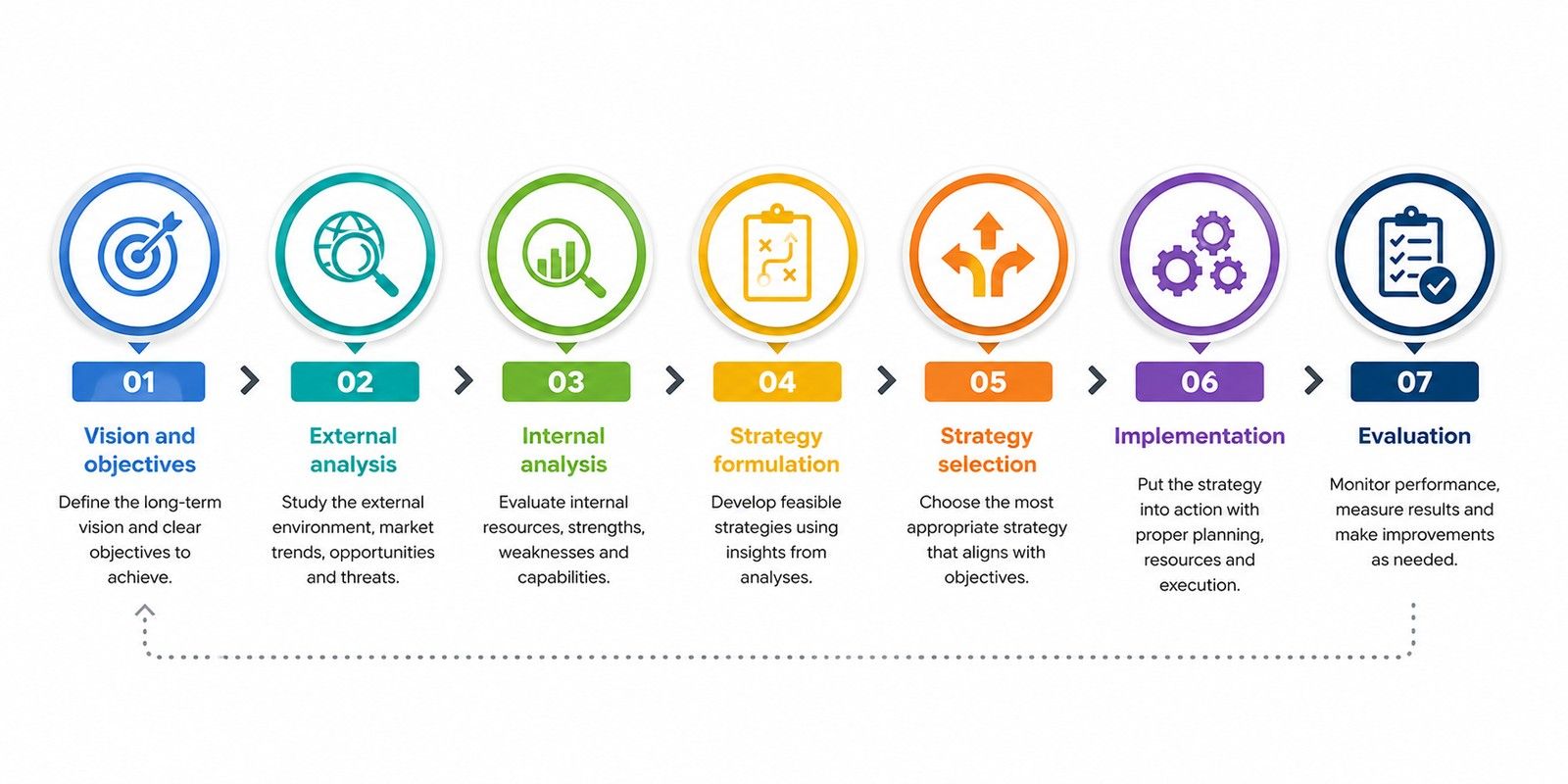
Different organisations may combine or rename some stages, but the overall logic remains similar.
The first stage of the process of strategic management is to define where the organisation wants to go and what it wants to achieve.
The vision describes the desired future, while the mission explains the organisation's purpose. Objectives turn these ideas into measurable goals.
For example, a food delivery company may set objectives such as:
Do read: Highest Paid CEO in the World 2026: Top 10 List of CEOs
The organisation studies external factors that can influence its performance. These may include competitors, customer preferences, economic conditions, technology, regulations, and social trends.
The aim is to identify opportunities that the organisation can use and threats it may need to address.
For example, growing demand for online shopping may be an opportunity for a traditional retailer, while increasing competition may be a threat. Tools such as PESTLE analysis and Porter's Five Forces can help businesses assess these factors.
Internal analysis focuses on what the organisation can do well and where it has limitations.
Businesses assess their resources, employees, finances, technology, processes, and capabilities. This helps identify strengths and weaknesses.
For example, a company may see an opportunity to develop an AI-powered product but first needs to determine whether it has the required technology, skills, and budget.
After analysing internal and external factors, the organisation develops possible strategies.
For example, a software company may consider:
The organisation then chooses the strategy that best supports its objectives and fits its available resources. Managers may consider expected results, cost, risk, competitive position, and long-term sustainability before making the decision.
For example, a company may choose to strengthen its existing market instead of entering a new country if international expansion requires more resources than it currently has.
The selected strategy is converted into action. This involves assigning responsibilities, allocating resources, setting timelines, and communicating priorities to employees.
For instance, an online growth strategy may require improvements to the e-commerce platform, digital marketing, delivery systems, and customer support.
A good strategy can still fail if implementation is poorly managed or employees do not have the resources needed to execute it.
Businesses can track metrics such as revenue, market share, customer retention, or operating costs. If results are below expectations, management can identify the problem and make necessary changes.
Like, if a company planned to increase market share by 10% but achieved only 3%, it may need to review its strategy, implementation, or market assumptions.
Also read: How to Create Social Media Content Strategy? Everything You Need to Know
DBA Courses to upskill
Explore DBA Courses for Career Progression
IIIT-B & IIM, Udaipur
Chief Technology Officer & AI Leadership ProgrammeA strategic management process model provides a framework for understanding how strategic decisions are made and managed. Different models organise the process in different ways, but most cover similar ideas such as analysis, formulation, implementation, and evaluation.
Two useful frameworks are David's Strategic Management Model and the AFI Framework.
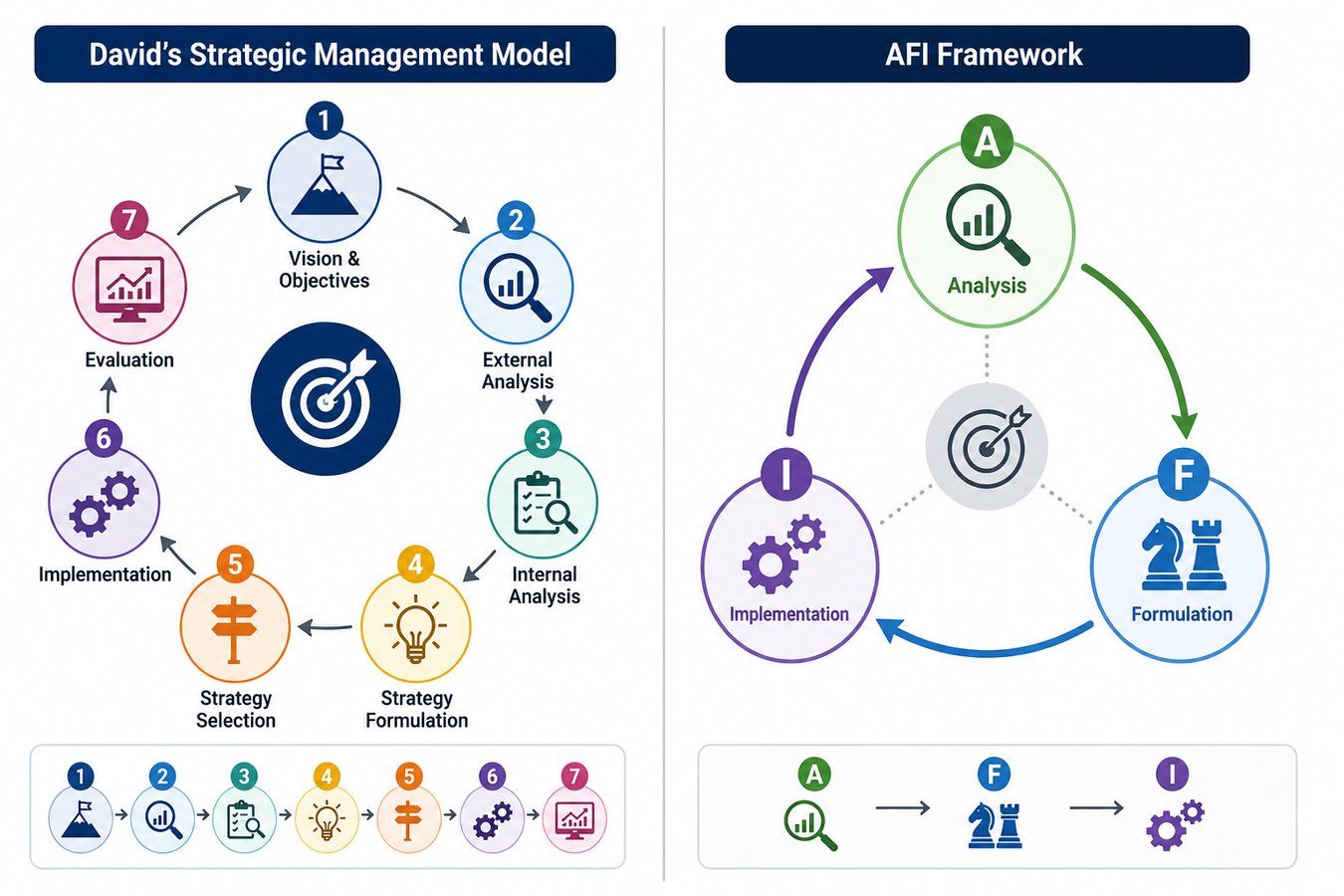
Fred R. David's model presents strategic management as a set of interconnected activities. It commonly focuses on three broad areas:
One advantage of this model is that it makes the connection between different strategic activities easy to see. Analysis influences formulation, formulation guides implementation, and performance evaluation can lead to changes in the strategy.
The AFI Framework stands for Analysis → Formulation → Implementation
The framework starts by analysing the organisation's internal and external environment. Leaders then formulate a strategy based on what they have learned. Finally, the organisation implements that strategy.
For example, a company considering expansion may first analyse customer demand, competitors, industry conditions, and its own resources. It can then formulate an expansion strategy and determine how to execute it.
The framework is useful because it shows that strategic decisions should be based on both external conditions and internal capabilities.
The 7-step process gives a more detailed sequence for explaining how strategy develops. It separates activities such as defining objectives, analysing the external environment, analysing internal capabilities, selecting a strategy, implementing it, and evaluating results.
Strategic management models often group these activities into broader stages.
For example:
| 7-Step Process | Broader Model Stage |
| Define vision, mission, objectives | Formulation |
| External analysis | Analysis |
| Internal analysis | Analysis |
| Develop alternatives | Formulation |
| Select strategy | Formulation |
| Implement strategy | Implementation |
| Evaluate strategy | Evaluation |
So, these approaches do not necessarily contradict each other. A strategic management process model provides a broader framework, while the seven steps explain the activities within that framework.
Also read: DIY Strategic Marketing Plan for Every Marketeer
Consider a fictional smartphone company called NovaTech that wants to increase its market share among young consumers.
The example below shows how all seven stages can work together.
Step 1: Define objectives
NovaTech sets an objective to increase its market share among consumers aged 18–30 by 15% within three years.
Step 2: Analyse the external environment
The company studies customer preferences, competitors, smartphone pricing, technology trends, and demand for features such as better cameras, longer battery life, and AI-powered functions.
The analysis shows that younger consumers are interested in affordable devices with strong cameras and useful AI features.
Step 3: Analyse internal capabilities
NovaTech examines its manufacturing capacity, product development team, brand reputation, distribution network, and financial resources.
It discovers that its product development capabilities are strong but its brand awareness is lower than that of major competitors.
Step 4: Formulate alternatives
The company considers several options:
Step 5: Select a strategy
Based on its research and resources, NovaTech chooses to launch an affordable smartphone with strong camera and AI features while increasing its digital marketing efforts.
Step 6: Implement the strategy
The company develops the product, works with suppliers, trains sales teams, launches advertising campaigns, and expands distribution through online and offline channels.
Step 7: Evaluate performance
After launch, NovaTech tracks sales, market share, customer reviews, repeat purchases, advertising performance, and competitor reactions.
If sales are lower than expected, the company may change its pricing, improve the product, adjust its advertising, or reconsider its target segment.
This example shows that the strategic management process is not simply about choosing an idea. Each stage informs the next one, and the final results can influence future decisions.
Accelerate your doctoral research with upGrad’s AI-Driven Research for Doctoral Scholars programme. Build stronger research skills, use AI more effectively, and get expert guidance throughout your research journey.
Businesses use different strategic tools to understand their environment, assess their capabilities, compare alternatives, and monitor performance. No single tool is suitable for every situation.
SWOT stands for Strengths, Weaknesses, Opportunities, and Threats.
It provides a simple way to look at internal and external factors together.
For example, a company may identify:
SWOT analysis is especially useful when a company needs a quick overview before making a strategic decision.
In PESTLE analysis, examines the broader external environment through six factors:
For example, a company entering a new country may use PESTLE to understand regulatory requirements, economic conditions, social preferences, technological adoption, and environmental expectations.
It helps businesses identify external changes that may affect their plans.
Porter's Five Forces helps organisations understand the competitive structure of an industry.
The five forces are:
For example, if customers can easily switch between many similar products, buyer power may be high. This can put pressure on companies to improve pricing, quality, or customer experience.
VRIO is used to assess whether an organisation's resources and capabilities can provide a competitive advantage.
It examines whether a resource is:
A strong brand, proprietary technology, unique data, or highly specialised expertise may become a strategic advantage if competitors cannot easily reproduce it.
The BCG Matrix helps companies manage different products or business units based on market growth and relative market share.
It divides offerings into four categories stars, cash cows, question marks, and dogs. A company can use the matrix to decide where to invest, maintain resources, or reduce spending.
For example, a high-growth product with a strong market position may require continued investment, while a low-growth product with weak market share may receive less attention.
The Balanced Scorecard helps organisations evaluate strategy using more than financial results.
It generally considers four perspectives:
Also read: How to Build Successful Marketing Strategy in 20 Minutes
A business can have talented employees, good products, and strong financial resources and still struggle if it lacks a clear strategic direction. The strategic management process helps bring these elements together and gives the organisation a structured way to make important decisions.
Here are some of the main reasons businesses use it.
Strategic management encourages leaders to make decisions using business information rather than assumptions.
Before entering a new market, for example, a company can study customer demand, competitors, costs, regulations, and its own capabilities. This reduces the chances of making decisions based only on short-term expectations.
Businesses compete for customers, talent, resources, and market share. A strong strategy can help an organisation develop something that competitors find difficult to match.
This could be:
The goal is not simply to copy what competitors are doing. Strategic management encourages businesses to understand where they can create distinctive value.
Resources are always limited. Companies have to decide where to spend their money, time, technology, and employee effort.
The strategic management process helps connect resource allocation with priorities.
For example, if a company's main objective is to expand its digital business, it may decide to increase investment in technology, digital marketing, cybersecurity, and online customer support rather than spreading its budget across unrelated initiatives.
Markets can change quickly. Customer expectations shift, new competitors appear, technology develops, and economic conditions can affect demand.
A strategy that worked three years ago may not work today.
Regular evaluation allows businesses to identify these changes and respond. This does not mean changing direction whenever a small problem appears. Instead, it means reviewing whether the assumptions behind the strategy are still valid.
Strategic management connects objectives with measurable outcomes. This makes it easier to determine whether the organisation is moving in the right direction.
Managers can establish key performance indicators (KPIs) and review them regularly. If performance falls below expectations, they can investigate the reason and take corrective action.
Also read: 6 Best Marketing Strategies on Facebook for Business
Although strategic management provides a useful structure, it does not guarantee success. Organisations can still face problems at almost every stage.
One of the biggest challenges is the gap between strategy and execution.
A company may develop an excellent plan but fail to provide employees with the resources, training, technology, or authority needed to execute it.
For example, a business may decide to improve customer experience but fail to invest in employee training or customer support systems. The strategy exists on paper, but the expected change does not happen.
Every strategy requires resources. Some require significant financial investment, while others depend heavily on skilled employees, technology, or management time.
A strategy may look attractive but become unrealistic if the organisation cannot support it.
Before selecting a strategy, businesses should therefore consider whether they have the resources required for implementation. If not, they may need to modify the strategy, phase the project, or build the necessary capabilities first.
Employees may resist a new strategy when they do not understand why it is needed or how it will affect their work.
A strategy becomes difficult to execute when its objectives are vague.
For example, “increase customer satisfaction” is a useful direction, but it does not provide enough information by itself.
A more useful objective could be to increase the customer satisfaction score from a specific baseline to a defined target within a particular period.
Strategic decisions are only as useful as the information behind them. If a company misunderstands customer needs, underestimates competitors, or relies on outdated market information, it may choose the wrong strategy.
This is why analysis should not be treated as a one-time activity. Businesses need to keep collecting relevant information and update their assumptions when conditions change.
Also read: 50 Tips From Digital Marketing Experts in India
The strategic management process gives organisations a practical framework for moving from business goals to meaningful action. It begins by defining a clear direction and understanding the external and internal environment. The organisation then develops strategic alternatives, selects the most suitable option, implements it, and evaluates the results.
The most effective approach is not simply to create a strategy and follow it blindly. Organisations need to review their assumptions, measure results, listen to customers, and adjust when circumstances change. That flexibility can help turn strategic plans into sustainable business performance.
Want to take the next step in your research journey? Book a consultation call with upGrad to explore the right programme and get personalised guidance.
The main goal is to help an organisation achieve its long-term objectives while responding effectively to changes in its business environment. It brings planning, decision-making, implementation, and performance evaluation together so the organisation can use its resources more effectively.
Senior leaders and executives usually have primary responsibility because they make major decisions about the organisation's direction. However, successful strategy execution involves managers and employees across different departments. Strategy works best when everyone understands their role in achieving the organisation's objectives.
There is no single schedule that works for every organisation. Many businesses conduct formal reviews annually or quarterly while monitoring important performance indicators more frequently. Companies operating in rapidly changing industries may need to review their strategy more often.
Strategy describes the broader direction an organisation chooses to achieve its objectives. Tactics are the specific actions used to execute that strategy. For example, expanding into a new customer segment can be a strategy, while targeted advertising campaigns may be tactics used to support it.
Yes. Small businesses can use the same basic principles without creating complicated planning systems. They can define their goals, study competitors and customers, assess their resources, select priorities, implement actions, and review results. A simple process can still provide valuable direction.
The organisation should first identify why the strategy is underperforming. The problem may be poor execution, changing market conditions, insufficient resources, or incorrect assumptions. Management can then modify the strategy, improve implementation, allocate resources differently, or choose another approach.
It helps organisations connect innovation with business goals. Instead of developing new ideas without a clear purpose, companies can identify customer problems, market opportunities, technology changes, and internal capabilities before deciding where innovation efforts should be focused.
Leaders provide direction, make major strategic choices, allocate resources, and communicate priorities. They also influence organisational culture and help employees understand why strategic changes are necessary. Strong leadership can make implementation more coordinated and increase organisational commitment to the strategy.
Company culture influences how employees respond to goals, change, risk, collaboration, and innovation. A strategy that requires experimentation may struggle in a culture where employees are discouraged from taking risks. Strategy and culture therefore need to support each other.
Strategic control is the process of monitoring whether a strategy is producing the intended results. Managers compare actual performance with strategic objectives, identify gaps, and take corrective action when necessary. It helps ensure that strategy remains aligned with changing business conditions.
It can help organisations identify valuable capabilities, understand competitors, respond to market opportunities, and use resources more effectively. When these choices allow a company to deliver greater value or operate differently from competitors, they can contribute to a sustainable competitive advantage.
1008 articles published
We are an online education platform providing industry-relevant programs for professionals, designed and delivered in collaboration with world-class faculty and businesses. Merging the latest technolo...
Speak with DBA expert
By submitting, I accept the T&C and
Privacy Policy