Machine Learning Frameworks: Types, Examples, Uses, and How to Choose
By upGrad
Updated on Sep 28, 2026 | 5 min read | 1.46K+ views
Share:

All courses
Certifications
More
By upGrad
Updated on Sep 28, 2026 | 5 min read | 1.46K+ views
Share:
Table of Contents
Key Highlights
Build practical AI skills with industry-focused learning. Explore artificial intelligence courses in India designed to help you understand AI concepts, tools, and real-world applications.
Popular AI Programs
Machine learning frameworks are the software platforms that provide tools, libraries, APIs, and components for developing and running machine learning models. They handle many technical tasks involved in preparing data, creating models, training them, and evaluating their performance.
In simple words, a machine learning framework is a software package that does the repetitive, technical parts of building a model, so you can focus on the problem you're solving. Machine learning involves several connected steps. You need to process data, define a model, train it, measure its performance, and sometimes deploy it for real-world predictions.
A good framework can reduce these repetitive programming work. It can also provide access to hardware acceleration, model optimisation tools, and deployment options.
The terms framework and library are very similar terms here, but there's a practical difference.
A library usually provides a collection of functions that you call when you need them. You stay in control of the program's flow. A framework provides a broader structure for developing an application and can influence how different parts of the project fit together. Scikit-learn, TensorFlow, PyTorch, and Keras are commonly discussed in the machine learning ecosystem, although their design and scope differ.
Feature |
Library |
Framework |
Who controls the flow |
You |
The framework |
Flexibility |
Very high |
Moderate to high |
Learning curve |
Usually gentler |
Usually steeper |
Example |
NumPy, Pandas |
TensorFlow, PyTorch |
Do read: How to Learn Machine Learning - Step by Step | upGrad blog
Free Courses
Machine learning development isn't one single task. It's a sequence of connected activities, and frameworks provide tools that support many of them.
The basic workflow looks like this.
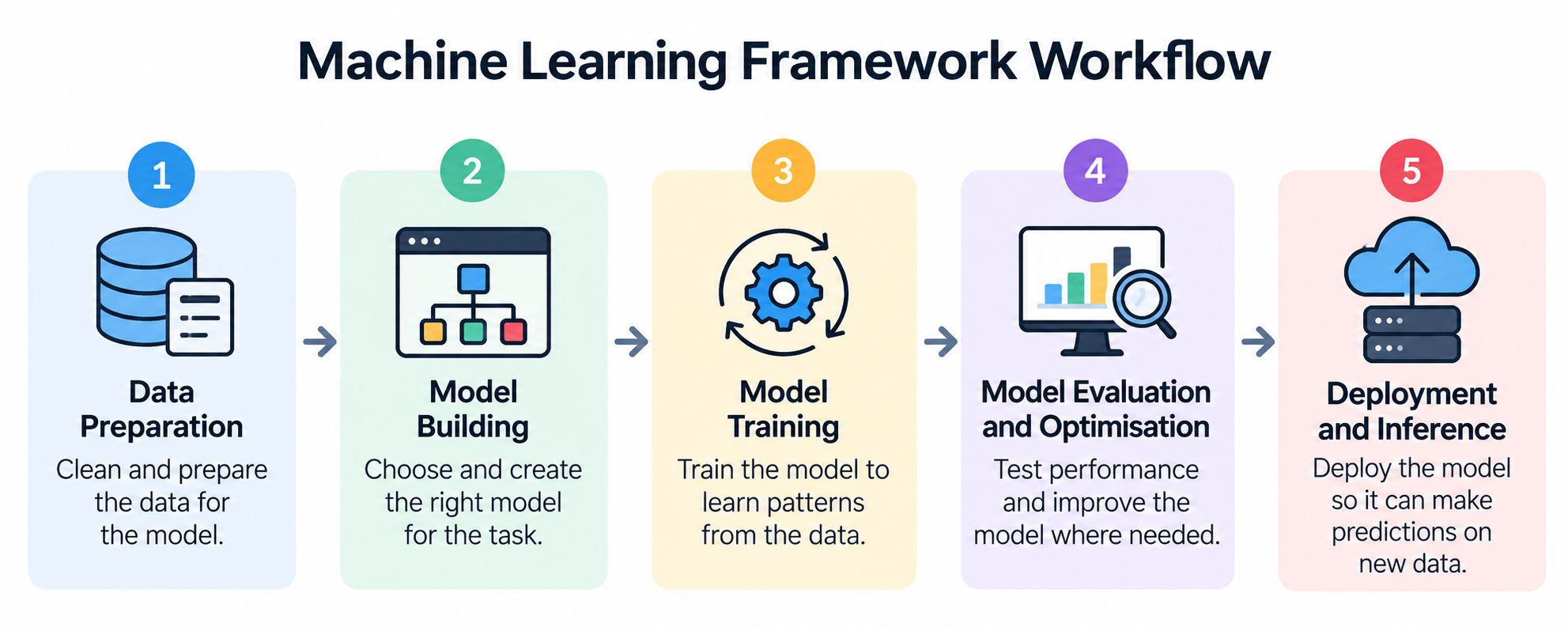
Before a model can learn, its input data needs to be prepared. This can include cleaning records, handling missing values, transforming features, and splitting data into training and testing sets.
Some frameworks provide tools for these tasks, while developers may use separate libraries alongside the framework.
The next step is defining how the model should learn from the data. Depending on the project, this could involve a regression model, decision tree, neural network, or another algorithm. Frameworks provide APIs that let developers construct these models without manually implementing every mathematical operation.
Training is where the model learns patterns from available data. The framework handles calculations required to adjust model parameters and reduce the selected loss function.
That's especially useful with neural networks, where training can involve millions or even billions of calculations.
A trained model needs to be tested against suitable metrics. Accuracy, precision, recall, F1 score, mean squared error, and other measures can help determine whether the model performs well for its intended task.
Developers can then tune parameters, change the model architecture, or improve the training data.
A model becomes useful when it can make predictions on new data. Deployment may involve putting the trained model into an application, website, business workflow, or cloud environment. Not every framework handles deployment in the same way, so this factor matters when you're choosing a tool for a real project.
Also read: Machine Learning Course Syllabus: A Complete Guide to Your Learning Path
AI Courses to upskill
Explore Artificial Intelligence Courses for Career Progression
Different machine learning frameworks solve different problems. Some focus on traditional algorithms, while others are designed mainly for neural networks or high-performance numerical computing.
Here are the different types of machine learning frameworks:
Traditional machine learning frameworks support algorithms such as regression, classification, clustering, and dimensionality reduction.
Scikit-learn is a well-known example of traditional machine learning framework. It's widely used for learning and applying traditional machine learning techniques because its API is relatively straightforward.
These tools work well for structured datasets and many business analytics problems.
Deep learning frameworks focus on neural networks and large-scale numerical operations.
TensorFlow, PyTorch, and Keras are common examples of deep learning frameworks. They support tasks such as image classification, language processing, speech applications, and other neural network workloads.
They also provide capabilities for training models using GPUs and other accelerators.
Some tools provide broader numerical computing capabilities that can be useful for advanced machine learning research and high-performance workloads.
JAX is an example of this framework. It combines numerical computing with transformations that support automatic differentiation and accelerated execution.
Must read: How to Learn Artificial Intelligence and Machine Learning
The most popular machine learning frameworks differ in their design, strengths, and typical applications. You shouldn't choose one simply because it's widely known.
Framework |
Common focus |
Typical use |
TensorFlow |
Machine learning and deep learning |
Neural networks and production applications |
PyTorch |
Deep learning |
Research, computer vision, NLP |
Scikit-learn |
Traditional machine learning |
Classification, regression, clustering |
Keras |
Deep learning |
Neural networks and rapid prototyping |
JAX |
High-performance numerical computing |
Advanced ML research and accelerated workloads |
TensorFlow is an open-source framework associated with machine learning and deep learning. It provides tools for creating and training neural networks and supports workflows that extend from experimentation to deployment.
It's used across areas such as computer vision, language processing, and predictive modelling.
PyTorch is an open-source machine learning framework widely used for deep learning. Its flexibility makes it popular for research and model development.
It's commonly used for neural networks, computer vision, natural language processing, and other AI applications.
Scikit-learn focuses on traditional machine learning rather than being primarily a deep learning framework.
It includes algorithms for classification, regression, clustering, preprocessing, and model evaluation. It's also a practical starting point for people learning the foundations of machine learning.
Keras provides a high-level approach to developing neural networks. Its syntax is designed to make model development easier to understand and experiment with. That makes it useful for beginners as well as developers who want to prototype deep learning models quickly.
JAX is designed for high-performance numerical computing and machine learning research. It supports automatic differentiation and compilation for accelerated hardware.
It's more suitable for users who already understand machine learning and want greater control over numerical computation and performance.
Do read: Exploring the Types of Machine Learning: A Complete Guide for 2025
Choosing a framework isn't only about the number of algorithms it offers. You also need to consider how well it fits your development workflow.
Useful features include:
Hardware support can become particularly important for deep learning. Training a neural network locally on a CPU can take far longer than training it with suitable GPU acceleration.
The ecosystem matters, framework with strong documentation and an active community can make debugging easier when you run into an unfamiliar error.
You should also check how well the framework fits your existing technology stack. A technically capable framework isn't automatically a practical choice for every project.
Earn an MBA degree from Liverpool Business School with IIM Udaipur certification and build the business, leadership, and management skills needed to progress in today’s competitive workplace.
Machine learning frameworks appear across many types of AI and data projects. The framework provides the development tools, while the actual application depends on the model and data.
Use case |
How frameworks are applied |
Predictive analytics |
Predicting outcomes from historical data |
Natural language processing |
Processing and generating text |
Computer vision |
Analysing images and video |
Recommendation systems |
Predicting user preferences |
Generative AI |
Training and running neural network models |
Large-scale machine learning |
Handling demanding training and inference workloads |
For example, a retailer could use machine learning to predict product demand. A healthcare organisation might analyse medical images with a computer vision model. A streaming platform could use recommendation models to estimate what a viewer might watch next. The framework doesn't decide the business problem. It provides the technical foundation for developing the model that addresses it.
Explore the IIM Kozhikode Professional Certificate Programme in AI for Business Professionals and learn to apply AI, GenAI, and Agentic AI to strategic business decisions and outcomes.
Here are the advantages and disadvantages of machine learning:
Advantages |
Limitations |
Reduce repetitive coding |
Frameworks have a learning curve |
Provide tested development tools |
Dependencies can create compatibility issues |
Support model training and evaluation |
Some projects may need custom solutions |
Enable hardware acceleration |
Advanced workloads can require significant resources |
Provide deployment capabilities |
Switching frameworks can require development effort |
Offer community and documentation |
APIs and features can change between versions |
The biggest advantage is usually productivity. Developers don't need to implement every low-level operation themselves, so they can spend more time working on the model and the problem it needs to solve. But abstraction has a cost. If you don't understand what's happening underneath, debugging an unexpected training result can become difficult.
Framework choice can also affect the project's long-term maintenance. A tool that works well for an experiment might not be the right fit for a production system with strict performance, infrastructure, or deployment requirements.
Also read: Best Machine Learning Free Online Courses with Certificates
There's no single framework for machine learning that fits every project. Start with the problem rather than the tool.
Ask yourself what type of model you're building, what your current skill level is, what hardware you'll use, and how the model will eventually be deployed.
Beginners usually benefit from a framework with simple APIs, clear documentation, and plenty of learning resources.
Scikit-learn is a practical option for learning traditional machine learning concepts. Keras can provide a simpler entry point into neural networks, while PyTorch and TensorFlow are useful when you're ready to work more deeply with modern deep learning.
Consider these factors before choosing a framework:
A beginner working on a small classification project doesn't need the same setup as a team training large neural networks. That's why choosing a framework for machine learning should always start with the project's actual requirements.
Conclusion
Machine learning frameworks give developers a practical foundation for creating and deploying models without implementing every operation from scratch. The ecosystem includes tools for traditional ML, deep learning, numerical computing, and specialised workloads.
The best choice depends on your project, experience, model requirements, hardware, and deployment plans. If you're starting out, focus on understanding machine learning concepts first, then choose a framework that matches the type of models you want to build.
Many widely used machine learning frameworks are open source and available at no direct software cost, including PyTorch, TensorFlow, and scikit-learn. However, real projects can still involve expenses for cloud computing, GPUs, storage, deployment infrastructure, monitoring, and other supporting services.
Python is the main language used with many popular machine learning frameworks, including PyTorch, TensorFlow, scikit-learn, Keras, and JAX. Some tools also support languages such as C++, JavaScript, R, or Java, depending on the framework and development environment.
Yes. Machine learning frameworks can run on cloud infrastructure, where developers can access virtual machines, GPUs, storage, and managed ML services. This setup is useful when local hardware isn't enough or when teams need shared environments for training, experiments, and deployment.
Before using a framework, learn basic Python, data handling, statistics, and core machine learning concepts. You don't need advanced mathematics at the start, but understanding features, labels, training, evaluation metrics, and overfitting will make framework-based learning much easier.
Yes. Machine learning frameworks and related libraries can work with tabular datasets used for classification, regression, and other predictive tasks. For structured rows and columns, traditional ML tools such as scikit-learn and specialised libraries can be more suitable than deep learning frameworks.
Many machine learning tools can work with pre-trained models, which lets developers start with an existing model instead of training everything from zero. This approach is useful for tasks such as language processing, image analysis, and other applications where suitable model checkpoints already exist.
Yes. Machine learning frameworks can support real-time prediction systems when the model and serving setup are designed for low-latency inference. The framework is only one part of the system, because response time also depends on the model, hardware, serving layer, data pipeline, and infrastructure.
Some machine learning frameworks and supporting tools provide distributed training, allowing computation to run across multiple devices or machines. This approach is useful for very large models and datasets, but it also adds networking, hardware, configuration, and monitoring requirements that smaller projects may not need.
Framework updates can add features, improve performance, fix bugs, and change compatibility. You shouldn't update a production project without testing first. Review release notes, check dependencies, run model validation, and confirm that training and deployment workflows still behave as expected after the change.
Models can sometimes be moved between frameworks using supported formats or conversion tools, but the process isn't always direct. Compatibility depends on the model architecture, operations, parameters, and target framework. Standards such as ONNX can help with interoperability across different machine learning ecosystems.
Machine learning frameworks can support reproducible development through fixed dependencies, saved model configurations, controlled training settings, and repeatable workflows. Reproducibility matters when you need to compare experiments, investigate unexpected results, or recreate a model after changes to code, data, or infrastructure.
999 articles published
We are an online education platform providing industry-relevant programs for professionals, designed and delivered in collaboration with world-class faculty and businesses. Merging the latest technolo...
Speak with AI & ML expert
By submitting, I accept the T&C and
Privacy Policy
Top Resources
Master's Degree
18 Months
Executive Diploma
12 Months
IIIT Bangalore
Executive Programme in Generative AI & Agentic AI for LeadersIndia’s #1 Tech University
Dual Certification
5 Months