Inductive Bias in Machine Learning: Types, Examples, and Applications
By Sriram
Updated on Jul 07, 2026 | 7 min read | 4.53K+ views
Share:

All courses
Certifications
More
By Sriram
Updated on Jul 07, 2026 | 7 min read | 4.53K+ views
Share:
Inductive bias in machine learning is the set of assumptions an algorithm relies on to make predictions for data it has not seen before. These assumptions enable the model to generalize beyond the training dataset by identifying meaningful patterns instead of memorizing examples. Without inductive bias, machine learning models would struggle to make accurate predictions on unseen data.
In this blog, you'll learn what inductive bias is, why it is essential, the different types of inductive bias, how it works, practical examples, and its real-world applications in machine learning.
Ready to build a strong foundation in machine learning? Explore upGrad's Machine Learning courses to gain hands-on experience with supervised learning, deep learning, model evaluation, and real-world AI applications guided by industry experts.
Popular AI Programs
Inductive bias in machine learning is the set of assumptions an algorithm uses to learn from training data and make predictions on unseen data. Rather than memorizing every example, these assumptions help the model identify meaningful patterns and generalize effectively.
For instance, linear regression assumes linear relationships, while decision trees assume data can be split using feature-based rules. Without inductive bias, machine learning models would require much more data and struggle to make accurate predictions.
Machine learning models are expected to perform well not only on training data but also on new, unseen data. Inductive bias makes this possible by narrowing the search space and helping algorithms focus on the most likely patterns.
The following points explain why inductive bias plays a critical role in machine learning.
Without suitable assumptions, a model may either memorize the training data or fail to identify useful relationships, resulting in poor performance.
Also Read: Machine Learning Tutorial: Basics, Algorithms, and Examples Explained
Free Courses
Different machine learning algorithms apply different forms of inductive bias depending on how they learn from data. Understanding these types helps explain why certain algorithms perform better on specific problems.
The table below compares the most common types of inductive bias used in machine learning.
Type |
Description |
Example |
| Preference Bias | Prefers one hypothesis over another without eliminating alternatives. | Decision Trees selecting simpler splits |
| Restriction Bias | Limits the hypothesis space by allowing only certain solutions. | Linear Regression assuming linear relationships |
| Structural Bias | Uses predefined model structures to learn patterns. | Convolutional Neural Networkspand recognizing image features |
| Statistical Bias | Makes probabilistic assumptions about data distributions. | Naïve Bayes assumes feature independence |
Each type influences how efficiently a model learns and how well it performs on different datasets.
Read : Weka Machine Learning: A Complete Guide for Beginners
AI Courses to upskill
Explore Artificial Intelligence Courses for Career Progression
Machine learning algorithms cannot evaluate every possible hypothesis because the number of potential solutions is enormous. Inductive bias in machine learning guides the learning process by making assumptions that help the algorithm focus on the most likely patterns.
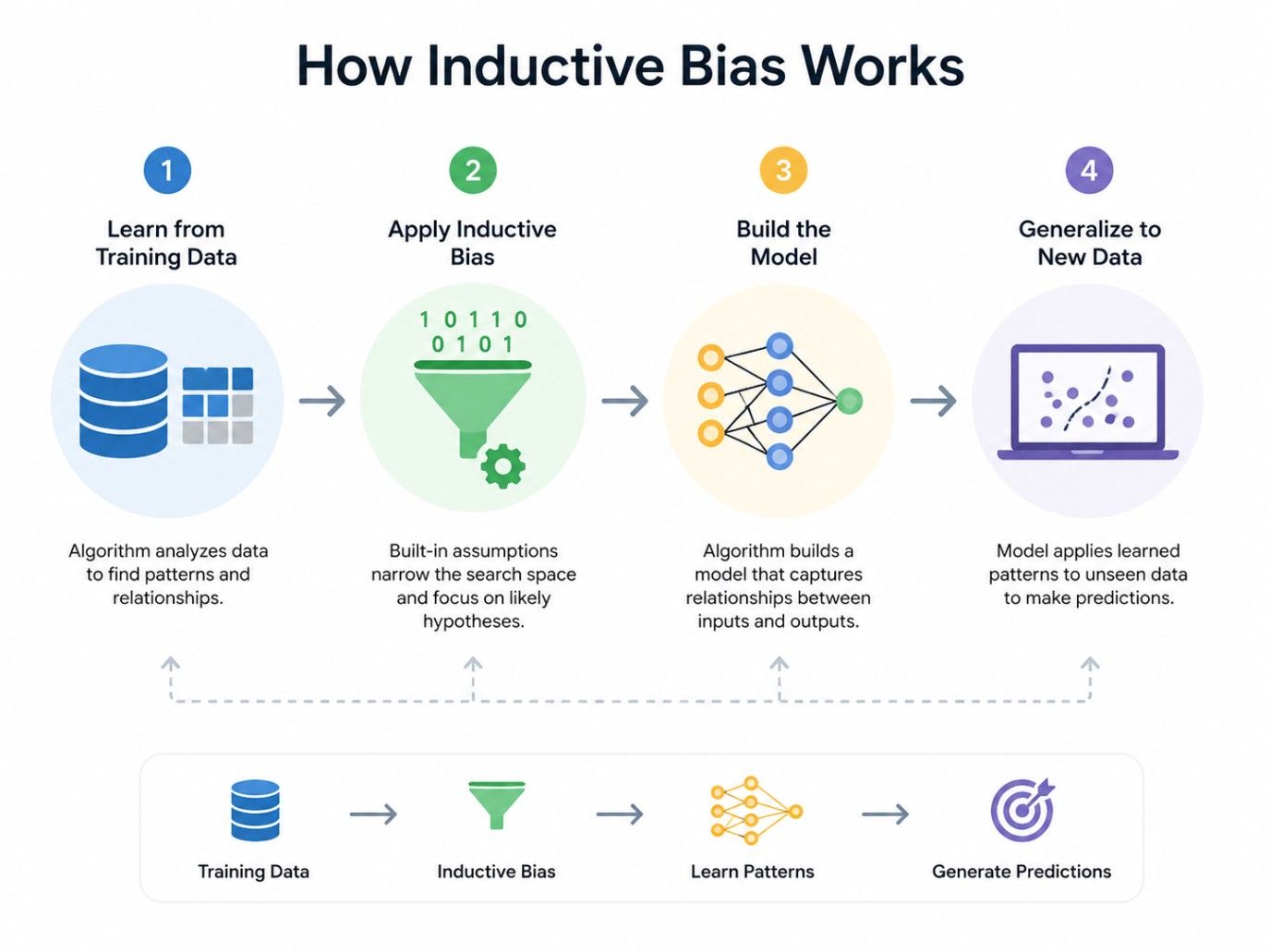
This enables models to learn efficiently and make accurate predictions on unseen data.
The learning process begins with the algorithm analyzing labeled or unlabeled training data. It identifies patterns, relationships, and feature interactions that can be used to understand the underlying structure of the dataset.
The algorithm uses its built-in assumptions to reduce the number of possible hypotheses. Rather than exploring every solution, it prioritizes those that align with its inductive bias, making learning more efficient.
Using the selected hypothesis, the algorithm constructs a mathematical model that represents the relationships between input features and the target variable. The quality of this model depends on both the training data and the chosen inductive bias.
Once trained, the model applies the learned patterns to new data it has never encountered before. Effective inductive bias enables the model to generalize well, improving prediction accuracy on real-world datasets.
Want to strengthen your machine learning fundamentals? Explore these upGrad programs to master core concepts like inductive bias, model evaluation and feature engineering
Master of Science in Machine Learning & AI from LJMU
Executive Post Graduate Programme in Applied AI and Agentic AI
Different algorithms rely on different assumptions to solve learning problems efficiently. Examining these examples makes the concept easier to understand.
The following table highlights how popular algorithms use inductive bias.
Algorithm |
Inductive Bias |
| Linear Regression | Assumes linear relationships between variables |
| Decision Tree | Prefers simple decision rules before complex ones |
| k-Nearest Neighbors (KNN) | Assumes nearby data points have similar outputs |
| Naïve Bayes | Assumes features are conditionally independent |
| Support Vector Machine (SVM) | Assumes a maximum-margin boundary separates classes |
| Neural Networks | Learn hierarchical feature representations through layered structures |
These assumptions allow each algorithm to specialize in solving particular types of machine learning problems.
Also Read: A Guide to Linear Regression Using Scikit [With Examples]
Inductive bias is embedded in almost every machine learning application. It helps algorithms learn efficiently while improving their ability to make reliable predictions across different industries.
The following examples show where inductive bias plays an important role.
Computer vision models use structural inductive bias to recognize edges, shapes, textures, and objects in images. Convolutional neural networks leverage spatial relationships, allowing them to perform image classification, object detection, and facial recognition with high accuracy.
Language models assume that words appearing close together often share contextual relationships. This inductive bias helps algorithms understand sentence structure, perform text classification, language translation, sentiment analysis, and question answering.
Machine learning models assist doctors by predicting disease risks, analyzing medical images, and recommending treatments. Appropriate inductive bias enables these models to identify meaningful medical patterns while improving diagnostic accuracy.
Financial institutions rely on machine learning algorithms to detect suspicious transactions. Inductive bias helps models distinguish normal customer behavior from fraudulent activities, allowing faster identification of unusual spending patterns.
Streaming platforms and e-commerce websites use inductive bias to recommend products, movies, and music based on user preferences and historical interactions. These assumptions help improve personalization while enhancing customer experience.
Read: Image Recognition Machine Learning: Brief Introduction
Selecting the right inductive bias helps machine learning models learn faster and produce more reliable predictions.
It also improves a model's ability to generalize instead of simply memorizing training data.
The table below summarizes the major advantages of using inductive bias in machine learning.
Advantage |
Benefit |
| Better Generalization | Helps models perform well on unseen data. |
| Faster Learning | Reduces the hypothesis space, making training more efficient. |
| Lower Data Requirements | Enables learning even with limited training examples. |
| Reduced Overfitting | Encourages meaningful patterns instead of memorization. |
| Improved Prediction Accuracy | Guides the algorithm toward more suitable solutions. |
| Efficient Model Development | Simplifies the learning process for many algorithms. |
These advantages make inductive bias in machine learning an essential concept for building practical and scalable AI systems.
Although inductive bias is necessary for machine learning, choosing inappropriate assumptions can negatively affect model performance.
The quality of predictions depends on whether the assumptions align with the characteristics of the data.
The following points highlight some common limitations.
Balancing inductive bias with data quality and model complexity is important for achieving reliable machine learning results.
There is no universal inductive bias that works for every machine learning problem. Selecting the appropriate assumptions depends on the dataset, business objective, and algorithm being used.
The following practices can help improve model performance.
Applying these practices helps data scientists build models that generalize effectively while minimizing prediction errors.
Inductive bias and overfitting are closely related but represent different concepts in machine learning. Understanding the difference helps in selecting algorithms that balance learning and generalization.
The table below compares the two concepts.
Aspect |
Inductive Bias |
Overfitting |
| Purpose | Guides the learning process using assumptions. | Occurs when a model memorizes training data. |
| Effect on Generalization | Usually improves performance on unseen data. | Reduces performance on new data. |
| Role | Necessary for every learning algorithm. | An undesirable outcome during training. |
| Impact | Helps simplify hypothesis selection. | Creates overly complex models with poor adaptability. |
A suitable inductive bias reduces the risk of overfitting by encouraging the model to learn meaningful patterns instead of noise.
As artificial intelligence continues to evolve, researchers are developing better ways to incorporate inductive bias into modern machine learning systems.
These improvements aim to make models more efficient, interpretable, and capable of learning from smaller datasets.
Future developments are expected to focus on:
These advancements will help create machine learning models that are not only more accurate but also more robust across diverse real-world applications.
Inductive bias in machine learning is a fundamental concept that enables algorithms to learn from limited data and make accurate predictions on unseen examples. By incorporating appropriate assumptions, machine learning models can reduce the search space, improve learning efficiency, and achieve better generalization.
From linear regression and decision trees to deep neural networks, every learning algorithm relies on some form of inductive bias to solve complex problems effectively. Understanding these assumptions allows data scientists to select suitable algorithms, improve model performance, and develop reliable AI systems across industries.
Want to explore more about machine learning? Book your free 1:1 personal consultation with our expert today.
A simple example of inductive bias is linear regression, which assumes there is a linear relationship between input features and the target variable. Decision trees use a different assumption by preferring simpler splits before more complex ones. These built-in assumptions help models learn efficiently and make reliable predictions on unseen data rather than memorizing every training example.
Inductive bias improves performance by guiding a model toward the most likely patterns instead of searching through every possible hypothesis. This reduces training time, improves generalization, and helps the model perform better on new data. Choosing the right assumptions also lowers the risk of overfitting and supports more accurate predictions in real-world applications.
In theory, a model without inductive bias could memorize the training dataset, but it would struggle to make predictions on unseen examples. Every practical machine learning algorithm includes some form of inductive bias because it enables generalization, reduces computational complexity, and allows learning from a limited amount of training data.
Inductive learning occurs when a model identifies general rules from specific examples. For instance, a spam detection system learns from thousands of labeled emails and then predicts whether new emails are spam or legitimate. Instead of memorizing each email, the model learns patterns that apply to future messages.
The hypothesis space is the collection of all possible models or solutions an algorithm can choose from during training. Inductive bias narrows this space by applying assumptions that guide the learning process. Without these assumptions, evaluating every possible hypothesis would be computationally impossible for most machine learning tasks.
The right inductive bias depends on your dataset, business objective, and the relationships within the data. If the data follows a linear pattern, linear models are often suitable. For complex or non-linear relationships, decision trees or neural networks may perform better. Comparing multiple algorithms through validation is usually the most effective approach.
Yes. Deep learning models also rely on inductive bias, although it is often built into their architecture rather than defined explicitly. For example, convolutional neural networks assume nearby pixels are related, making them highly effective for image recognition. These assumptions help deep learning models learn efficiently from large datasets.
In explanation-based learning, inductive bias comes from prior domain knowledge rather than only the training data. The system explains why an example satisfies a concept and then generalizes that explanation into a rule. This approach enables faster learning, especially when only a small number of training examples are available.
Inductive bias helps a model generalize by making reasonable assumptions about the data, while overfitting occurs when a model memorizes the training dataset instead of learning meaningful patterns. A well-chosen inductive bias can reduce overfitting and improve prediction accuracy on unseen data by encouraging simpler, more reliable solutions.
When training data is limited, inductive bias in machine learning becomes even more important because the model cannot rely on examples alone. Appropriate assumptions help the algorithm recognize useful patterns and generate accurate predictions. This makes inductive bias in machine learning especially valuable in domains where collecting large datasets is expensive or difficult.
Yes. If the assumptions made by an algorithm do not match the underlying characteristics of the data, prediction accuracy can decrease significantly. For example, using a linear model for highly non-linear data may produce poor results. Selecting the appropriate inductive bias in machine learning through experimentation and validation is essential for building reliable AI models.
730 articles published
Sriram K is a Senior SEO Executive with a B.Tech in Information Technology from Dr. M.G.R. Educational and Research Institute, Chennai. With over a decade of experience in digital marketing, he specia...
Speak with AI & ML expert
By submitting, I accept the T&C and
Privacy Policy
Top Resources
Master's Degree
18 Months
Executive Diploma
12 Months
IIIT Bangalore
Executive Programme in Generative AI & Agentic AI for LeadersIndia’s #1 Tech University
Dual Certification
5 Months