Why Organizational Skills Matter in the Workplace and How to Improve Them
By upGrad
Updated on May 11, 2026 | 498 views
Share:

All courses
Certifications
More
By upGrad
Updated on May 11, 2026 | 498 views
Share:
Table of Contents
Organizational skills are the ability to plan, prioritize, and manage your time, tasks, and resources in a way that helps you work efficiently and meet your goals.
These skills are important for professional effectiveness, helping you to stay on top of responsibilities, reduce confusion, and make better decisions under pressure. If you have ever missed a deadline, lost track of a task, or felt overwhelmed by unfinished work, you already know what happens when these skills are absent.
This guide covers everything you need to know what organizational skills mean and how they are defined, the top skills. You will also learn how they compare to time management, what happens when they are weak, and practical techniques and tools to strengthen them.
If you are looking to build these skills in a structured way, upGrad's management programs offer the right foundation to help you lead, plan, and perform at your best.
Popular Management Programs
Organizational skills are a set of abilities that help you plan, prioritize, and complete your work in a structured way. Professionals who develop these skills consistently stay on top of responsibilities without constant follow-up or last-minute rushing.
Here are the core skills that matter most in any professional setting.
This is about knowing what to do first. Not every task carries equal weight. Professionals who plan well look at their list and decide what needs immediate attention and what can wait.
Knowing what to do is one thing. Knowing when to do it and how long it will take is another. When you estimate time accurately, you avoid overbooking yourself and running over deadlines.
Track how long tasks take versus how long you expected, block dedicated time for focused work, not just meetings, and avoid switching between tasks too often as it reduces output quality.
Clear goals give your work direction. Without them, you end up being busy but not productive. Set goals that are specific, measurable, and time-bound, so you know when you have succeeded.
Missing minute details leads to bigger problems down the line. Organized professionals review their work before giving it. They double-check figures, re-read emails, and confirm meeting details in advance.
Being organized also means following up on what you said you would do. If you are committed to sending a document by Friday, it should go out on Friday. Reliable follow-through builds trust within any team.
Also read: Project Management Process: Phases and Life Cycle Explained
Free Courses
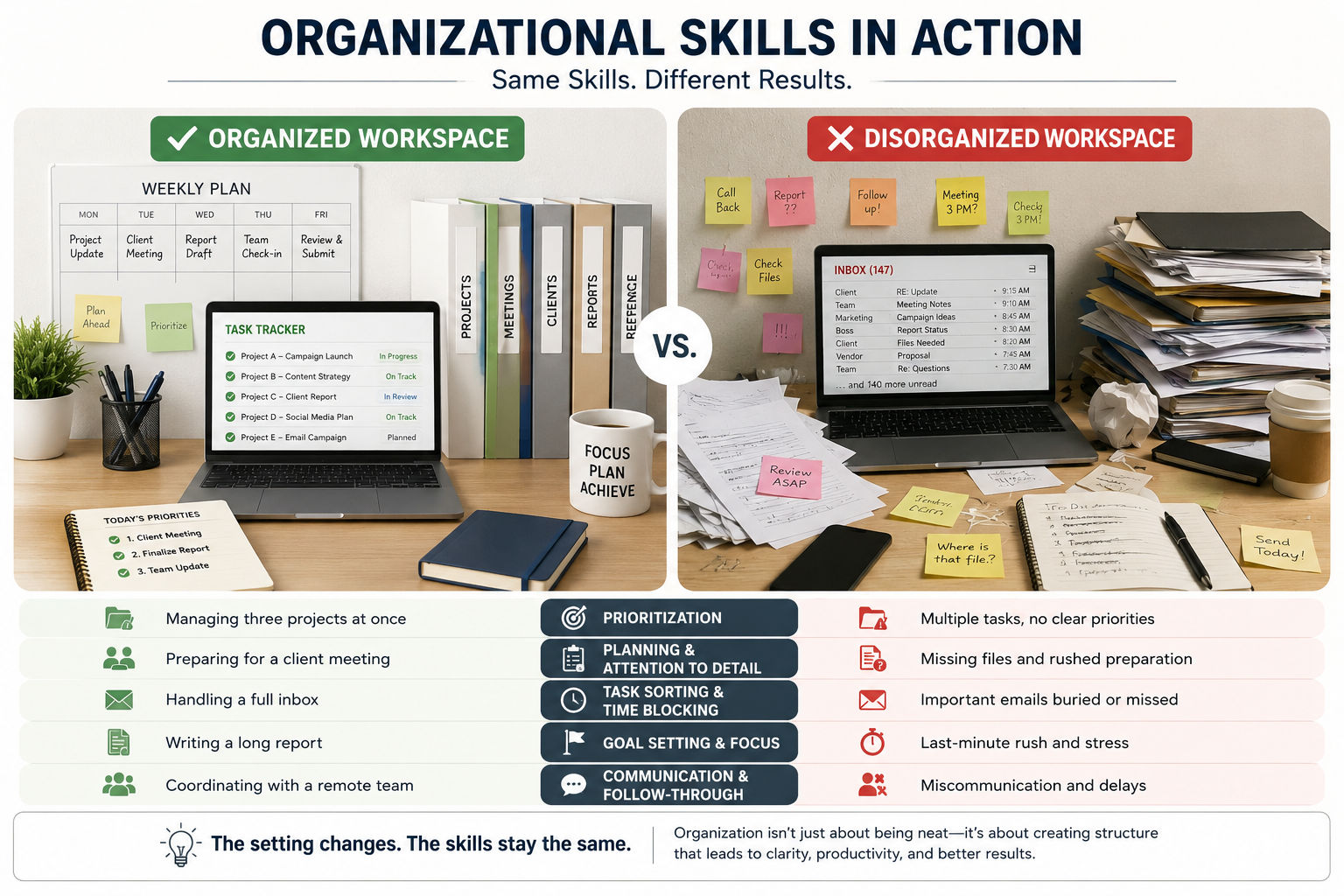
Talking about organizational skills examples in abstract terms is easy. Seeing them in real situations makes it far easier to apply. Here is what these skills look like when put to use.
Also read: Which of These Product Management Tools are You Already Using?
Management Courses to upskill
Explore Management Courses for Career Progression
IIIT-B & IIM, Udaipur
Chief Technology Officer & AI Leadership Programme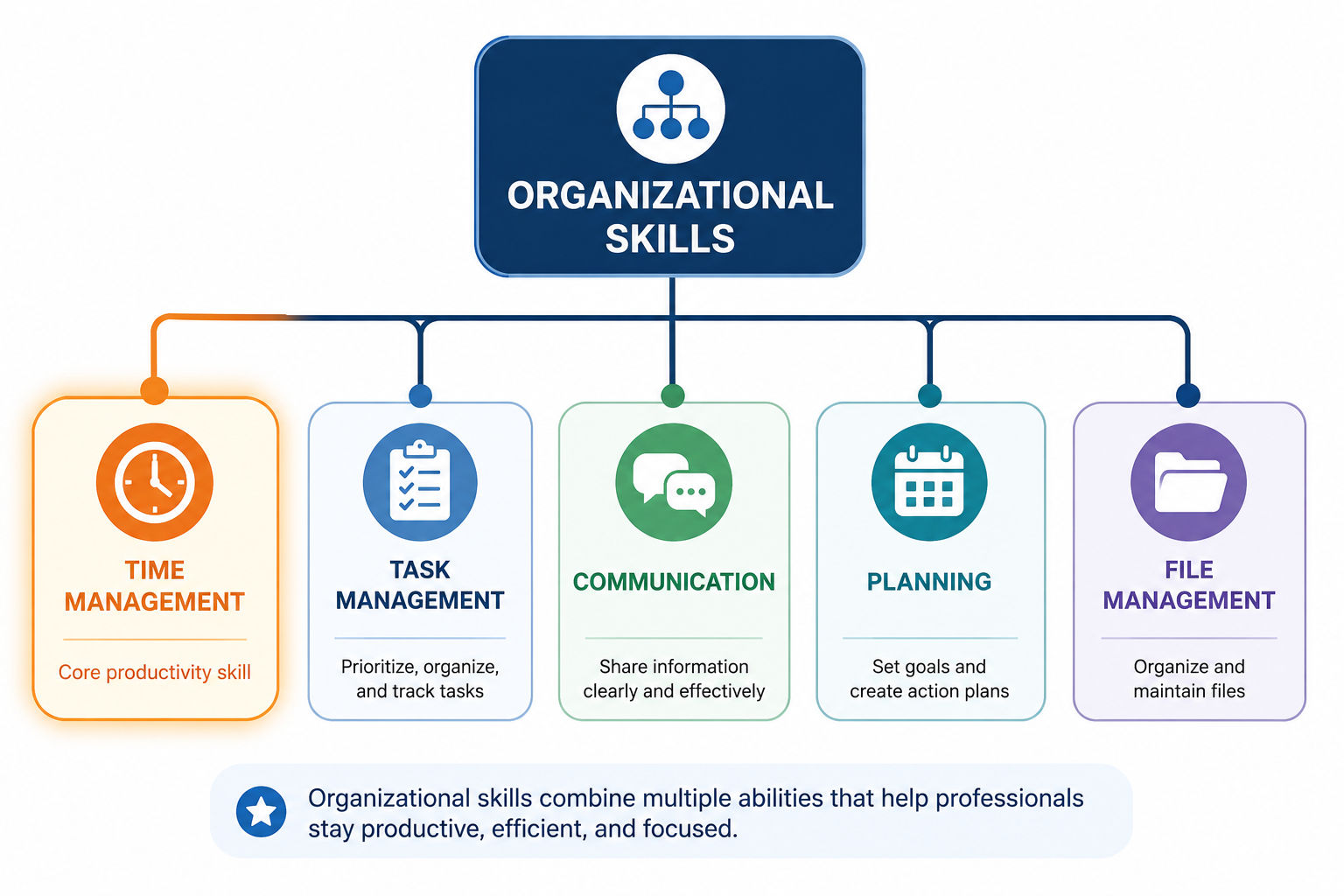
People often use these two terms interchangeably. They are not the same thing. Understanding the difference helps you work on both more deliberately.
Organizational skills refer to how you structure your work, resources, tasks, and information. They cover a wide scope. They include project planning, prioritization, file management, communication, and the systems you build to keep your work under control.
Time management is one part of organizational skills. It focuses on how you distribute and use your hours. It answers the specific question: how do I fit everything into the time I have?
Think of it this way. Organizational skills are the overall framework. Time management is one tool within that framework.
Strong time management and organizational skills work together. If you manage time well but have no structure, you end up doing the right things in the wrong order. If you have structure but poor time management, you plan clearly but still miss deadlines.
Also read: 16 Best Time Management Techniques & Tools for 2025
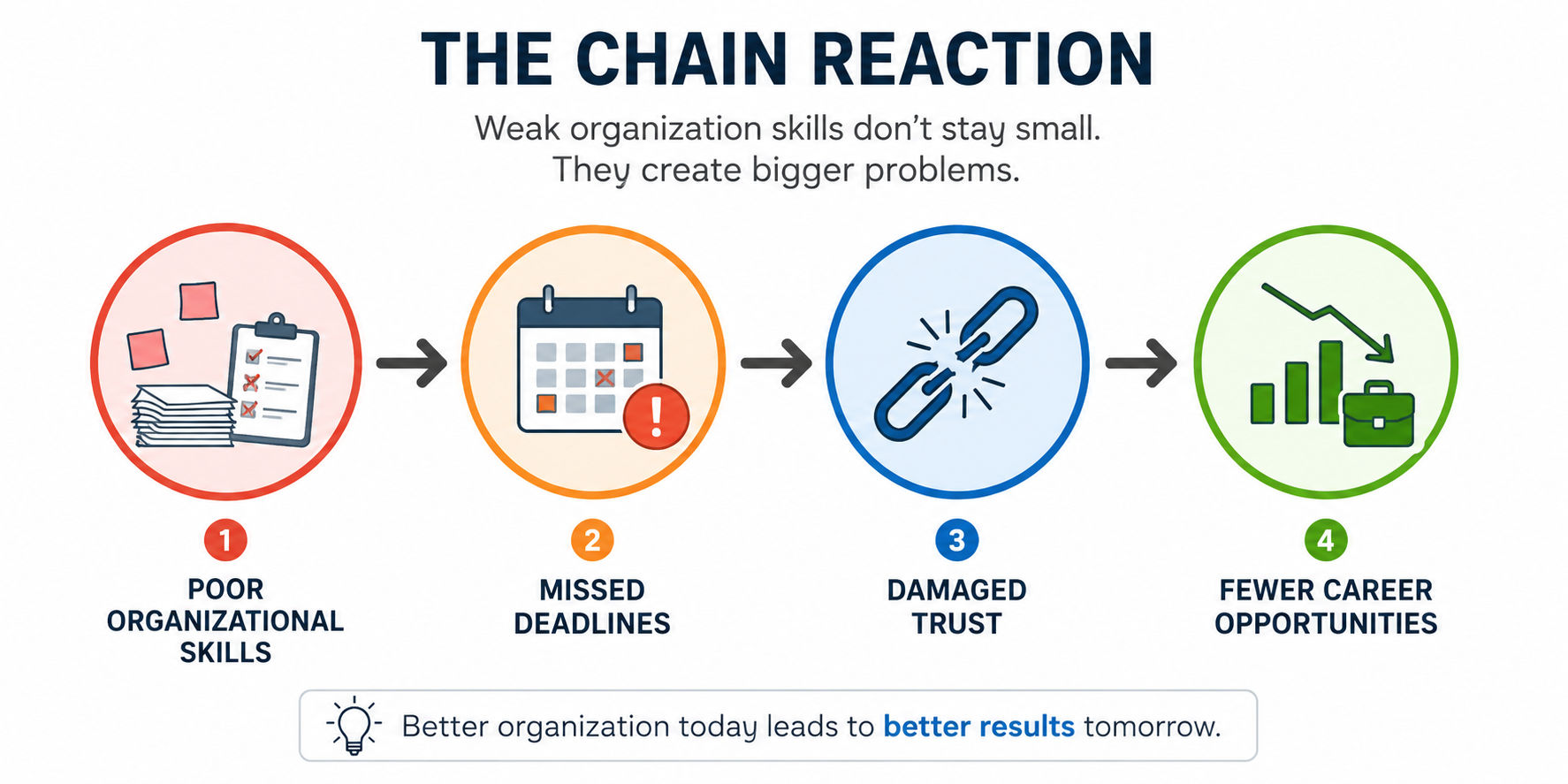
Weak organizational skills do not just slow you down individually. They create a chain of small problems that compound over time and affect everyone around you.
Here is what poor organizational skills look like in a workplace:
When a manager notices that someone regularly misses deadlines or forgets follow-ups, they stop assigning that person for high stakes to work. This limits visibility and slows career progression directly.
On the other hand, someone who delivers on time, keeps their work organized, and communicates clearly gets noticed fast. They receive more responsibility, more visible opportunities, and faster advancement.
Organizational skills are not a soft skill in the background. They directly shape your career path.
Also read: Top Productivity Hacks to Boost Efficiency and Success
Developing organizational skills does not require overhauling your entire routine. It starts with choosing one technique, applying it consistently, and building it once it becomes a habit. Here are some practical techniques:
This method helps you sort tasks by urgency and importance. Draw a simple 2x2 grid and place every task in one of four boxes.
Use this at the start of each week. It keeps your attention on work that actually moves things forward.
| Urgent | Not Urgent | |
| Important | Do it now | Schedule it |
| Not Important | Delegate it | Drop it |
Assign specific time blocks to specific tasks on your calendar. Instead of a loose to-do list, your calendar becomes your actual plan for the day. Block two hours in the morning for deep work, thirty minutes for email, and a short buffer at the end for review.
Time blocking removes the daily question of what to do next. You follow the schedule you already built.
Work in 25-minute focused sessions, followed by a 5-minute break. After four rounds, take a longer 15 to 30-minute break.
This pomodoro technique works well for people who struggle with focus or feel overwhelmed by long tasks. Breaking work into short, timed chunks makes it feel approachable rather than endless.
The GTD method, created by productivity consultant David Allen, works in five steps:
GTD works particularly well for people managing many projects at once who need a reliable system to prevent things from falling through.
Set aside ten minutes every morning to plan your day. Write down your three most important tasks. At the end of the day, review what got done and what carries forward to tomorrow.
Simple daily habits like this are how developing organizational skills becomes a permanent practice rather than a one-time effort.
You do not need a physical planner to stay organized. A range of digital tools make structure easier to keep across your tasks, projects, and schedule.
Pick one tool, learn it well, and build your system around it. Using too many tools at once creates its own form of disorganization and adds switching costs to every task. Here are some better tools in the market:
| Tool | Best For | Free Plan Available |
| Notion | Notes, projects, and databases | Yes |
| Trello | Visual task tracking with boards | Yes |
| Todoist | Simple daily task management | Yes |
| Google Calendar | Time blocking and scheduling | Yes |
| Asana | Team projects and assignments | Yes |
| Forest App | Focus sessions and distraction blocking | Partial |
Also read: How to Improve Productivity? Top 10 Ways You Can Implement Today
Organizational skills are not a fixed personality trait. They are a practice you build over time through small, repeatable choices. Start with one technique from this guide. Apply it for two weeks. Add another once the first feels natural.
The professionals who consistently get the most done are not the ones working the most hours. They are the ones who have learned to work within a structure that keeps them clear, focused, and on track.
To build stronger organizational and leadership skills, book a free consultation call with upGrad to find the right fit for your career goals.
Yes. These skills are learned through practice, not inherited. Starting with one small habit, like a daily planning session, creates real change over time. Adding techniques and tools gradually builds a system that works consistently, even on difficult or overwhelming days.
They directly shape how well you manage your workload day to day. Professionals with strong organizational skills miss fewer deadlines, make fewer errors, and communicate more clearly. Managers notice and typically assign them more responsibility, which opens opportunities for advancement and broader impact.
Productivity fixes tend to be short-term. Developing organizational skills is about building consistent habits and systems that hold up over time. The goal is a structure that functions even on your worst days, not just when motivation is high or conditions are ideal.
Digital tools reduce the mental load of tracking everything yourself. They make it easier to capture tasks, set reminders, and check progress. They work best when combined with a clear method like GTD or time blocking. The tool supports the skill. It does not replace the underlying discipline.
Common signs include missing deadlines, losing track of tasks, spending time searching for files, feeling overwhelmed without a clear cause, or being caught off guard by events you already knew were coming. These patterns point to specific gaps in structure that can be addressed with the right approach.
The core skills stay consistent, such as planning, prioritizing, and following through. A software developer organizes code and sprint cycles. A nurse organizes patient schedules and care plans. The underlying organizational skills are shared even when the context looks completely different.
Research on habit formation suggests new habits take between 18 and 66 days to solidify. Most people notice a real difference within two to four weeks of applying a consistent method. Progress depends on how regularly you practice and whether you review and adjust your approach as you learn what works.
Employers prioritize these skills because they are a direct indicator of how an employee will handle their workload. An organized employee requires less supervision, makes fewer mistakes, and hits deadlines more reliably. These traits save the company money and reduce the stress levels of the entire team.
In a remote work setting, you lack the physical structure of an office and the immediate presence of a manager. So, you must be able to manage your own schedule, keep a productive home office, and stay aligned with your team through digital tools. Without strong organizational habits, remote workers often struggle with distractions and blurring boundaries between work and home life.
Busy people are often reactive and stressed, jumping from one task to another without a clear plan. Organized people are proactive; they have a strategy and work with intention. Organization ensures that your efforts actually lead to meaningful progress rather than just constant movement.
Common examples include project management, calendar coordination, record keeping, and strategic planning. You can also mention specific methodologies like Agile or Scrum if they apply to your field. Instead of just listing the skills, provide evidence, such as "Managed a project involving five stakeholders and delivered it two weeks ahead of schedule." This proves you have the skills in a real-world context.
1011 articles published
We are an online education platform providing industry-relevant programs for professionals, designed and delivered in collaboration with world-class faculty and businesses. Merging the latest technolo...
Get Free Consultation
By submitting, I accept the T&C and
Privacy Policy
Top Resources
Certification
3 Months
Certification
6 Months
O.P. Jindal Global University
Masters in International Accounting and Finance (Accredited by ACCA, UK)Master's Degree
12 Months