Coaching vs Mentoring: Differences, Examples, and When to Use Each
By upGrad
Updated on May 11, 2026 | 0.6k+ views
Share:

All courses
Certifications
More
By upGrad
Updated on May 11, 2026 | 0.6k+ views
Share:
Table of Contents
Coaching is a task-oriented process that aims to improve specific skills or performance over a short period of time. Mentoring is a relationship driven approach where a more experienced professional guides a less experienced person in long term career growth and personal development.
While a coach helps you master a specific tool or behavior, a mentor provides wisdom and perspective based on their own professional journey.
In this guide, you will read about: the core differences between coaching and mentoring, how both show up in the workplace, their benefits for organizations, how they compare with counseling, and a step-by-step way to build a program around them.
If you want to learn management better, check out upGrad’s management programs for better insights and tools to accelerate your professional journey.
Popular Management Programs
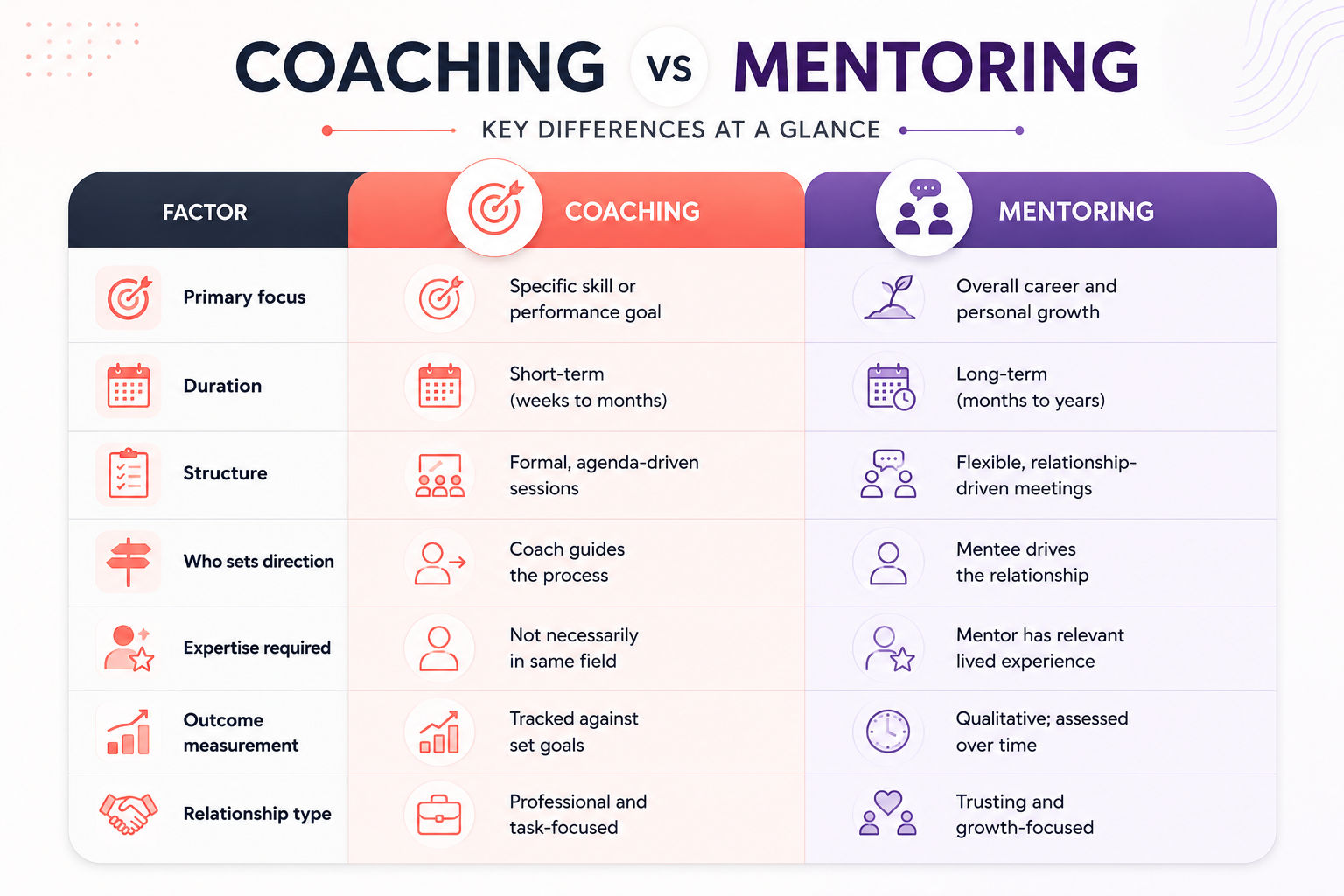
The simplest way to separate coaching vs mentoring is by asking one question: are you solving a specific problem, or are you building a person?
Solve a specific problem. It is time-bound, structured, and focused on measurable outcomes. A coach helps you find your own answers by asking the right questions, giving direct feedback, and tracking progress against defined goals.
The coach does not need to work in your industry.
Mentoring builds people over time. It is relationship-based, long-term, and driven by lived experience. A good mentor does not just answer the questions you bring to them. They help you figure out which questions you should be asking in the first place.
A mentor typically offers:
In practice, the line can blur. A mentor might shift into coaching mode when you are working through a specific challenge. A coach might draw on personal experience in a way that feels more like mentoring. What matters is knowing which one you need to go in, because walking into the wrong setup will leave you frustrated on both sides.
Also read: 15 Ways to Improve Your Time Management Skills [With Actionable Tips]
Free Courses
The difference between coaching and mentoring becomes much clearer with concrete examples.
Example 1: Priya is a sales manager who struggles to close enterprise deals. Her company brings in a sales coach for a 12-week program. The coach reviews her call recordings, finds weak points in her pitch, and sets weekly targets. By week 12, her conversion rate improves by 35%. The engagement ends there.
Example 2: A startup founder is preparing for a Series A funding round. She hires a pitch coach for 6 weeks. The coach runs mock sessions, tightens her messaging, and gives structured feedback after every session. The goal is clear and time bound.
Example 3: A new teacher is struggling with classroom management. The school assigns a coaching program for one semester. Sessions happen fortnightly, and progress is reviewed at the end.
Example 1: Arjun is a junior software engineer who wants to move into product management. His company pairs him with a senior product leader who made the same transition five years ago. Over 18 months, the mentor shares how they made the shift, introduces Arjun to key stakeholders, and helps him build the right visibility. There is no fixed endpoint.
Example 2: A first-generation college student gets a mentor through a university program. The mentor helps them understand how to navigate campus culture, internship applications, and career planning. The relationship grows organically and often continues after graduation.
Example 3: A mid-level marketing manager wants to move into a director role. A senior leader mentors her over a year, sharing insights about leadership, organizational politics, and how to build influence within the company.
Also read: 10 best leadership courses
Management Courses to upskill
Explore Management Courses for Career Progression
IIIT-B & IIM, Udaipur
Chief Technology Officer & AI Leadership ProgrammeMost organizations use both coaching and mentoring, but very few use them intentionally. The result is that employees end up in the wrong kind of support at the wrong time, and nobody quite understands why it is not working.
Here is the distinction that matters at work:
A performance review flags that a manager is struggling to have difficult conversations with their team. That is a specific, definable gap. A coach does not need to know the manager's industry or their five-year plan. They need to work on that one thing, measure progress, and close the gap within a set period.
This is why coaching tends to show up at inflection points: before a promotion, during a role change, after a performance concern is raised, or when a team needs to build a capability fast. The situation has a beginning and an end. So does coaching.
Now consider a different scenario. A high-potential employee is two years into their career and technically strong, but they are not sure what they want to build toward.
There is no specific skill gap. There is no performance problem. What they need is someone who has navigated a similar path and can help them see around corners they do not even know exist yet.
That is mentoring. And it cannot be rushed or reduced to a six-week program with tracked milestones. The value builds slowly, through repeated conversations over months or years, as the mentee grows into new challenges and the relationship adjusts around them.
The most common mistake is using coaching when mentoring is needed, and vice versa.
A new hire paired with an executive mentor in their first week rarely gets much from it because they do not yet know what questions to ask. That same hire would benefit far more from a structured onboarding coach who helps them adapt quickly and close early skill gaps. Flip the timeline forward two years, and the mentoring relationship starts to make real sense.
The table below is a practical reference, but the bigger point is this: the right choice is not about the tool; it is about reading where the employee actually is.
| Aspect | Coaching at Work | Mentoring at Work |
| Trigger | Performance gap or skill need | Career development or retention goal |
| Who provides it | External coach or trained manager | Senior internal employee |
| Meeting frequency | Weekly or bi-weekly | Monthly or as needed |
| Formal tracking | Progress tracked against goals | Informal, relationship-based |
| Duration | Fixed program length | Open-ended |
Yes. Not only can they work together, but in most cases, they should.
The mistake most people make is treating them as alternatives, as if choosing one means giving up the other. They are not competing with approaches. They operate at different levels and serve different needs, which is exactly what makes them so effective when used alongside each other.
The two work well together because they fill gaps the other cannot. Here is where each one picks up where the other leaves off:
Deepa wants to become a data analyst. Her mentor, a senior analytics manager, helps her understand what the role actually looks like day-to-day, which skills matter most, and what the career path ahead of her realistically involves. At the same time, Deepa is enrolled in a coaching program focused on Excel, SQL, and data storytelling.
The mentor gives her direction. The coach gives her the tools to move in that direction. Neither knows everything the other is doing, and that is fine. The two relationships serve completely different purposes, and Deepa benefits both without any confusion about what each one is for.
Also read: Master Problem-Solving Skills: Examples & Key Techniques
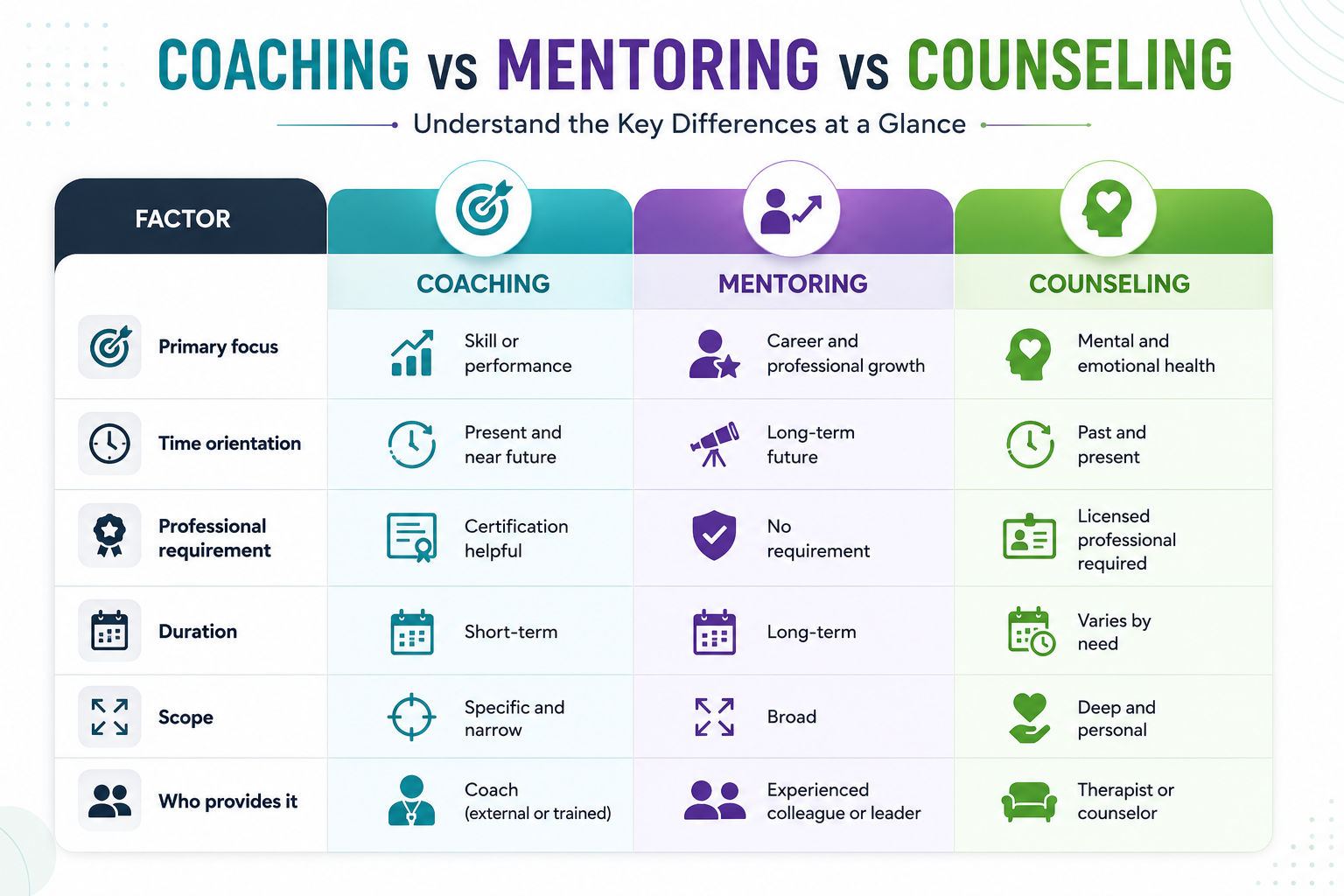
These three terms get used interchangeably all the time, in organizations, in leadership conversations, even in HR policies. That's a problem because they describe fundamentally different relationships with different purposes, different boundaries, and different qualifications needed to practice them.
Getting this wrong isn't just a semantic issue. It can cause real harm.
Also read: Top 5 Types of Leadership in Management
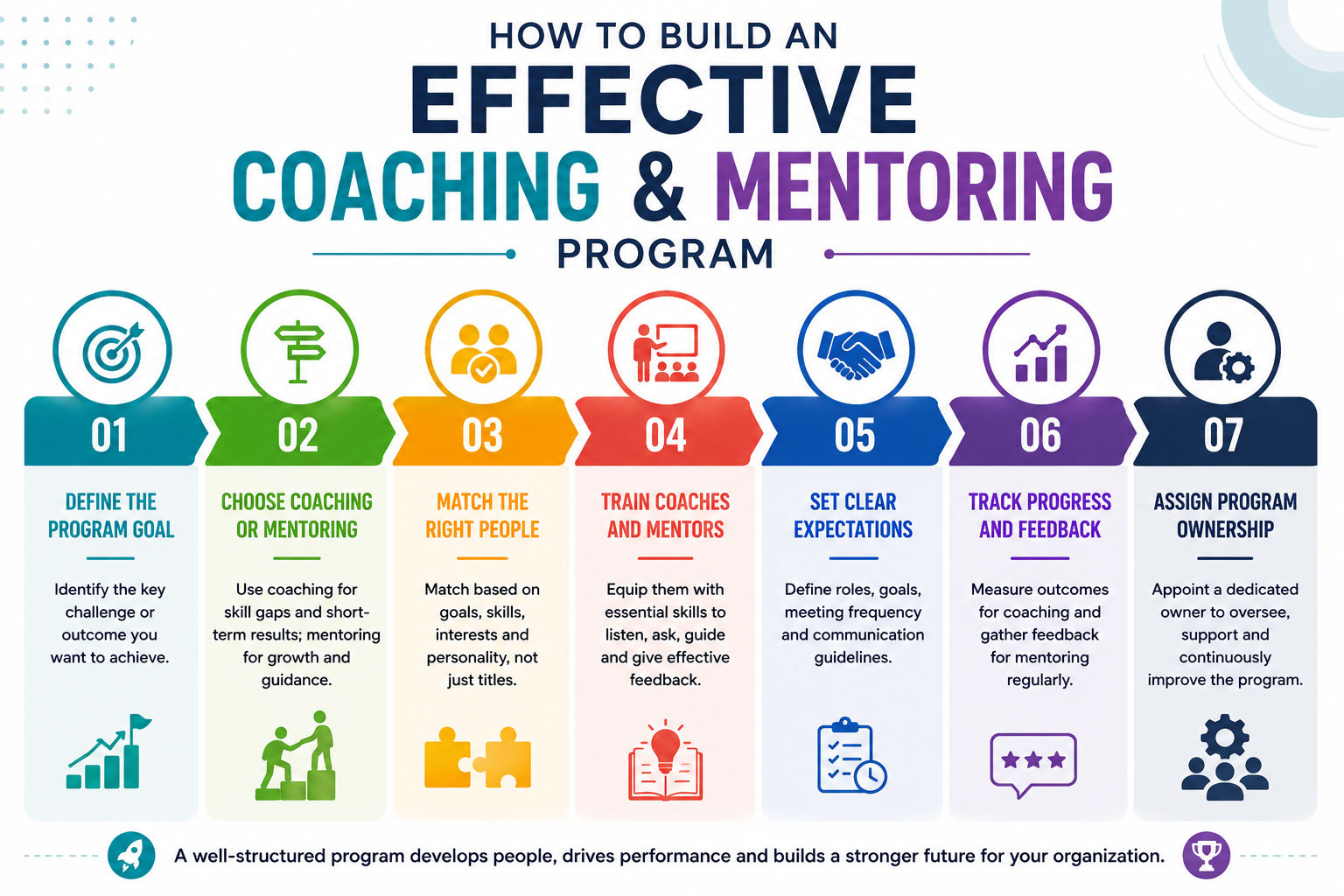
A good program doesn't fail dramatically. It fades because of missed meetings, unclear goals, and matches that never clicked. Here's how to build one that doesn't.
What problem are you actually solving?
Attrition in a specific group. A performance gap at the manager level. High-potential employees with no visible path forward. Your answer determines whether you need coaching, mentoring, or both. Write the problem in one sentence. That sentence becomes your filter for every decision that follows.
Coaching handles specific, measurable gaps. Mentoring builds career direction over time.
Running them as one blended program without separating the goals produces mediocre results on both fronts. Keep them structurally distinct, even when the same employee needs both.
Most programs underinvest here. Most programs fail here.
For coaching, match on the specific gap, not seniority, not availability. For mentoring, ask the mentee what they're looking for before you match them. Their answer tells you more than any form.
Being senior is not the same as being skilled at developing others.
A focused half-day on four skills is enough to raise the floor significantly:
Set a timeline. Define a meeting cadence. Put expectations in writing before the first session. A one-page document outlining what both parties have agreed to is worth more than a forty-page program manual.
Coaching has numbers. Track them. Review performance metrics at agreed checkpoints. If the goal was to improve retention of direct reports, that figure should be visible at month three and month six.
Mentoring has stories. Listen for them. Every three to six months, ask: Does the mentee navigate the organization differently? Are they asking better questions? Have they taken a step they wouldn't have before?
Every program that works has a keeper, someone who notices when a match goes quiet, sends check-in prompts, and flags what's stalling.
Without that person, busy participants let months slide. The program drifts. Then it disappears.
Recognize visible wins publicly. Not for the trophies but because the rest of the organization needs to see that this program produces real outcomes. That visibility turns participation from optional to sought after.
Also read: Top 20 Leadership Qualities in Management to Excel as a Manager and Leader
Coaching and mentoring are both powerful, but they work differently and serve different needs. Coaching helps you get better at something specific, within a clear timeframe. Mentoring helps you grow as a professional, in the context of a trusted relationship that develops over time.
Organizations that use both thoughtfully build stronger performers, more confident leaders, and teams that are more likely to stay. The key is knowing when to use each, how to run them well, and building a structure that people engage with.
To build stronger leadership and management skills, book a free consultation call with upGrad and find the right program for your career goals.
While one person can technically play both roles, it is not recommended. When coaching and mentoring happen in the same relationship, expectations become unclear and outcomes get muddled. Keeping the two roles separate allows each to work as it should. Different people filling each role gives the employee more perspective and support.
No. Mentoring is valuable at every stage. Senior leaders often have mentors too, sometimes called executive mentors or peer advisors. The focus shifts as you move up, but having an experienced perspective is useful at any level. Some of the most impactful mentoring relationships happen between mid-level and senior professionals.
Most coaching engagements run between 3 and 6 months. Some programs are shorter, around 6 to 8 weeks, for very specific skill goals. The timeline is agreed upon at the beginning, which is what makes coaching focused and results-oriented. At the end of the engagement, both parties review progress against the original goals.
For formal programs, working with a coach credentialed by the International Coaching Federation (ICF) or a similar body is recommended. For internal peer coaching or manager-as-coach models, structured training is a good alternative.
A good mentor listens more than they speak, shares honest experiences including failures, respects the mentee's individual goals, and keeps conversations confidential. They do not direct; they reflect and ask. A good mentor also knows when to connect the mentee with someone more relevant to a specific challenge, rather than trying to answer everything themselves.
Managing is about team performance, task delivery, and operational outcomes. Coaching is about helping an individual grow through reflection, feedback, and questions. A good manager can use coaching techniques, but the two roles are distinct. Managing is often directive. Coaching is developmental. Combining both skillfully is what good leadership looks like in practice.
Reverse mentoring is when a junior employee mentors a more senior leader, usually in areas like technology, digital trends, or generational perspectives. It works best when the senior leader approaches it with genuine curiosity and openness. It benefits both parties; the junior employee builds confidence and visibility, and the senior leader gains ground-level insight they may otherwise miss.
Mentoring success can be tracked through retention rates, promotion rates among mentees, engagement survey scores, and qualitative feedback from both sides. Because mentoring outcomes are less quantifiable than coaching outcomes, combining data with structured feedback interviews gives a more complete picture of program impact.
Coaching can help identify what is causing stress and build more sustainable work habits. Mentoring offers perspective from someone who has faced similar pressures and can share what helped them. Neither replaces professional mental health support, but both can play a meaningful role in building resilience. If burnout is already severe, a referral to professional support should come first.
Group coaching involves a certified or trained coach working with a cohort toward shared or individual goals in a structured format. Peer mentoring involves colleagues at similar career stages learning from each other through regular conversation and shared experience. Group coaching is facilitated by an expert. Peer mentoring is collaborative, self-organized, and mutual in nature.
Success can be measured through employee retention rates, internal promotion statistics, and qualitative feedback from participants. If mentees are staying longer and moving up the ladder, the program is likely working effectively for the organization.
1015 articles published
We are an online education platform providing industry-relevant programs for professionals, designed and delivered in collaboration with world-class faculty and businesses. Merging the latest technolo...
Get Free Consultation
By submitting, I accept the T&C and
Privacy Policy
Top Resources
Certification
3 Months
Certification
6 Months
O.P. Jindal Global University
Masters in International Accounting and Finance (Accredited by ACCA, UK)Master's Degree
12 Months