Revenue Management: How Businesses Decide What to Charge and When
By upGrad
Updated on May 11, 2026 | 398 views
Share:

All courses
Certifications
More
By upGrad
Updated on May 11, 2026 | 398 views
Share:
Table of Contents
Revenue management is a way to grow profits by selling the right product to the right person at the right time for the right price. By looking at how people shop and what is happening in the market, businesses predict demand and change their prices quickly.
This makes sure that items like hotel rooms or plane seats are sold at a price that matches their value at that moment. This helps businesses avoid losing money on products that cannot be sold later.
In this blog, you will learn what revenue management is, how it works, and what strategies businesses use to get the most value from what they sell. By the end, you will understand why prices change, how businesses predict demand, and what tools and skills power this practice today.
If you want to build expertise in pricing, business strategy, and market analysis, upGrad's management programs can help you develop the practical skills needed for careers.
Popular Management Programs
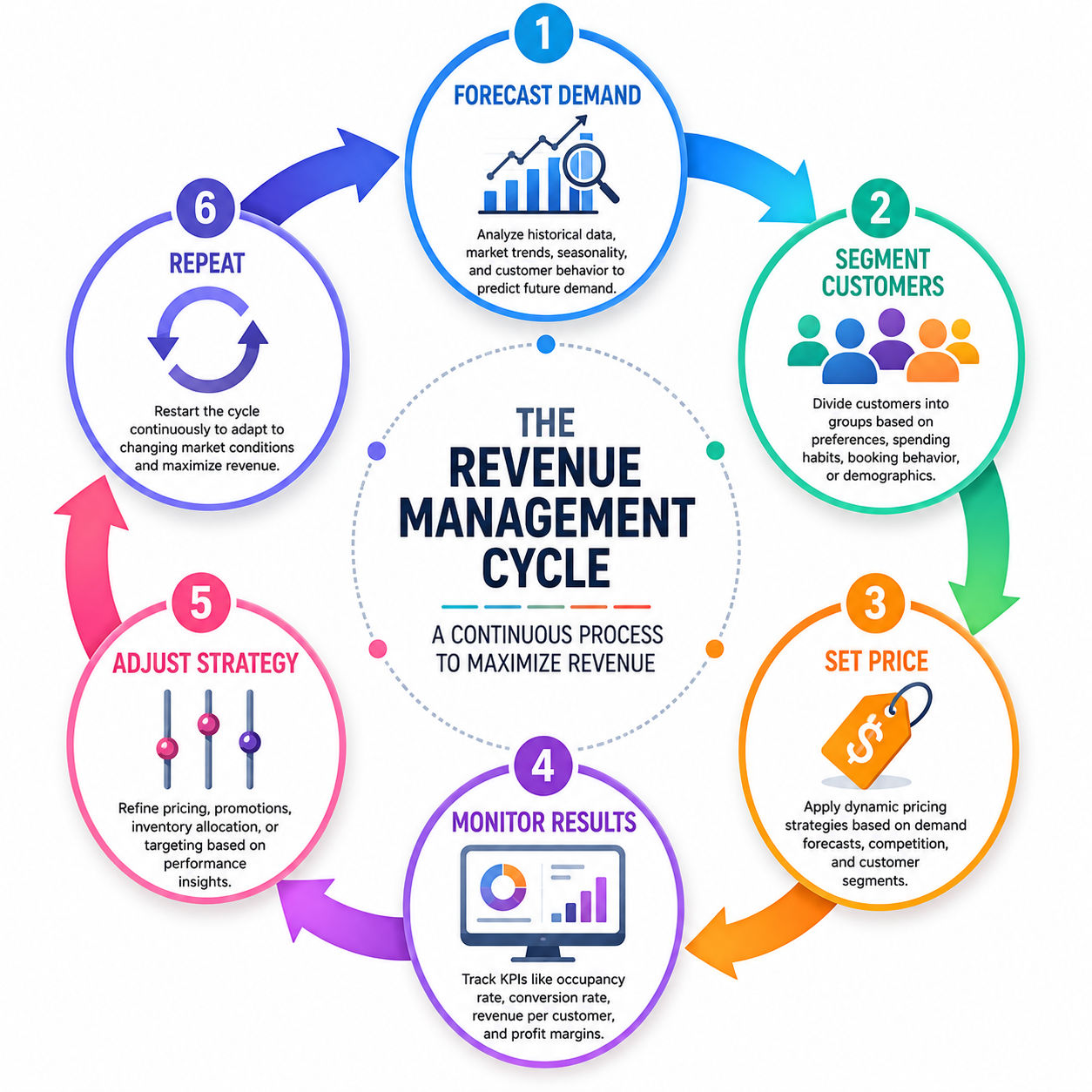
Revenue management runs on three connected pillars: demand forecasting, market segmentation, and dynamic pricing. Adjusting one without understanding the others creates noise, not results.
Forecasting means predicting how many people will want your product and when.
This is not guesswork. It is pattern recognition built on data. If your hotel fills up every year during a cricket tournament, that is a reliable pattern you can plan your pricing around.
Businesses use two types of data to forecast:
You do not need advanced software to start forecasting. Begin by asking one question: When do we get busy, and why? That question is the foundation.
Not all customers are the same. Some are willing to pay more. Others will only book if the price is low enough.
Willingness to pay is the maximum a customer would spend before deciding your product is not worth it.
A business traveler booking a flight the day before departure will pay a premium. A student planning a vacation six weeks in advance is more price-sensitive because they have time and options.
Revenue management finds these groups and builds pricing that serves both without pushing away.
Dynamic pricing is what most people notice first. Prices rise when demand is high. Prices drop when demand is low.
Example: A 50-room hotel has a major conference happening nearby next weekend. As rooms fill up, the remaining rooms become more valuable because supply is shrinking. Raising the price reflects that reality. But on a slow Monday in January, lowering the price attracts budget-conscious guests who would otherwise look elsewhere.
The price change is not arbitrary. It is a direct response to what the data is showing.
Also read: International Business Management: Skills, Importance & Future
Free Courses
Businesses have a limited number of products or services to sell. Hotel rooms. Airline seats. Event tickets. Appointment slots. If these go unsold, that opportunity is lost forever.
A hotel room that stays empty tonight cannot be sold twice tomorrow. A concert ticket that goes unsold on event night is worthless by midnight. That is what makes these products perishable.
Revenue management helps businesses avoid loss. It uses data to understand when demand is high or low and adjusts prices before it is too late.
Revenue management is not for every business. It works best when three conditions are present in a business:
The following table shows how different industries use these factors to stay profitable:
| Industry | What They Sell | Why Revenue Management Works |
| Airlines | Seats | Demand shifts by date and urgency |
| Hotels | Rooms | Rates change with seasons and local events |
| Car Rentals | Vehicles | Availability varies by day and location |
| Healthcare | Appointment slots | Limited capacity, varying urgency |
| SaaS / Tech | Software plans | Different users, diverse needs and budgets |
| Event Venues | Tickets or space | Perishable once the event passes |
Also read: What Is Operations Management? Key Roles & Career Opportunities
Management Courses to upskill
Explore Management Courses for Career Progression
IIIT-B & IIM, Udaipur
Chief Technology Officer & AI Leadership ProgrammeKnowing pillars is one thing. Putting them into practice is another thing. Here are the most widely used revenue management strategies across industries.
This is often called dynamic pricing. It means your prices move up or down in real time based on how many people want to buy and how much supply you have left. You see this every day with flight tickets, ride-sharing apps, and even online shopping sites.
In the hotel industry, this is a very popular trick. During a busy holiday weekend, a hotel might require a three-night minimum stay. This stops a one-night guest from taking up a room that a high-paying, long-term guest would have booked instead. It helps the business make the most money out of a busy period.
Where you sell your product is just as important as the price. This is called channel management. You want to list your products in places that bring in the most profit after fees.
The following table compares different sales channels based on their cost and the best way to use them:
| Booking Channel | Typical Cost | Best Use Case |
| Direct (website or app) | Low | Returning or loyal customers |
| OTAs (Booking.com, MakeMyTrip) | High commission (15-25%) | New customer discovery |
| Corporate accounts | Fixed negotiated rate | Predictable, high-volume bookings |
| Walk-ins | Variable | Last-minute availability management |
You can charge different prices based on who you buy. For example, morning movie tickets are often cheaper. The movie is the same, but the audience is different. Students or seniors with flexible schedules might only go if the price is low. This fills seats that would otherwise stay empty.
Sometimes the best way to grow revenue is not by raising the base price, but by selling extras. This includes things like room upgrades, early check-in, or meal packages. These small additions can lead to a much higher total without making your main product feel expensive.
Many businesses sell a few more tickets or rooms than they actually have. They do this because they know a small percentage of people will cancel at the last minute. When done correctly using good data, it makes sure you don't lose money on empty spots. However, it must be handled carefully so you don't run out of space.
Also read: What is Supply Chain Management? Learn Its Impact on Business
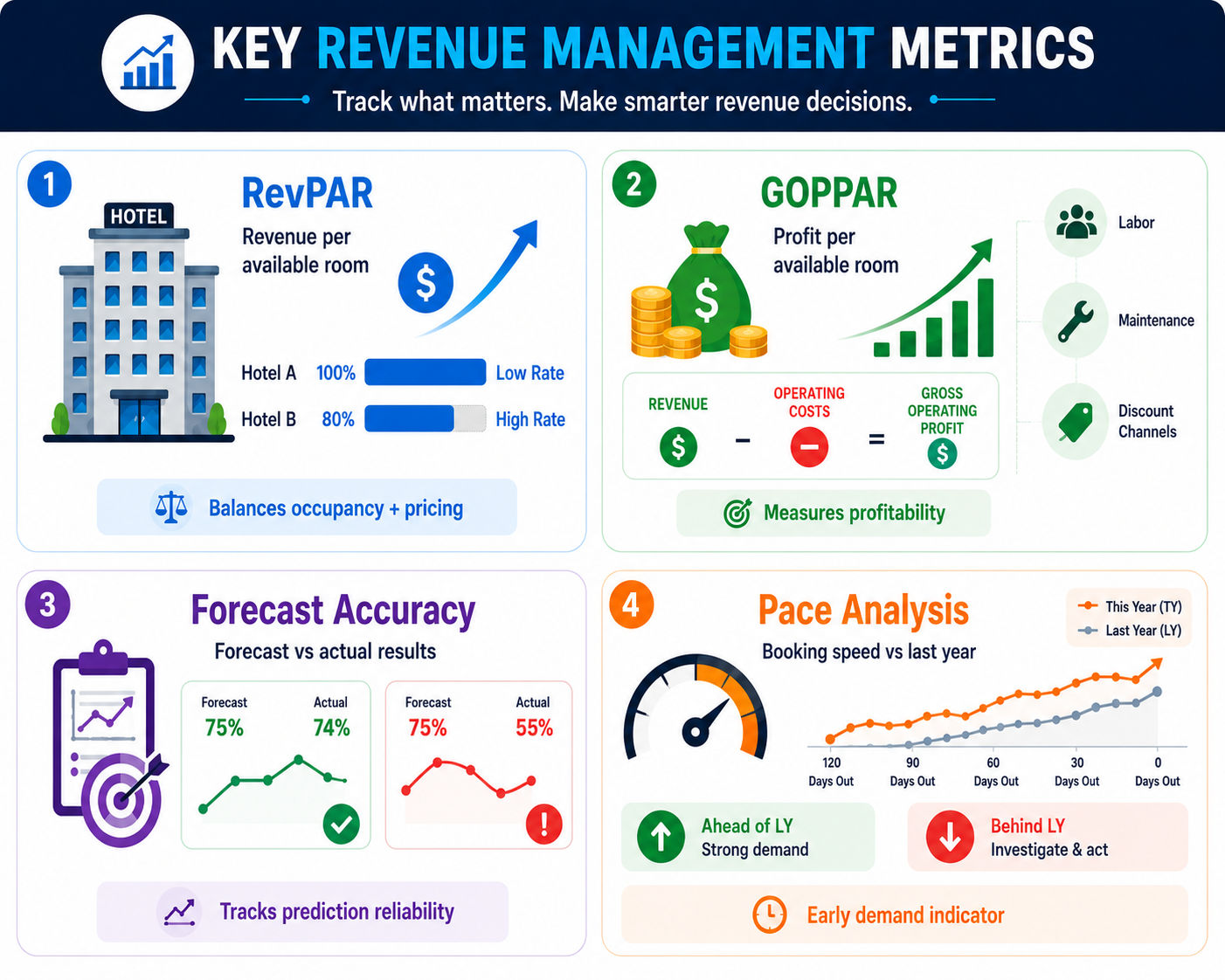
You do not need to memorize complex formulas. You just need to understand what each number is telling you about your business.
RevPAR takes your total room revenue and divides it by the number of rooms available, whether those rooms were sold or not. That last part is what makes it useful. Consider two hotels, each with 100 rooms:
RevPAR catches that difference. It forces you to look at occupancy and pricing together, not separately, which is exactly how they should be evaluated.
GOPPAR brings operating costs into the picture. A room generating strong revenue but requiring high labor costs, heavy discounting through expensive channels, or significant maintenance may be less profitable than a room earning slightly less but costing far less to sell and service.
Where RevPAR tells you how much each room is generating, GOPPAR tells you how much it is keeping after the business has paid to run itself.
Forecast accuracy measures how close your predictions were to what actually happened and tracking it over time tells you whether your model is improving or drifting.
If you forecasted 75% occupancy and landed at 74%, your decisions going into that period were well-grounded. If you forecasted 75% and landed at 55%, there was a gap somewhere, either in the data used, the assumptions made, or a market shift that was not accounted for.
Closing that gap is an ongoing process, not a one-time fix.
Pace compares how quickly bookings are coming in right now against the same period last year, at the same point in advance. It works as an early warning system, giving you time to act before the dates actually arrive.
Also read: Inventory Management Made Easy: Complete 2025 Guide
The discipline is shifting from reactive analysis to predictive intelligence, and the businesses that understand where it is heading will be better positioned to use it.
Modern platforms do not just process historical data. They pull in competitor's pricing, local events, weather, and demand signals all at once, compressing decision making that once took days into minutes.
Where Artificial Intelligence still falls short:
Segment-level pricing gives way to individual-level pricing. Using loyalty data, browsing behavior, and purchase history, businesses are beginning to serve each customer with an offer based on their specific signals at that specific moment. The opportunity is real, but so is the risk done poorly; it erodes trust faster than it captures value.
Revenue management principles are showing up across industries:
Also read: Best Supply Chain Management Project Ideas for Beginners
For revenue management, you do not need complex software to begin. Start by mapping out when your business gets busy and why. Find at least two customer types with different budgets or urgency levels and set prices that reflect that difference.
As your understanding deepens, the tools will start to make sense on their own. Revenue management systems, AI forecasting, channel managers. Technology follows the thinking, not the other way around.
Book a free consultation call with upGrad and our advisors will help you find the right management program to master management skills and advance your career.
The main goal is to maximize the revenue a business earns from a fixed and perishable inventory. It does this by forecasting demand, segmenting customers by their willingness to pay, and adjusting prices so that capacity does not go to waste, and value is not left uncaptured.
No. Revenue management started in the airline industry but has since expanded into hotels, car rentals, healthcare, SaaS, events, and e-commerce. Any business with limited capacity, perishable inventory, and customers who have different willingness to pay can benefit from applying these principles.
Yield management is a narrower concept focused on optimizing pricing and inventory for a specific perishable resource, like an airline seat. Revenue management is broader. It covers pricing strategy, demand forecasting, channel management, and segmentation across the whole business, not just one product or resource.
Dynamic pricing is one of the key tools within revenue management. It adjusts the price of a product based on real-time demand signals including current bookings, time remaining before the service date, competitor rates, and seasonal trends. When demand is high and supply is tight, prices rise. When demand softens, prices drop to attract more price-sensitive buyers.
A revenue management professional needs strong analytical skills, a solid understanding of pricing strategy, and the ability to work with revenue management software. Communication skills matter just as much, since revenue managers work closely with sales, marketing, and operations teams.
A Revenue Management System, or RMS, is software that automates pricing and inventory decisions by processing large volumes of data including historical patterns, competitor rates, and demand signals. Large hotels and airlines use them to handle a volume of decisions that no human team could manage manually. Small businesses do not need one to start.
AI is taking over the routine parts of revenue management, including automated forecasting, rate recommendations, and competitor monitoring, which frees human managers to focus on strategy and exception handling. Modern systems also pull in real-time external data like weather forecasts and local event calendars.
Yes. Start by finding your busiest and slowest periods and understanding what drives them. Then create at least two customer tiers with different pricing based on urgency or booking lead time. Even this basic structure is a functioning form of revenue management. Formal tools and training become valuable once these fundamentals feel natural and repeatable.
Perishable inventory refers to products or services that lose their value permanently once a specific moment pass. A hotel room that goes unoccupied tonight, a flight seat that travels empty, or an appointment slot that goes unfilled cannot be recovered or resold. This perishability is what makes revenue management essential. The urgency to sell at the right price before the window closes is the entire reason the discipline exists.
Market segmentation divides customers into groups based on their willingness to pay, booking behavior, and purpose of travel or purchase. A hotel might identify business travelers, leisure tourists, and group bookings as separate segments, each with different price sensitivity and booking windows. Revenue management then builds pricing structures designed to capture the maximum value from each segment without pricing any group out entirely.
Structured programs in business analytics, hospitality management, and pricing strategy cover revenue management in depth with practical case studies. Starting with foundational concepts in data analysis, pricing models, and consumer behavior gives you the strongest base for a revenue management career.
972 articles published
We are an online education platform providing industry-relevant programs for professionals, designed and delivered in collaboration with world-class faculty and businesses. Merging the latest technolo...
Get Free Consultation
By submitting, I accept the T&C and
Privacy Policy
Top Resources
Certification
3 Months
Certification
6 Months
O.P. Jindal Global University
Masters in International Accounting and Finance (Accredited by ACCA, UK)Master's Degree
12 Months