Planning Graph in Artificial Intelligence: Explained
By Sriram
Updated on Jun 29, 2026 | 6 min read | 2.61K+ views
Share:

All courses
Certifications
More
By Sriram
Updated on Jun 29, 2026 | 6 min read | 2.61K+ views
Share:
Table of Contents
A planning graph is Artificial Intelligence is a way of thinking ahead, mapping out what's possible before committing, to a plan of action. Picture it as a layered structure that alternates between two things: the facts that are true at any given moment, and the actions that can be taken based on those facts. Each layer builds the previous one, creating a step-by-step picture of how a situation can evolve. The AI system uses this planning graph to figure out if it can do what you want it to do and to find a way to do it.
In this guide, you'll learn what a planning graph in artificial intelligence is, why it matters, how it works, where it is used, and what its advantages and limitations are.
Start your AI journey at upGrad today, enroll in Artificial Intelligence Courses and learn to build the problem-solving skills from planning graphs to production-ready AI.
Popular AI Programs
A planning graph in intelligence is like a map that shows all possible situations in a problem and the things we can do to get from one situation to another.
This structure serves two key purposes. First, it helps AI systems extract valid executable plans efficiently without blindly exploring every possible path. Second, it acts as a guide for search algorithms, generating smart heuristics that point the search in the right direction from the start, saving significant time and computing.
The idea of a planning graph became well known because of the Graphplan algorithm. This algorithm was created by Avrim Blum and Merrick Furst in 1995.
Also Read: Chart on Artificial Intelligence: Types, Examples, and How to Create
Every planning graph contains two alternating layers.
Layer |
Purpose |
| State Layer | Represents facts or conditions that are true at a specific stage. |
| Action Layer | Represents actions that can be performed based on the current state. |
These layers continue expanding until either:
A planning graph in artificial intelligence has several unique features.
Without a planning graph, AI systems would often waste time checking thousands or even millions of unnecessary action combinations. As planning problems become larger, these benefits become increasingly important.
Instead, the graph helps by:
Related Article: Graphs in Data Structures: Top Techniques Every Programmer Must Know!
Free Courses
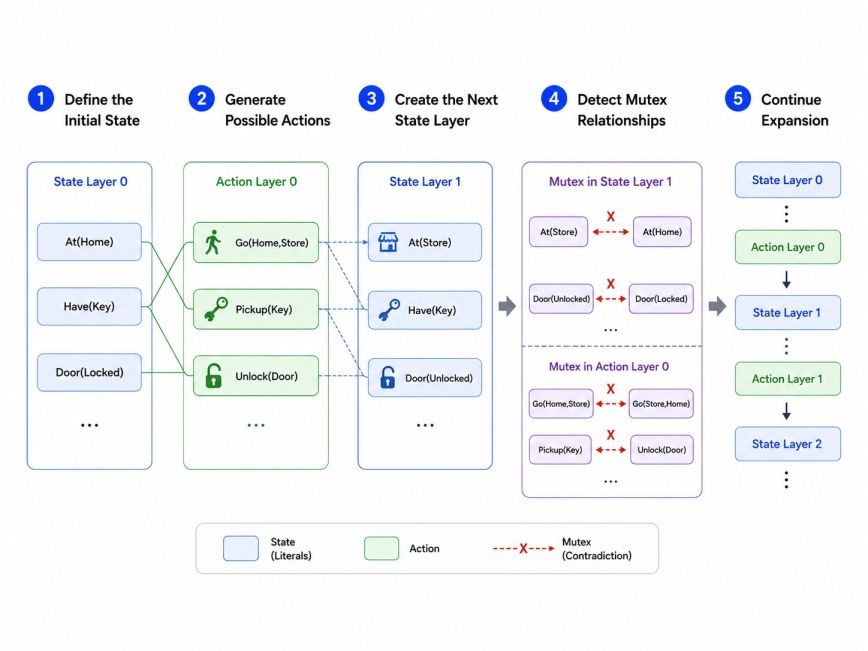
Understanding how a planning graph in artificial intelligence works, first understand the facts form the first state layer (S₀). After that there serves a several actions, this forms the first action layer (A₀).
After executing valid actions, the graph generates a new state layer. The process repeats until the final goal is achieved,
The planning graph begins with all known facts.
Example:
The system checks every action whose preconditions are satisfied. Only valid actions are added.
Each successful action creates new facts.
For example:
Some actions cannot happen together. These problems are known as mutual exclusions (mutex). We can see them marked in the graph when we look at the exclusions. Mutual exclusions are important to notice.
Examples include:
The graph keeps growing until:
Level |
Contains |
| S₀ | Initial facts |
| A₀ | Valid actions |
| S₁ | Updated facts |
| A₁ | New possible actions |
| S₂ | More updated facts |
| ... | Continue until goal |
One reason we like planning graphs is that they are simple and they work well. Planning graphs do not make every planning problem easy. Planning graphs give us a good way to remove paths that will not work before we use a lot of computer power to search.
This makes planning graphs very useful when we have to make decisions, and we cannot try every possible thing we can do. Planning graphs are helpful because planning graphs let us make choices without taking too much time.
Explore our Artificial Intelligence Courses and find a program designed to help you develop the practical, industry-ready skills that today's AI roles demand.
AI Courses to upskill
Explore Artificial Intelligence Courses for Career Progression
A planning graph in intelligence is really more than just an idea. It actually helps solve problems that we have in the world. When an artificial intelligence system needs to figure out what to do to get something done, a planning graph is very useful. It helps the artificial intelligence system make a list of what it can do and what might happen so it can make choices.
While a lot of intelligence these days uses machine learning planning graphs are still very important, for things that need us to think carefully manage what we have and make decisions one step at a time using artificial intelligence and planning graphs together.
Also Read: Artificial Intelligence Mind Map: A Complete Guide
Robots do a lot of tasks that involve multiple steps. Before a robot does anything, it must know what is going on, figure out what it can do and think about what will happen if it does each thing.
A planning graph is really helpful to the warehouse robot because it shows the robot what to do first and what to do next and it helps the robot stay away, from things that it cannot do or things that will not work together with the warehouse robot.
For example, think about a robot that works in a warehouse and needs to move a package from one shelf to another shelf. It may need to:
Self-driving cars constantly make plans on what to do. They use a lot of AI methods to figure things out, but planning graphs can really help in making higher-level decisions for self-driving cars.
Examples include:
Large logistics companies handle thousands of deliveries every day. Planning graphs can help optimize operations by organizing tasks into manageable sequences. Reducing unnecessary actions can save both time and operational costs.
Common use cases include:
Modern factories use AI planning to coordinate machines, workers, and production schedules. When one machine becomes unavailable, the planner can identify an alternative sequence of actions without rebuilding the entire plan.
Planning graphs assist with:
Hospitals also benefit from AI planning techniques. These systems help improve efficiency while ensuring resources are used effectively.
Possible applications include:
Video games use planning to create believable non-player characters (NPCs). Instead of following fixed scripts, AI characters can evaluate different action sequences depending on the player's behavior. Planning graphs help organize these possibilities into logical action sequences.
For example, an enemy character may decide whether to:
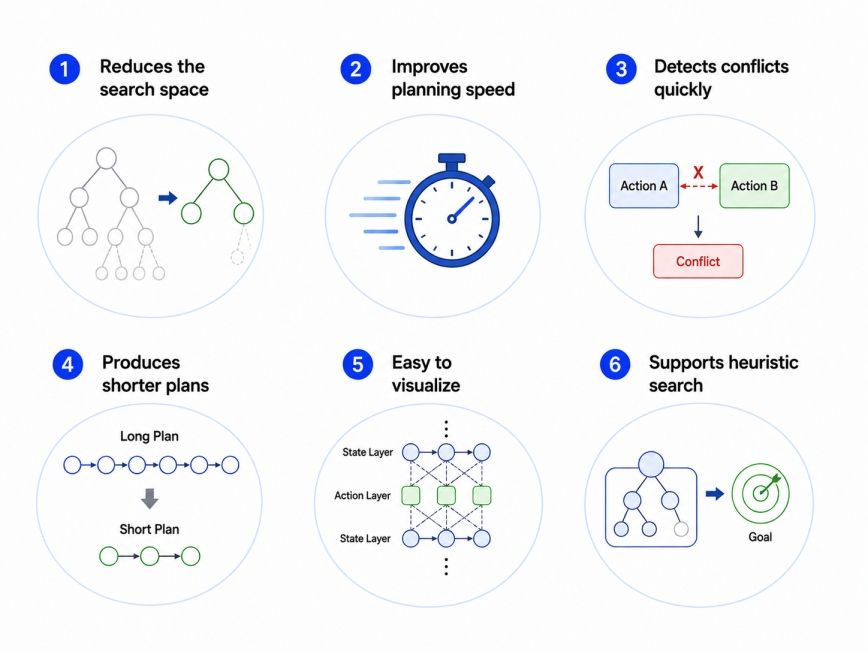
Planning graphs became popular because they significantly improved the efficiency of classical AI planning. These benefits make planning graphs especially useful for structured planning tasks.
Some major advantages include:
Despite their strengths, planning graphs are not suitable for every AI problem.
Some common limitations include:
Advantages |
Limitations |
| Faster planning | Higher memory usage for large problems |
| Smaller search space | Limited handling of uncertainty |
| Detects conflicting actions | Less suitable for highly dynamic environments |
| Supports heuristic algorithms | Mainly designed for classical planning |
| Easy to interpret | May require graph reconstruction after major changes |
If the environment changes continuously or contains significant uncertainty, other AI planning approaches may be more appropriate.
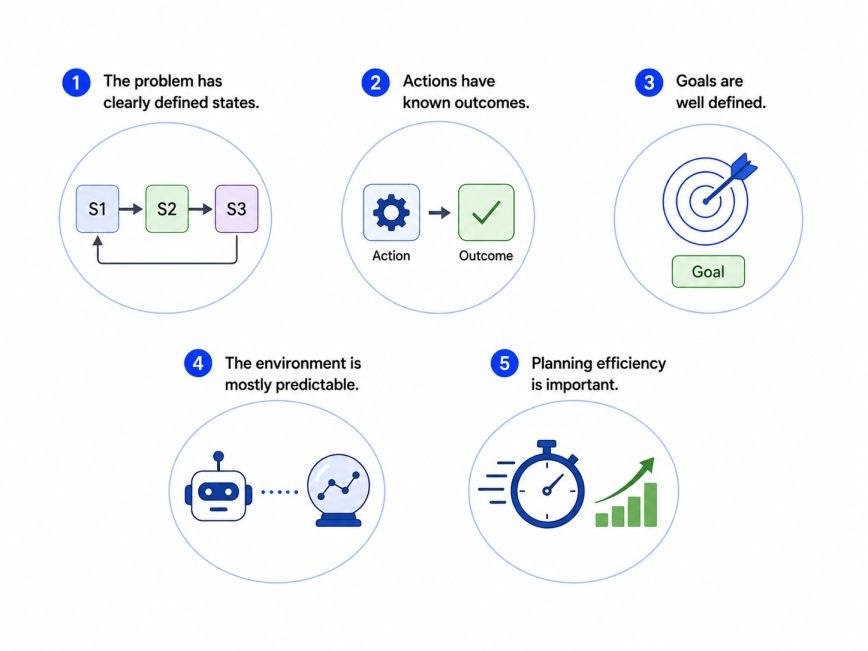
A planning graph is a good choice when:
Subscribe to upGrad's Newsletter
Join thousands of learners who receive useful tips
Students get confused between planning graphs and other methods used for planning and searching. They all aim to find solutions and work differently. Planning graphs, decision trees, and state space searches are used to solve problems. They represent problems and find solutions in their own ways.
The choice of methods depends on what you want to achieve. If you want to find a series of steps that work a planning graph is usually better than a decision tree or a simple state space search.
Feature |
Planning Graph |
State Space Search |
Decision Tree |
| Primary purpose | Planning actions | Searching states | Prediction and classification |
| Representation | Layered graph | Individual states | Tree structure |
| Handles action conflicts | Yes | Limited | No |
| Uses mutex relations | Yes | No | No |
| Best suited for | Classical AI planning | General search | Machine learning tasks |
A planning graph in artificial intelligence is one of the most practical tools for solving structured planning problems. By organizing states and actions into alternating layers, it allows AI systems to identify efficient action sequences while avoiding impossible combinations through mutex relationships.
Although planning graphs were originally developed for classical AI planning, their underlying ideas continue to influence robotics, logistics, manufacturing, autonomous systems, and other planning-intensive applications. They also provide a strong foundation for students learning AI because they demonstrate how AI systems can reason actions instead of relying solely on trial and error.
Want to explore more about management accounting? Book your free 1:1 personal consultation with our expert today.
A graph in artificial intelligence is a data structure made up of nodes and edges that represent objects and the relationships between them. AI systems use graphs to model search spaces, knowledge, planning problems, and networks. They help algorithms organize information and find efficient paths or solutions.
Planning in artificial intelligence is the process of identifying a sequence of actions that enables an AI system to achieve a specific goal. The system evaluates the current state, available actions, and desired outcome before selecting the most suitable plan. Planning is widely used in robotics, automation, and intelligent decision-making.
A planning graph improves planning efficiency by reducing unnecessary searches and identifying conflicting actions early. It also supports heuristic search, simplifies visualization, and often produces shorter action sequences. These benefits make it a valuable technique for solving structured AI planning problems.
A planning graph in AI is a layered representation of states and actions that helps determine whether a goal can be achieved. It expands possible actions step by step while tracking relationships between states. The graph is widely used in classical AI planning algorithms such as Graphplan.
Mutex, or mutual exclusion, relationships identify actions or states that cannot occur together. By detecting these conflicts early, the planner avoids exploring impossible solutions. This reduces computational effort and improves the efficiency of the planning process.
Yes. Although many modern AI systems combine planning with machine learning, planning graphs remain useful for structured decision-making tasks. They continue to be applied in robotics, logistics, automated scheduling, and research involving symbolic AI and classical planning.
A planning graph organizes states and actions into alternating layers, while a search tree explores one possible sequence of actions at a time. Planning graphs reduce redundant exploration by representing multiple possibilities together, making them more efficient for many planning problems.
Traditional planning graphs are designed for deterministic environments where action outcomes are known. Handling uncertainty often requires extensions or different planning methods, such as probabilistic planning or decision-theoretic approaches that account for changing conditions.
The planning graph concept was introduced through the Graphplan algorithm by Avrim Blum and Merrick Furst in 1995. Their work demonstrated how layered graph structures could significantly improve the efficiency of automated planning compared with many earlier approaches.
A planning graph improves performance by organizing possible actions logically, eliminating impossible combinations, and providing useful heuristic information. Instead of examining every possible action sequence, the planner focuses on feasible paths, saving both time and computational resources.
Yes. Planning graphs are commonly covered in university AI courses and technical interviews because they introduce key concepts such as automated planning, state representation, heuristics, and mutex relationships. Understanding them also provides a strong foundation for learning advanced planning algorithms.
698 articles published
Sriram K is a Senior SEO Executive with a B.Tech in Information Technology from Dr. M.G.R. Educational and Research Institute, Chennai. With over a decade of experience in digital marketing, he specia...
Speak with AI & ML expert
By submitting, I accept the T&C and
Privacy Policy
Top Resources
Master's Degree
18 Months
Executive Diploma
12 Months
IIIT Bangalore
Executive Programme in Generative AI & Agentic AI for LeadersIndia’s #1 Tech University
Dual Certification
5 Months