Problem Solving in Artificial Intelligence
By Sriram
Updated on Aug 11, 2026 | 6 min read | 7.38K+ views
Share:

All courses
Certifications
More
By Sriram
Updated on Aug 11, 2026 | 6 min read | 7.38K+ views
Share:
Problem solving in artificial intelligence is the process by which an intelligent agent evaluates its environment, identifies a goal, and determines the best sequence of actions to achieve it. AI systems represent problems as state spaces and use search, reasoning, or optimization techniques to find efficient and effective solutions.
In this blog , you'll learn how AI systems solve problems, the role of search and reasoning, different problem-solving approaches, the importance of agents, practical applications, and the challenges that arise when AI tackles real-world problems.
Discover upGrad's Artificial Intelligence and Machine Learning programs and learn how to build, deploy, and optimise intelligent systems using technologies that are driving innovation across Bussiness, healthcare, finance, and other sectors.
Popular AI Programs
Problem solving in artificial intelligence refers to the process of finding a sequence of actions that transforms an initial state into a goal state. AI systems analyze available information, evaluate possible actions, and select the most effective path to achieve a desired objective.
At its core, AI problem solving resembles how humans approach challenges. When planning a trip, solving a puzzle, or managing a project, people evaluate options before choosing a solution. AI follows a similar principle but relies on algorithms, search strategies, and computational reasoning.
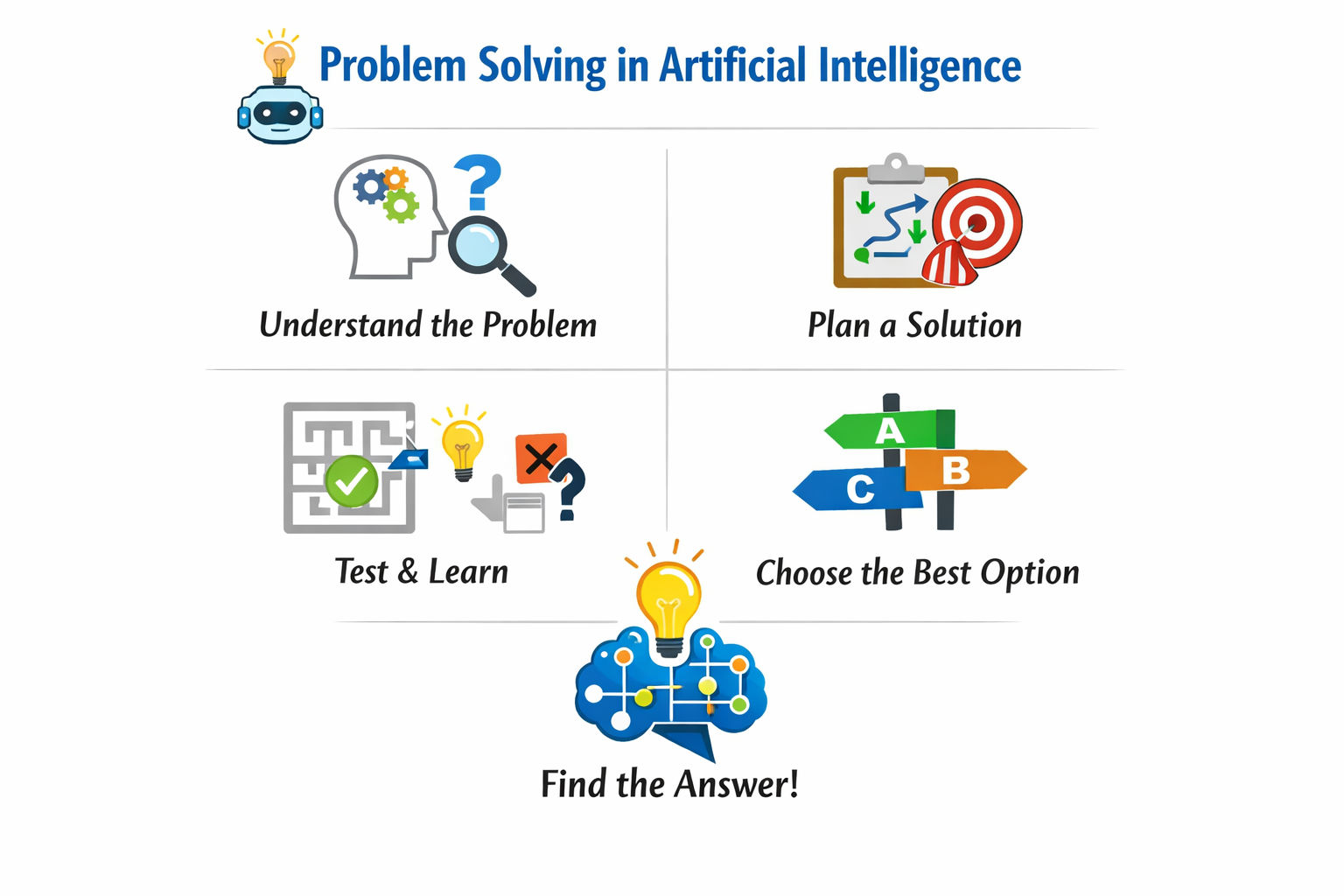
The following elements work together to create a problem-solving framework:
For example, a food delivery application must determine the fastest route between a restaurant and a customer. The AI evaluates road conditions, distance, traffic, and delivery constraints before selecting an optimal path.
Modern AI systems use problem-solving capabilities in planning, robotics, autonomous vehicles, recommendation systems, logistics optimization, and decision support tools. Without effective problem-solving mechanisms, AI would struggle to move beyond simple pattern recognition tasks.
Also Read : AI in Logistics: Benefits, Use Cases, Trends and Future Impact
Free Courses
Problem-solving abilities become truly valuable when they are integrated into intelligent agents. These agents observe their surroundings, analyze situations, make decisions, and take actions to achieve specific goals.
Problem solving agents in AI are designed to identify a goal, evaluate possible solutions, and choose the most effective path to success. Unlike simple systems that react immediately to inputs, these agents plan ahead and consider the likely outcomes of different actions before making decisions.
The table explains the typical workflow followed by a problem-solving agent:
Stage |
What It Means |
| Goal Formulation | Identifies what needs to be achieved |
| Problem Formulation | Defines the problem and possible actions |
| Search | Explores different solution paths |
| Decision Making | Selects the most suitable solution |
| Action Execution | Carries out the chosen action |
Consider a warehouse robot that needs to move inventory from one location to another.
Situation |
Agent's Action |
| Receives a destination | Identifies where the item needs to go |
| Detects obstacles | Looks for alternative routes |
| Evaluates paths | Compares available options |
| Selects route | Chooses the fastest or safest path |
| Environment changes | Recalculates and adjusts its plan |
This ability to adapt makes problem-solving agents useful in real-world environments where conditions can change unexpectedly.
Different AI applications use different types of agents depending on the complexity of the task.
Agent Type |
Description |
Example |
| Simple Reflex Agent | Responds directly to current inputs | Thermostat |
| Model-Based Agent | Maintains an internal model of the environment | Autonomous vacuum cleaner |
| Goal-Based Agent | Makes decisions based on desired outcomes | GPS navigation system |
| Utility-Based Agent | Chooses actions that provide the highest value | Investment recommendation platform |
| Learning Agent | Improves performance through experience | AI virtual assistant |
Problem-solving agents play a critical role in modern AI because they can evaluate future possibilities instead of simply reacting to current conditions. This makes them especially effective in dynamic environments where multiple solutions exist.
As AI systems become more advanced and autonomous, these agents will continue to support decision-making in areas such as robotics, healthcare, transportation, finance, and business operations. Their ability to plan, adapt, and optimize actions makes them a fundamental component of intelligent systems.
AI Courses to upskill
Explore Artificial Intelligence Courses for Career Progression
AI systems use different methods to solve problems depending on the complexity of the task, available data, and desired outcome. Most problem solving methods in artificial intelligence focus on searching for solutions, making decisions, optimizing results, or learning from experience.
The following table summarizes the most common approaches:
Method |
Purpose |
Example |
| Uninformed Search | Explores solutions without prior knowledge | BFS, DFS |
| Informed Search | Uses heuristics to find solutions faster | A* Search, Greedy Search |
| Constraint Satisfaction | Solves problems with specific rules or restrictions | Timetable scheduling |
| Optimization | Finds the best possible solution | Route optimization |
| Planning | Creates a sequence of actions to achieve a goal | Robot task planning |
| Reinforcement Learning | Learns through trial and error feedback | Game-playing AI |
Also read :What are Problem Solving Skills? Definition, Examples and Steps to learn
Search lies at the heart of many AI systems. In fact, most problem-solving tasks can be represented as a search through possible states until a goal is reached.
The process starts by representing a problem as a state space. Each state reflects a possible situation, while transitions represent actions that move the system between states.
The search process generally follows these steps:
The following comparison highlights major search strategies.
| Search Method | Advantages | Limitations |
| BFS | Guarantees shortest path in simple cases | High memory usage |
| DFS | Requires less memory | May miss optimal solution |
| Uniform Cost Search | Finds lowest-cost solution | Can be computationally expensive |
| Greedy Search | Fast exploration | May produce suboptimal results |
| A* Search | Efficient and often optimal | Depends on heuristic quality |
A classic example involves solving a maze. The AI evaluates intersections, tracks visited locations, and gradually explores pathways until it discovers a route to the exit.
Real-world search problems often become much more complex. Autonomous vehicles must consider traffic, weather, pedestrians, regulations, and safety constraints simultaneously. The search space becomes enormous, making efficient algorithms essential.
One practical challenge involves balancing solution quality with computational cost. Finding the absolute best solution may require excessive processing time. In many applications, a sufficiently good solution delivered quickly proves more valuable.
This tradeoff explains why heuristic search methods remain popular across modern AI applications.
Do read : NLP in Artificial Intelligence: Complete Beginner Guide
Problem-solving capabilities have become a key driver of modern AI adoption. Organizations use AI systems to make decisions faster, improve operational efficiency, reduce costs, and solve complex business challenges that would be difficult to handle manually.
From healthcare and finance to logistics and robotics, AI-powered problem solving helps businesses analyze situations, evaluate alternatives, and choose the most effective course of action. As AI technologies continue to evolve, their ability to solve increasingly complex problems is becoming a major competitive advantage across industries.
The following industries demonstrate how AI problem-solving techniques create real-world value.
Industry |
Application |
| Healthcare | Treatment planning, diagnosis support, and patient care optimization |
| Finance | Fraud detection, credit risk assessment, and portfolio management |
| Logistics | Route planning, delivery optimization, and supply chain management |
| Manufacturing | Production scheduling and resource allocation |
| Retail | Inventory forecasting and demand planning |
| Robotics | Autonomous navigation and task execution |
The following examples highlight common use cases of AI-driven problem solving across industries:
While AI can solve many complex problems, real-world environments introduce several challenges that affect performance and decision-making accuracy.
Many practical problems contain millions or even billions of possible solutions. Evaluating every option is often computationally impossible.
For example, a logistics company planning delivery routes across hundreds of cities faces an enormous number of route combinations. AI must rely on efficient search and optimization techniques rather than exhaustive exploration.
AI systems rarely operate with perfect information. Missing, inaccurate, or delayed data can affect decision quality.
A healthcare diagnostic system, for instance, may need to recommend treatments even when patient records are incomplete or test results are still pending.
Many environments change while the AI system is making decisions. This requires continuous adaptation and recalculation.
Autonomous vehicles represent a classic example. Traffic conditions, weather, road closures, and pedestrian behavior can change within seconds, forcing the system to update its decisions constantly.
Complex optimization and planning tasks often require significant processing power, memory, and time.
As problem complexity increases, organizations must balance solution quality against computational cost. In many cases, finding a good solution quickly is more practical than spending hours searching for the perfect one.
Organizations often need to optimize several goals simultaneously.
For example, a manufacturing company may want to:
Improving one objective can sometimes negatively affect another, making decision-making considerably more challenging.
The future of problem solving in artificial intelligence will likely involve a combination of traditional search techniques, advanced machine learning models, and reasoning-based systems.
Rather than relying on a single approach, next-generation AI systems are increasingly adopting hybrid architectures that combine learning, planning, and optimization capabilities. These systems can learn from past experiences while applying structured reasoning to new situations.
Several emerging trends are shaping the future of AI problem solving:
As generative AI, intelligent agents, and autonomous systems continue to advance, effective problem-solving capabilities will become even more important. The ability to reason, plan, adapt, and optimize decisions will play a central role in the next generation of AI applications, enabling systems to solve increasingly sophisticated real-world challenges with greater efficiency and accuracy.
Problem solving in artificial intelligence allows machines to make intelligent decisions by identifying goals, evaluating options, and selecting the best course of action. From route planning to autonomous systems, it plays a crucial role in modern AI applications.
Understanding problem-solving agents and key AI problem-solving methods helps explain how intelligent systems operate. As AI advances, improved search, planning, optimization, and learning techniques will enable machines to solve increasingly complex real-world problems more effectively.
Ready to start your journey? Book a free consultation with upGrad today to find the best path for your career.
Problem solving allows AI systems to make decisions rather than simply respond to inputs. It helps machines evaluate alternatives, plan actions, and achieve goals in dynamic environments. This capability supports applications such as robotics, route planning, scheduling, and autonomous systems where choosing the right action matters.
Traditional programs follow predefined instructions for every situation. AI problem-solving systems evaluate multiple possibilities and determine solutions dynamically. Instead of relying entirely on fixed rules, they often search through alternatives, apply heuristics, or learn from data to reach objectives.
Heuristics provide estimates that guide search algorithms toward promising solutions. They help reduce the number of states explored and improve efficiency. While heuristics may not always guarantee the optimal answer, they often produce practical solutions much faster than exhaustive search methods.
Yes. Many AI systems operate under uncertainty and make decisions using partial information. Techniques such as probabilistic reasoning, Bayesian inference, and reinforcement learning help AI estimate likely outcomes and choose actions even when all details are not available.
Industries such as healthcare, logistics, finance, manufacturing, retail, and transportation benefit significantly. AI helps optimize routes, detect fraud, manage resources, improve operational efficiency, and support decision-making processes that would otherwise require extensive human effort.
Problem-solving agents allow autonomous systems to evaluate future outcomes before acting. Instead of reacting only to immediate inputs, they formulate goals, analyze alternatives, and select actions that maximize success. This capability is critical for robots, drones, and self-driving vehicles.
Search algorithms focus on finding a valid path or solution within a state space. Optimization algorithms go further by identifying the best solution according to defined criteria such as cost, speed, or efficiency. Many AI systems combine both approaches to improve results.
No. Many classic AI systems solve problems using search, planning, and reasoning without machine learning. However, modern AI increasingly combines learning techniques with traditional methods to improve adaptability, accuracy, and performance in complex environments.
Real-world environments often include uncertainty, changing conditions, large search spaces, conflicting objectives, and limited computational resources. These factors make it difficult to find optimal solutions quickly and require sophisticated algorithms to balance efficiency and accuracy.
Generative AI models increasingly use planning and reasoning mechanisms to complete complex tasks. Problem-solving techniques help them break tasks into smaller steps, evaluate alternatives, and generate more accurate outputs instead of relying solely on pattern prediction.
Future developments will likely focus on hybrid systems that combine symbolic reasoning, search algorithms, machine learning, and autonomous agents. These systems may solve more complex tasks, adapt to changing environments faster, and provide better decision-making support across industries.
724 articles published
Sriram K is a Senior SEO Executive with a B.Tech in Information Technology from Dr. M.G.R. Educational and Research Institute, Chennai. With over a decade of experience in digital marketing, he specia...
Speak with AI & ML expert
By submitting, I accept the T&C and
Privacy Policy
Top Resources
Master's Degree
18 Months
Executive Diploma
12 Months
IIIT Bangalore
Executive Programme in Generative AI & Agentic AI for LeadersIndia’s #1 Tech University
Dual Certification
5 Months