Artificial Intelligence Market
By Sriram
Updated on Jun 19, 2026 | 6 min read | 7.13K+ views
Share:

All courses
Certifications
More
By Sriram
Updated on Jun 19, 2026 | 6 min read | 7.13K+ views
Share:
Table of Contents
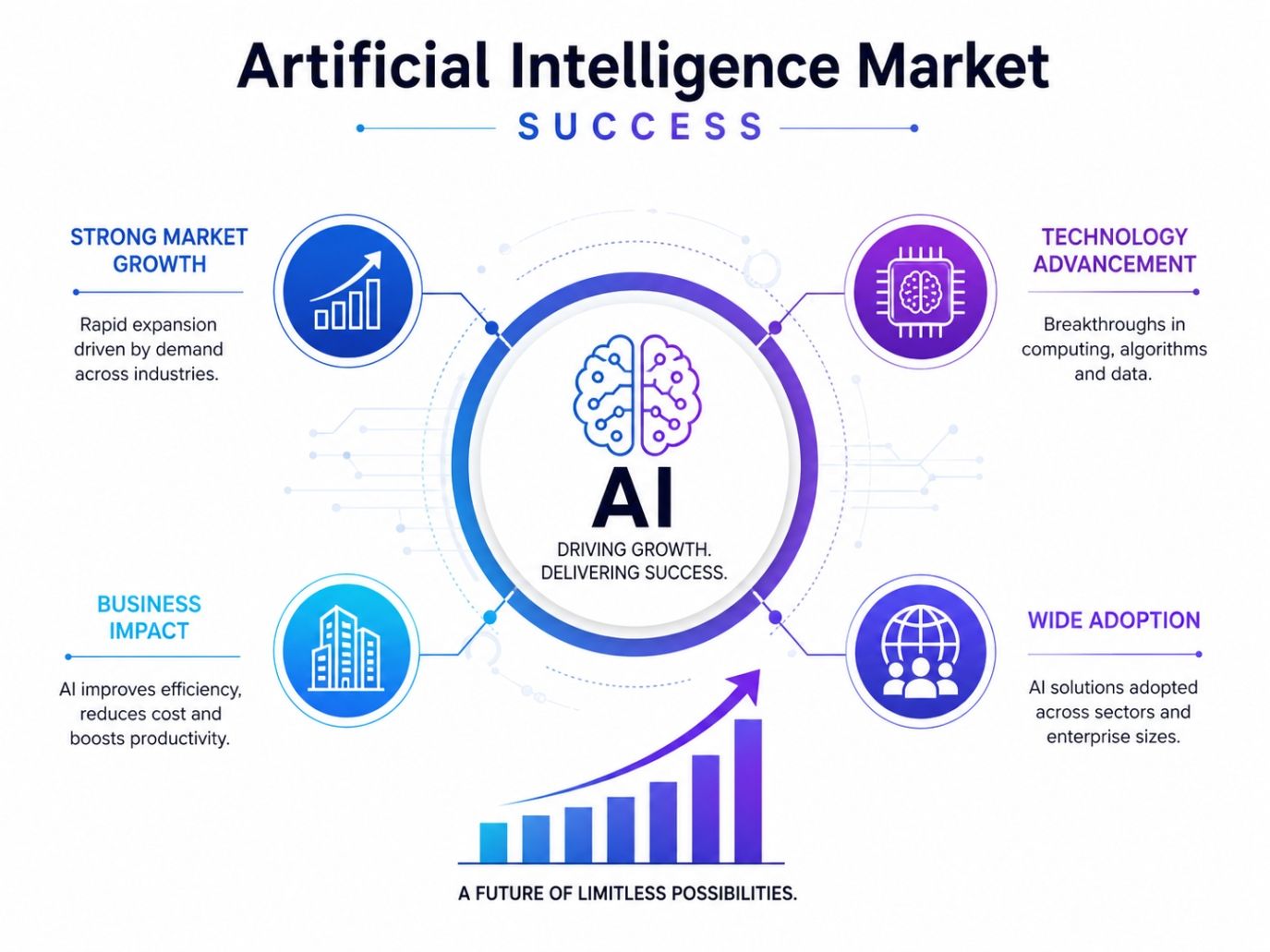
The global artificial intelligence (AI) market is currently valued at approximately $400–600 billion and is expected to exceed $3.5 trillion by the early 2030s. Fueled by rapid advancements in generative AI and increasing enterprise adoption across industries, the market is experiencing strong growth, with a projected compound annual growth rate (CAGR) of more than 29% over the coming years.
This Blog explores the artificial intelligence market in depth. You'll learn about market growth drivers, major segments, emerging trends, challenges, and future opportunities. Whether you're a student, developer, business professional, or technology enthusiast, this article provides a practical understanding of how the AI economy is evolving.
Explore Artificial Intelligence Courses on upGrad to learn how modern chatbots work, understand the technologies behind them, and build practical skills in conversational AI.
Popular AI Programs
The artificial intelligence market refers to the global ecosystem of technologies, products, platforms, services, and solutions built around AI. It includes software vendors, cloud providers, AI startups, hardware manufacturers, consulting firms, and organizations that implement AI systems.
AI systems enable machines to perform tasks that traditionally require human intelligence. These tasks include learning from data, recognizing patterns, understanding language, generating content, making predictions, and supporting decisions.
Today, organizations use AI for much more than automation. Companies leverage AI to:
One reason the market continues expanding is that AI technologies solve real business problems. Organizations can process large volumes of data faster than humans and uncover insights that would otherwise remain hidden.
Also Read : Best AI Chatbot: A Guide to Choosing the Right AI Assistant in 2026
Free Courses
The artificial intelligence market is growing rapidly due to the explosion of digital data and advances in computing technology. Businesses use AI to turn vast amounts of customer, operational, and behavioral data into valuable insights. At the same time, powerful GPUs and scalable cloud infrastructure have made AI development and deployment more accessible, affordable, and effective across industries.
The following factors contribute significantly to market growth:
Growth Driver |
Impact on AI Adoption |
| Data Explosion | Provides training data for AI systems |
| Cloud Computing | Reduces infrastructure costs |
| Generative AI | Expands AI use cases rapidly |
| Business Automation | Improves productivity |
| Digital Transformation | Encourages AI integration |
| Increased Investment | Accelerates innovation |
Despite these challenges, market momentum remains strong because companies increasingly view AI as a competitive necessity rather than an optional innovation project.
AI Courses to upskill
Explore Artificial Intelligence Courses for Career Progression
The artificial intelligence market consists of multiple segments, each serving different business and technical needs.
Understanding these segments helps explain how AI creates value across industries. Some companies focus on AI software, while others specialize in hardware, cloud infrastructure, or consulting services.
Software represents one of the largest portions of the market. Organizations use AI-powered applications for customer service, analytics, marketing, cybersecurity, and business automation.
Advanced AI systems require significant computing power. Specialized processors and GPUs support model training and inference workloads.
Cloud services allow businesses to access AI capabilities without investing heavily in infrastructure. This approach lowers barriers to adoption.
Generative AI has become one of the fastest-growing categories. Businesses use these tools for:
Many vendors now build AI products tailored to specific industries.
Examples include:
This specialization helps organizations implement AI more quickly because solutions align with industry-specific workflows and regulations.
Also Read : Best AI Chatbot: A Guide to Choosing the Right AI Assistant in 2026
The artificial intelligence market continues evolving as new technologies and business requirements emerge.Several trends are currently influencing investment decisions, product development, and adoption strategies.
The following trends are having a significant impact on market direction.
Trend |
Why It Matters |
| Generative AI Expansion | Creates new business applications |
| AI Regulation | Improves accountability |
| Responsible AI | Addresses ethical concerns |
| Multimodal AI | Combines text, image, audio, and video |
| Edge AI Growth | Reduces latency and privacy risks |
| AI Agents | Automates complex workflows |
These trends suggest that future growth will depend not only on model performance
but also on trust, governance, and practical business value.
Do read: Future Scope of Artificial Intelligence in 2026 and Beyond
Although opportunities are substantial, the artificial intelligence market faces several important challenges.
Organizations often underestimate the complexity of successful AI implementation. Building a model is only one part of the process. Data quality, governance, security, and user adoption also influence outcomes.
The table below summarizes common challenges.
Challenge |
Impact |
| Data Quality Issues | Reduces model accuracy |
| Talent Shortages | Slows implementation |
| High Infrastructure Costs | Limits scalability |
| Privacy Concerns | Creates compliance risks |
| Bias in Models | Affects fairness |
| Regulatory Uncertainty | Increases complexity |
The future of the artificial intelligence market appears highly dynamic as organizations continue integrating AI into everyday operations.
Over the next decade, AI will likely become a standard component of digital infrastructure rather than a specialized technology. Much like cloud computing today, AI capabilities may become embedded across software platforms and business processes.
Several developments could shape future growth:
Organizations that invest in AI literacy, governance, and practical implementation strategies will be better positioned to benefit from future advancements.
While market forecasts vary, one trend remains consistent: artificial intelligence is becoming a foundational technology across industries, and its influence will continue expanding as capabilities improve.
The artificial intelligence market continues to grow rapidly as businesses adopt AI for automation, data analysis, customer experiences, and decision-making. Advances in cloud computing, machine learning, and generative AI are accelerating adoption across industries and creating new opportunities for innovation.
Despite this growth, organizations must address challenges such as data privacy, governance, talent shortages, and ethical AI use. Understanding the artificial intelligence market helps professionals, students, and business leaders prepare for an increasingly AI-driven digital economy.
Ready to start your journey? Book a free consultation with upGrad today to find the best path for your career.
Healthcare, financial services, retail, manufacturing, and technology companies currently lead AI investments. These sectors use AI for predictive analytics, automation, fraud detection, customer support, and operational efficiency. Healthcare providers apply AI in diagnostics, while manufacturers use it for predictive maintenance. Investment levels often depend on data availability and the potential return from automation.
Many organizations initially adopt AI to automate repetitive tasks, but the value extends much further. AI helps businesses identify patterns in large datasets, improve forecasting accuracy, personalize customer experiences, optimize supply chains, and support strategic decision-making. In many cases, better insights create more value than simple cost reduction.
Employers increasingly seek professionals with machine learning, data engineering, natural language processing, cloud computing, and AI governance skills. Knowledge of Python, data visualization, model deployment, and responsible AI practices is also valuable. Companies often prefer candidates who can connect technical AI capabilities with real business outcomes.
Yes. Many small businesses use AI through cloud-based services and software platforms rather than developing models internally. AI-powered tools support customer service, marketing, content creation, sales forecasting, and analytics. This approach reduces costs and allows smaller organizations to access advanced capabilities without large technical teams.
he future scope of the artificial intelligence market remains broad because AI is becoming part of everyday business software and digital infrastructure. Growth is expected across sectors such as healthcare, education, logistics, cybersecurity, and finance. As AI tools become easier to use, adoption will likely expand beyond large enterprises to startups and mid-sized organizations.
Governments play a major role through funding, regulations, research initiatives, and public-sector adoption. National AI strategies often support innovation while establishing guidelines for privacy, security, and ethical use. Clear regulations can increase trust and encourage businesses to invest in AI technologies with greater confidence.
Yes, the artificial intelligence market continues to grow rapidly due to increasing demand for automation, data-driven decision-making, and generative AI applications. Organizations across industries are investing in AI solutions to improve efficiency and remain competitive. Continued advances in computing power and cloud services also support long-term market expansion.
Several challenges can delay adoption, including regulatory requirements, data privacy concerns, limited technical expertise, and integration difficulties. Organizations may also struggle with poor-quality data or unclear business objectives. In highly regulated sectors, companies often move cautiously to ensure compliance and reduce operational risks.
Several factors drive the growth of the artificial intelligence market. Businesses generate larger amounts of data than ever before, creating demand for intelligent analysis tools. Cloud computing has lowered infrastructure barriers, while generative AI has introduced new use cases. Strong investment from governments and private companies also accelerates innovation.
Data quality often determines whether an AI initiative succeeds or fails. Even advanced models produce weak results when trained on incomplete or inaccurate data. Organizations that invest in data cleaning, governance, and validation typically achieve better outcomes. Strong data foundations improve reliability, performance, and business trust in AI systems.
727 articles published
Sriram K is a Senior SEO Executive with a B.Tech in Information Technology from Dr. M.G.R. Educational and Research Institute, Chennai. With over a decade of experience in digital marketing, he specia...
Speak with AI & ML expert
By submitting, I accept the T&C and
Privacy Policy
Top Resources
Master's Degree
18 Months
Executive Diploma
12 Months
IIIT Bangalore
Executive Programme in Generative AI & Agentic AI for LeadersIndia’s #1 Tech University
Dual Certification
5 Months