Constraint Satisfaction Problem in Artificial Intelligence: Complete Guide
By Rahul Singh
Updated on Jun 17, 2026 | 11 min read | 4.81K+ views
Share:

All courses
Certifications
More
By Rahul Singh
Updated on Jun 17, 2026 | 11 min read | 4.81K+ views
Share:
Table of Contents
A constraint satisfaction problem in artificial intelligence (CSP) is a problem-solving framework where an AI system must find values for a set of variables while satisfying a collection of constraints. Rather than searching through every possible solution blindly, CSP techniques focus on eliminating invalid choices and identifying combinations that meet all requirements.
In this guide, you will learn what a constraint satisfaction problem in artificial intelligence is, how it works, which algorithms solve it, and where it is applied in the real world.
Popular AI Programs
A constraint satisfaction problem in artificial intelligence (CSP) is a type of problem where you need to assign values to a set of variables, but each assignment must satisfy a list of constraints or rules.
Think of it like solving a Sudoku puzzle. You have a grid of cells (variables), each cell can hold a number from 1 to 9 (possible values), and no row, column, or box can repeat a number (constraints). Your goal is to fill every cell without breaking any rule.
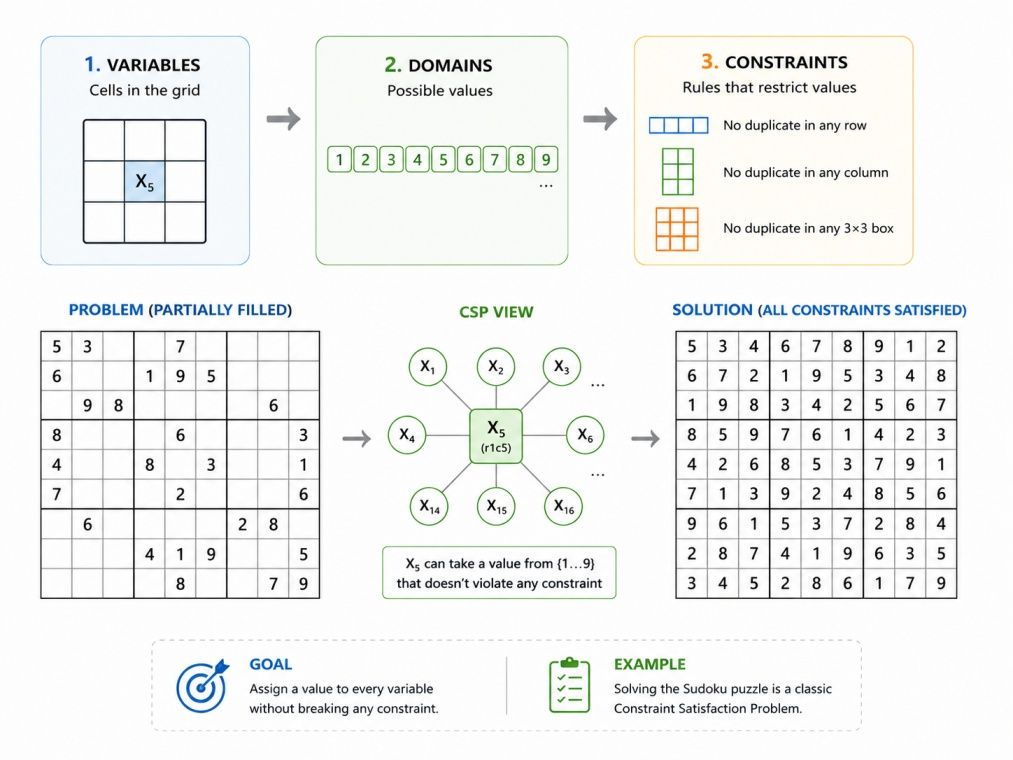
AI uses the same logic to solve far more complex problems, from scheduling flights to planning robot movements.
Every constraint satisfaction problem in artificial intelligence has three main parts:
Component |
What It Means |
Example |
| Variables | The things you need to assign values to | Days of the week, map regions |
| Domains | The set of possible values for each variable | Colors, numbers, time slots |
| Constraints | The rules that valid assignments must follow | No two neighbors can share the same color |
A solution is valid only when every variable has a value from its domain and no constraint is violated.
Also Read: Artificial Intelligence Optimization: A Complete Guide from Basics to Advanced
In formal terms, a CSP is defined as a triple:
CSP = {X, D, C}
A constraint Ck involves a subset of variables and specifies the combinations of values those variables can take together.
Constraints in a CSP can be:
Also Read: Artificial Intelligence Subjects: Everything You Need to Know Before Enrolling
Free Courses
The most straightforward way to solve a CSP is to try every possible combination of values until one satisfies all constraints. This is called a brute-force or generate-and-test approach. It works for tiny problems, but it becomes impractical fast. If you have 10 variables each with 10 possible values, that is 10 billion combinations to check.
AI uses smarter approaches.
Backtracking is the most widely used algorithm for solving CSPs. It works like this:
It is essentially a depth-first search through the space of possible assignments.
Example: Map Coloring
Imagine you need to color the regions of a map such that no two neighboring regions share the same color.
Backtracking assigns colors one region at a time and backtracks whenever a conflict arises.
Plain backtracking can still be slow. AI improves it with three key heuristics:
1. Minimum Remaining Values (MRV)
Always pick the variable with the fewest legal values remaining in its domain. This catches failures early and reduces backtracking.
2. Degree Heuristic
Among variables with the same MRV count, choose the one with the most constraints on other unassigned variables. It reduces future conflicts faster.
3. Least Constraining Value (LCV)
When choosing a value for a variable, pick the one that eliminates the fewest options for neighboring variables. This keeps more flexibility for future assignments.
Also Read: Artificial Intelligence Tools: Platforms, Frameworks, & Uses
Constraint propagation reduces the domains of variables before or during search. Instead of waiting for a conflict, AI actively removes values that cannot possibly lead to a valid solution.
Arc Consistency (AC-3) is the most common technique. It checks every pair of connected variables and removes values from a domain that have no compatible match in the other domain. This often shrinks the search space dramatically before backtracking even begins.
AI Courses to upskill
Explore Artificial Intelligence Courses for Career Progression
Beyond backtracking, several other algorithms tackle CSPs depending on the problem size and structure.
Instead of building a solution from scratch, local search starts with a complete assignment (even if it violates constraints) and then improves it step by step.
Min-Conflicts Algorithm:
This method works extremely well for large CSPs. It was famously used to solve the N-Queens problem (placing N queens on an NxN board so none attacks another) with one million queens in seconds.
Algorithm |
Approach |
Best Used When |
| Backtracking | Systematic depth-first search | Small to medium CSPs |
| Backtracking + MRV/LCV | Smarter variable and value ordering | Medium to large CSPs |
| AC-3 (Arc Consistency) | Constraint propagation before search | Preprocessing to shrink domains |
| Min-Conflicts | Local search from a random assignment | Very large CSPs, scheduling |
| Genetic Algorithms | Evolutionary optimization | Soft constraints, optimization CSPs |
Forward checking is a technique used alongside backtracking. Each time a variable is assigned a value, AI immediately checks the domains of all unassigned neighboring variables and removes incompatible values. If any domain becomes empty, backtracking happens right away without exploring a dead-end path.
This prevents a lot of wasted effort compared to vanilla backtracking.
Also Read: Why AI Is The Future & How It Will Change The Future?
The constraint satisfaction problem in artificial intelligence is not just a theoretical concept. It powers systems you interact with every day.
Universities use CSP to build exam timetables. Variables are the exams, domains are the time slots and rooms, and constraints include rules like no student should have two exams at the same time. The same logic applies to airline crew scheduling, factory production planning, and hospital shift management.
One of the classic examples of what is constraint satisfaction problem in artificial intelligence is map coloring. Given a map, the goal is to color regions so no two adjacent regions share the same color using the minimum number of colors. This has real use in frequency assignment for mobile networks, where nearby towers must broadcast on different frequencies to avoid interference.
Also Read: Top 10 Uses of Artificial Intelligence
Sudoku, crosswords, and the N-Queens problem are all CSPs. Solving them efficiently requires constraint propagation and smart search. AI-powered puzzle solvers use these exact techniques.
In chip design, engineers must place components on a board without overlapping, while keeping connected components physically close. CSP handles the placement and routing with millions of constraints.
Parsing sentences involves assigning grammatical roles to words while satisfying syntactic constraints. CSP-based approaches help AI understand sentence structure correctly.
It helps to understand how CSPs relate to other types of AI problems.
Feature |
CSP |
Search Problems |
Optimization Problems |
| Goal | Find any valid assignment | Find a path to a goal state | Find the best assignment |
| Solution type | Complete assignment satisfying all constraints | Sequence of actions | Optimal value assignment |
| Evaluation | Constraint check | Goal test | Objective function |
| Common algorithms | Backtracking, AC-3, Min-Conflicts | BFS, DFS, A* | Genetic Algorithms, Simulated Annealing |
| Example | Sudoku, timetabling | Maze solving, 8-puzzle | Traveling salesman |
CSPs sit between pure search and optimization. They are more structured than general search problems because you always know what a solution must look like. But unlike optimization problems, the goal is not to maximize or minimize anything. Any valid solution will do.
Once you are comfortable with the basics, here are the deeper concepts that AI practitioners work with.
In some problems, not every constraint can be satisfied at the same time. Soft constraints are assigned weights or penalties. The goal becomes minimizing the total penalty rather than satisfying everything perfectly. This is called a Constraint Optimization Problem (COP).
Real-world scheduling almost always involves soft constraints, such as employee preferences for certain shifts or preferred delivery windows.
Also Read: Convex Optimization in Machine Learning: A Complete Guide
In a distributed CSP, different parts of the problem are held by different agents, and no single agent has a full view of the entire problem. Agents must communicate and coordinate to find a global solution. This is useful in multi-robot systems, distributed sensor networks, and supply chain management.
In a dynamic CSP, variables, domains, or constraints can change over time. For example, if a machine breaks down in a factory schedule, the CSP must adapt without rebuilding the entire solution from scratch. AI systems for real-time operations often deal with dynamic CSPs.
CSPs intersect with machine learning in areas like neural architecture search, where the goal is to find the best neural network structure subject to resource constraints (memory, inference time, accuracy). Constraint-guided search helps narrow down the enormous space of possible architectures.
The constraint satisfaction problem in artificial intelligence is a foundational concept that shows up across almost every domain of applied AI. From scheduling systems to robot planning, from puzzle solvers to chip design, CSP gives AI a clean, structured way to find valid solutions under complex rules.
The key ideas to remember are simple. You have variables, domains, and constraints. You use algorithms like backtracking, arc consistency, and min-conflicts to search for valid assignments. You improve efficiency with heuristics like MRV, LCV, and forward checking.
Want personalized guidance on AI and upskilling? Speak with an expert for a free 1:1 counselling session today.
A constraint satisfaction problem in artificial intelligence is a problem where you assign values to a set of variables while following a list of rules or constraints. Think of it as filling in a form where each field has options, but your choices must not break any of the given rules.
Every CSP has three core elements: variables (the things being assigned), domains (the list of allowed values for each variable), and constraints (the rules that every valid assignment must satisfy). A solution is valid only when all three are respected together.
Backtracking is the standard search method for CSPs because it systematically explores possible assignments and undoes choices that lead to conflicts. It avoids exploring every possible combination blindly, making it far more efficient than brute-force methods for most problems.
Arc consistency is a constraint propagation technique where AI checks pairs of connected variables and removes values from their domains that cannot possibly be part of a valid solution. The AC-3 algorithm automates this process and is used to shrink the search space before or during backtracking.
In a general search problem, AI looks for a path to a goal state through a sequence of actions. In a CSP, the goal is to find a complete assignment of values to all variables that satisfies every constraint. CSPs focus on what the solution looks like, not how to reach it step by step.
The Min-Conflicts algorithm is a local search method that starts with a random complete assignment and iteratively reassigns variables to reduce constraint violations. It is especially effective for very large CSPs like scheduling problems and has been shown to solve million-variable problems efficiently.
Yes. Recent research combines machine learning with CSP solvers. ML models can learn to predict good variable orderings, value selections, or constraint structures from past problems. This hybrid approach, often called learning-based constraint solving, speeds up search significantly on structured problem families.
A hard constraint is a rule that can never be broken. A valid solution must satisfy all hard constraints without exception. A soft constraint is a preference that should ideally be met but can be violated at a cost. Problems with soft constraints are called constraint optimization problems, and the goal is to minimize the total penalty from violated soft constraints.
A dynamic CSP is one where the variables, domains, or constraints change over time. Unlike standard CSPs, dynamic CSPs require AI systems to adapt existing solutions when conditions change, rather than solving from scratch each time. They are common in real-time logistics, robot control, and live scheduling systems.
The Minimum Remaining Values (MRV) heuristic selects the variable with the fewest legal values left in its domain to assign next. This strategy catches dead ends early in the search process and reduces the total number of backtracks needed to find a valid solution, making the overall search significantly faster.
Yes, CSP techniques appear in game-playing AI, especially for logic-based games like Sudoku, Minesweeper, and constraint-based board games. In video game development, CSP is used for procedural content generation, NPC scheduling, and level design validation, where game rules act as constraints that all generated content must satisfy.
97 articles published
Rahul Singh is an Associate Content Writer at upGrad, with a strong interest in Data Science, Machine Learning, and Artificial Intelligence. He combines technical development skills with data-driven s...
Speak with AI & ML expert
By submitting, I accept the T&C and
Privacy Policy
Top Resources
Master's Degree
18 Months
Executive Diploma
12 Months
IIIT Bangalore
Executive Programme in Generative AI & Agentic AI for LeadersIndia’s #1 Tech University
Dual Certification
5 Months