Retail Management: Complete Guide to Operations, Strategy, and Career Growth
By Sriram
Updated on Jun 16, 2026 | 7 min read | 4.72K+ views
Share:

All courses
Certifications
More
By Sriram
Updated on Jun 16, 2026 | 7 min read | 4.72K+ views
Share:
Table of Contents
Retail management involves overseeing store operations, inventory, staff, pricing, and merchandising to improve sales and profitability. It focuses on delivering a smooth customer experience across physical and online channels while ensuring efficient operations. Effective retail management helps businesses meet customer needs, optimize resources, and achieve sustainable growth in competitive markets.
In this blog , you'll learn what retail management is, its core functions, key strategies, technologies shaping the industry, career opportunities, and practical challenges retailers face in today's market.
Explore Management Courses from upGrad to learn about retail and become an expert in Retail management.
Popular Management Programs
Retail businesses operate in highly competitive markets with rapidly changing customer expectations. Planning and executing product, employee, inventory, and customer experience management. Here's where retail management comes in.
At the heart of retail management is offering the right product to the right customer at the right time and doing so profitably. Businesses that manage their retail operations effectively can see higher customer retention and revenue growth.
If you are wondering about what retail management is, it is the process of planning, organising, controlling and monitoring of retail operations to maximise customer satisfaction and business performance.
The following table highlights the core aspects of retail management.
Aspect |
Purpose |
| Inventory Management | Ensure product availability |
| Customer Service | Improve customer satisfaction |
| Pricing Strategy | Maximize sales and profits |
| Store Operations | Increase efficiency |
| Marketing | Attract and retain customers |
Retail managers handle multiple responsibilities daily, including:
Major responsibilities of retail managers are listed below.
Enabling smooth store operations
Consider a fashion retailer at festive seasons. Poor inventory planning can result in popular products being unavailable. Customers often immediately switch over to competitors. Such losses are avoided by good retail operations.
Modern retailers rely heavily on data too. Sales reports, customer behavior analytics and demand forecasting enable managers to make informed decisions rather than depend on experience alone.
Retail management is important because small inefficiencies can lead to large losses in time.
Also read : Management process: Definition, Features & function
Free Courses
Every retail business depends on several interconnected functions. A store may have excellent products, but poor operations can still hurt customer satisfaction and profits.
Successful retail management combines operational efficiency with customer-focused decision-making. Each function contributes directly to business growth.
The following table explains the key functions involved in retail operations.
Function |
Description |
| Merchandising | Product selection and display |
| Inventory Control | Stock monitoring and replenishment |
| Customer Relationship Management | Customer engagement and loyalty |
| Sales Management | Revenue generation activities |
| Staff Management | Hiring and training employees |
Inventory is still one of the most important retail assets. Too much stock means extra storage costs, but too little means lost sales.
Many retailers now use predictive analytics to predict demand. A grocery chain, for example, may stock up prior to holidays, following historical trends of sales.
Store design influences customer behavior more than many businesses recognize.
Products at eye level sell better. Retailers strategically position shelves to boost impulse buys and facilitate navigation.
Customers do not recall products only. They recall experiences.
Rapid billing, knowledgeable staff and tailored recommendations greatly enhance satisfaction. Conversely, poor service can quickly destroy brand reputation.
Retail staff deal with customers face-to-face. Better shopping experiences are created by training staff in communication, product knowledge, conflict resolution.
Factors that enhance retail performance are explained in the following points.
Retail businesses are increasingly operating across physical stores, websites and mobile apps. Strong operational processes and technology support are required to coordinate these channels.
Management Courses to upskill
Explore Management Courses for Career Progression
IIIT-B & IIM, Udaipur
Chief Technology Officer & AI Leadership ProgrammeRetail success rarely happens by chance. Businesses need clear strategies that align customer expectations with operational goals.
Modern retail management goes beyond managing stores. It includes data analysis, customer engagement, pricing optimization, and digital transformation.
Retailers today compete on convenience as much as price. Customers expect smooth experiences across channels.
The picture below shows a comparison of popular retail strategies.
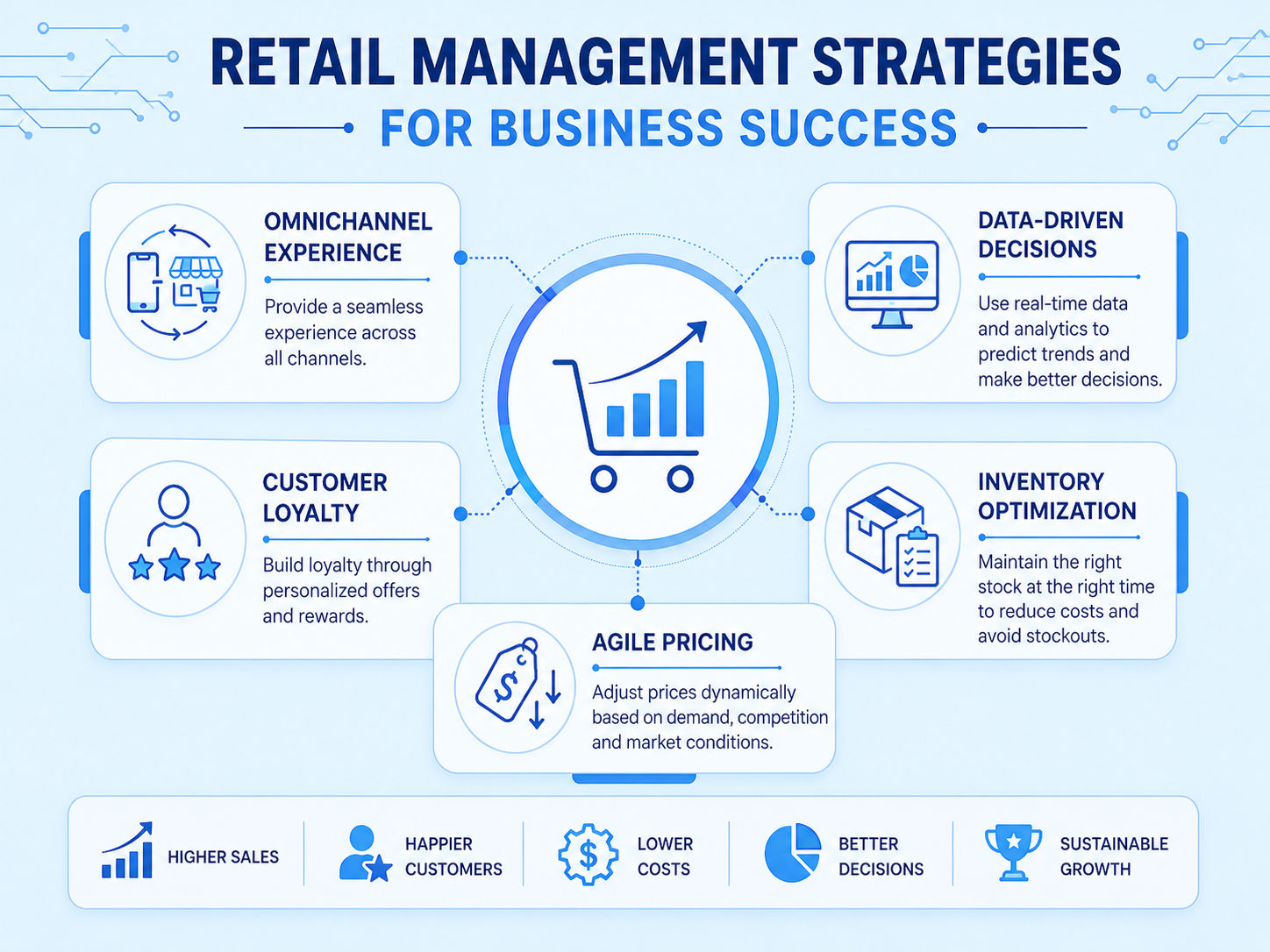
Customers can shop online and buy in stores. Others may do the opposite
Retailers are creating a seamless shopping experience by integrating websites, apps and stores. That’ll cut down on friction and make things more convenient.
Retail creates a huge amount of data every day.
following points show important retail metrics:
These insights allow businesses to improve their forecasting and their marketing effectiveness.
Pricing directly affects consumer behavior.
Retailers use strategies such as:
However, excessive discounting can reduce profit margins and alter customer perceptions of value.
Reward loyalty with repeat purchases and personalized offers.
Airlines, supermarkets and online retailers are big users of these programs. Simple point systems can often improve long-term customer retention.
But even with sophisticated tools retailers still have uncertainty. Consumer tastes can shift rapidly, owing to economic conditions, social trends, or new competitors.
Also read : Financial Risk Management: A Complete Beginner's Guide
Technology continues to reshape retail operations worldwide. Artificial intelligence, automation, and analytics are changing how retailers interact with customers and manage stores.
Modern retail management increasingly relies on digital systems to improve efficiency and reduce operational costs.
Retailers adopting technology often gain competitive advantages, but implementation also comes with challenges.
The following table highlights major technologies used in retail
Technology |
Use Case |
| Artificial Intelligence | Demand forecasting |
| RFID | Inventory tracking |
| Chatbots | Customer support |
| Analytics Platforms | Business insights |
| Automation Systems | Warehouse operations |
AI helps retailers predict customer demand, personalize recommendations, and optimize inventory.
Online marketplaces frequently suggest products based on browsing history. These recommendation systems improve conversion rates and customer engagement.
Smart shelves and sensors enable real-time inventory tracking.
Retailers receive alerts when products run low, reducing stock shortages and improving operational efficiency.
Self-checkout systems shorten queues and improve convenience.
However, some customers still prefer human interaction. Retailers must balance automation with customer expectations.
Data visualization tools help managers monitor sales performance and customer behavior.
Businesses use dashboards to identify trends quickly and make faster decisions.
As retail evolves, professionals with analytical and digital skills become increasingly valuable. Understanding both business operations and technology creates strong career opportunities.
Also read : A Guide to Training Management System
The retail industry remains one of the largest employers globally. Career opportunities extend far beyond store management.
Professionals working in retail management often move into operations, marketing, supply chain, and business strategy roles.
The rise of digital commerce has further expanded career paths.
The following table lists common retail careers.
Role |
Key Responsibility |
| Store Manager | Daily operations |
| Category Manager | Product planning |
| Merchandising Manager | Product presentation |
| Retail Analyst | Data analysis |
| Supply Chain Manager | Inventory movement |
Professionals entering this field usually develop skills in:
Retail careers are often pursued by graduates from business, commerce, marketing, and management programs. But experience counts just as much as a qualification in the real world.
With digital transformation speeding up, retail leaders of the future will probably blend business acumen with analytics and tech hnology knowledge.
Understanding what retail management and its evolving nature is helps professionals prepare for long-term career growth in this dynamic industry.
Retail continues to evolve as customer expectations, technology, and market conditions change. Businesses that invest in strong retail management practices can improve customer experience, optimize operations, and maintain profitability in competitive markets.
Whether you aim to build a retail business or pursue a career in the field, understanding what retail management is provides a strong foundation for navigating the modern retail landscape. The future of retail belongs to organizations that combine operational excellence with customer-centric innovation.
Ready to start your journey? Book a free consultation with upGrad today to find the best path for your career.
Retail management in physical stores focuses heavily on store layout, staff interactions, and in-person customer experiences. Online retail prioritizes website performance, digital marketing, and logistics.
Today, many businesses operate in both environments. This creates the need for omnichannel coordination where customers can browse online and purchase offline or vice versa. Managing inventory and customer data across channels has become a major operational challenge for modern retailers.
Employers increasingly seek professionals who combine business knowledge with digital skills. Communication and leadership remain essential, but analytical abilities now carry equal importance.
You should develop skills in:
Retail businesses value candidates who can make decisions using data rather than relying only on intuition.
Customer behavior directly affects pricing, inventory, promotions, and store layouts. Retailers analyze buying patterns to understand what customers purchase, when they shop, and how frequently they return.
For example, if shoppers consistently abandon carts during checkout, businesses may simplify payment processes. Understanding customer behavior helps retailers improve experiences and reduce lost sales opportunities.
Yes. Small businesses often benefit significantly from basic retail management practices. Even simple inventory tracking systems and customer feedback collection can improve operations.
A neighborhood store can use sales data to identify fast-moving products and avoid overstocking slow sellers. Small operational improvements often create measurable financial gains without requiring major investments.
Sales alone do not provide a complete picture of performance. Retailers monitor several operational metrics to evaluate business health.
Common metrics include:
These indicators help businesses identify hidden inefficiencies that sales numbers may not reveal.
Demand forecasting helps retailers estimate future product demand using historical data, seasonality, and market trends. Accurate forecasts reduce stock shortages and excess inventory.
For instance, retailers often increase inventory before festivals based on previous sales patterns. Poor forecasting can lead to lost revenue or unnecessary storage costs, making it a critical business function.
Artificial intelligence helps retailers automate repetitive tasks and improve decision-making. AI systems analyze customer preferences, forecast demand, and generate product recommendations.
Modern retail management increasingly uses AI to optimize inventory and personalize customer experiences. However, AI still depends on accurate data. Poor data quality often leads to unreliable predictions and business risks.
Retail businesses operate in rapidly changing environments. Consumer expectations continue to evolve while competition grows across digital and physical channels.
Some common challenges include:
Businesses that adapt quickly often remain more competitive in uncertain markets.
Retail remains one of the world's largest industries, creating opportunities across operations, analytics, merchandising, and supply chain management.
As businesses adopt technology, professionals with expertise in retail management and digital tools become increasingly valuable. Career growth often extends beyond store operations into strategic and leadership roles.
Loyalty programs encourage repeat purchases by rewarding customers for continued engagement. Discounts, points, and personalized offers often increase long-term retention.
However, successful programs go beyond rewards. Customers expect relevance and convenience. Retailers that use customer data responsibly often create stronger relationships and improve lifetime customer value.
The future of retail management will likely involve greater automation, AI-driven analytics, and personalized customer experiences. Retailers will continue integrating online and offline channels to meet changing expectations.
Businesses that invest in data capabilities, operational efficiency, and customer-centric strategies are better positioned for long-term growth. The role of retail professionals will also evolve as technology becomes more deeply embedded in daily operations.
730 articles published
Sriram K is a Senior SEO Executive with a B.Tech in Information Technology from Dr. M.G.R. Educational and Research Institute, Chennai. With over a decade of experience in digital marketing, he specia...
Get Free Consultation
By submitting, I accept the T&C and
Privacy Policy
Top Resources
Certification
3 Months
Certification
6 Months
O.P. Jindal Global University
Masters in International Accounting and Finance (Accredited by ACCA, UK)Master's Degree
12 Months