Organizational Management: Meaning, Types, Functions, and Best Practices
By upGrad
Updated on Jun 15, 2026 | 7 min read | 2.46K+ views
Share:

All courses
Certifications
More
By upGrad
Updated on Jun 15, 2026 | 7 min read | 2.46K+ views
Share:
Table of Contents
Organizational management connects the work that people do with the goals that the business wants to achieve. This means that effort gets put into the things that really matter; waste gets cut down, and the business can grow in a way that lasts.
Every business, whether it is a startup or a big company, uses organizational management in some way. Organizational management helps companies get people, processes, and resources working together towards the goal. Without management even teams with talented people can have problems like not communicating well, not knowing what to do first and taking too long to make decisions.
This blog is, about what organizational management's why it is important how it works, the different ways that organizations can be set up the problems that can happen and some practical ideas that really work in the real world for organizational management.
Explore Management Courses from upGrad and understand why organizational management remains one of the most essential skills for leaders and professionals across every industry.
Popular MBA Programs
Organizational management involves planning, organizing, directing, and controlling the resources of the organization. This helps the organization achieve its objectives in an effective way.
The people in charge of management must make sure everything runs smoothly and that the organization has what it needs to succeed. They do this by planning, organizing, directing, and controlling the resources of the organization.
It involves managing:
Also Read: Why Organizational Skills Matter in the Workplace and How to Improve Them
At the heart, organizational management makes sure all departments are working towards the goal.
Organizational management is about making sure everyone is on the page.
Element |
Purpose |
| Planning | Defines goals and strategies |
| Organizing | Allocates resources and responsibilities |
| Leading | Motivates and guides employees |
| Controlling | Measures performance and outcomes |
Imagine an e-commerce company preparing a sale. The marketing team drives traffic. The operations team manages inventory. The customer service team handles queries. The leadership team tracks performance.
Good management of a company makes sure that all the teams work together to achieve their goals. This is what effective organizational management is about. It helps the teams to work together and not operate in groups.
Free Courses
Research from Gallup, a management consulting firm, always shows that managers have an impact on how engaged employees are and how well teams do their jobs.
Managers are really important when it comes to employee engagement and team performance. Gallups research is very clear about this.
Strong management creates:
MBA Courses to upskill
Explore MBA Courses for Career Progression
O.P.Jindal Global University
MBA (with Career Acceleration Program by upGrad)Become interview ready with Career Services
PSB MBA + IIML Certification
MBA from Paris School of Business with Certification from IIM LucknowOne important part of managing an organization is creating the structure.
The structure of an organization in management shows who reports to whom responsibilities people have and how information is shared across the company.
A good structure helps employees know:
Also Read: Organizational Behavior Model: Comprehensive Guide to Understanding and Application
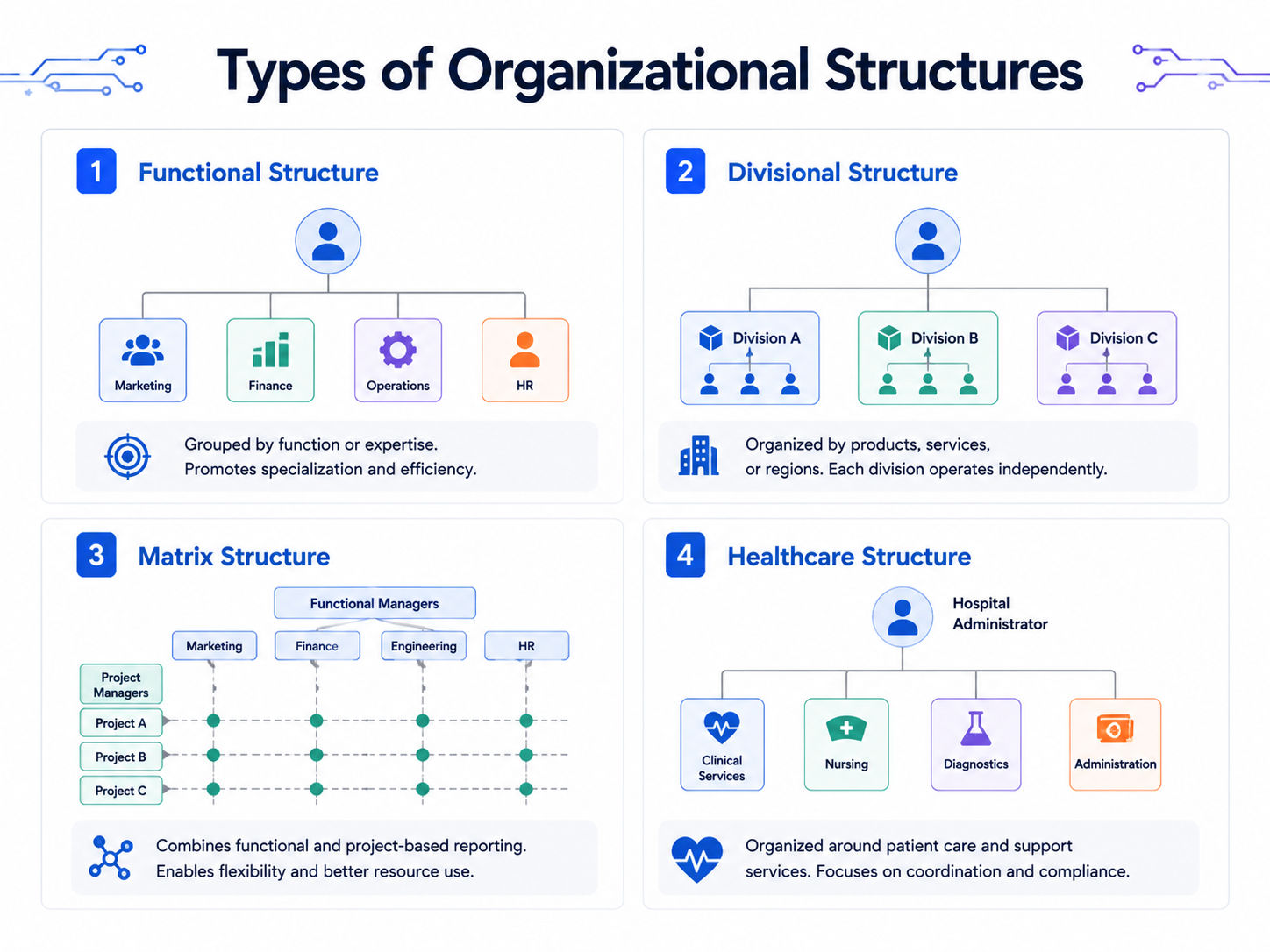
Functional Structure: Functional Structure: Employees are grouped by their expertise; Marketing, Finance, Human Resources, Operations are examples. In this structure, people with skills and knowledge are grouped together.
Advantages
Challenges
Divisional Structure: Organizations are divided by product lines, regions, or customer segments.
Advantages
Challenges
Matrix Structure: Employees report to multiple managers.
For example: A software developer may report to both a project manager and an engineering manager.
Advantages
Challenges
A management organizational chart visually represents reporting structures. A basic example:
A basic example:
Level |
Role |
| Executive | CEO |
| Senior Management | Directors |
| Middle Management | Department Managers |
| Operational Level | Team Leaders |
| Employees | Individual Contributors |
Organizations frequently update their management organizational chart as teams grow, and business needs evolve.
Also Read: Types of Organisational Structure: A Complete Guide for Modern Businesses
The human resource management (HRM) organizational structure plays a role in workforce planning. Typical HR departments include:
Typical HR departments include:
HR Function |
Responsibility |
| Recruitment | Hiring talent |
| Learning & Development | Employee training |
| Compensation & Benefits | Rewards and payroll |
| Employee Relations | Workplace policies |
| HR Operations | Administrative processes |
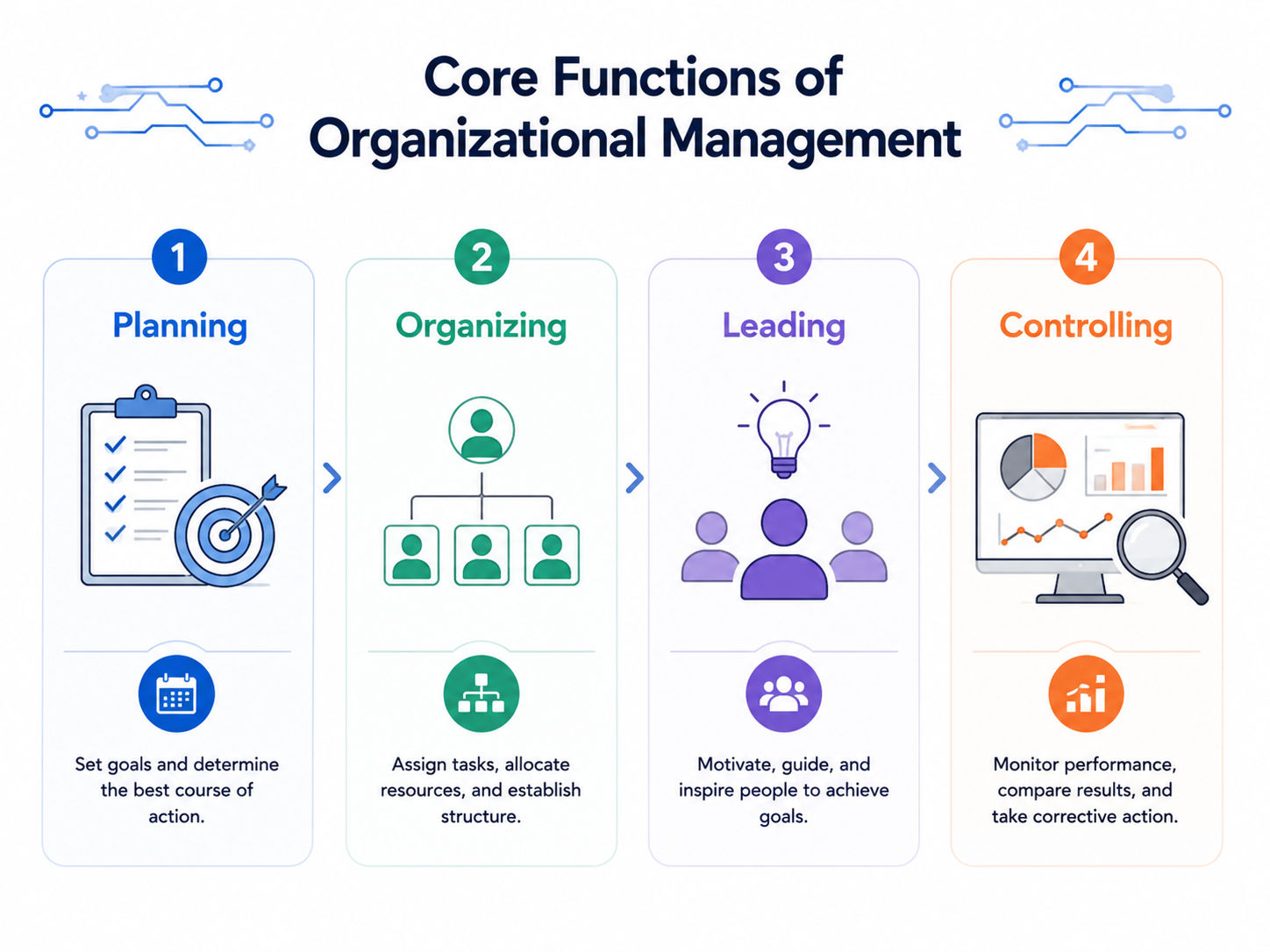
To understand what management is, you have to look at the things it does. Management is about making sure people and things work well together, and management helps leaders do that by giving them a way to guide their teams and make decisions.
Management is important because it helps teams reach their goals and that is what management is about.
Planning involves setting goals and defining strategies.
Managers answer questions such as:
Good planning reduces uncertainty and improves decision-making.
Organizing focuses on arranging resources effectively.
This includes:
The chosen organizational structure in management directly influences how work gets organized.
Leadership is about influencing people.
Managers lead by:
Strong leaders create trust and accountability.
Controlling ensures that organizational goals are being met.
Common activities include:
Also Read: Top 10 Management Skills Required to Become a Successful Manager
Modern managers increasingly rely on insights from the journal of organizational behavior management and similar academic research to understand workplace performance.
Research in organizational behavior helps companies:
Insights from the journal of organizational behavior management often influence corporate training programs and leadership development initiatives.
Also Read: Organizational Behavior Model: Comprehensive Guide to Understanding and Application
Subscribe to upGrad's Newsletter
Join thousands of learners who receive useful tips
Successful organizations do more than create structures. They continuously improve how people work together. Here are proven practices for stronger organizational management.
Many companies adopt structures that no longer fit their goals.
Review the organizational structure in management regularly to ensure it supports business objectives.
Poor communication remains one of the biggest barriers to organizational success.
Organizations should:
Managers directly influence team performance.
Leadership training should focus on:
The HRM organizational structure should evolve alongside workforce needs.
Key focus areas include:
Data-driven organizations make faster and more accurate decisions.
Examples include:
A current management organizational chart helps employees understand reporting relationships and accountability.
Benefits include:
Managers can gain valuable insights from the journal of organizational behavior management and other evidence-based resources.
Research-backed management practices often produce more sustainable results than relying solely on intuition.
Challenge |
Impact |
| Communication gaps | Reduced productivity |
| Role ambiguity | Employee confusion |
| Resistance to change | Slow transformation |
| Poor leadership | Low morale |
| Resource constraints | Delayed projects |
Organizations that proactively address these issues tend to build stronger and more resilient teams.
Organizational management is much more than supervising employees. It is a structured approach to aligning people, processes, and resources with business goals. Effective management helps organizations improve productivity, strengthen collaboration, and adapt to changing market conditions.
At the same time, insights from resources such as the journal of organizational behavior management can help leaders make more informed decisions and build high-performing workplaces. Organizations that continuously refine their management practices are better positioned to grow, innovate, and remain competitive in an increasingly complex business environment.
Want to explore more about Organizational Management? Book your free 1:1 personal consultation with our expert today.
The five commonly recognized principles are planning, organizing, staffing, directing, and controlling. Together, these functions help organizations coordinate resources and achieve objectives efficiently. Businesses of all sizes rely on these principles to maintain productivity and alignment.
Organizational management improves coordination, accountability, and communication across teams. It helps leaders allocate resources effectively and monitor performance against goals. This leads to higher efficiency, stronger employee engagement, and better business outcomes.
Management refers to overseeing people or processes within a specific area. Organizational management takes a broader approach by aligning the entire organization, including strategy, structure, culture, and resources, to achieve long-term objectives.
The organizational structure in management defines authority, reporting relationships, and workflow processes. A clear structure reduces confusion, improves accountability, and helps teams collaborate more effectively toward common goals.
Successful managers need leadership, communication, problem-solving, decision-making, and strategic thinking skills. Emotional intelligence and adaptability are also increasingly important as organizations face rapid technological and workplace changes.
Organizations should review their management organizational chart whenever significant changes occur, such as restructuring, rapid growth, mergers, or leadership transitions. Regular updates ensure employees understand reporting relationships and responsibilities.
The human resource management organizational structure supports recruitment, employee development, performance management, and workplace culture. HR ensures organizations have the talent and systems needed to achieve strategic goals.
Common challenges include communication breakdowns, unclear responsibilities, resistance to change, ineffective leadership, and resource limitations. Addressing these issues early helps organizations maintain productivity and employee satisfaction.
Research published in sources like the journal of organizational behavior management helps leaders understand employee motivation, workplace culture, and performance. These insights support evidence-based management decisions and improved organizational outcomes.
Current trends include remote work management, data-driven decision-making, agile organizational structures, employee well-being initiatives, and AI-assisted workforce planning. These approaches help organizations remain competitive and adaptable.
Yes. Small businesses often benefit significantly from organizational management because it creates structure during growth. Even simple management systems can improve efficiency, clarify responsibilities, and support sustainable expansion over time.
972 articles published
We are an online education platform providing industry-relevant programs for professionals, designed and delivered in collaboration with world-class faculty and businesses. Merging the latest technolo...
Speak with MBA expert
By submitting, I accept the T&C and
Privacy Policy
From MBA to Dream Job - Explore Our Alumni Success Stories
Top Resources
Master's Degree
13 Months
Master's Degree
12 Months
Master's Degree
15 Months