Types of Organisational Structure: A Complete Guide for Modern Businesses
By Sriram
Updated on Jun 11, 2026 | 6 min read | 4.66K+ views
Share:

All courses
Certifications
More
By Sriram
Updated on Jun 11, 2026 | 6 min read | 4.66K+ views
Share:
Table of Contents
An organisational structure determines how a company assigns responsibilities, makes decisions, and manages communication across teams. Organizations typically range from mechanistic structures, which are centralized and rule-driven, to organic structures, which encourage flexibility, collaboration, and decentralized decision-making to adapt more quickly to changing business needs.
In this blog, you'll learn about the different types of organisational structure, how they work in practice, their advantages and drawbacks, and how businesses choose the right model based on their goals, size, and industry requirements.
Build stronger business-management skills with upGrad’s management courses and learn how to manage your time, goals, productivity, and professional growth more effectively.
Popular Management Programs
Organizations adopt different organisational structures based on their size, goals, industry, and operational needs. Each structure defines how teams are organized, how decisions are made, and how information flows across the business. Understanding these models helps companies choose an approach that supports efficiency, collaboration, and long-term growth.
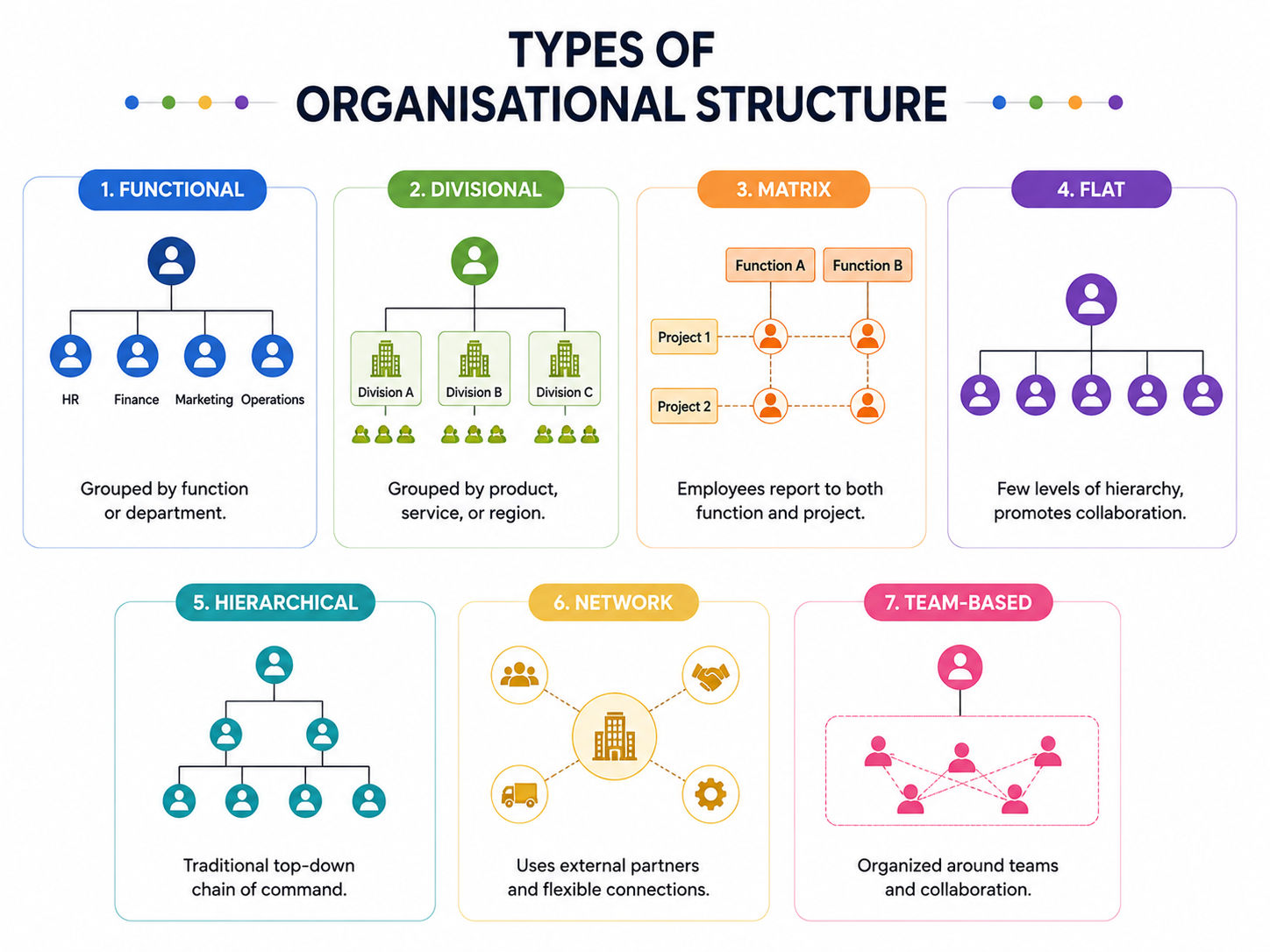
A functional structure groups employees based on specialized functions.
Common departments include:
Employees report to managers within their respective functions.
For example, marketing professionals report to the marketing manager, while finance staff report to the finance director.
Advantages include:
Challenges include:
Many established companies continue to use this model because it supports operational efficiency.
In a divisional structure, teams are organized around products, regions, customers, or markets.
For example, a multinational company may create divisions such as:
Each division operates almost like an independent business unit.
Benefits include:
However, divisions may duplicate resources, increasing operational costs.
The matrix structure combines functional and divisional approaches.
Employees often report to two managers:
This model supports collaboration across departments and projects.
For example, a software engineer may belong to the engineering department while simultaneously working under a project manager for a product launch.
Advantages include:
Potential challenges include:
Matrix structures are common in consulting, engineering, and technology companies.
Do read : Top 25 People Management Skills for Managers: A Guide for New and Experienced Managers
Free Courses
Sales teams need a structure that matches their customers, products, and market strategy. The right sales organization structure helps businesses improve customer relationships, increase efficiency, and drive revenue growth. It also influences how sales representatives manage territories, handle accounts, and achieve performance targets.
As organizations expand, they often adjust their sales structure to support new products, regions, or customer segments. Understanding the various types of sales organisation structure can help businesses choose a model that aligns with their growth objectives.
In a geographic sales structure, sales representatives are assigned to specific territories or regions. Each salesperson manages customers within a designated location.
Common territory examples include:
The key benefits of this structure include:
This model works particularly well for organizations with a broad customer base spread across different locations.
A product-based sales structure organizes teams around specific product categories. Sales representatives become specialists in the products they sell.
For example, separate teams may focus on:
This approach allows representatives to develop deep product knowledge and provide more informed guidance to customers.
However, businesses should consider that customers purchasing multiple products may need to interact with several sales representatives, which can create coordination challenges if communication is not managed effectively.
In a customer-based structure, sales teams are grouped according to customer types rather than products or locations.
Typical customer segments include:
This structure helps sales professionals develop a deeper understanding of the unique needs, purchasing behavior, and challenges of each customer group.
As a result, organizations can deliver more personalized solutions and build stronger long-term relationships.
Many modern organizations combine elements of multiple sales structures to increase flexibility and improve performance.
A hybrid model may:
This approach allows businesses to balance customer focus, product expertise, and geographic coverage.
While a hybrid structure offers significant flexibility, it requires clearly defined responsibilities and strong communication processes to prevent overlapping roles and reporting confusion.
As companies expand into new markets and launch additional products, hybrid structures often become the preferred choice because they can adapt more easily to changing business requirements.
Also Read: Principles of Business Management
Management Courses to upskill
Explore Management Courses for Career Progression
IIIT-B & IIM, Udaipur
Chief Technology Officer & AI Leadership ProgrammeIIM Kozhikode
PCP in AI for Business ProfessionalsSelecting among the various types of organisational structure requires balancing business objectives, operational complexity, and future growth plans. There is no perfect structure. The most effective model depends on the organization's unique circumstances.
The factors below help guide the decision.
| Decision Factor | Consideration |
| Company Size | Number of employees |
| Growth Stage | Startup, scaling, mature |
| Product Range | Single or multiple products |
| Geographic Reach | Local or global operations |
| Innovation Needs | Stability versus flexibility |
| Customer Complexity | Number of customer segments |
Organizations should evaluate the following questions:
The important consideration involves future growth. A structure that works for 50 employees may become ineffective when the workforce reaches 1,000 people.
Many organizations modify their structure over time rather than maintaining a single model indefinitely.
Also Read : Matrix Organization Structure
Every organisational structure influences how people work, communicate, and make decisions. While a well-designed structure can improve efficiency and accountability, no model is without limitations.
Understanding both the benefits and challenges helps businesses select a structure that supports their goals while preparing for potential obstacles as they grow.
The table below highlight the key advantages that a clear organisational structure can provide.
Benefit |
Impact on the Organization |
| Clear Accountability | Employees understand roles and responsibilities |
| Improved Operational Efficiency | Workflows become more organized and streamlined |
| Better Resource Coordination | Teams and resources are allocated effectively |
| Faster Execution | Decisions and tasks move through defined channels |
| Stronger Performance Management | Managers can monitor and evaluate performance more easily |
| Improved Scalability | Supports business growth without creating confusion |
A well-defined structure helps employees know who they report to, where decisions are made, and how work should be completed. This clarity reduces misunderstandings and improves overall productivity.
Despite their advantages, organisational structures can also create operational challenges if they are not aligned with business needs.
The Table below outline some common drawbacks.
Challenge |
Potential Impact |
| Bureaucratic Decision-Making | Slower approvals and response times |
| Communication Barriers | Information may not flow efficiently across teams |
| Departmental Silos | Teams may focus on their own goals rather than company objectives |
| Resource Duplication | Multiple departments may perform similar tasks |
| Reduced Flexibility | Adapting to change can become difficult |
| Management Complexity | Additional layers of supervision may increase costs |
For example, highly hierarchical organizations often maintain strong control and accountability but may struggle to respond quickly to changing market conditions. On the other hand, flat structures encourage collaboration and innovation but can become difficult to coordinate as the workforce expands.
The most effective organizations regularly review their structure to ensure it continues to support business priorities. As markets, technologies, and customer expectations evolve, structural adjustments often become necessary to maintain efficiency and competitiveness.
Do Read : Top 10 Types of Project Management Organizational Structures: Explained
The various types of organisational structure influence how businesses operate, communicate, and grow. From functional and divisional models to matrix, flat, and team-based approaches, each structure offers distinct advantages and challenges.
Understanding the different types of organisational structure helps organizations improve collaboration, streamline decision-making, and support business objectives. Choosing the right structure based on company size, strategy, and growth plans can enhance accountability, efficiency, and long-term success.
Want personalised guidance on Management and upskilling? Speak with an expert
for a free 1:1 counselling session today.
Most companies reconsider their organisational structure when growth creates operational challenges. Common signs include slower decision-making, communication gaps, duplicated work, and unclear responsibilities. If teams struggle to collaborate or managers oversee too many employees, the current structure may no longer support business goals. Reviewing the structure regularly helps organizations stay efficient as they scale.
Yes, many organizations combine elements from different structures. For example, a company may operate with a functional structure while using cross-functional project teams for product development. Large enterprises often blend divisional and matrix structures to support multiple markets, products, and customer groups. The key is maintaining clear reporting lines and accountability.
Startups often benefit from flat or team-based structures because they encourage faster communication and quicker decision-making. Employees typically handle multiple responsibilities and work closely with leadership. As the business grows, however, startups usually introduce more formal structures to manage larger teams, improve coordination, and support long-term expansion.
A clear structure helps employees understand their responsibilities, reporting relationships, and decision-making authority. This reduces confusion and delays. When employees know who to approach for approvals or support, work moves more efficiently. Poorly designed structures can create bottlenecks, overlapping responsibilities, and communication issues that negatively affect productivity.
Organisational structure defines how a company is organized, including reporting relationships, authority levels, and workflows. Organizational culture refers to shared values, behaviors, and workplace norms. Two companies may have the same structure but very different cultures. Structure determines how work is managed, while culture influences how people interact and collaborate.
Remote and hybrid work models often encourage businesses to adopt more flexible structures. Companies increasingly rely on team-based and network structures to support collaboration across locations. Digital communication tools reduce the need for strict hierarchies in some situations. However, organizations still need clear reporting relationships and accountability to maintain productivity.
Yes, structure can significantly influence innovation. Flexible structures often make it easier for employees to share ideas, collaborate across departments, and respond quickly to market changes. Highly centralized structures may provide stronger control but can sometimes slow experimentation. The right balance depends on the company's industry, goals, and risk tolerance.
Transitioning to a matrix structure can create confusion if roles and reporting relationships are not clearly defined. Employees often report to both functional and project managers, which may lead to competing priorities. Organizations must establish strong communication practices and decision-making processes to prevent conflicts and maintain efficiency.
Global organizations typically consider factors such as geographic reach, product diversity, customer segments, and regulatory requirements. Many multinational companies adopt divisional or hybrid structures because these models allow regional teams to respond to local market conditions while maintaining overall corporate alignment and strategic control.
Yes, the way a company organizes its teams can directly influence customer satisfaction. Structures that improve communication between departments often enable faster problem resolution and better service delivery. Customer-focused structures can also help teams understand client needs more effectively, leading to stronger relationships and improved customer retention.
Many organizations are moving toward more agile and collaborative models. Team-based structures, hybrid frameworks, and cross-functional project teams are becoming increasingly common. Businesses want structures that support flexibility, innovation, and faster decision-making while still providing enough clarity to manage growth and maintain accountability across the organization.
695 articles published
Sriram K is a Senior SEO Executive with a B.Tech in Information Technology from Dr. M.G.R. Educational and Research Institute, Chennai. With over a decade of experience in digital marketing, he specia...
Get Free Consultation
By submitting, I accept the T&C and
Privacy Policy
Top Resources
Certification
3 Months
Certification
6 Months
O.P. Jindal Global University
Masters in International Accounting and Finance (Accredited by ACCA, UK)Master's Degree
12 Months