Principles of Business Management
By upGrad
Updated on Jun 03, 2026 | 8 min read | 2.64K+ views
Share:

All courses
Certifications
More
By upGrad
Updated on Jun 03, 2026 | 8 min read | 2.64K+ views
Share:
Table of Contents
The principles of business management form the foundation of how organizations plan, operate, and grow. Every successful organization, no matter its size or industry, runs on a set of core principles. These aren't just theoretical concepts reserved for business school classrooms. They're practical building blocks that keep everything moving in the right direction.
Whether you're running your own startup, leading a team for the first time, or simply looking to sharpen your leadership edge, getting a solid grasp of business management principles can make a real difference in how effectively you operate and grow.
Explore Management Courses from upGrad and dive deep into the principles of business management, from core decision-making frameworks and leadership strategies to the processes that help organizations plan smarter, operate efficiently and grow with confidence.
Popular Management Programs
The principles of business management help managers use resources wisely lead their teams and reach their goals. These principles are not rules, rather they give managers an idea of how to handle different situations at work.
Management experts came up with these principles by studying how organizations function, identifying what works, and what doesn't work. They found out that some practices consistently lead to better outcomes. While business environments have changed over the years, many management principles remain relevant even today. Because they focus on human behavior, leadership, and organizational effectiveness.
Also Read: What is Management?
Without a clear framework to operate from, even the most talented teams can lose direction. Management principles give organizations the structure they need to function well, and the results speak for themselves. When applied consistently, they:
In short, management principles aren't just good practice; they're what separates organizations that thrive from those that simply get by.
Also Read: An Introduction to Principles of Management
The principles of business management are really significant because they can be utilized in different situations. Businesses can implement these principles in different industries and, in different ways, for different organizational structures all while keeping the main goal of the principles of business management the same.
Benefit |
Impact on Business |
| Better coordination | Teams work toward common goals |
| Improved productivity | Resources are used efficiently |
| Faster decision-making | Managers have clear frameworks |
| Employee engagement | Roles and expectations become clearer |
| Sustainable growth | Businesses scale more effectively |
Businesses that consistently apply strong management principles often develop clearer strategies, stronger cultures, and better-performing teams.
Good management principles are:
Free Courses
The principles of business management don't exist in isolation; they come to life through five fundamental functions: planning, organizing, staffing, directing, and controlling.
Together, these functions give managers a clear path for turning big-picture business objectives into real, measurable action.
Everything begins with planning. Before any work gets done, managers need to define where the organization is headed and map out how to get there. It's the foundation that everything else is built on.
For instance, a company is launching a new product. Before a single task is executed, timelines need to be set, budgets agreed upon, marketing strategies developed, and performance targets established. That's planning in action.
Good planning helps organizations:
Once there's a plan, the next step is organizing, making sure the right resources, roles, and responsibilities are in place to execute it.
It's worth noting that even the best-laid plans can unravel without proper organizing. When people are unclear about their roles, execution suffers no matter how strong the strategy is.
Organizing typically involves:
A business is only as strong as the people behind it. Staffing is about making sure the right talent is in the right positions and that they have what they need to succeed.
This covers everything from:
Forward-thinking organizations treat staffing as a strategic priority, not just an HR function because the quality of your people directly shapes the quality of your results.
Having a great team isn't enough if they aren't being led well. Directing is where management becomes leadership. It's about guiding, motivating, and empowering people to give their best.
Effective directing helps managers:
Strong communication and genuine leadership are at the heart of this function without them; even well-structured teams can lose momentum.
The final function is controlling, and it's what closes the loop. Controlling is how managers measure progress, identify gaps, and make adjustments to stay on course.
Think of controlling not as micromanagement, but as the built-in feedback system that keeps the entire organization honest, accountable, and continuously improving.
In practice, this looks like:
Management Courses to upskill
Explore Management Courses for Career Progression
IIIT-B & IIM, Udaipur
Chief Technology Officer & AI Leadership ProgrammeIIM Kozhikode
PCP in AI for Business ProfessionalsThese five functions continue to form the operational backbone of the principles of business management and are widely taught in management education today.
Function |
Purpose |
| Planning | Setting goals and strategies |
| Organizing | Structuring resources and work |
| Staffing | Acquiring and developing talent |
| Directing | Leading and motivating employees |
| Controlling | Monitoring and improving performance |
Also Read: What Is a Business Management Degree and How Can It Benefit Your Career in 2026?
Any serious conversation about business management principles has to include Henri Fayol. Writing in the early twentieth century, Fayol laid out 14 principles that were remarkably ahead of their time and the fact that they're still widely referenced and taught today says everything about their lasting relevance.
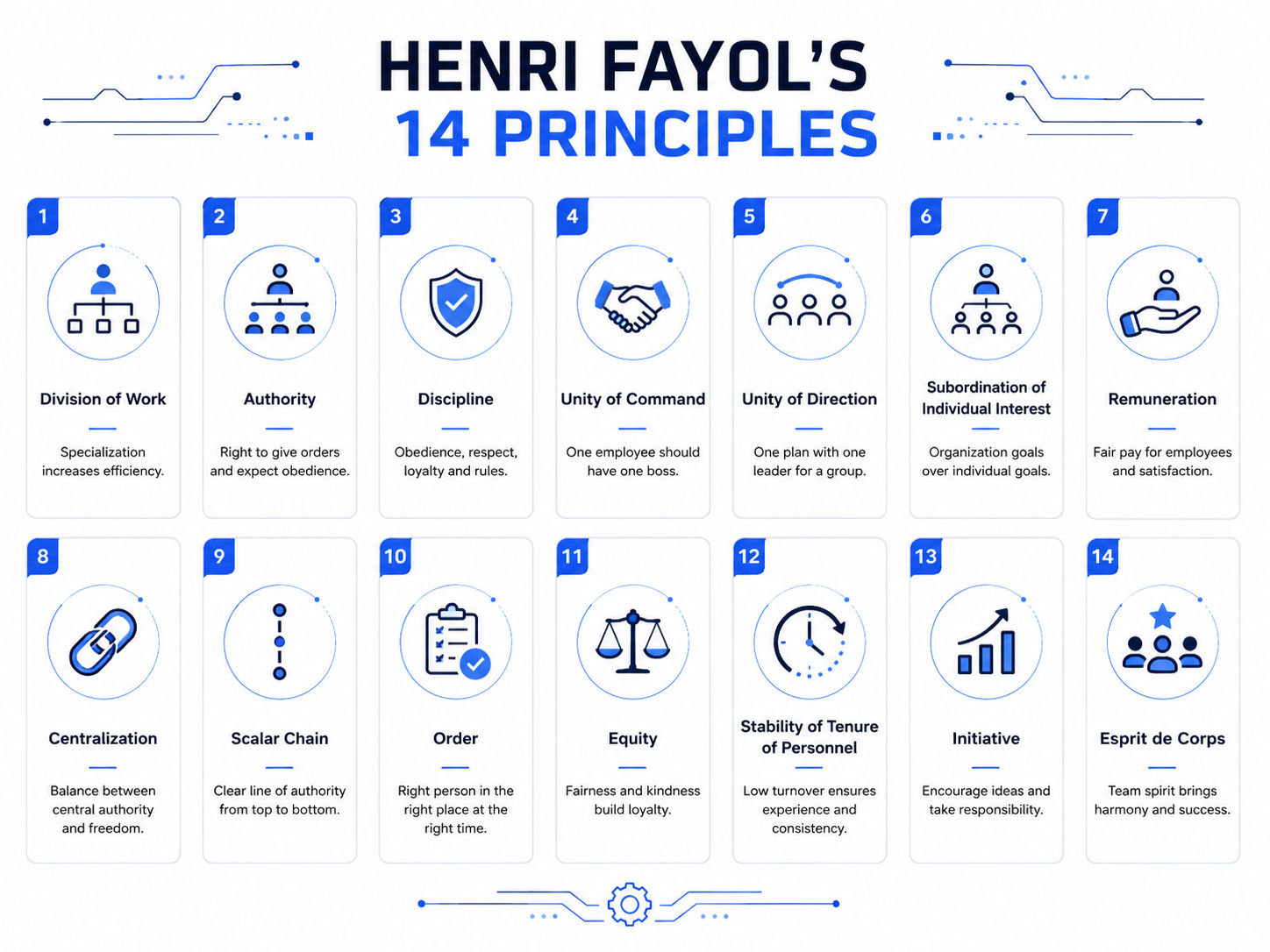
Here's a closer look at each principle and what it really means in practice:
While the world of business has changed enormously since Fayol's time, these principles have proven remarkably durable. Whether you're managing a small team or leading an enterprise, the logic behind each one remains as relevant as ever.
Modern organizations often apply Henri Fayol's 14 Principles in more flexible ways. For example, companies may maintain clear reporting structures while encouraging cross-functional collaboration.
Although workplaces have evolved, many challenges remain the same:
This combination of classical and modern approaches explains why Henri Fayol's 14 Principles continue to influence management education and leadership practices worldwide.
Consider a software company launching a new application.
At the same time, principles such as initiative, equity, and teamwork help maintain employee motivation and engagement.
Business environments are more dynamic than ever. Digital transformation, remote work, and changing customer expectations have expanded the traditional principles of business management.
Today's successful managers combine classical principles with modern management practices.
Customer Focus places customer needs at the center of business decisions.
Organizations with strong customer focus typically:
A customer-focused culture often leads to stronger brand loyalty and sustainable growth.
Evidence-Based Decision Making means relying on data, research, and measurable outcomes rather than assumptions.
Managers use evidence-based approaches to:
Examples include analyzing customer behavior, reviewing performance metrics, and conducting market research before making major decisions.
Emotional Intelligence has become one of the most valuable leadership skills in modern organizations.
It includes:
Research consistently shows that leaders with strong emotional intelligence build healthier teams and improve workplace performance.
The most effective managers do not choose between traditional and modern approaches. Instead, they combine:
This balanced approach helps organizations stay competitive while maintaining operational excellence.
Traditional Focus |
Modern Focus |
| Structure | Adaptability |
| Authority | Collaboration |
| Supervision | Empowerment |
| Efficiency | Customer value |
| Hierarchy | Agility |
The principles of business management provide a proven framework for leading organizations effectively. From the foundational functions of planning, organizing, staffing, directing, and controlling Henri Fayol's 14 Principles, these concepts continue to guide businesses across industries.
At the same time, modern organizations must embrace Customer Focus, Evidence-Based Decision Making, and Emotional Intelligence to succeed in today's competitive environment. Businesses that combine classical management principles with contemporary leadership practices are better positioned to improve performance, engage employees, and achieve sustainable growth.
Understanding these principles is not just important for managers. It is essential for anyone who wants to build leadership skills and contribute meaningfully to organizational success.
Want personalized guidance on Principles of Business Management? Speak with an expert for a free 1:1 counselling session today.
The principles of business management are broad guidelines that help managers make decisions, coordinate resources, and achieve organizational goals. They provide a framework for leadership, planning, communication, and performance management. These principles are flexible and can be adapted to different industries and business environments.
These principles help organizations improve efficiency, productivity, and decision-making. They create consistency in operations and support better coordination among teams. Businesses that apply management principles effectively are often better equipped to achieve long-term success.
The five functions are planning, organizing, staffing, directing, and controlling. Together, they help managers set goals, allocate resources, build teams, lead employees, and monitor performance. These functions form the operational foundation of modern management.
Planning involves setting objectives and determining the best course of action to achieve them. It helps businesses prepare for future opportunities and challenges. Effective planning improves resource allocation and reduces uncertainty in decision-making.
Organizing ensures that resources, responsibilities, and workflows are structured effectively. It helps employees understand their roles and improves coordination across departments. Strong organizing practices reduce confusion and improve productivity.
Staffing focuses on recruiting, selecting, training, and retaining employees. It ensures that the organization has the right talent to achieve its objectives. Effective staffing also supports employee development and long-term business growth.
Directing helps managers guide, motivate, and communicate with employees. It ensures that teams remain aligned with organizational goals. Strong directing skills contribute to higher employee engagement and better performance outcomes.
Controlling involves monitoring performance and comparing results against established goals. Managers use controlling to identify gaps, make improvements, and maintain accountability. It ensures that organizational objectives stay on track.
Henri Fayol's 14 Principles are foundational management guidelines covering authority, discipline, teamwork, equity, initiative, and other organizational practices. These principles continue to influence leadership and management education around the world.
Evidence-Based Decision Making involves using data, research, and measurable insights to make business decisions. It reduces reliance on assumptions and improves the accuracy of strategic choices. Many modern organizations use analytics to support this approach.
Emotional Intelligence helps managers understand and manage emotions effectively. Leaders with strong emotional intelligence communicate better, resolve conflicts more successfully, and build stronger workplace relationships. This skill is increasingly important in modern team environments.
1320 articles published
We are an online education platform providing industry-relevant programs for professionals, designed and delivered in collaboration with world-class faculty and businesses. Merging the latest technolo...
Get Free Consultation
By submitting, I accept the T&C and
Privacy Policy
Top Resources
Certification
3 Months
Certification
6 Months
O.P. Jindal Global University
Masters in International Accounting and Finance (Accredited by ACCA, UK)Master's Degree
12 Months