Structure of Agents in Artificial Intelligence: A Complete Beginner's Guide
By Sriram
Updated on Jun 30, 2026 | 6 min read | 2.23K+ views
Share:

All courses
Certifications
More
By Sriram
Updated on Jun 30, 2026 | 6 min read | 2.23K+ views
Share:
Table of Contents
Understanding the Structure of Agents in Artificial Intelligence will help you understand how modern AI systems work. Artificial intelligence agents are designed to look at what's around their surroundings, process information, and acts to get what they want. Every AI agent has a plan, behind it that says how it gets information makes choices and gives the right answers.
In this blog, you'll learn what the structure of agents in artificial intelligence means, why it matters, and how different agent architecture functions, core components of AI agents, compare different structures, and explore practical examples from various industries such as healthcare, finance, and autonomous systems.
Understanding agent architectures is key to advancing in AI roles. Build this foundational expertise through upGrad's specialized Artificial Intelligence Courses.
Popular AI Programs
The structure of agents in artificial intelligence refers to the internal framework that allows an AI agent to look at its environment, think about information, make choices, and perform actions. Every artificial intelligence agent follows a sequence of operations that helps it react smartly to what is happening.
Think about a navigation app. It detects the traffic and helps you by figuring out the quickest way to get somewhere and changing directions as you are driving. This process of making choices is like the plan of an artificial intelligence agent.
At a high level, an AI agent continuously performs four tasks:
Also Read: Autonomous AI Agent: How Intelligent Systems Make Decisions Without Constant Human Input
Artificial Intelligence systems can get good at what they do. Most Artificial Intelligence systems have a similar setup.
Each part of the Artificial Intelligence system is important. If one part of the Artificial Intelligence system does not work, the Artificial Intelligence system will not work well.
Component |
Purpose |
| Sensors | Collect information from the environment |
| Agent Program | Processes inputs and selects actions |
| Knowledge Base | Stores facts, rules, or learned information |
| Decision Mechanism | Chooses the best possible action |
| Actuators | Perform actions in the environment |
Also Read: The Complete Guide to Knowledge-Based Agents in AI
Free Courses
The process usually follows this flow: Environment → Sensors → Agent Program → Decision → Actuators → Environment
This continuous cycle is often called the perceive-think-act loop. The cycle repeats hundreds of times every minute.
For example, consider a robotic vacuum cleaner:
Knowing how agents work in intelligence is important. It helps us understand how artificial intelligence systems act when we use them.
If artificial intelligence systems do not have a structure, they will just do things without thinking instead of making good decisions, with artificial intelligence systems.
A well-designed structure helps an AI agent:
Also Read: A Complete Guide to AI Architecture
As AI applications become more advanced, these structures also become more complex. Modern AI systems often combine multiple decision-making techniques.
An effective AI agent structure usually includes:
Also Read: A Complete Guide on Agent Systems
AI Courses to upskill
Explore Artificial Intelligence Courses for Career Progression
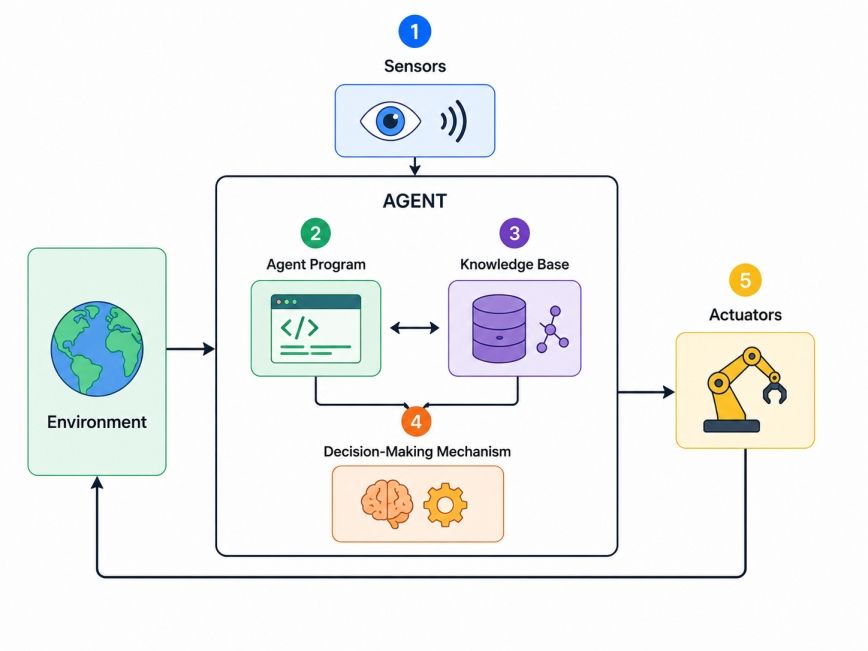
To understand how Artificial Intelligence agents work, you need to look at each part on it’s own. Artificial Intelligence systems can be very different. Some are more complicated than others, but they are all built on the same basic ideas. Every part of an Artificial Intelligence agent helps make it smart, not a machine that can do things automatically.
Sensors do a job. They collect information from the world around us.
For example, a self-driving car uses cameras, radar, LiDAR and GPS to understand its surroundings before the self-driving car makes driving decisions about where the self-driving car should go.
Depending on the application, sensors may include:
The agent program acts as the brain of the system. It gets data from sensors. Decides what to do next. The programs complexity varies depending on the AI agent type. A basic thermostat uses rules to work. On the other hand, a conversational AI model looks at millions of parameters to create an answer.
Many AI agents store information that helps improve future decisions. Example, the email spam filter keeps getting updated with information, about spam emails.
A knowledge base may contain:
This component of the system looks at all the information available and picks the best thing to do. The choice of what to do depends on the problem that the component is trying to solve with the component.
Common decision-making approaches include:
Technique |
Best Used For |
| Rule-based logic | Simple tasks |
| Search algorithms | Pathfinding and planning |
| Machine learning | Pattern recognition |
| Reinforcement learning | Sequential decision-making |
| Probabilistic reasoning | Uncertain environments |
Actuators convert decisions into real-world actions. In software applications, an actuator might simply send an email or display a recommendation. In robotics, it could move physical components.
Examples include:
This coordinated workflow enables AI agents to interact intelligently with their environment instead of merely following static instructions.
The following table summarizes the complete flow.
Step |
Component |
Function |
| 1 | Sensors | Gather information |
| 2 | Agent Program | Process inputs |
| 3 | Knowledge Base | Provide context |
| 4 | Decision Mechanism | Select the best action |
| 5 | Actuators | Execute the action |
Build next-generation AI applications with the IIT Kharagpur - Executive Post Graduate Certificate in AI-Native Software Engineering and learn how to integrate AI into modern software development workflows.
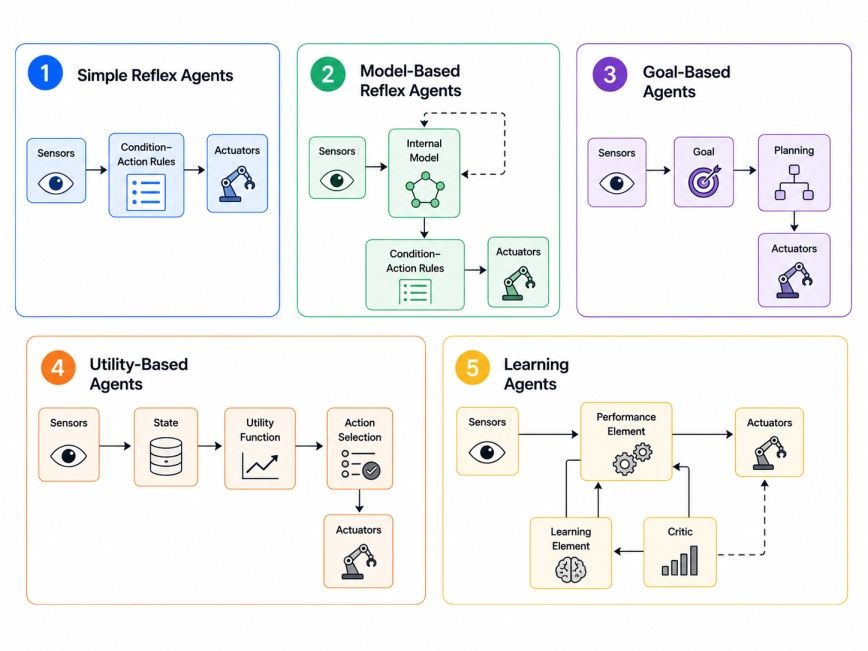
The way AI agents are set up is different depending on how hard the task is, how much information they have, and whether AI agents need to get better over time.
Some AI agents follow rules that never change, while agents get better as they operate. Knowing how AI agents are set up makes it easier to choose the right approach, for a specific task that needs AI.
Simple reflex agents just do what they have to do based on what is happening right now in the environment. They do not think about what happened or what will happen later. Simple reflex agents follow some predefined if-then rules.
For example, a motion sensor light turns on when it sees someone moving, and it turns off when it does not see anyone moving. The motion sensor light is just reacting to what is happening now, not considering past activity.
Best suited for:
Limitations:
Model-based reflex agents keep a picture of their surroundings. This helps them stay updated on changes even if they can't see everything. For instance, a robotic vacuum cleaner recalls which rooms it has already cleaned. It then changes its route and avoids re-cleaning.
Advantages:
Goal-based agents evaluate different options before acting. Their decisions depend on whether an action moves them closer to a defined goal. A navigation app is a good example. Instead of choosing the first available road, it compares multiple routes and selects the fastest or shortest path based on the user's destination.
These agents are commonly used in:
Sometimes you have than one way to get what you want. These utility-based agents give a score to each result and pick the one that is best overall.
For example, a system that tells you where to invest your money may look at how risky it is and what is happening in the market before it suggests what you should do with your money.
This way of doing things is helpful when you have to make choices that involve giving up something to get something rather than just picking the right answer.
Learning agents get better at what they do by looking at what happens and what people think of it. They do not just follow a set of rules that were decided beforehand. Learning agents can change what they do when new data becomes available.
These learning agents help make the experience better, for streaming platforms, online shopping websites, and recommendation engines.
A learning agent generally includes:
Each type of system deals with an issue. When AI systems get advanced, the people who make them usually put a few agent structures together in one program to make it work better and be more flexible. This way, the AI systems can improve performance and adaptability.
Agent Type |
Memory |
Learns Over Time |
Common Applications |
| Simple Reflex | No | No | Basic automation |
| Model-Based Reflex | Yes | No | Robotics |
| Goal-Based | Limited | No | Navigation systems |
| Utility-Based | Yes | Sometimes | Decision support systems |
| Learning Agent | Yes | Yes | Recommendation systems, autonomous AI |
The structure of agents in artificial intelligence is more than just a theoretical concept. It is the foundation of many systems that use AI in everyday life. AI agents are used in systems, like assistants and self-driving cars. When the structure of these AI agents is designed well, it helps machines to make good decisions and deal with recent developments. AI agents are able to do their jobs when they have a good structure.
Hospitals and healthcare providers use AI agents to assist with diagnosis, medical imaging, patient monitoring, and treatment recommendations. The structured flow of sensing, reasoning, and acting helps improve both speed and accuracy.
For example, an AI system can:
Banks and financial institutions rely on AI agents to process large volumes of transactions in real time. These systems continuously analyze incoming data and adapt to new fraud patterns or market conditions.
Common applications include:
Online retailers use AI agents to personalize the shopping experience. A recommendation engine learns from browsing history and purchase behavior to suggest products that match customer preferences.
Typical tasks include:
Self-driving cars are among the most advanced examples of AI agent structures in action.
Their systems continuously:
Modern smart home devices also rely on intelligent agent structures. These devices collect data, interpret user preferences, and make decisions with minimal human intervention.
Examples include:
Subscribe to upGrad's Newsletter
Join thousands of learners who receive useful tips
The structure of agents in artificial intelligence provides the foundation for how intelligent systems interact with the world. By combining sensors, decision-making mechanisms, knowledge, and actuators, AI agents can observe their environment, evaluate possible actions, and achieve specific goals.
As artificial intelligence becomes more integrated into healthcare, finance, education, transportation, and everyday consumer technology, understanding these agent structures is increasingly valuable. Whether you're a student, developer, or AI enthusiast, mastering this concept will make it easier to understand advanced topics such as machine learning, robotics, and autonomous systems.
Want to explore more about management accounting? Book your free 1:1 personal consultation with our expert today.
The structure of artificial intelligence refers to the framework that enables AI systems to collect data, process information, make decisions, and perform actions. It includes components such as sensors, algorithms, knowledge representation, and output mechanisms that work together to solve problems and achieve specific goals.
The basic structure of an AI agent consists of five main components: sensors, an agent program, a knowledge base, a decision-making mechanism, and actuators. Sensors gather information, the program processes it, the knowledge base provides context, the decision mechanism selects an action, and actuators execute that action.
The structure of agents in artificial intelligence determines how effectively an AI system perceives its environment, processes information, and responds to changing situations. A well-designed structure improves accuracy, efficiency, adaptability, and overall decision-making, making AI applications more reliable across industries.
The most common AI agent structures include simple reflex agents, model-based reflex agents, goal-based agents, utility-based agents, and learning agents. Each structure is designed for different levels of complexity, from basic rule-based automation to adaptive systems that improve through experience.
A reflex agent follows predefined rules and reacts only to current inputs. A learning agent, on the other hand, improves its performance by analyzing past experiences and feedback. This ability to adapt makes learning agents suitable for dynamic environments such as recommendation systems and autonomous vehicles.
The structure of agents in artificial intelligence is used in self-driving cars, healthcare diagnostics, virtual assistants, online recommendation systems, fraud detection, robotics, and smart home devices. These applications rely on structured decision-making to deliver accurate and efficient results in real time.
An AI model focuses on making predictions or generating outputs based on data. An AI agent goes a step further by observing its environment, making decisions, and taking actions to achieve specific goals. Many modern AI agents use one or more AI models as part of their decision-making process.
Yes, some simple AI agents can function without a knowledge base by relying on fixed rules. However, more advanced agents use stored knowledge or learned information to make better decisions, adapt to new situations, and improve performance over time.
For beginners, simple reflex agents are the easiest starting point because they clearly demonstrate the relationship between inputs and outputs. Once that concept is understood, learners can move on to model-based, goal-based, utility-based, and learning agents to explore more advanced AI systems.
AI agents operating in uncertain environments often use probabilistic reasoning, machine learning, or reinforcement learning to evaluate possible outcomes. Instead of relying on fixed rules, they estimate the likelihood of success for different actions and continuously refine their decisions as new information becomes available.
Yes. Understanding the structure of agents in artificial intelligence helps learners connect theoretical AI concepts with practical applications. It also builds a strong foundation for careers in machine learning, robotics, autonomous systems, data science, and AI engineering, where agent-based thinking is widely used.
730 articles published
Sriram K is a Senior SEO Executive with a B.Tech in Information Technology from Dr. M.G.R. Educational and Research Institute, Chennai. With over a decade of experience in digital marketing, he specia...
Speak with AI & ML expert
By submitting, I accept the T&C and
Privacy Policy
Top Resources
Master's Degree
18 Months
Executive Diploma
12 Months
IIIT Bangalore
Executive Programme in Generative AI & Agentic AI for LeadersIndia’s #1 Tech University
Dual Certification
5 Months