Predicate Logic in Artificial Intelligence: A Complete Guide
By Sriram
Updated on Jun 24, 2026 | 7 min read | 2.33K+ views
Share:

All courses
Certifications
More
By Sriram
Updated on Jun 24, 2026 | 7 min read | 2.33K+ views
Share:
Table of Contents
Predicate Logic in Artificial Intelligence is important because it provides us with a structural method to put knowledge into a form that machines can understand and process. Predicate logic plays a crucial role in helping the AI systems to be able to look at the world and understand how things are related to each other as AI depends on knowledge, reasoning, and decision-making to function properly.
In this blog, you'll learn what predicate logic in intelligence is, why it matters in AI, how it works, what are the main parts in AI, examples, benefits, what role it will play in the future. This guide is for anyone who wants to learn about logic in AI. This article will help you understand logic in artificial intelligence in a way that is easy to grasp and apply, in real life.
Master Predicate Logic and AI reasoning with upGrad’s industry-focused Artificial Intelligence Courses develop in-demand skills, solve complex problems, and advance.
Popular AI Programs
Predicate logic in artificial intelligence is a way to show facts and rules about the world. People also call it First-Order Logic or First-Order Predicate Logic.
It is different from logic. Propositional logic only deals with statements that are either true or false. Predicate logic allows AI systems to describe objects and how they are connected to each other. This makes predicate logic really useful for figuring out world problems.
For example:
The second statement is more useful because it shows a connection between John and the university.
Also Read: A Brief Intro to Propositional Logic as the Foundation of Artificial Intelligence
AI systems often work with complex information. They need to answer questions such as:
Predicate logic is useful because it helps us answer these questions by using a logical and structured way of thinking.
Free Courses
When we use predicate logic, it does not look at every statement as a fact. Predicate logic breaks down the knowledge into parts, which are the components of the knowledge.
For example: Student (John)
This means John belongs to the category of students.
Similarly: Studies At (John, University)
This represents a relationship between John and a university.
Feature |
Propositional Logic |
Predicate Logic |
| Represents simple facts | Yes | Yes |
| Represents relationships | No | Yes |
| Uses variables | No | Yes |
| Uses quantifiers | No | Yes |
| Suitable for complex AI systems | Limited | Highly suitable |
Consider the statements:
Using predicate logic, an AI system can infer:
The ability to figure out things from what we already know makes predicate logic a foundation of Artificial Intelligence reasoning.
Also Read: AI’s Secret Language: What Is Knowledge Representation in AI Really About?
AI Courses to upskill
Explore Artificial Intelligence Courses for Career Progression
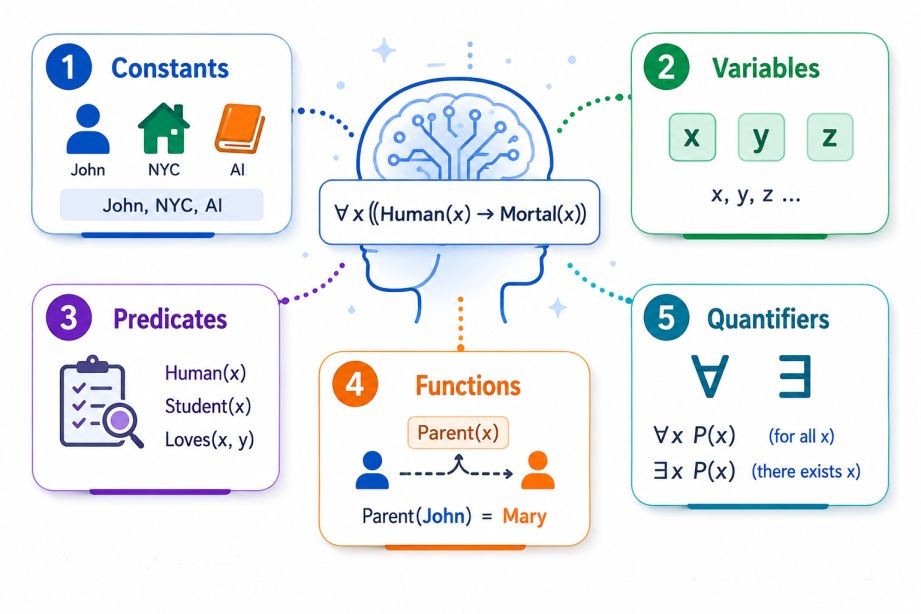
To get a grasp of predicate logic, in artificial intelligence you need to know its basic parts first. These parts work together to help represent knowledge in an organized way.
Constants represent specific objects or entities.
Examples:
These values remain fixed.
Variables represent unknown or general entities.
Examples:
Instead of referring to a specific person, "x" can represent any person.
Predicates describe properties or relationships.
Examples:
Predicates can return either true or false.
Functions map one object to another.
Examples:
Functions help represent more detailed information.
Quantifiers define the scope of variables.
There are two main types:
Means "for all."
Example: ∀x Human(x) → Mortal(x)
Meaning: All humans are mortal.
Means "there exists."
Example: ∃x Student(x)
Meaning: At least one student exists.
Component |
Purpose |
Example |
| Constant | Specific object | John |
| Variable | General object | x |
| Predicate | Property or relationship | Student(x) |
| Function | Maps objects | FatherOf(x) |
| Quantifier | Defines scope | ∀, ∃ |
The strength of predicate logic is that it helps us model real-world knowledge in a way. It can represent people, places, objects, events, and relationships in a way that computers can easily understand and work with.
Consider:
Representation:
∀x Student(x) → Studies(x)
Student (Alice)
Inference:
Studies (Alice)
This simple example shows how AI systems use rules to make conclusions from facts that we already know.
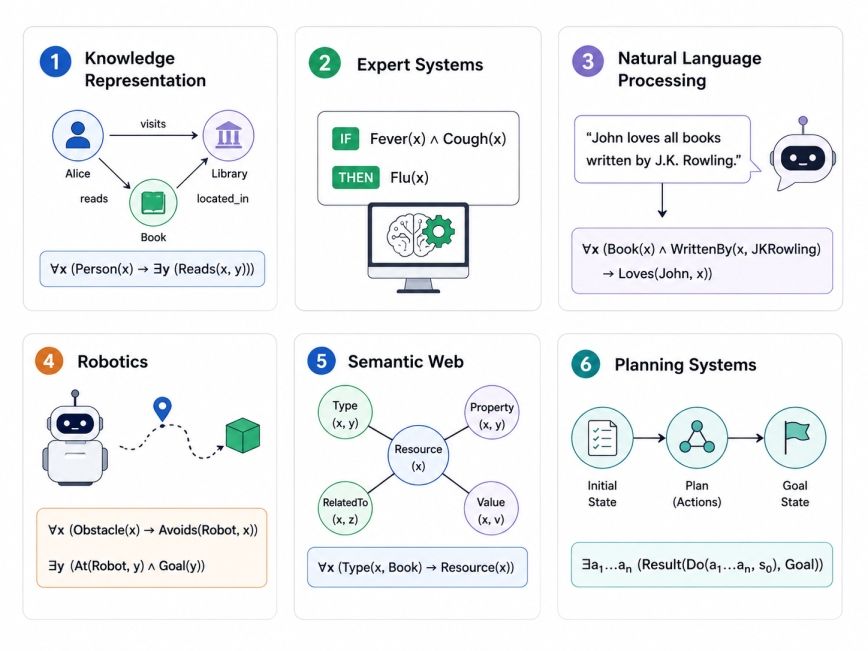
Predicate logic in artificial intelligence is really important in a lot of AI systems. Artificial intelligence is using machine learning more these days, but logical reasoning is still very important, in many areas of artificial intelligence.
One of the biggest uses of predicate logic is knowledge representation. AI systems need a structured way to store information.
For example:
These statements allow machines to understand relationships between entities.
Also Read: AI’s Secret Language: What Is Knowledge Representation in AI Really About?
Expert systems use logical rules to mimic human expertise.
Examples include:
Predicate logic helps these systems draw conclusions from known facts.
Also Read: Expert Systems in Artificial Intelligence: Architecture, Types, Applications & Examples
Human language contains relationships and meanings. Predicate logic helps AI interpret statements such as:
"The teacher teaches students."
Representation: Teaches (Teacher, Students)
This structure enables language understanding and reasoning.
Also Read: Natural Language Processing Algorithms
Robots often need logical reasoning to make decisions. Predicate logic helps robots understand their environment and act accordingly.
Examples:
Also Read: Applications of Robotics: Industrial & Everyday Use Cases
The internet is full of data, and the Semantic Web is trying to make this data make sense to computers.
The Semantic Web uses something called logic to show how different contents on the web are connected to each other.
AI planning systems use logical rules to determine actions.
Examples:
AI Area |
Use of Predicate Logic |
| Expert Systems | Rule-based reasoning |
| Robotics | Decision-making |
| NLP | Language understanding |
| Knowledge Graphs | Relationship modeling |
| Planning Systems | Action selection |
Modern AI systems often combine reasoning and machine learning together. This approach is called Neuro-Symbolic AI.
Researchers think that putting the goals together is a way to make AI systems easier to understand.
The goal is to combine:
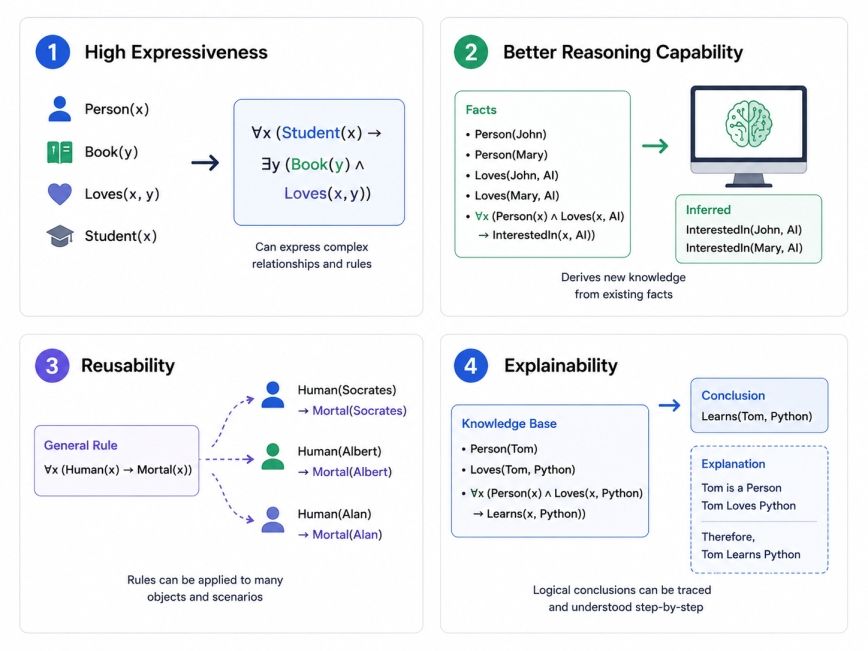
Predicate logic has been around for a time, and it is still useful today because it helps us understand things in a clear way. Predicate logic is not perfect.
To understand this logic, we need to know what predicate logic can do well and what predicate logic cannot do well. This gives us a view of predicate logic.
Predicate logic can describe complex relationships that propositional logic cannot.
Example: Owns (Person, Car)
This captures meaningful relationships directly.
AI systems can derive new facts automatically.
For example:
Inference:
General rules can apply across many situations. This reduces redundancy in knowledge representation.
Logical systems can explain how they reached a conclusion.
This is valuable in:
Subscribe to upGrad's Newsletter
Join thousands of learners who receive useful tips
Advantages vs Limitations Table
Advantages |
Limitations |
| Expressive representation | Computationally expensive |
| Strong reasoning | Difficult with uncertainty |
| Explainable decisions | Requires manual rule creation |
| Reusable knowledge | Scaling challenges |
Computational Complexity: Reasoning becomes slower as the knowledge base grows. Large-scale systems may require significant computational resources.
Difficulty Handling Uncertainty: Real-world situations often involve uncertainty.
Example:
A patient may or may not have a disease. Traditional predicate logic struggles with probabilities.
Knowledge Engineering Challenges: Creating large, logical rule sets require significant human effort. Maintaining these systems can become difficult over time.
Yes. Although machine learning dominates many AI applications today, predicate logic remains important for:
Many researchers think that the artificial intelligence systems we will have in the future will use both learning and logical reasoning. They will not just use one of these methods. The artificial intelligence systems will use both learning and logical reasoning to work.
Predicate logic in artificial intelligence is one of the most important foundations of AI reasoning and knowledge representation. It extends simple logical statements by introducing predicates, variables, functions, and quantifiers that allow machines to represent complex relationships.
While it has limitations in handling uncertainty and large-scale reasoning, its ability to provide structured, explainable, and reusable knowledge makes it highly valuable. AI evolves toward more explainable and trustworthy systems; predicate logic is likely to remain a key component of future intelligent technologies.
Want to explore more about Predicate logic in artificial intelligence? Book your free 1:1 personal consultation with our expert today.
Predicate logic in artificial intelligence is a formal method used to represent knowledge about objects, their properties, and relationships. It helps AI systems perform reasoning and draw conclusions from available information. It is commonly known as First-Order Logic and serves as a foundation for knowledge representation.
A simple example is : Human (John)
∀x Human(x) → Mortal(x)
From these statements, an AI system can infer Mortal (John). This demonstrates how predicate logic allows machines to derive new knowledge using logical rules and existing facts.
Predicate logic helps AI systems represent real-world information in a structured manner. It allows machines to understand relationships, perform reasoning, and generate conclusions. This capability is essential for applications such as expert systems, robotics, and intelligent decision-making.
Propositional logic deals with simple true-or-false statements without describing relationships. Predicate logic extends this by introducing variables, predicates, and quantifiers. As a result, it can represent more complex knowledge and support advanced reasoning tasks in AI.
Predicates describe properties or relationships involving objects. For example, Student (Rahul) indicates Rahul is a student, while Loves (Alice, Music) describes a relationship between Alice and music. Predicates form the core building blocks of logical representations.
Quantifiers define how variables are interpreted. The universal quantifier (∀) means "for all," while the existential quantifier (∃) means "there exists." These symbols help AI systems express general rules and existence-based statements more effectively.
Predicate logic is widely used in expert systems, knowledge representation, robotics, natural language processing, planning systems, and semantic web technologies. It provides the logical foundation required for reasoning and intelligent decision-making.
Traditional predicate logic is not designed to handle uncertainty directly. It works best with facts that are either true or false. To address uncertainty, AI systems often combine predicate logic with probabilistic methods and machine learning techniques.
Temporal logic is a form of logic that represents events and actions over time. Unlike predicate logic, which focuses on facts and relationships, temporal logic helps AI reason about sequences, timing, future states, and changing conditions in dynamic environments.
Predicate logic provides transparent reasoning paths. Every conclusion can be traced back to specific rules and facts. This makes it easier for developers and users to understand how an AI system reached a decision, improving trust and accountability.
Yes, predicate logic remains highly relevant. Although machine learning dominates many AI applications, logical reasoning is still essential for explainability, knowledge graphs, automated reasoning, and neuro-symbolic AI systems that combine learning with structured reasoning.
730 articles published
Sriram K is a Senior SEO Executive with a B.Tech in Information Technology from Dr. M.G.R. Educational and Research Institute, Chennai. With over a decade of experience in digital marketing, he specia...
Speak with AI & ML expert
By submitting, I accept the T&C and
Privacy Policy
Top Resources
Master's Degree
18 Months
Executive Diploma
12 Months
IIIT Bangalore
Executive Programme in Generative AI & Agentic AI for LeadersIndia’s #1 Tech University
Dual Certification
5 Months