Artificial Intelligence Technology: A Complete Guide
By Sriram
Updated on Jun 19, 2026 | 7 min read | 2.48K+ views
Share:

All courses
Certifications
More
By Sriram
Updated on Jun 19, 2026 | 7 min read | 2.48K+ views
Share:
Table of Contents
Artificial intelligence technology is changing how people live, work and learn. It is also changing how people interact with systems. Voice assistants, recommendation engines, self-driving cars, and advanced healthcare tools are all examples of AI. Artificial intelligence has become a part of modern life.
Many businesses, governments, and individuals use AI systems. They use these AI systems to solve problems and automate tasks. They also use them to make decisions.
In this blog, you will learn what AI technology is, how it works, and its major types. Its real-world applications, benefits and challenges of AI.
Explore Artificial Intelligence Courses from upGrad and gain hands-on skills to build the technology powering the future
Generative AI Courses to upskill
Explore Generative AI Courses for Career Progression
IIIT Bangalore
Executive Diploma in Machine Learning and AI360° Career Support
Artificial intelligence technology refers to a computer system that can do tasks that usually require human intelligence to do. These are like learning from information, understanding language, recognizing pictures, solving problems, making decisions, and finding patterns.
In words, AI allows machines to think, learn, and perform tasks like human intelligence does. Ther current AI system is not exactly like humans; they can still perform certain tasks in a fast and accurate manner.
Also Read: Why AI Is The Future & How It Will Change The Future?
AI systems use data, algorithms, and computing power to identify patterns and make predictions or take action.
For example, streaming platforms, like Netflix, learn what you like to watch and suggest shows based on your viewing habits and preferences.
The process generally involves:
Also Read: How to Learn Artificial Intelligence: A Step-by-Step Roadmap
Component |
Purpose |
| Machine Learning | Helps systems learn from data |
| Deep Learning | Uses neural networks for complex tasks |
| Natural Language Processing | Enables machines to understand human language |
| Computer Vision | Allows systems to interpret images and videos |
| Robotics | Combines AI with physical machines |
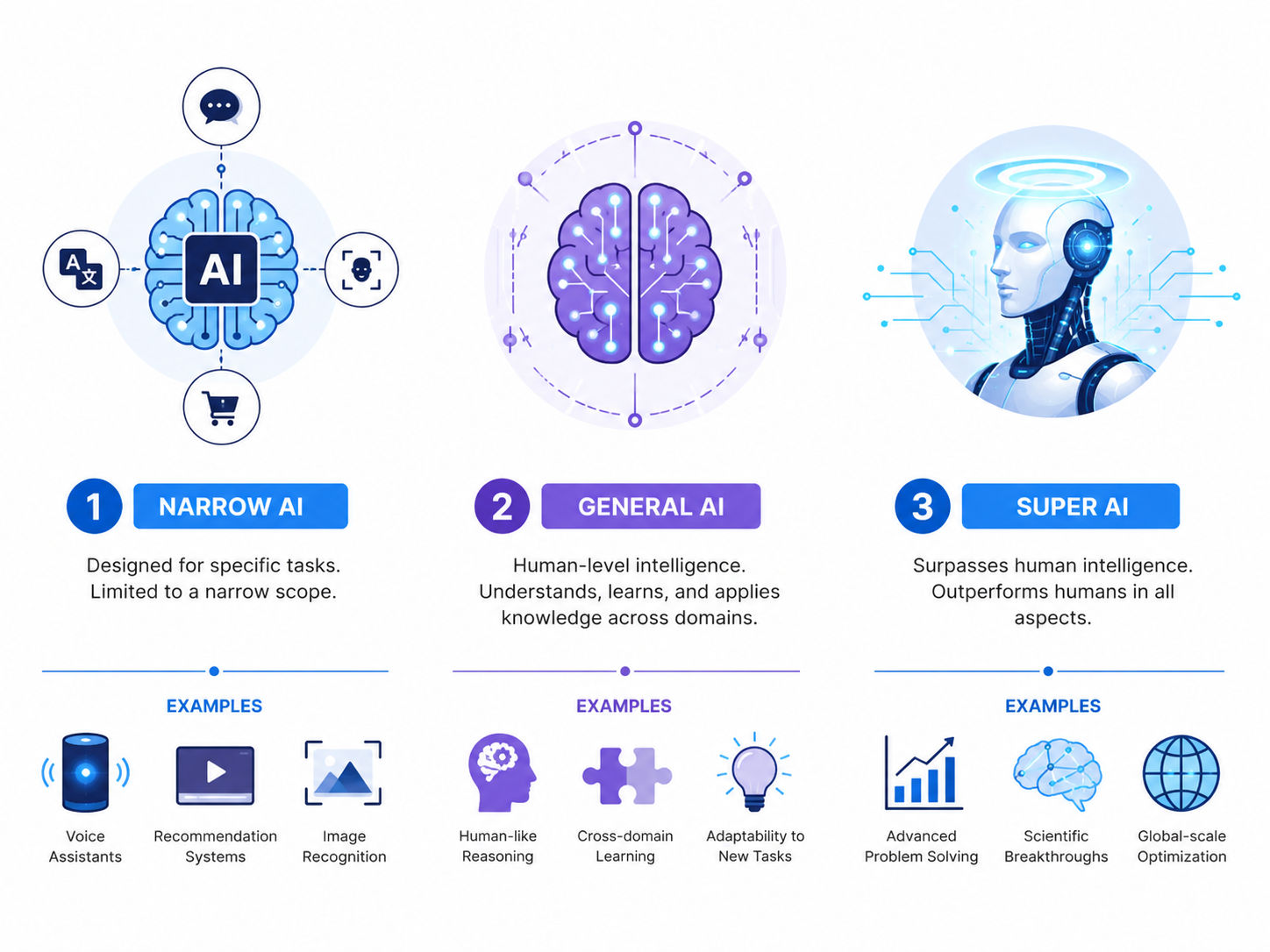
Not all AI thinks alike. From task-specific tools to theoretical superintelligence, AI exists across a fascinating and evolving spectrum.
This is the most common form of AI today. It performs specific tasks such as facial recognition, language translation, or product recommendations.
Examples include:
General AI refers to machines capable of performing any intellectual task a human can perform. This remains largely theoretical.
Super AI is a hypothetical concept where machines surpass human intelligence across all domains. It remains a subject of research and debate.
Read: Types of AI: From Narrow to Super Intelligence with Examples
Artificial intelligence technology does not only affect the technology sector. Its effect is on every major industry today.
Doctors get assistance from AI when they diagnose patients. In analyzing medical images and predicting the outcomes of a treatment.
Researchers have already demonstrated that AI can detect certain diseases. They are just as good at it, as doctors who have been trained as specialists in specific cases.
Common applications include:
Also Read: How AI in Healthcare is Changing Diagnostics and Treatment
Educational institutions are using AI to make learning more personal for students and help them do better. Students receive a special way of learning that is based on their potential and their weaknesses.
Examples include:
Financial organizations use AI for risk assessment, fraud detection, and customer service.
Key use cases:
Application |
Benefit |
| Fraud Detection | Identifies suspicious transactions |
| Credit Scoring | Improves lending decisions |
| Algorithmic Trading | Executes trades faster |
| Customer Support | Provides instant assistance |
Also Read: AI in Banking and Finance Explained: Trends, Uses, & Impact
AI helps retailers understand customer behavior and optimize operations.
Examples include:
Many online retailers generate a significant portion of sales through AI-driven recommendation systems.
Manufacturers use AI to improve productivity and reduce downtime.
Applications include:
One of the fastest-growing areas is artificial intelligence in information technology. IT teams use AI to monitor systems, detect security threats, automate workflows, and manage infrastructure more efficiently.
As cloud computing and digital transformation continue to expand, artificial intelligence in information technology plays an increasingly important role in maintaining reliable and secure systems.
The growing adoption of artificial intelligence in information technology demonstrates how AI is becoming deeply integrated into everyday business operations.
Key benefits include:
Also Read: Top 20 Types of AI in 2026 Explained
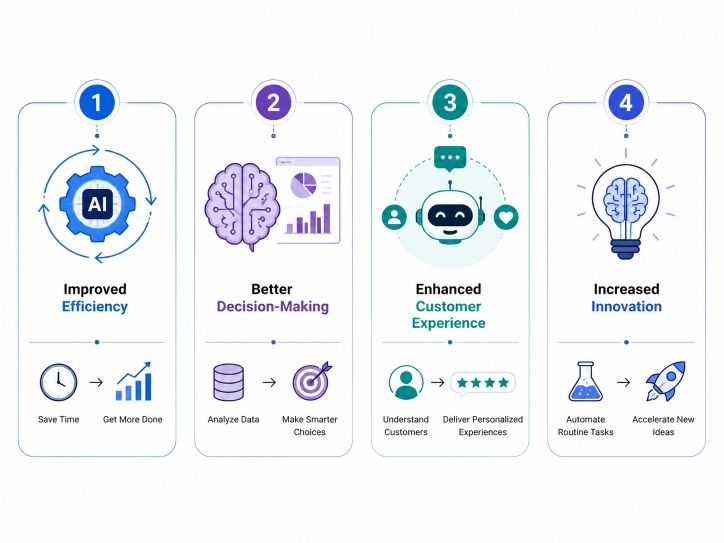
Like any transformative technology, AI offers significant advantages while also presenting challenges that organizations must address.
AI automates repetitive tasks that would otherwise require human effort.
Examples:
This allows employees to focus on higher-value work.
AI systems can analyze large datasets faster than humans.
Benefits include:
Businesses use AI to deliver personalized experiences.
Examples include:
AI enables the development of entirely new products and services.
Examples:
Also Read: Top 10 Artificial intelligence Models
Despite its advantages, artificial intelligence technology presents several concerns.
AI systems require large volumes of data. Organizations must ensure that personal information is collected and used responsibly.
AI models can reflect biases present in training data.
Potential consequences include:
Automation may replace some repetitive roles.
However, experts generally believe AI will also create new job categories focused on:
AI systems themselves can become targets for cyberattacks.
Organizations must implement:
Many companies struggle to find professionals with expertise in AI.
This challenge is increasing demand for:
Successfully implementing artificial intelligence technology requires balancing innovation with responsibility.
The conversation around future technology artificial intelligence is becoming increasingly important as AI capabilities continue to evolve.
While predicting the future is difficult, several trends are already emerging.
Generative AI can create text, images, audio, video, and code.
Popular applications include:
This area represents one of the most significant examples of new artificial intelligence technology in recent years.
Future workplaces will likely combine human expertise with intelligent automation.
Expected developments include:
Governments and organizations are placing greater emphasis on ethical AI.
Key focus areas:
Area |
Objective |
| Transparency | Explain AI decisions |
| Fairness | Reduce bias |
| Privacy | Protect user data |
| Accountability | Ensure responsible use |
Researchers increasingly use AI to accelerate discoveries.
Applications include:
Rather than replacing people entirely, many experts believe AI will function as a powerful assistant.
Professionals may use AI to:
Also Read: The Future Scope of Artificial Intelligence in 2026 and Beyond
These innovations continue to push the boundaries of what machines can accomplish. Several examples of new artificial intelligence technology are gaining attention:
Artificial intelligence technology has evolved from a niche research field into a powerful force shaping modern society. It helps organizations improve efficiency, enhance decision-making, automate repetitive tasks, and create innovative products and services.
Understanding what is artificial intelligence technology is becoming increasingly important for students, professionals, and business leaders. As new artificial intelligence technology continues to emerge, and as future technology artificial intelligence becomes more advanced, those who understand AI today will be better prepared for tomorrow's opportunities.
Want to explore more about Artificial intelligence technology? Book your free 1:1 personal consultation with our expert today.
Artificial intelligence technology refers to computer systems that can perform tasks requiring human-like intelligence. These tasks include learning from data, understanding language, recognizing images, and making decisions. AI helps machines solve problems more efficiently and accurately.
AI works by processing large amounts of data through algorithms and machine learning models. The system identifies patterns, learns from examples, and improves over time. This allows AI applications to make predictions and perform specific tasks with increasing accuracy.
The main types include Narrow AI, General AI, and Super AI. Narrow AI is widely used today for specific tasks. General AI remains a research goal, while Super AI is a theoretical concept involving intelligence beyond human capabilities.
AI appears in voice assistants, navigation apps, recommendation systems, online shopping platforms, and customer service chatbots. Many people interact with AI daily without realizing it because it operates behind many digital services.
Artificial intelligence in information technology involves using AI to automate IT operations, monitor systems, detect cybersecurity threats, and improve infrastructure management. It helps organizations maintain more reliable and efficient technology environments.
Examples include generative AI tools, multimodal AI systems, autonomous vehicles, advanced robotics, and AI-powered healthcare solutions. These innovations continue to expand the capabilities of intelligent systems across industries.
The top three generative AI tools, widely recognized for their versatility and market dominance, are: ChatGPT by OpenAI, Google Gemini, Claude by Anthropic
Common skills include programming, statistics, machine learning, data analysis, problem-solving, and critical thinking. Professionals often learn languages such as Python and gain experience with AI frameworks and tools.
AI can be safe when developed and used responsibly. Organizations must address privacy, security, fairness, and transparency concerns. Proper governance and ethical guidelines help ensure AI systems operate in a trustworthy manner.
Future technology artificial intelligence refers to emerging AI capabilities such as advanced automation, intelligent robotics, personalized healthcare, and human-AI collaboration. These developments may significantly influence how people work and live.
Beginners should start with AI fundamentals, machine learning basics, and simple programming concepts. Online courses, practical projects, and hands-on experimentation can help build a strong foundation and improve understanding over time.
727 articles published
Sriram K is a Senior SEO Executive with a B.Tech in Information Technology from Dr. M.G.R. Educational and Research Institute, Chennai. With over a decade of experience in digital marketing, he specia...
Speak with AI & ML expert
By submitting, I accept the T&C and
Privacy Policy