Artificial Intelligence Mind Map: A Complete Guide
By Sriram
Updated on Jun 24, 2026 | 7 min read | 2.63K+ views
Share:

All courses
Certifications
More
By Sriram
Updated on Jun 24, 2026 | 7 min read | 2.63K+ views
Share:
Table of Contents
Artificial Intelligence Mind Map is one of the ways to understand the world of artificial intelligence. It helps you see how different AI ideas connect. A mind map organizes AI concepts into a picture, making it easier to learn instead of reading long explanations, a mind map shows you how AI ideas are linked. This is helpful for students, professionals, researchers, or anyone new to AI. An AI mind map makes learning simpler and helps you remember more.
In this blog, you'll learn what an artificial intelligence mind map is, why it matters, how to create one, the major branches of AI to include, practical examples, popular AI mind-mapping tools, and best practices. By the end, you'll have a clear understanding of how to build and use a mind map of artificial intelligence framework for learning, planning, and problem-solving.
Build your AI career with upGrad's Artificial Intelligence Courses. Start learning today and map your future in artificial intelligence.
Popular AI Programs
An artificial intelligence mind map is like a picture that shows what artificial intelligence is all about. It has intelligence in the middle and then it spreads into lots of connected lines that talk about important things like key areas and technologies and applications and other related artificial intelligence concepts.
This is really helpful because it is not like traditional notes. When you look at an artificial intelligence mind map, you can see how all the different artificial intelligence topics are connected to each other right away.
Also Read: Artificial Intelligence Tools: Platforms, Frameworks, & Uses
Artificial intelligence is made up of a lot of things that are all connected. It includes things, like machine learning and deep learning. Artificial intelligence also includes natural language processing and robotics, and computer vision.
A mind map helps by:
Also Read: How to Learn Artificial Intelligence: A Step-by-Step Roadmap
An AI mind map is like a roadmap that you can follow. It does not just teach you about topics one, by one. An AI mind map gives you an idea of how different topics relate to each other and how they affect each other. You get to see the picture and understand how everything fits together with an AI mind map.
Central Topic |
Main Branches |
| Artificial Intelligence | Machine Learning |
| Artificial Intelligence | Deep Learning |
| Artificial Intelligence | NLP |
| Artificial Intelligence | Computer Vision |
| Artificial Intelligence | Robotics |
| Artificial Intelligence | Expert Systems |
Also Read: Understanding the Key Elements of AI
For beginners, it is really helpful to have a way to organize things. This makes it a lot easier to learn about AI. Artificial intelligence can be scary at first, but when you can see how things are connected, it does not seem so bad.
A mind map artificial intelligence framework is useful for:
Free Courses
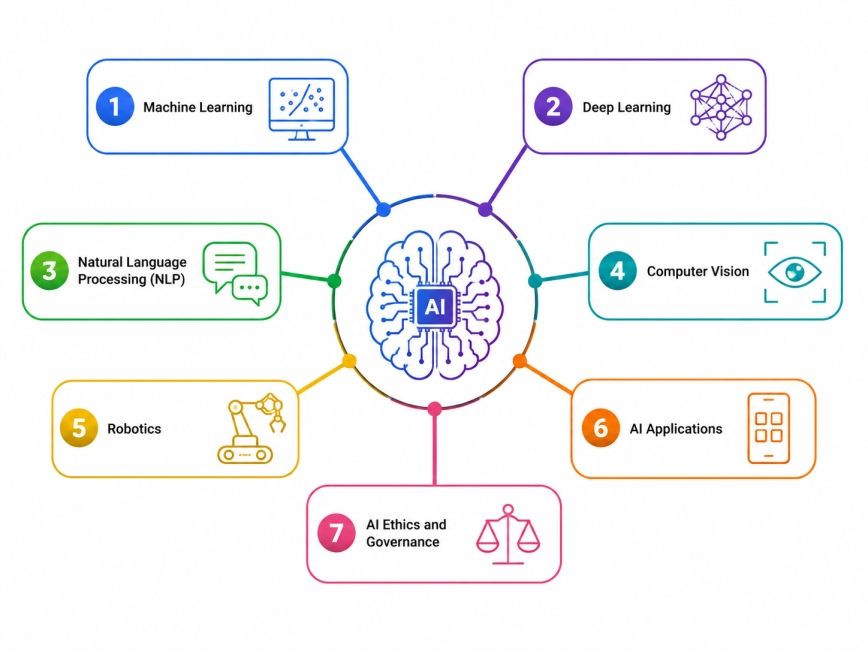
A strong mind map of artificial intelligence should include the most important AI domains. These branches provide a structured view of the field.
A well-designed artificial intelligence mind map should have a balance of technical concepts with real world uses and ethical considerations.
Machine learning is a way that systems can learn from the data they get and improve what they do without explicit programming.
Key subtopics:
Deep learning is a specialized category of machine learning that uses neural networks with multiple layers.
Important concepts:
Natural Language Processing enables machines to understand and generate the way of human language.
Applications include:
Computer vision helps machines interpret visual information.
Common applications:
Robotics combine AI with mechanical systems.
Examples include:
Industry |
AI Use Cases |
| Healthcare | Disease Diagnosis |
| Finance | Fraud Detection |
| Retail | Recommendations |
| Education | Personalized Learning |
| Manufacturing | Predictive Maintenance |
Modern AI discussions are incomplete without ethics.
Key areas:
Also Read: AI Ethics: Ensuring Responsible Innovation for a Better Tomorrow
AI Courses to upskill
Explore Artificial Intelligence Courses for Career Progression
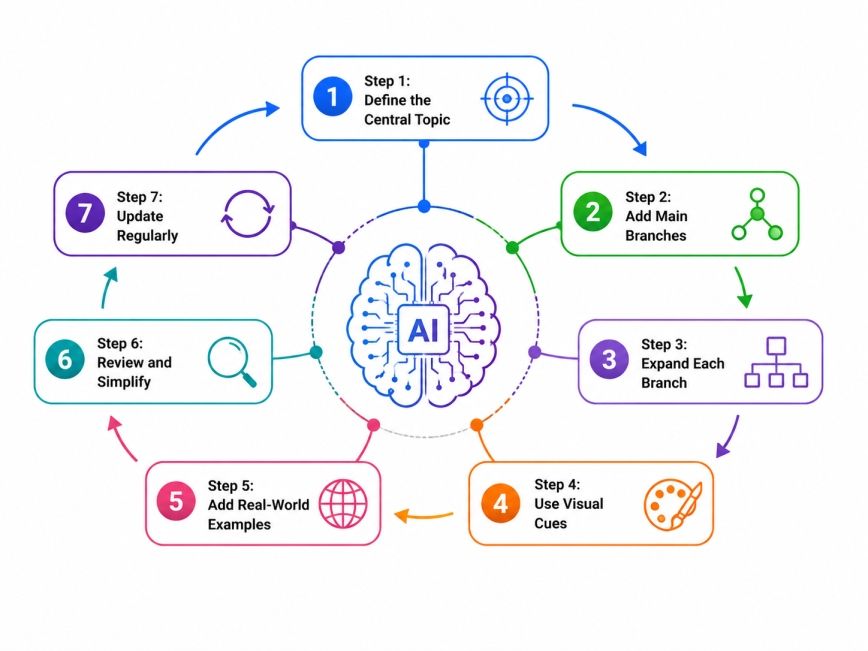
Making an AI mind map is really not that hard. The main thing is to put information in order, so it makes sense. The structure is easy to understand. This is what you want to do when you are creating an AI mind map.
Step 1: Define the Central Topic
Place "Artificial Intelligence" at the center of your page or software canvas. This becomes the foundation of your entire map.
Step 2: Add Main Branches
Create primary branches for:
These categories form the backbone of your mind map artificial intelligence structure.
Step 3: Expand Each Branch
For example:
Machine Learning:
Deep Learning:
Step 4: Use Visual Cues
Improve readability with
Visual distinction makes learning easier.
Step 5: Add Real-World Examples
Theory becomes easier to remember when linked to practical examples.
AI Domain |
Example |
| NLP | ChatGPT |
| Computer Vision | Face Unlock |
| Robotics | Warehouse Robots |
| Machine Learning | Recommendation Engines |
Step 6: Review and Simplify
Many beginners overload their maps.
Focus on:
Avoid unnecessary detail in early versions.
Step 7: Update Regularly
AI evolves quickly. New models, tools, and techniques emerge every year. Updating your mind map of artificial intelligence ensures it remains useful and accurate.
Technology now makes creating an artificial intelligence mind map faster than ever. Several tools can automatically generate mind maps from prompts, notes, or documents.
Popular Mind Mapping Tools
Tool |
Best For |
| XMind | Visual brainstorming |
| MindMeister | Collaboration |
| Miro | Team workshops |
| Coggle | Simple mind maps |
| EdrawMind | Academic learning |
| Whimsical | Fast diagrams |
These features help users build a mind map artificial intelligence framework in minutes.
Modern platforms offer:
For Students
Students can use an AI mind map to:
For Professionals
Professionals often use mind maps for:
For Businesses
Organizations benefit through:
An artificial intelligence mind map is a powerful learning and planning tool that transforms complex AI concepts into a clear visual structure. By organizing topics such as machine learning, deep learning, NLP, robotics, computer vision, and AI ethics into connected branches, learners can understand relationships faster and retain information more effectively.
Whether you're a beginner exploring AI for the first time or a professional building expertise, creating a mind map artificial intelligence framework can significantly improve learning efficiency. Over time, your mind map of artificial intelligence can become a personalized knowledge hub that supports continuous learning and professional growth.
Want to explore more about artificial intelligence mind map? Book your free 1:1 personal consultation with our expert today.
Mind mapping in AI is the process of visually organizing artificial intelligence concepts around a central topic. It helps learners understand relationships between machine learning, deep learning, NLP, robotics, and other AI domains. An artificial intelligence mind map makes complex information easier to understand by presenting ideas in a structured visual format. This approach improves learning, recall, and knowledge organization.
The commonly discussed stages of AI include Reactive Machines, Limited Memory AI, Theory of Mind AI, Self-Aware AI, Artificial Narrow Intelligence (ANI), Artificial General Intelligence (AGI), and Artificial Superintelligence (ASI). Some stages exist today, while others remain theoretical. Understanding these stages helps learners place current AI technologies within a broader developmental framework.
You can create a mind map through AI by using tools such as XMind, MindMeister, Miro, EdrawMind, or other AI-assisted diagramming platforms. Enter a topic, and the system generates branches automatically. Many tools can summarize documents, identify key concepts, and create a visual structure. You can then customize the map to fit your learning goals.
The seven steps typically include choosing a central topic, creating main branches, adding subtopics, using keywords, applying colors, adding visual connections, and reviewing the final map. Following these steps helps create a clear and organized artificial intelligence mind map that is easy to understand and update.
The seven pillars often referenced in AI education include Machine Learning, Deep Learning, Natural Language Processing, Computer Vision, Robotics, Expert Systems, and Data Science. Together, these areas form the foundation of modern AI systems and are commonly included in a comprehensive mind map of artificial intelligence.
Five widely recognized AI techniques are Machine Learning, Deep Learning, Natural Language Processing, Expert Systems, and Fuzzy Logic. Each technique solves different types of problems. Understanding them helps learners appreciate the diversity of methods used in artificial intelligence applications.
Beginners often struggle because AI contains many interconnected concepts. An artificial intelligence mind map simplifies learning by breaking topics into manageable sections and showing clear relationships. This visual approach reduces confusion and makes it easier to build a strong foundation before moving into advanced subjects.
Yes. AI mind maps are effective for organizing interview topics and revising technical concepts quickly. They provide a visual summary that is easier to review than long notes. Candidates can map algorithms, frameworks, applications, and industry use cases to strengthen their preparation.
A complete mind map of artificial intelligence should cover machine learning, deep learning, NLP, computer vision, robotics, expert systems, applications, and ethics. Including both technical and practical topics creates a balanced understanding of the field and its real-world impact.
Artificial intelligence evolves rapidly. Updating your map every few months helps ensure it reflects new technologies, frameworks, and industry developments. Regular updates also reinforce learning and keep your knowledge current as the field continues to grow.
AI-generated mind maps can provide a strong starting point, but they should always be reviewed by the user. Automated tools may miss context or oversimplify certain concepts. Combining AI-generated structures with human review usually produces the most accurate and useful results.
730 articles published
Sriram K is a Senior SEO Executive with a B.Tech in Information Technology from Dr. M.G.R. Educational and Research Institute, Chennai. With over a decade of experience in digital marketing, he specia...
Speak with AI & ML expert
By submitting, I accept the T&C and
Privacy Policy
Top Resources
Master's Degree
18 Months
Executive Diploma
12 Months
IIIT Bangalore
Executive Programme in Generative AI & Agentic AI for LeadersIndia’s #1 Tech University
Dual Certification
5 Months