Small Language Models: A Complete Guide for Modern AI Applications
By Sriram
Updated on Jun 03, 2026 | 9 min read | 430 views
Share:

All courses
Certifications
More
By Sriram
Updated on Jun 03, 2026 | 9 min read | 430 views
Share:
Table of Contents
Small Language Models (SLMs) are compact AI models designed to perform language-related tasks using significantly fewer parameters than large language models. Most SLMs contain anywhere from a few hundred million to around 10 billion parameters, allowing them to run efficiently without requiring extensive computing resources.
Their smaller size enables faster response times, lower deployment costs, and improved data privacy. As a result, SLMs are well suited for mobile devices, offline applications, edge computing environments, and enterprise systems that need secure and efficient AI capabilities.
This blog explains Small Language Models (SLMs), how they work, their key benefits, real-world applications, and limitations.
Learn more about AI skills with upGrad’s Artificial Intelligence Courses to know more
About SLMs how it significantly performs a language-related task with a few Parameters
Popular AI Programs
Small Language Models are AI models trained to understand and generate human language, but with a fraction of the parameters used by large language models .
A Large Language Model might have hundreds of billions of parameters. In contrast, SLM usually contains from a few million to several billion parameters.
These models, despite their small size, are able to perform many common natural language processing tasks such as:
The main difference is in the use of resources. Small Language Models are not made to be a general purpose model but for targeted tasks.
Do read: Types of AI: From Narrow to Super Intelligence with Examples
Why Are They Becoming So Popular?
Not every task needs a giant AI model for every organization.
For example, a customer support chatbot handling order status inquiries may only require a specialized model trained for a specific domain. Running a smaller model can reduce infrastructure costs while maintaining acceptable performance.
This shift has increased interest in lightweight AI models that balance capability and resource consumption.
Free Courses
Small Language Models process and generate text by identifying patterns learned during training. While they share many architectural foundations with larger models, they are designed to use fewer parameters and computing resources. This allows them to deliver faster responses and operate on devices with limited hardware while still handling many language tasks effectively.
Must read : How to Build Your Own AI System: Step-by-Step Guide
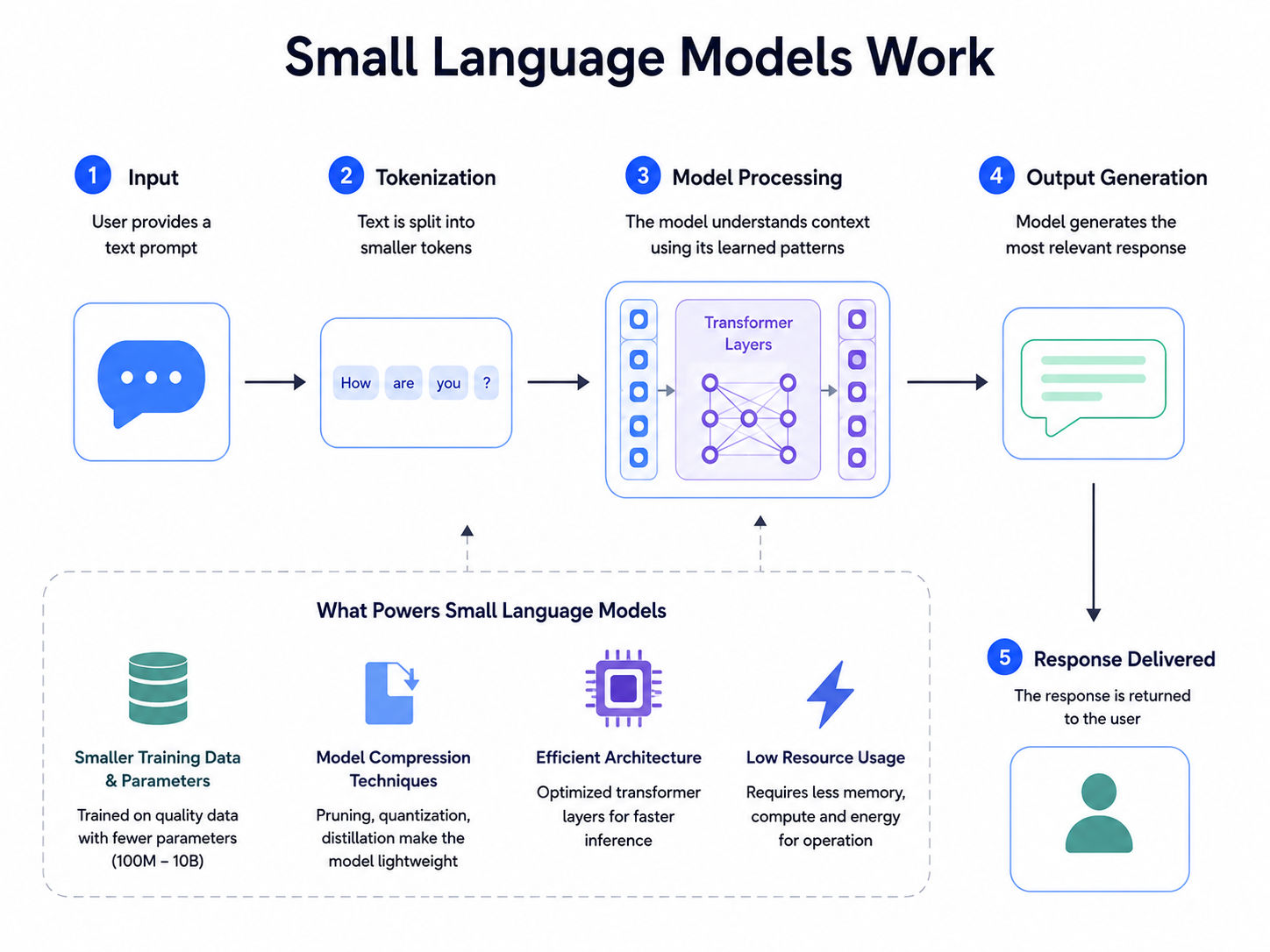
There are several techniques that help create high performing Small Language Models:
Distilling a Model
Knowledge distillation transfers knowledge from a large model to a small model.
The bigger model is the teacher and the smaller one learns to imitate its behavior.
This process helps to reduce the size of the model while preserving performance.
Quantization
Quantization decreases the precision of the model weights.
Rather than store values with high precision, developers will use smaller numbers to represent the numerical values.
Advantages include:
Pruning:
Pruning removes unnecessary parameters from a model.
Many neural network connections contribute very little to predictions. Removing them can shrink the model without significantly affecting performance.
These model improvement techniques have helped create increasingly powerful lightweight language models suitable for real-world deployment.
AI Courses to upskill
Explore Artificial Intelligence Courses for Career Progression
One of the most common discussions in AI today involves Small Language Models vs Large Language Models.
While both types use similar underlying technologies, they serve different purposes.
| Feature | Small Language Models | Large Language Models |
| Model Size | Millions to billions of parameters | Tens or hundreds of billions |
| Cost | Lower | Higher |
| Inference Speed | Faster | Slower |
| Hardware Requirements | Modest | Significant |
| Deployment | Easier | More complex |
| General Knowledge | Limited | Extensive |
When to use SLMs
Small models often do better when:
For example, a health care organization operating an internal documentation assistant may want an SLM that runs locally instead of transmitting sensitive information to external cloud services.
This practical advantage continues to power interest in Small Language Models vs Large Language Models comparisons across industries.
Also Read: Top 48 Machine Learning Projects [2026 Edition] with Source Code
Small Language Models are gaining popularity due to their feasible trade-off between performance and resource consumption. Many organizations and developers like them for tasks that do not need huge amounts of computing power. Their smaller size makes them easier to deploy while helping reduce costs, speed up response times and allow use cases where privacy and local processing are important.
Running large models often requires expensive GPUs and cloud resources.
SLMs significantly reduce operational costs.
Organizations can deploy AI solutions without investing heavily in infrastructure.
Smaller models generally produce responses more quickly.
This speed improvement matters in:
Many on-device AI models operate locally without sending user data to external servers.
This approach supports privacy-sensitive industries such as healthcare, finance, and government services.
Edge Deployment
Modern devices increasingly support AI processing directly on the device.
Examples include:
These on-device AI models reduce dependence on cloud connectivity while improving responsiveness.
Also Read: Learning Models in Machine Learning: 16 Key Types and How They Are Used
Small Language Models are making their way into everyday applications across industries. Their compact design enables them to operate on devices with limited computing resources, making them suitable for mobile apps, enterprise tools, customer support systems and edge AI environments.
Many smartphone apps depend on small models for offline capabilities.
Benefits for users include:
SLMs are used by organizations to:
Read more :What Tools Are Used in LLMOps?
Small Language Models are used by companies to search and summarize their internal documents.
The models can be run locally ensuring sensitive business information is protected.
Edge AI Solutions
Many on-device AI models can be applied in manufacturing, transportation, and healthcare applications where access to the cloud may be limited.
These deployments continue to grow as hardware gets more powerful.
Small LMs Limitations
Despite the many advantages offered by SLMs, they are not perfect.
Decreased General Knowledge
Smaller models tend to have less broad knowledge than large models.
They could struggle with highly specialized or uncommon topics.
Decreased ability to reason
Complex multi-step reasoning tasks remain difficult to solve.
SLMs generally underperform large models on advanced problem-solving benchmarks.
Small Context Windows
Smaller models process less information at a time.
This limitation can affect long-document analysis.
Task-Specific Performance
Many SLMs excel within specific domains but may struggle when asked to handle unfamiliar tasks.
Understanding these tradeoffs helps organizations choose the right model for their needs.
Must know : Top Machine Learning Algorithms - Real World Applications & Career Insights
The future of AI will probably involve both small and large models working together.
Researchers continue to improve:
That means lightweight AI models get more capable every year. Many experts expect organizations to increasingly use hybrid strategies, in which large models perform complex reasoning, while smaller models address routine tasks.
This approach offers both performance and savings.
Small Language Models are transforming the way organizations deploy artificial intelligence. They offer a practical alternative to large language models for many real-world applications, with lower costs, faster performance, and greater deployment flexibility.
Although they can’t replace large models in every scenario, their benefits make them a key component of the modern AI ecosystem. With the continued advancement of model improvement methods, Small Language Models will likely become even more capable, supporting wider adoption across industries and devices.
Want personalized guidance on AI and upskilling? Speak with an expert for a free 1:1 counselling session today.
Yes. Many Small Language Models can operate entirely on a local device once installed. This makes them useful for mobile apps, field operations, and environments with limited connectivity. Offline operation can also help reduce data transfer costs and keep sensitive information on the device rather than sending it to external servers.
The hardware requirements depend on the model size and the task. Some models can run on modern smartphones, laptops, or edge devices. Others may require dedicated hardware for faster processing. For tasks such as document classification or chatbot support, many organizations can deploy SLMs without investing in expensive AI infrastructure.
Yes. Many businesses use SLMs for focused tasks such as customer support, document search, ticket routing, and content categorization. When a task has clear boundaries and predictable requirements, a smaller model can often provide reliable results while keeping operating costs under control.
Yes. Organizations often fine-tune smaller models using internal documents, support records, knowledge bases, or industry-specific content. This approach helps the model understand company terminology and workflows without requiring a large general-purpose model for every interaction.
Several industries are adopting SLMs for practical use cases, including healthcare, finance, manufacturing, retail, logistics, and education. These sectors often need fast responses, local deployment, or stronger control over sensitive information. A smaller model can meet those needs while remaining easier to manage.
Accuracy depends on the task. For focused applications with clear objectives, a Small Language Model can perform very well. Large models usually have an advantage when dealing with broad knowledge, complex reasoning, or highly varied user requests. Choosing the right model depends on the problem you want to solve.
Many modern SLMs support multiple languages. Their performance varies based on the languages included during training and the amount of available data. Before deployment, it is a good idea to test the model with real-world content from your target audience to verify language quality.
An edge AI model processes data directly on a local device, while a cloud AI model sends data to remote servers for processing. Edge deployment can reduce latency and improve privacy. Cloud systems may offer access to larger models and more computing resources. The right choice depends on your performance and security requirements.
Developers often use methods such as knowledge distillation, quantization, and pruning. These techniques reduce memory usage and computing demands while preserving much of the model's performance. The goal is to create a model that remains useful without requiring large amounts of hardware resources.
Most experts expect both types of models to coexist. Large models are useful for advanced reasoning and broad knowledge tasks. Small models are often a better fit for routine operations, local deployment, and cost-conscious projects. Many organizations are already combining both approaches within the same AI strategy.
Start by defining your use case. Consider factors such as response speed, privacy requirements, available hardware, budget, and expected workload. You should also evaluate how much domain knowledge the model needs. Testing several models with real data often provides the clearest picture of which option fits your requirements.
695 articles published
Sriram K is a Senior SEO Executive with a B.Tech in Information Technology from Dr. M.G.R. Educational and Research Institute, Chennai. With over a decade of experience in digital marketing, he specia...
Speak with AI & ML expert
By submitting, I accept the T&C and
Privacy Policy
Top Resources
Master's Degree
18 Months
Executive Diploma
12 Months
IIIT Bangalore
Executive Programme in Generative AI & Agentic AI for LeadersIndia’s #1 Tech University
Dual Certification
5 Months