Staffing in Management: Meaning, Process, Principles, Importance, Examples & Best Practices
By Sriram
Updated on Jul 28, 2026 | 9 min read | 4.44K+ views
Share:

All courses
Certifications
More
By Sriram
Updated on Jul 28, 2026 | 9 min read | 4.44K+ views
Share:
Table of Contents
Key Highlights
Strengthen your understanding of staffing, leadership, and organisational management with upGrad's industry-relevant Management Courses.
Popular Management Programs
People are the foundation of every successful organisation. While technology and capital support operations, employees drive business growth and achieve organisational goals. That's why staffing is a key function of management.
So, what is staffing in management? It is the process of planning, recruiting, selecting, placing, developing, and retaining the right people for the right roles. The staffing meaning in management goes beyond recruitment, as it also includes employee development, performance management, and career growth to build a capable workforce.
People decisions are made by every manager. They plan workforce needs, assign responsibilities, assess employee performance and prepare teams for future business needs. Therefore, staffing is a continuous function of management and not a one-time activity of recruitment.
For instance, take a growing software company. As it expands its product portfolio, management projects future hiring needs, recruits top developers, trains new hires and readies current team members for leadership roles. This structured approach allows the business to grow without disruption to operations.
Without effective staffing, organisations may face:
Every stage of staffing works together to build a capable and productive workforce.
Staffing Activity |
Purpose |
| Workforce Planning | Identifies current and future employee requirements. |
| Recruitment | Attracts qualified candidates for available roles. |
| Selection | Chooses the most suitable candidate. |
| Placement | Assigns employees to roles that match their skills. |
| Training and Development | Improves employee knowledge and performance. |
| Performance Evaluation | Reviews performance and identifies improvement areas. |
| Career Growth | Supports promotions, succession planning, and retention. |
Also Read: What is Management?
Staffing plays a vital role in helping organisations build a capable workforce and achieve business goals. A well-planned staffing process improves productivity, supports employee development, and prepares businesses for future growth.
Also Read: Top 10 Risk Management Strategies You Need to Follow for Success!
Free Courses
Every organisation hires employees to achieve specific business goals. The purpose of staffing goes beyond filling vacancies. It focuses on building a skilled workforce that helps the organisation grow while supporting employee learning and career development.
Understanding what is staffing in management also means understanding how the right staffing decisions improve productivity, reduce hiring mistakes, and create long-term value.
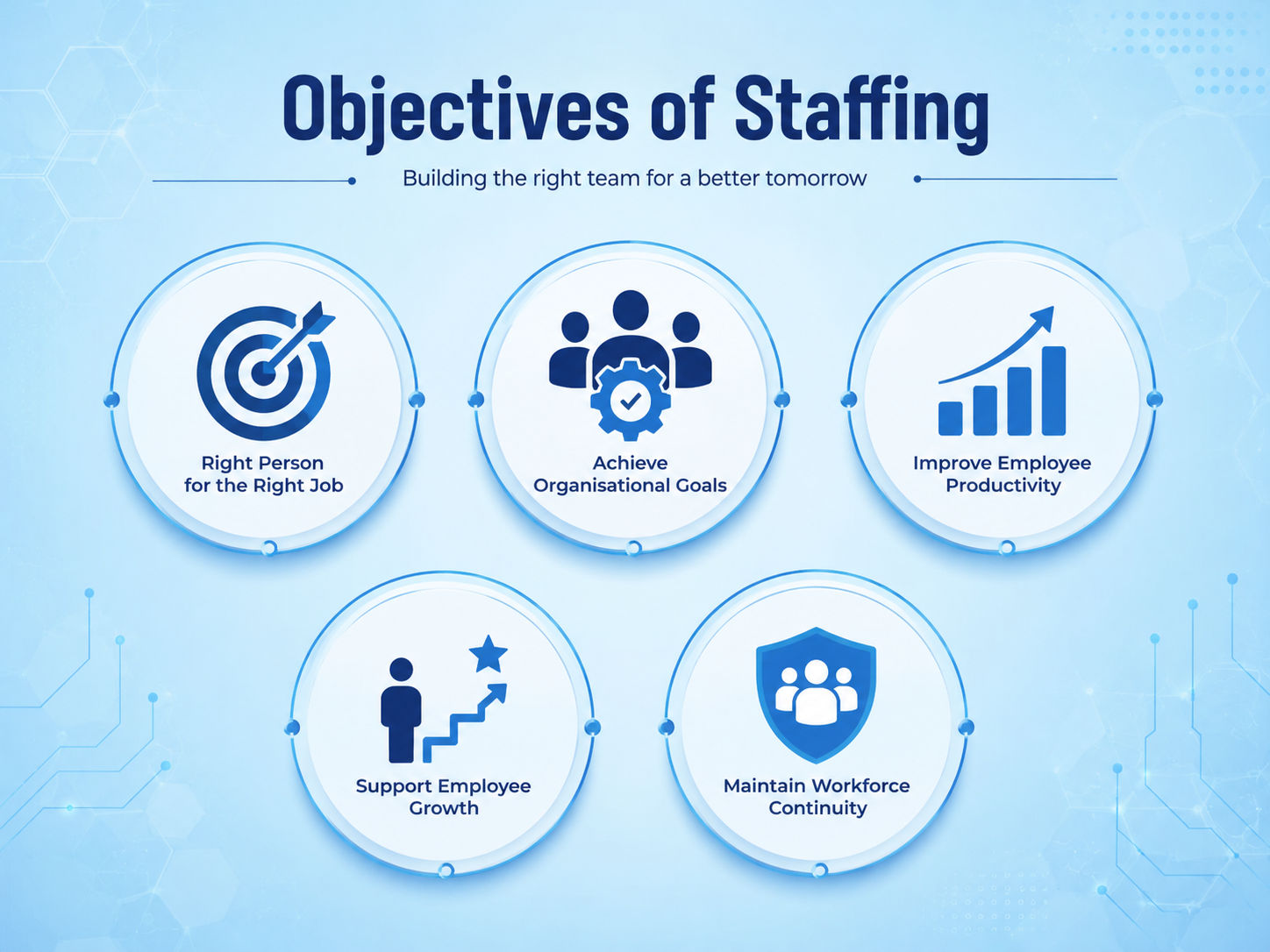
1. Right Person for the Right Job
The first objective of staffing is to place the right person in the right job. Matching an employee’s skills and experience with the job makes for better performance, job satisfaction, and retention and reduces hiring errors.
2.Achieve Organisational Goals
Every staffing decision should be in support of business objectives. Whether an organisation is growing, launching a new product or improving customer service, having the right people makes achieving these goals easier.
3. Improve Employee Productivity
Employees perform better with the right training, clear responsibilities and regular feedback. Staffing in management refers to developing employees so that they can contribute more effectively over time.
4. Support Employee Growth
Staffing also focuses on employee development through promotions, leadership opportunities, and continuous learning.
This helps organisations retain skilled employees and prepare future leaders.
5. Maintain Workforce Continuity
Workforce needs change as businesses grow. Effective staffing helps organisations plan ahead by identifying future talent requirements and preparing employees for key roles before vacancies arise.
Take the next step towards a successful management career with the Certificate Programme in General Management for Young Leaders (YLP) from IIMB and learn industry-relevant business and leadership skills.
Management Courses to upskill
Explore Management Courses for Career Progression
IIIT-B & IIM, Udaipur
Chief Technology Officer & AI Leadership ProgrammeIIM Kozhikode
PCP in AI for Business ProfessionalsEffective staffing is guided by a set of principles that help organisations hire, develop, and retain the right talent. These principles improve hiring decisions, employee performance, and long-term business success while creating a fair and productive workplace.
The main principle of staffing is placing the right person in the right role. Employees whose skills, qualifications, and interests match their responsibilities perform better and stay motivated. Proper job matching also reduces employee turnover, improves productivity, and helps organisations achieve better business outcomes.
Staffing decisions should be based on a candidate's qualifications, skills, experience, and performance instead of personal preferences.
Using structured interviews, skill assessments, and objective evaluation methods helps organisations select the most suitable candidates while promoting fairness, transparency, and trust throughout the hiring process.
Every candidate should receive an equal opportunity regardless of gender, age, religion, disability, or background. An inclusive hiring process attracts diverse talent, encourages fresh ideas, and creates a workplace where employees feel respected, valued, and motivated to contribute their best work.
Recruitment is only the beginning of staffing. Employees need regular training, upskilling, and development opportunities to adapt to changing technologies and business needs.
Continuous learning improves employee performance, supports career growth, and strengthens the overall staffing definition in management.
Business needs change with market demand, expansion plans, and project requirements. Organisations should adopt flexible staffing approaches by hiring permanent, temporary, contract, or project-based employees whenever required. This helps maintain productivity while responding quickly to changing workforce demands.
Poor hiring decisions increase recruitment, onboarding, and training costs. Careful workforce planning, clear job descriptions, and structured selection methods help organisations reduce hiring mistakes, improve employee retention, and make better use of their recruitment budget over the long term.
Employees perform better when they receive fair treatment, learning opportunities, recognition, and career growth.
A positive work environment increases engagement, strengthens employee loyalty, improves retention, and creates a motivated workforce that contributes to the organisation's long-term success.
Also Read: An Introduction to Principles of Management
Even experienced managers get it wrong. Some organizations focus only on filling vacancies quickly and overlook long-term workforce planning. Others hire based solely on technical expertise while ignoring communication skills, adaptability, or cultural fit. These mistakes usually lead to lower productivity and higher turnover.
The staffing meaning in management reminds us that staffing is a continuous management function, not a single recruitment event. Every staffing decision influences organizational performance for months or even years.
Also Read: Cybersecurity Frameworks: Types, Benefits, and Best Practices
The staffing process in management is a series of planned steps that help organisations hire, develop, and retain the right employees. It begins with identifying workforce needs and continues throughout an employee's journey. Each stage plays an important role in building a skilled and productive workforce.
The first step is identifying the organisation's current and future workforce requirements. Managers estimate how many employees are needed, the skills required, and the right time to hire. Proper workforce planning helps avoid both employee shortages and overstaffing.
Once workforce needs are identified, organisations analyse each job role. This involves defining key responsibilities, required qualifications, skills, and experience. A clear job analysis creates accurate job descriptions and attracts candidates who are the right fit.
Recruitment focuses on attracting qualified candidates through suitable hiring channels such as job portals, company websites, employee referrals, recruitment agencies, and campus placements. The objective is to build a strong pool of applicants who meet the organisation's requirements.
Selection involves evaluating candidates through application screening, interviews, skill assessments, and reference checks. Choosing the right candidate improves job performance, reduces hiring mistakes, and strengthens the overall staffing meaning in management.
After selection, employees are assigned suitable roles based on their skills and experience. Orientation introduces them to workplace policies, job responsibilities, company culture, and reporting structures, helping them become productive more quickly.
Employees need continuous learning to keep pace with changing technologies and business needs. Training improves job performance, builds confidence, and supports career growth. This is why the staffing definition in management extends beyond recruitment and includes employee development.
Regular performance evaluations help managers measure employee contributions, provide constructive feedback, and identify areas for improvement. Consistent reviews also recognise high performers and prepare them for future leadership opportunities.
Staffing also includes supporting employee growth through promotions, internal transfers, mentoring, and leadership development programmes. Career development improves employee motivation while helping organisations build future leaders from within.
The final step focuses on retaining talented employees through competitive compensation, recognition, career growth opportunities, and a positive work environment. Strong retention strategies reduce turnover and help organisations maintain a stable and experienced workforce.
Also Read: What Is a Business Management Degree and How Can It Benefit Your Career in 2026?
A well-planned staffing strategy helps organisations hire the right people and prepare for future workforce needs. It combines planning, recruitment, employee development, and regular performance reviews.
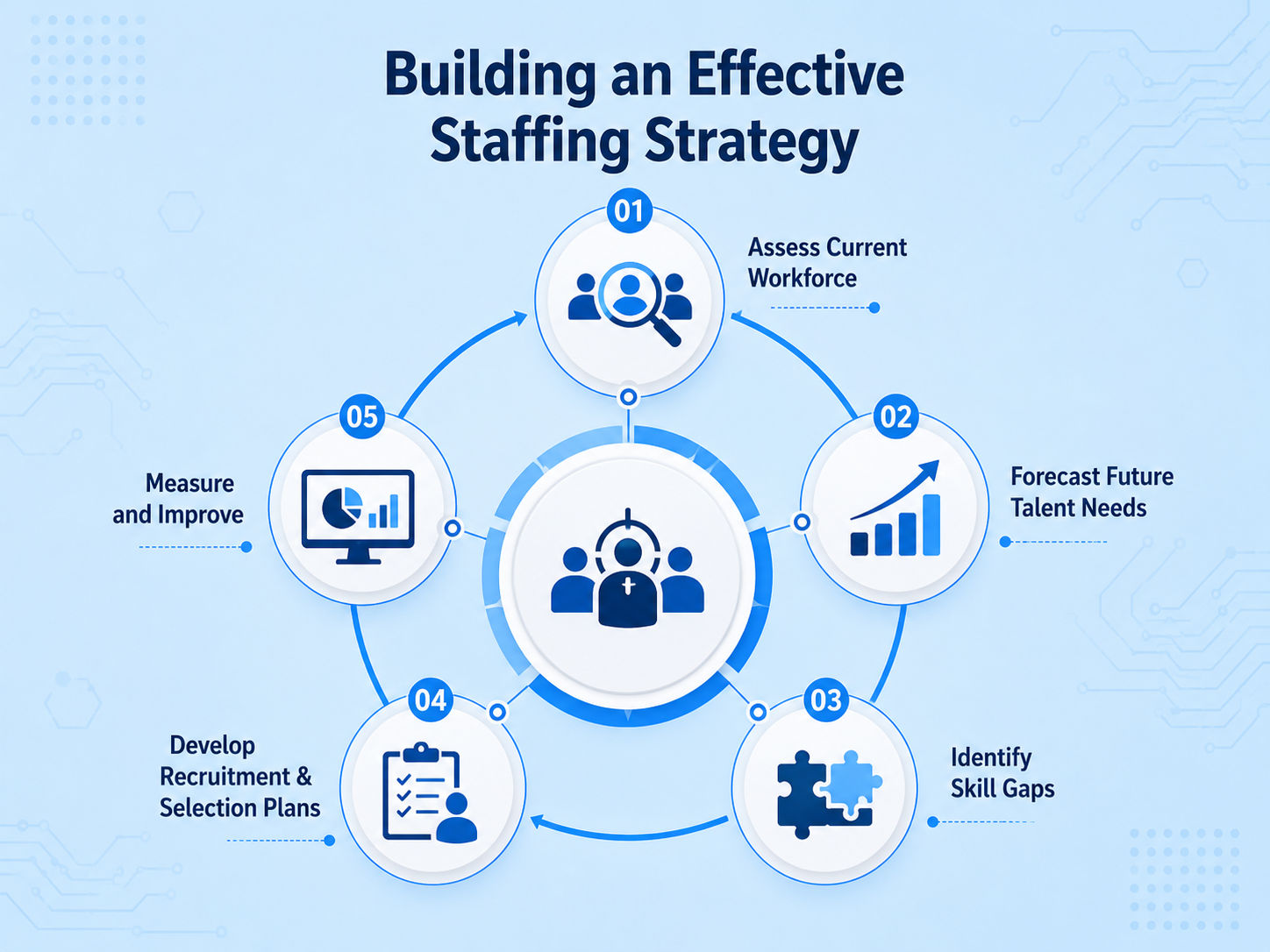
Recruitment and staffing are closely related, but they aren't the same. Recruitment focuses on attracting candidates for a job, while staffing covers the complete process of planning, hiring, developing, and retaining employees. Understanding this difference helps organisations build a stronger and more capable workforce.
Recruitment is one stage of the staffing process. Its purpose is to attract qualified candidates for available positions through different hiring channels. A strong recruitment process increases the chances of finding the right talent.
Internal Sources |
External Sources |
| Employee promotions | Job portals |
| Internal transfers | Recruitment agencies |
| Employee referrals | Campus placements |
| Re-employment | Professional networking platforms |
Staffing is a broader management function that begins before recruitment and continues throughout an employee's career. It includes workforce planning, job analysis, recruitment, selection, placement, training, performance management, career development, and employee retention.
Many students and first-time managers assume recruitment and staffing are identical because both involve hiring employees. In reality, recruitment is only one activity within staffing.
Think of staffing as the complete journey. Recruitment is just one stop along the way.
Staffing |
Recruitment |
| Strategic management function | Hiring activity |
| Covers planning, hiring, development and retention | Focuses only on attracting candidates |
| Long-term approach | Short-term activity |
| Improves workforce quality | Builds the candidate pool |
| Includes employee growth | Ends after hiring |
Organisations benefit from stronger staffing practices when they:
Also Read: Cybersecurity Frameworks: Types, Benefits, and Best Practices
Selection is another important stage of staffing. After recruitment attracts candidates, selection identifies the applicant who best fits the job. It involves interviews, assessments, reference checks, and final hiring decisions. Selection affects the quality of every future staffing decision.
Staffing and Selection Compared:
Staffing |
Selection |
| Complete workforce management process | One stage within staffing |
| Starts with workforce planning | Starts after recruitment |
| Includes training and retention | Ends when the candidate is selected |
| Strategic and continuous | Tactical and role-specific |
A poor selection decision can increase training costs, reduce productivity, and raise employee turnover. That's why organisations invest significant time in structured interviews, practical assessments, and behavioural evaluations before making hiring decisions.
The principles of staffing in management remain the same across industries, but organisations apply them differently based on their workforce needs, business goals, and operational requirements. These examples show how staffing supports day-to-day operations and long-term growth.
Technology companies rely on skilled professionals to stay competitive. Before starting new projects, they identify required technical skills, recruit suitable candidates, and conduct technical assessments.
After hiring, employees receive continuous training and certification programmes to keep up with changing technologies and industry trends, improving both productivity and innovation.
Hospitals require careful staffing to deliver quality patient care. Management plans the number of doctors, nurses, technicians, and support staff needed for each department. Regular training, shift scheduling, and performance reviews help maintain healthcare standards while ensuring patients receive timely and efficient medical services.
Manufacturing companies depend on workforce planning to maintain smooth production. Before expanding operations or introducing new production lines, they recruit machine operators, quality inspectors, and maintenance engineers.
Employees also receive technical training to improve efficiency, reduce errors, and maintain consistent product quality.
Retail businesses experience changing workforce requirements throughout the year. During festive seasons, sales events, or holiday periods, they recruit temporary staff to manage higher customer demand. Once business returns to normal, staffing levels are adjusted, helping the organisation control costs without affecting customer service.
Start-ups usually operate with small teams and limited budgets. Instead of hiring specialists immediately, they recruit employees who can handle multiple responsibilities across different functions.
As the business grows, they gradually build dedicated teams and introduce structured staffing practices to support long-term expansion.
Even a well-planned staffing process comes with challenges. Identifying these issues early helps organisations make better hiring decisions and build a more capable workforce.
Challenge |
Brief Explanation |
Practical Solution |
| Skill Shortages | Finding qualified candidates is difficult due to high demand for specialised skills. | Expand recruitment channels and invest in employee upskilling. |
| High Employee Turnover | Frequent resignations increase hiring costs and affect productivity. | Improve employee engagement, career growth, and retention programmes. |
| Hiring Bias | Unconscious bias can lead to unfair hiring decisions and missed talent. | Use structured interviews and objective evaluation criteria. |
| Changing Skill Requirements | New technologies and business needs require employees to continuously learn new skills. | Offer regular training and continuous learning opportunities. |
| Budget Constraints | Limited hiring budgets make workforce planning more challenging, especially for small businesses. | Prioritise critical roles and optimise workforce planning. |
Also Read: HR Management Made Easy Using 15 HR Tools and Software
Effective staffing requires careful planning and continuous improvement. Following these best practices helps organisations hire the right talent, improve employee performance, and build a stable workforce.
Staffing in management is a key management function that helps organisations build and maintain a capable workforce. It goes beyond recruitment by covering workforce planning, selection, training, performance management, and employee development. Understanding what staffing in management is enables businesses to place the right people in the right roles at the right time.
A well-planned staffing process improves productivity, supports employee growth, and helps organisations achieve long-term goals. By applying the right staffing principles and strategies, businesses can adapt to changing workforce needs while creating a skilled, motivated, and future-ready team.
Ready to start your journey? Book a free consultation with upGrad today to find the best path for your career.
The four common types of staffing are permanent staffing, temporary staffing, contract staffing, and project-based staffing. Organisations choose the right approach based on business goals, workload, budget, and the skills required. Many businesses combine multiple staffing types to maintain workforce flexibility while controlling recruitment costs.
The key functions of staffing include workforce planning, recruitment, selection, placement, training and development, performance appraisal, and employee retention. Together, these functions help organisations attract qualified employees, improve productivity, and maintain a capable workforce that supports long-term business objectives.
If explained in one word, staffing can be described as "talent management." It reflects the complete process of acquiring, developing, and retaining employees. While hiring is one part of it, staffing also focuses on workforce planning, employee development, and long-term organisational success.
Several factors influence staffing decisions, including business goals, workforce demand, budget, labour market conditions, employee skills, technological changes, and legal requirements. Organisations must balance these factors to recruit the right talent while supporting productivity, employee retention, and future business growth.
Although organisations follow different models, the seven commonly accepted steps are workforce planning, job analysis, recruitment, selection, placement, training, and performance management. Some organisations also include career development and retention as ongoing staffing activities to support future business growth.
Staffing can be classified in several ways depending on organisational needs. Common types include internal staffing, external staffing, permanent staffing, temporary staffing, contract staffing, and seasonal staffing. The choice depends on workforce requirements, project duration, and business expansion plans.
The main characteristics of staffing are that it is continuous, people-oriented, goal-focused, developmental, and managerial. These characteristics show that staffing is not limited to recruitment. It supports employee growth, workforce planning, and organisational success throughout the employee lifecycle.
The five major HR functions are recruitment, employee development, performance management, compensation and benefits, and employee relations. Staffing works closely with these HR activities by helping organisations attract, develop, and retain skilled employees who contribute to business performance.
The 5 C's of Human Resource Management are commonly explained as Commitment, Competence, Congruence, Cost-effectiveness, and Creativity. These principles help HR teams create productive workplaces, improve employee engagement, and align workforce practices with overall organisational goals and long-term business success.
The twelve commonly recognised HRM functions include human resource planning, recruitment, selection, onboarding, training, performance management, compensation, employee welfare, labour relations, compliance, career development, and succession planning. Staffing contributes directly to many of these functions by building and managing an effective workforce.
HR can be demanding because professionals manage recruitment, employee concerns, performance issues, compliance, and organisational change. However, the level of stress depends on the organisation, role, and workload. Strong communication, planning, and problem-solving skills help HR professionals handle challenges more effectively.
695 articles published
Sriram K is a Senior SEO Executive with a B.Tech in Information Technology from Dr. M.G.R. Educational and Research Institute, Chennai. With over a decade of experience in digital marketing, he specia...
Get Free Consultation
By submitting, I accept the T&C and
Privacy Policy
Top Resources
Certification
3 Months
Certification
6 Months
O.P. Jindal Global University
Masters in International Accounting and Finance (Accredited by ACCA, UK)Master's Degree
12 Months